


- The war has redefined security, energy, and international alliances… and the Gulf is becoming part of the Indo-Pacific equation
- TRENDS launches its virtual office in Australia to strengthen knowledge partnerships.
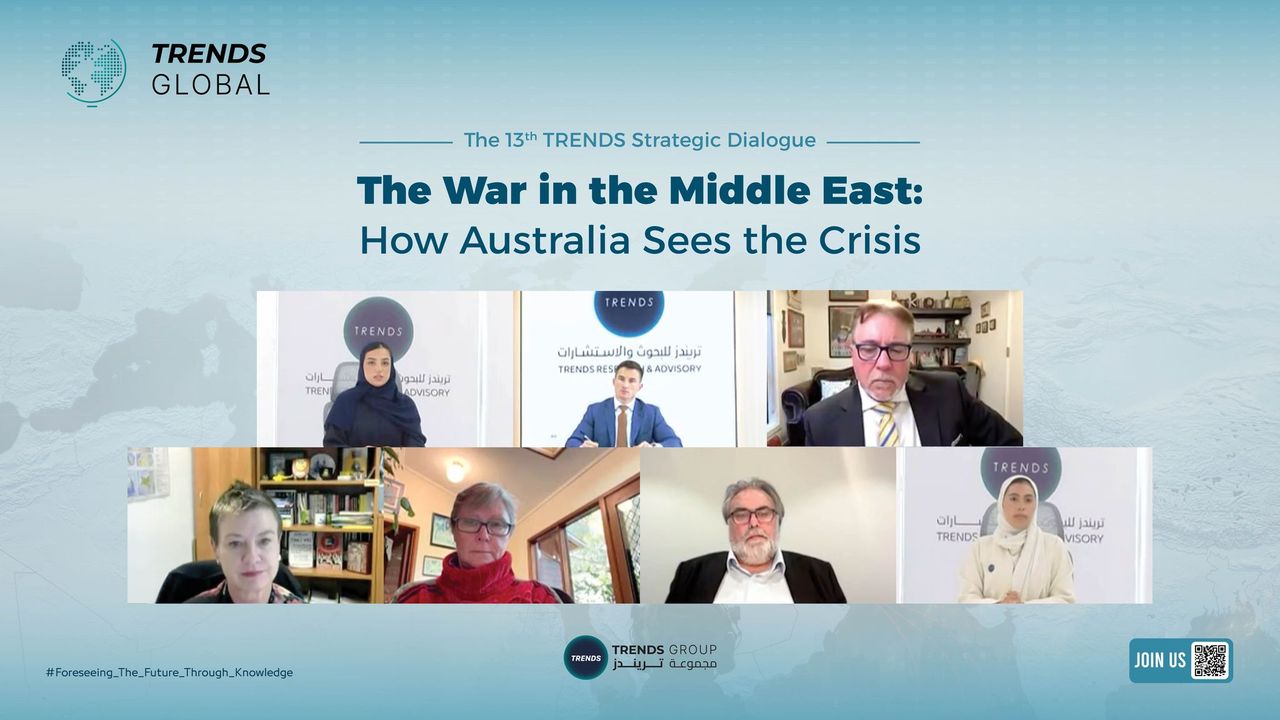
TRENDS Global, affiliated with TRENDS Group, organized its 13th Strategic Dialogue titled The War in the Middle East: How Does Australia View the Crisis? The event brought together a distinguished group of researchers and experts from leading Australian think tanks alongside TRENDS analysts to examine the latest regional developments, accelerating geopolitical transformations, and possible future trajectories of the crisis.
The dialogue also explored the growing intersection between maritime and economic security in the Gulf region and the broader Indo-Pacific sphere.
Australia Virtual Office
The session opened with remarks by Nicholas Lyall, Senior Researcher at TRENDS Research & Advisory and moderator of the session, who welcomed participants and announced a new strategic step: the launch of TRENDS’ virtual office in Australia (Canberra), which is expected to become a physical office in the coming months.
Lyall explained that the new office will focus on three core pillars that support the Comprehensive Economic Partnership Agreement between the UAE and Australia:
- Critical minerals, green hydrogen, and clean energy supply chains.
- Maritime ports and logistics infrastructure.
- Artificial intelligence, deep technology (Deep Tech), and the innovation economy.
He noted that the dialogue addressed four key themes, highlighting the extent to which Australia has been affected by the recent Iran war, ranging from fuel security and supply chains to the reshaping of Australia’s defense and diplomatic posture. He stressed that the UAE-Australia partnership represents a strategic opportunity to redesign channels of engagement with the world and develop a shared understanding of current economic and diplomatic challenges.
The Wisdom of the UAE’s Vision
In her opening remarks on behalf of Dr. Mohammed Abdullah Al-Ali, CEO of TRENDS Group, researcher Sheikha Al Nuaimi stated that despite the halt in large-scale military operations between the United States, Israel, and Iran, and the fragile return to negotiations, the repercussions of the war have extended far beyond the region itself.
“The profound effects of the crisis have reached countries historically and geographically perceived as distant from the conflict, such as Australia, due to the complex interconnectedness of global supply chains that transmit crises rapidly in a domino-like effect,” Al Nuaimi said.
She emphasized that Australia’s exposure to economic and terrorist spillover threats demonstrates the foresight and strategic vision of the United Arab Emirates in combating terrorism and safeguarding global maritime routes. She also called for building unconventional alliances between Australia and Gulf countries—particularly the UAE—to navigate the growing uncertainty and fluidity of the international system.
Australia’s Energy Security
Raelene Lockhorst, Deputy Director of the National Security Program at the Australian Strategic Policy Institute (ASPI), presented an in-depth analysis of Australia’s energy security structure, emphasizing that the war with Iran demonstrated how energy, trade, defense, and agriculture systems are interconnected and inseparable.
Using data, she highlighted several vulnerabilities facing Australia:
- The number of domestic oil refineries has declined from eight to only two.
- Australia imports 90% of its fuel needs from Asian refineries, which themselves depend heavily on Middle Eastern crude oil.
- The country’s strategic fuel reserves cover only 40-50 days, well below the International Energy Agency’s 90-day benchmark.
- Around 83% of Australia’s maritime imports pass through Southeast Asian chokepoints, meaning that any disruption in the Strait of Hormuz would immediately impact those routes.
Lockhorst called for diversifying energy sources and warned against “replacing dependence on oil with another form of dependency in clean energy,” stressing the need for resilient and sustainable national infrastructure.
AUKUS and the Challenge of Asymmetric Warfare
Dr. John S. Bruni, Founder and CEO of SAGE International Australia, argued that the war exposed a major gap between Australia’s defense planning and battlefield realities. He explained that Canberra’s focus on high-end deterrence capabilities—such as submarines and AUKUS-related military systems—is insufficient against asymmetric threats like missiles, drones, proxy networks, and maritime disruption tactics.
Bruni raised sensitive questions regarding the future of the AUKUS agreement and Australia’s alignment with U.S. policy, noting that segments of the U.S. administration and strategic community are increasingly demanding greater burden-sharing and operational support from allies. This, he said, places Canberra in a delicate position between preserving the alliance and avoiding automatic involvement in every American military operation.
He added that Australia’s comparative advantage lies not in projecting overwhelming military force in the Middle East, but rather in strategic diplomacy, maritime coordination, and acting as a pragmatic middle power that contributes to regional stability.
Reshaping the Global Economic Order
Dr. Jenny Gordon, Non-Resident Fellow at the Lowy Institute, examined the global geoeconomic landscape, describing the Iran war as “a final wake-up call” following the COVID-19 pandemic and the Ukraine war, amid growing risks of the global economy fragmenting into competing blocs.
She pointed to the challenges Australia faces due to its reliance on commodities and vital trade routes, recalling China’s trade sanctions against Australia in 2020 and Beijing’s current dominance over critical minerals processing.
Gordon stressed that Australia’s diplomatic outreach to countries such as Singapore, Malaysia, Indonesia, and Japan to secure fuel and gas supplies reflects a pragmatic, interest-based approach. She called for building flexible alliances and smaller cooperative frameworks to reconstruct a rules-based international system grounded in practical cooperation.
Should the Indo-Pacific Include the Gulf?
Anthony Bubalo, CEO of Asia Society Australia, offered a historical and analytical perspective on Australian foreign policy, explaining that since 2001, Australia’s engagement in the Middle East has been driven by three factors: alliance commitments with Washington, international responsibility, and economic interests.
He noted that recent years have revealed increasing divergences between Australian and American positions on several regional issues, including the war in Gaza, recognition of the Palestinian state, and reservations regarding certain strikes against Iran.
Bubalo explained that successive Australian governments have strategically prioritized the Indo-Pacific region, traditionally defined as ending at India’s western boundary and excluding the Gulf region. However, the current crisis has prompted policymakers to reconsider a fundamental question:
“Is it time to officially expand the concept of the Indo-Pacific to include the Arabian Gulf?”
The Middle East Is No Longer a Distant Crisis
The dialogue concluded with remarks by Mozah Al Mehairi, researcher at TRENDS Research & Advisory, who stressed that the war in the Middle East can no longer be viewed as a limited regional conflict. Instead, it has become a real test of the international system’s ability to contain cross-border crises.
She noted that the discussions demonstrated how Australia, as an influential middle power and key Western ally, increasingly sees stability in the Middle East and the Gulf as directly linked to global energy security, international economic stability, maritime security, and strategic balances within the Indo-Pacific.
Al Mehairi emphasized that geography alone is no longer sufficient to shield countries from the repercussions of distant conflicts. She praised the UAE’s leading diplomatic role in promoting regional stability, advancing dialogue, combating extremism, and shaping balanced approaches that safeguard international peace and security.
