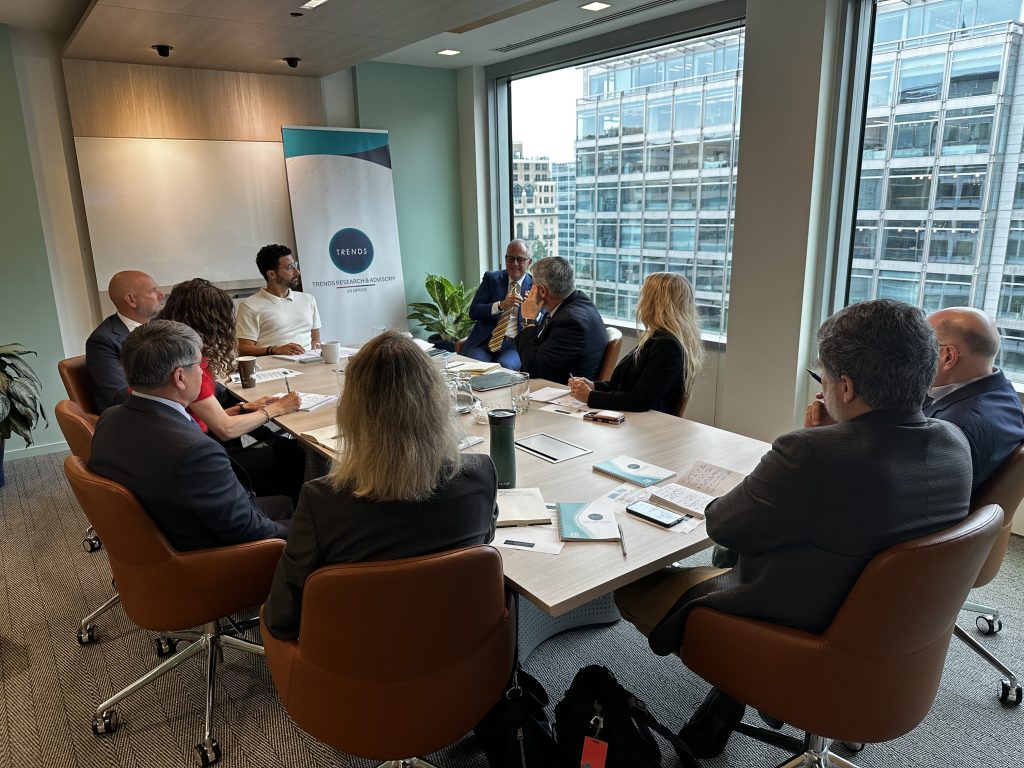
On September 30, 2025, TRENDS US held its third Strategy Session, entitled Unmanned Surface Vessels: The Future of Maritime Security. The session explored the impact, challenges, and future of unmanned surface vessels (USVs) and autonomous underwater vehicles (AUVs) in the maritime domain.
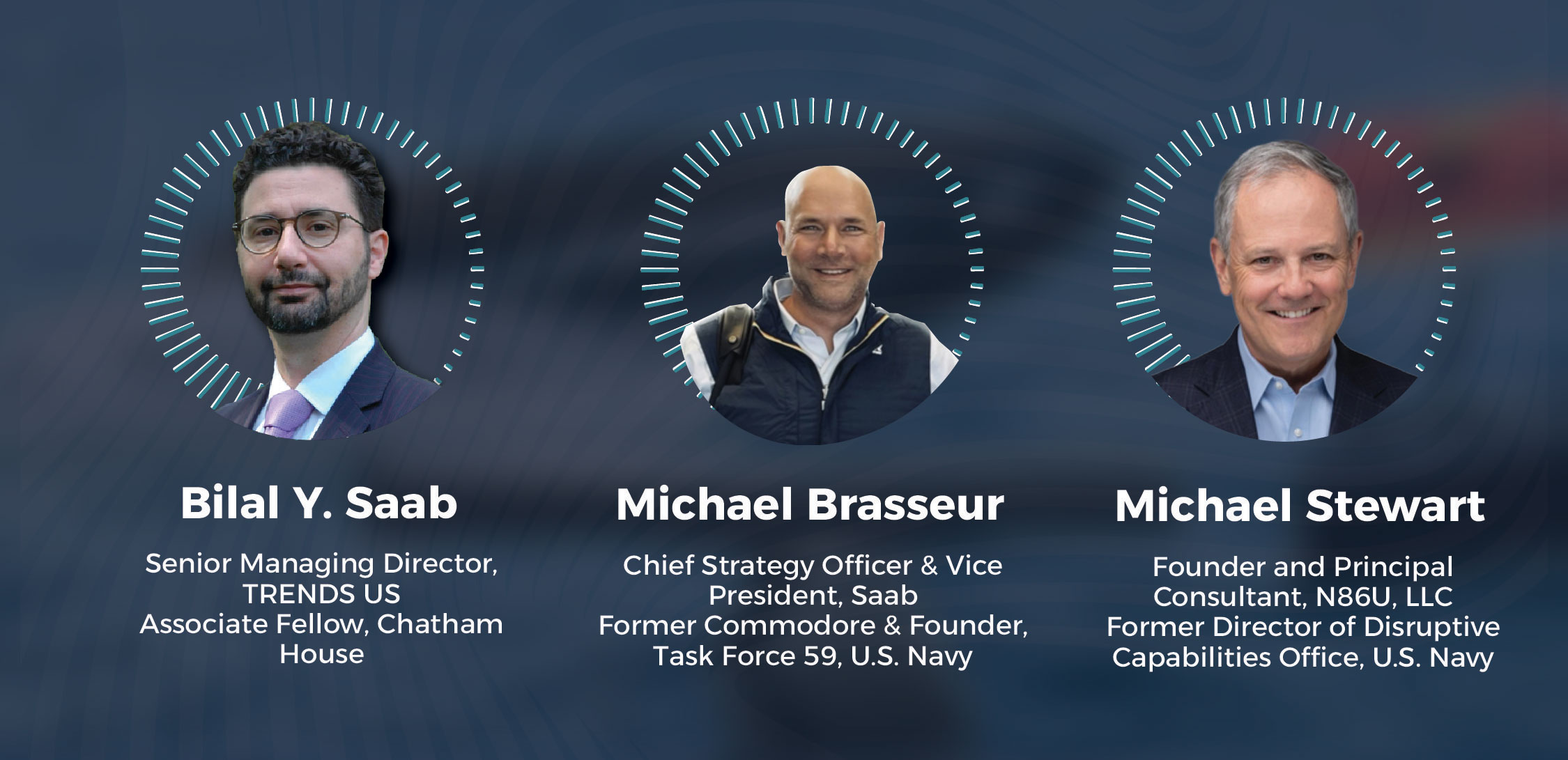
Guest speakers Michael Brasseur, chief strategy officer and vice president with Saab and former founder and commodore of the US Navy’s Task Force 59, and Michael Stewart, Founder and Principal Consultant of N86U LLC and former director of the Disruptive Capabilities Office in the US Navy, led the discussion. Moderator Bilal Y. Saab, Senior Managing Director of TRENDS US, divided it into three main parts:
- The impact of USVs and AUVs on maritime security in the Gulf and elsewhere.
- The future of these capabilities
- The strategic importance of collaboration and cooperation with regional and international partners
The session was on-the-record, bringing together former practitioners and retired senior personnel from the US Navy including TRENDS US senior advisor Vice Admiral (ret.) Kevin Donegan, who commanded US Naval Forces Central Command (NAVCENT), the Fifth fleet, and Combined Maritime Forces (CMF) in Bahrain. Seasoned subject matter experts on maritime security and the defense industry, as well as senior representatives of defense primes and startups actively participated in the discussion.
Key Insights and Recommendations
First Part
- When it comes to deterrence and warfighting in various domains, size always matters. At sea, however, numbers and speed matter equally, if not more. Having the right set of capabilities or force mix to meet current and emerging threats – including illegal and violent activities by the Iranian navy, Houthi missile and drone attacks, piracy, smuggling, human trafficking, and terrorism – in Gulf territorial waters and elsewhere is key. But how best to deter and defend at sea? In an increasingly budget-constrained environment, the strategic and operational imperative is to do more (or better) with fewer financial costs.
- This challenge is exacerbated in the case of America’s regional partners, who often have limited naval, and more specifically, maritime domain awareness (MDA) capabilities to detect and monitor threats in their exclusive economic zones (EEZs) and territorial seas and lack sufficient interdiction capabilities to protect their valuable sea-based resources and maritime sector.
- USVs and AUVs – relatively cheap, effective, and easier to acquire and field than the larger naval platforms (most of which fall under International Traffic in Arms Regulation, or ITAR, the subject of TRENDS US’s previous strategy session) – can be great equalizers.
- The attractiveness of USVs, AUVs and other autonomous assets that can be used in the maritime domain is not limited to their affordability and ease of (and dual) use. They can be effective and virtually indispensable in military operations at sea and have already made a significant impact in Gulf waters and the conflict between Russia and Ukraine.
- In the Gulf, Task Force 59, which Brasseur founded and commanded, specializes in the integration of unmanned systems and artificial intelligence with maritime operations in the 5th Fleet area of operations. Admiral Brad Cooper, current CENTCOM commander and previously the head of NAVCENT, summed up the value proposition of the task force rather nicely: “for pennies on the dollar we can put unmanned platforms out there, we can couple it with artificial intelligence … [and then] we can use our manned ships much more efficiently, much more effectively.”
- Ukraine’s campaign in the Black Sea is a perfect example of the real-world impact of unmanned maritime capabilities. Lacking a real navy, Ukraine has successfully damaged or destroyed nearly half of Russia’s naval force in the Black Sea. Innovation and adaptation played a huge part in Ukraine’s operational success. First, the Ukrainians redesigned and repurposed unmanned surface drones. Then they created their own USVs, known as “Sea Babies”. They modified the USVs by integrating explosive payloads and advanced navigation systems, enabling these drones to autonomously and remotely target and damage Russian ships with precise, coordinated attacks.
- These emerging, uncrewed technologies are not there to replace the aircraft carriers, the destroyers and the heavily-armed large platforms but rather to complement them to bring to bear a faster and more holistic, lethal, and economical response to various threats at sea.
Second Part
- The future of uncrewed technologies at sea is virtually limitless from a technological viewpoint. The challenge has always been organizational and financial.
- For all the reforms that have been implemented in the US acquisition process, things are still slow, disorganized, and un-strategic. The bureaucracy of the Pentagon has made positive changes including the creation of the Defense Innovation Unit (DIU) but there is still limited disruption in the acquisition process, and the culture of innovation is still lacking. Entities like Task Force 59 aren’t sufficiently supported by the bureaucracy, despite the groundbreaking work they are doing in their respective domains and responsibilities. “We know what works, we just aren’t nimble enough,” said one speaker.
- Testing and evaluating emerging capabilities is anything but easy for the warfighters (at least those like CENTCOM who seek to experiment with and integrate those capabilities in their area of responsibility). There is neither enough money to fund these initiatives nor enough organisational support to sustain any progress or breakthroughs. Resistance from the Pentagon bureaucracy and the military services is real, and the bias for larger platforms is still considerable. The mechanisms for funding are difficult to identify and navigate.
- There is no institutional memory when it comes to positive experiences with or lessons learned about emerging technologies (be it in the maritime domain or others). Innovation tends to die or slow down with the departure of the ambitious individual spearheading an initiative that develops and leverages emerging technologies.
Third Part
- The importance of allies and partners in developing, testing, and deploying USVs and AUVs cannot be overstated. Once again, the real-world examples of the Gulf and Ukraine show the advantages of leveraging international partnerships.
- Partners are vital for testing and integrating new unmanned systems and AI technologies into naval operations. This collaboration drives innovation and helps develop new operating concepts and technologies for the US Navy and its allies.
- By leveraging a diverse range of partners and their unmanned systems, Task Force 59 has sought to create a comprehensive and persistent network to improve the ability to see and understand activities above, on, and below the water. Task Force 59 provides training and support to ensure these systems are operated correctly and independently, which enhances their ability to participate in joint, multi-domain exercises.
- The collaborative network of manned and unmanned systems, developed with partners, helps to deter potential threats and build trust among human-machine teams. This integrated approach enhances the US Navy’s ability to respond to challenges and maintain regional maritime security.
- The success of Task Force 59’s partnerships in the Middle East has led to plans for establishing similar unmanned task forces globally, modelling its approach on the successful functions developed with its partners.
- Partners bring a wealth of diverse experiences and backgrounds, from other naval forces to the commercial sector and even young, innovative talent, which strengthens the task force’s ability to tackle complex challenges.
Speakers: