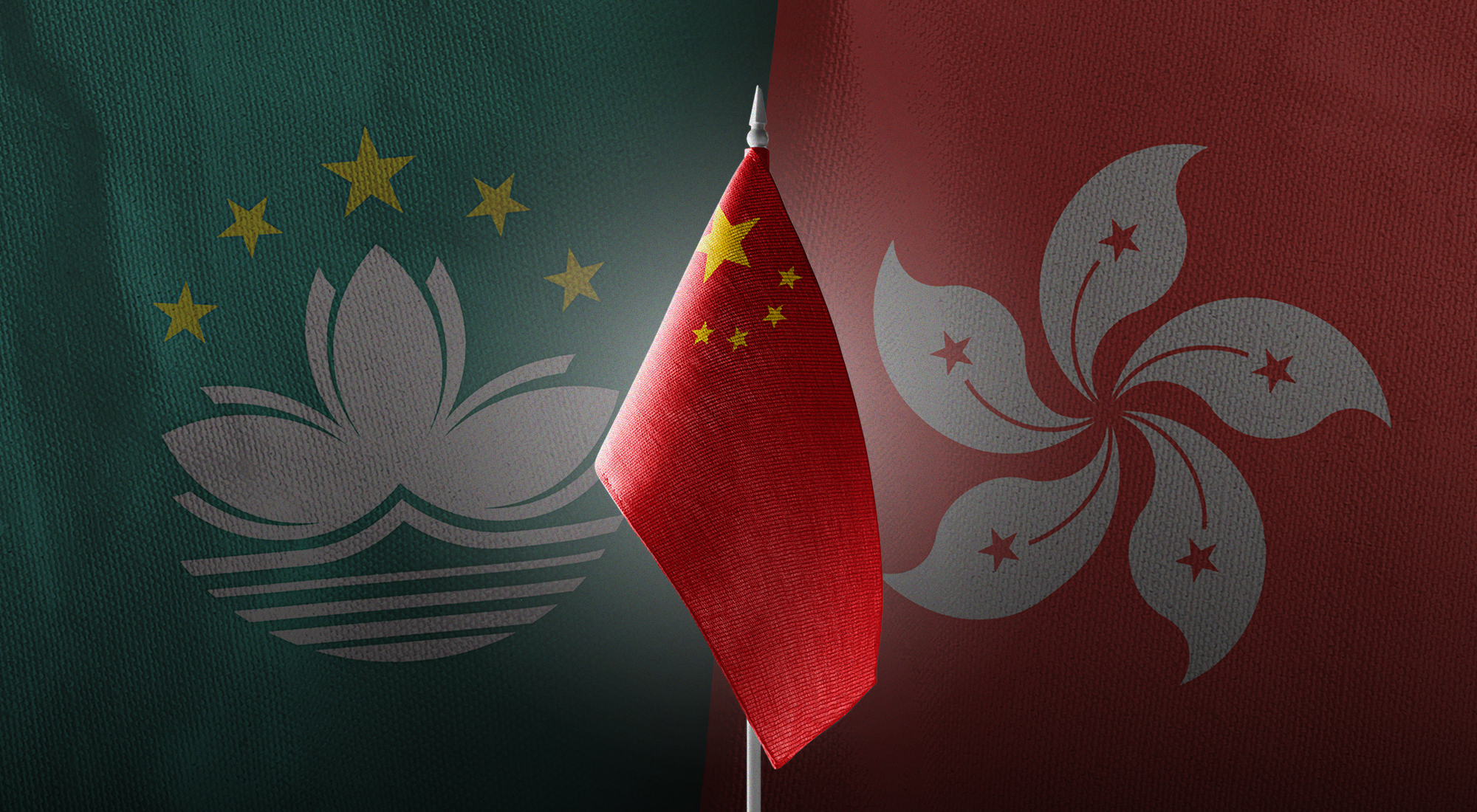

The concept of the reunification of “One China” represents a significant shift in the future of Southeast Asia and the world as a whole. In a bid to unify all the regions within China, the former leader of the People’s Republic of China (PRC), Deng Xiaoping, presented the concept of “One Country, Two Systems” at the Fifth Session of the National People’s Congress in 1982. The aspiration of the proposed principle is to have two systems coexisting under the umbrella of one unified country.[1] Hong Kong and Macau are two regions that successfully implemented the policy in 1997 and 1999, respectively. In 1984, the Sino-British Joint Declaration was signed by Margaret Thatcher, the Prime Minister of the United Kingdom, and Chinese Premier Deng Xiaoping, with the intention of setting conditions upon the return of Hong Kong to mainland China in 1997. The Declaration stated that the governmental and economic system of Hong Kong would remain unchanged for 50 years.[2] Subsequently, the Sino-Portuguese Joint Declaration was signed in 1987, stating that Macau would return to China in 1999 and would act as a special administrative region (SAR) under the concept of “One Country, Two Systems.”[3] The two SARs in China practice a high degree of autonomy as well as the management of internal and economic affairs independently.
This insight aims to examine the implementation of the “One Country, Two Systems” policy in the cases of Hong Kong and Macau in China, given their actual experience in presenting this policy and their running administrative systems. In addition, it aims to foresee the future possibilities of implementing the principle in other regions globally and the contexts that might promote or limit it. In doing so, the insight gives a clearer vision of the co-existence of two different systems that are argued to contradict each other.
Hong Kong
Legal Framework
Looking at Hong Kong in the legal context, the application of the “One Country, Two Systems” policy has exceeded expectations. The policy is described as the bedrock of peace and continued stability in Hong Kong after the establishment of the Hong Kong Special Administrative Region (HKSAR) in 1997. The HKSAR has a high degree of autonomy in addition to maintaining its economic, social, and common law systems under the “One Country, Two Systems”, where it actively participates in international organizations under the name “Hong Kong, China.”
Economic Cooperation
Both Hong Kong and Mainland China have demonstrated efforts in trade cooperation as they have separate economic systems. In 2003, they signed the “Mainland and Hong Kong Closer Economic Partnership Arrangement”, with the aim of increasing market liberalization in addition to paving the way for trade and investments. The HKSAR has shown that the policy is advantageous as it has outshined other nations in multiple international rankings, most importantly being ranked as the world’s number one for economic freedom since 1996.[4] The legal documents presented by the HKSAR demonstrate that following the policy is favorable for the administrative system and increased cooperation between Hong Kong and Mainland China on various fronts.
Political Challenges
Upon Hong Kong’s return to China in 1997, it operated under a constitutional document known as “the Basic Law”, which protects freedom of assembly and speech. While Hong Kong has a Chief Executive who has the responsibility of implementing the Basic Law, and he is supported by the Executive Council, a formal body of advisors.[5] Hong Kong’s current Chief Executive, John Lee, has expressed the importance of upholding the principle, as it has been the systemic support for Hong Kong’s continued stability and prosperity.[6] The exercise of autonomy was of utmost importance in establishing the “One Country, Two Systems” policy in Hong Kong in 1997. Despite being shelved now, a bill stating that suspects from Hong Kong will be allowed to be sent to the mainland for trial sparked pro-democracy protests in the province.[7] The protests started with the introduction of the bill, but the real reason people started taking to the streets is that the laws and bills issued by the mainland challenge the autonomy of Hong Kong. In this case, the autonomy has been proven to be challenged upon the passing of the National Security Law by China’s highest legislature, the National People’s Congress Standing Committee, in 2020. Acts of secession, subversion, terrorism, or collusion with foreign forces are criminalized under the National Security Law.[8] This has shown that China bypasses Hong Kong’s administrative system when needed, as the passing of the law has stabilized the complicated situation.
As a result, there has been a shift in Chinese influence in Hong Kong after the passing of the National Security Law. Books were taken off shelves, news outlets have left the city, and most companies have aligned their data policies with those of the mainland. Apart from this, people in Hong Kong are speaking mostly Mandarin instead of Cantonese, and the Chinese flag has been more prominent than that of Hong Kong.[9] Nonetheless, this does not directly indicate that the policy is being meddled with, as the Chinese government has always taken the position that 2047 is not a deadline for the policy, as it sees having the principle as the core of its prosperity and if it stays successful, there is no need to change that. By the 25th anniversary of Hong Kong’s return to the mainland in 2022, Chinese President Xi Jinping had stated that as long as the “one country, two systems” principle serves the primary interests of both Hong Kong and China, the policy must be maintained and adhered to in the long run.[10] In other words, pro-democratic thinking would see China as intervening in Hong Kong’s internal affairs, but the fact is that Hong Kong is in itself part of China when setting the laws for mutual benefit.
Macau
Having examined Hong Kong, it is now necessary to consider Macau, the second region where China has applied “One country, Two Systems”. The case of Macau gives a different narrative than that of Hong Kong when we delve deeper into the elements of the application of the policy. The return of Macau to China, following the “One Country, Two Systems” policy, and the establishment of a SAR are argued to be the only similarities between Macau and Hong Kong.[11] Macau had a more limited economic capacity formerly compared to Hong Kong; nonetheless, the successful implementation of the policy has led it to witness a significant rise in its GDP, surpassing that of Hong Kong. Apart from this, it can be shown that the government in Beijing is committed to directly involving Macau in its national development strategy, which is one of the biggest factors in its success today.
Economic Framework
The mainland government’s commitment was illustrated in its endeavors since the significant start of the initiation of the Mainland and Macau Closer Economic Partnership in 2003.
From its return to the mainland, not only did Macau amplify its GDP by seven times its original output from 51.9 billion patacas to 379.5 billion patacas, but it also has the world’s third-highest per capita GDP.[12] This staggering rise materialized in just the span of 24 years, leading to it being classified as one of the richest countries in the world.[13] This rise in the region’s GDP is a direct outcome of the Chinese government opening up Macau as a hub for Western gaming, turning it into one of the global leaders when it comes to gaming. In 2021, with a view to sustaining the success of Macau, the government of China established the Guangdong-Macau cooperation zone in Hengqin. Cultivating industries, namely high-end manufacturing, Traditional Chinese Medicine, financial services, and cultural tourism, shifts the overreliance on the gaming industry in Macau.[14]
Political Consent
In contrast to the protests that took place in Hong Kong in 2019, the situation in Macau remained predominantly stable. Macau local activist and former president of the New Macau Association, a pro-democracy party, Jason Chao, has stated that the issues that have existed in Hong Kong do not apply in Macau. Furthermore, he signaled that the primary distinction between Hong Kong and Macau is their desire for autonomy; as the Hong Kong population is fighting for freedom and rights, the population of Macau is mainly pro-China and does not support the protests in Hong Kong.[15] Given the fact that the population of Macau mainly consists of immigrants from China, along with them having a comfortable life, retaliations against the government would be unlikely to happen.
Additionally, the Chinese government includes both Hong Kong and Macau in its national development strategies, such as the introduction of the Guangdong-Hong Kong-Macau Greater Bay Area in 2019, as well as their inclusion in the Belt and Road initiative.[16] The inclusion of the regions into national strategies not only gives advantages to the country itself but also to Hong Kong and Macau, as such important development plans do indeed assist in improving the regions’ economies alongside that of the mainland. To put it another way, the commitment and initiatives taken by the government in Beijing to include the regions in its development and strategic plans are a display of its responsibility in integrating the two systems and having them co-exist simultaneously by optimizing the advancement of all systems in the country.
Analysis and Conclusion
The “One Country, Two Systems” policy illustrates an approach for how various nations across the globe can establish a form of consensus when it comes to administering a specific region. Upon delving deeper into the dynamics of the policy’s application in the cases of Hong Kong and Macau, it was revealed that although there were certain challenges, it was deemed successful. The fact that the policy has stood for more than 25 years without major concessions lends it credibility for being used in different situations in the long run. Exploring the history of the policy gives a deeper understanding of the potential rise of issues and how China approached the issues to sustain the policy. Not only do the cases of Hong Kong and Macau present different outcomes, but they also provide comprehensible insights into optimizing how two systems can co-exist under the umbrella of one country. It is evident that the local population is more content in Macau than in Hong Kong, and it is important to understand that, although a different administrative system may exist, the population views the mainland as its original homeland.
This policy is a strategic step taken by China to unify provinces, specifically those that were under Western governance, as in the cases of Hong Kong and Macau. The population has spent decades, if not centuries, living under a different system than that on the mainland; thus, changing this system upon their unification would prove to be an obstacle rather than a solution. There are different factors that play a significant role in measuring the policy’s success. First, it became apparent that cooperation on the shared interest was optimized rather than focusing on enforcing the systematic change in the regions. Second, the combination of capitalist and socialist systems under one country has resulted in the economic growth of Beijing, Hong Kong, and Macau. Third, having the mainland government deal with the issues that surfaced during the time of implementing the policy, with consideration of the local population, has been deemed one of the most significant factors. This can be seen when they introduced a bill in Hong Kong and later shelved it when dissent in the region arose in 2019. Apart from this, it faced challenges given the fact that the ideologies of the regions and the mainland do not always see eye-to-eye. The administration of the policy-related issues has been guided by public concerns. To sum it up, there are several disputes worldwide, and the application of an identical or equivalent policy in other regions globally would theoretically settle many systematic or ideological disputes.
[1] Ministry of Foreign Affairs of the People’s Republic of China, “A Policy of ‘One Country, Two Systems’ on Taiwan,” May 31, 2024, https://www.mfa.gov.cn/eng/zy/wjls/3604_665547/202405/t20240531_11367561.html.
[2] Wang Zhan, “Tsang: HK Way of Life Stays Beyond ‘47 under ‘One Country, Two Systems’,” China Daily (Hong Kong Edition), March 26, 2025, https://www.chinadailyhk.com/hk/article/607930.
[3] “Macau: China’s Other ‘One Country, Two Systems’ Region,” BBC News, December 20, 2019, https://www.bbc.com/news/world-asia-china-50832919.
[4] “One Country, Two Systems,” fact sheet, Government of the Hong Kong Special Administrative Region, August 16, 2021, https://www.brandhk.gov.hk/uploads/brandhk/files/factsheets/Hong_Kong_Themes/One-country-two-systems-E.pdf.
[5] “Hong Kong: How Is It Run, and What Is the Basic Law?,” BBC News, July 1, 2022, https://www.bbc.com/news/world-asia-china-49633862.
[6] Chief Executive of the Hong Kong Special Administrative Region, “Welcome Message,” CEO.gov.hk, last modified September 2025, https://www.ceo.gov.hk/en/welcome.html.
[7] “Hong Kong: ‘One Country, Two Systems’ Is Breaking Down, but Not Yet Dead,” The Interpreter, Lowy Institute, February 5, 2025, https://www.lowyinstitute.org/the-interpreter/hong-kong-one-country-two-systems-breaking-down-not-yet-dead.
[8] “Hong Kong: How Is It Run”
[9] “Hong Kong: ‘One Country, Two Systems’ Is Breaking Down.”
[10] Zhan, “Tsang: HK Way of Life.”
[11] “Macau: China’s Other ‘One Country, Two Systems’ Region.”
[12] “Leading Macao to Greater Success of ‘One Country, Two Systems,’” The State Council of the People’s Republic of China, December 19, 2024, https://english.www.gov.cn/news/202412/19/content_WS67635793c6d0868f4e8ee174.html.
[13] “Leading Macao to Greater Success.”
[14] “Leading Macao to Greater Success.”
[15] “Macau: China’s Other ‘One Country, Two Systems’ Region.”
[16] “Leading Macao to Greater Success.”