


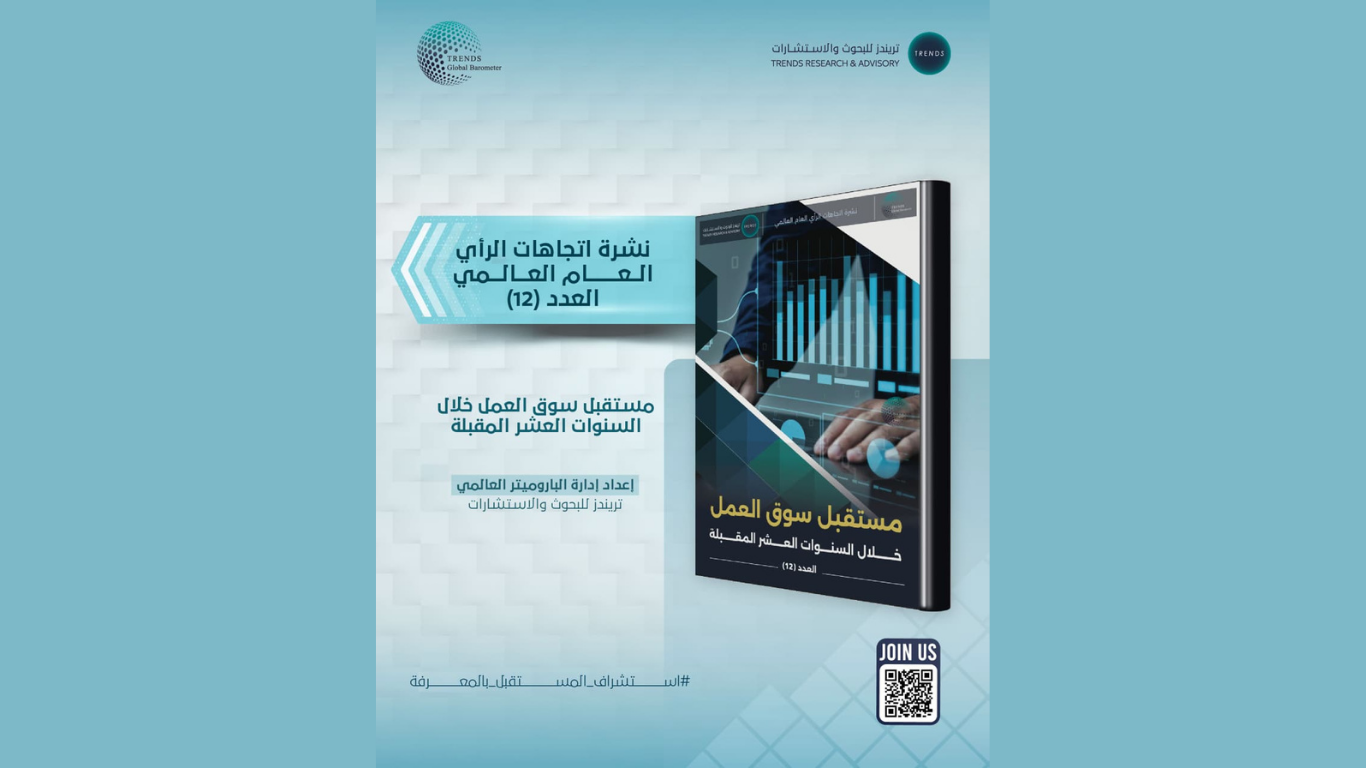
The edition provides an in-depth analytical reading of global labor market trends over the coming decade.
Coinciding with the World Government Summit 2026, TRENDS Research & Advisory has released the twelfth edition of the Global Barometer of public opinion, which examines the profound transformations shaping the future of the global workforce amid the acceleration of artificial intelligence (AI), the climate transition, demographic changes, and the expansion of the care economy and human services.
The new edition provides an in-depth analytical reading of global labor market trends over the coming decade, drawing on reliable secondary data from leading international institutions, including the World Economic Forum, the International Labour Organization, the Organisation for Economic Co-operation and Development, and the McKinsey Global Institute, in addition to recent global surveys such as PwC, Adecco, and the Harvard Youth Poll.
The report — prepared by the Global Barometer Department at TRENDS within the Dubai Office — explains that the primary challenge in the next phase lies not in job losses but in the reconfiguration of work environments and the transformation of required skills. It projects the creation of around 170 million new jobs globally by 2030, alongside the decline of many traditional jobs due to automation and the adoption of artificial intelligence. This means that more than one-fifth of the global workforce will undergo fundamental career transitions in the coming years.
The issue highlights the growing role of AI as a transformative force that goes beyond automation to include the redistribution of tasks and increased demand for advanced analytical and human-centered skills. It underscores that the positive impact of modern technologies is linked to the degree of practical exposure to them, the level of trust in organizational leadership, and the clarity of reskilling and upskilling pathways.
The issue also addresses the global shift toward the green economy, noting that sustainability and climate-neutrality policies can generate millions of new jobs — particularly in renewable energy, energy efficiency, sustainable construction, and environmental technologies — alongside rising demand for advanced scientific and technical skills in these fields.
The report highlights the expansion of the care economy and human services as one of the strongest global drivers of employment, driven by demographic change and rising life expectancy. It emphasizes that investment in healthcare, education, and early childhood development delivers a dual impact by creating sustainable job opportunities while strengthening social cohesion and equitable economic growth.
At the level of the United Arab Emirates, analyses confirm that the country has strong fundamentals to benefit from these transformations, given its ambitious national strategies, such as the UAE AI Strategy 2031, the Net Zero 2050 Strategic Initiative, and the UAE Centennial 2071. The report stresses the importance of continued investment in human capital, the development of digital and human skills, and the promotion of lifelong learning.
The twelfth edition of the TRENDS Global Barometer concludes that future readiness cannot be built on technology alone, but rather through the integration of three core pathways: technology, transferable skills, and institutional trust. It emphasizes that countries that place people at the heart of their policies and invest in their capabilities will be best positioned to lead labor markets in the decade ahead.
To read the report https://bit.ly/49RI2Ks
