


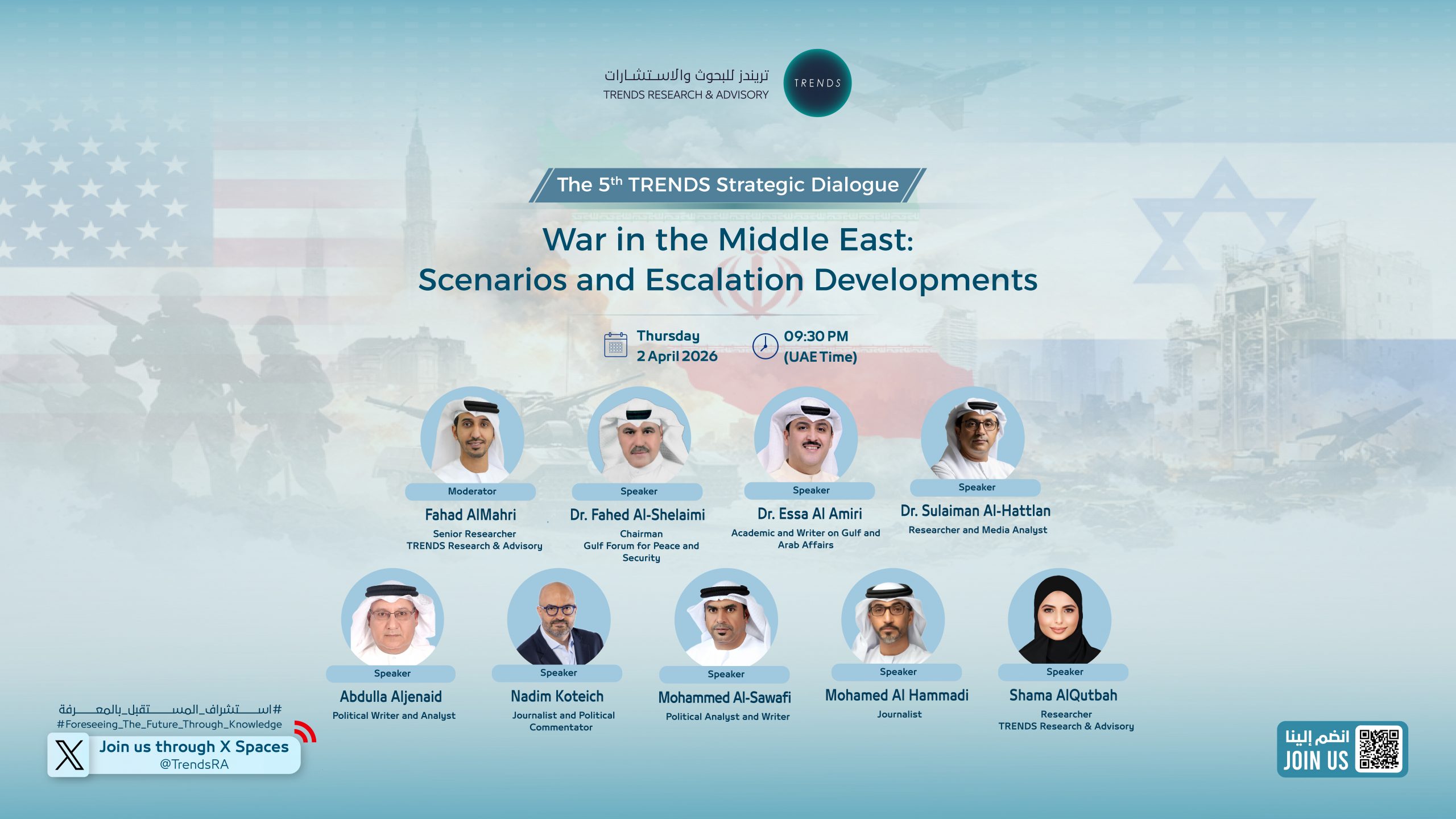
As part of its research efforts to provide an in-depth understanding and accurate analytical assessment of the course and developments of the United States-Israel-Iran conflict in the Middle East, TRENDS Research & Advisory is convening a strategic dialogue titled The War in the Middle East: Scenarios and Developments of Escalation. The session will bring together prominent media professionals and analysts specializing in regional and international affairs.
TRENDS is organizing the discussions via the X Spaces platform tomorrow, Thursday, at 9:30 PM UAE time. Participants include Dr. Fahad Al-Shalimi, Head of the Gulf Forum for Security and Peace; writer and political analyst Mohammed Khalfan Al-Sawafi; journalist Mohamed Al Hammadi; writer and political analyst Abdullah Al-Junaid; academic and writer on Gulf and Arab affairs Dr. Essa Al Amiri; researcher and media figure Dr. Sulaiman Al-Hattlan; and media figure and political writer Nadim Koteich, and Shamma Al-Qutbah, Researcher at TRENDS Research and Advisory. The discussion will be moderated by Fahad Al-Mahri, Senior Researcher at TRENDS Research and Advisory.
The fifth TRENDS Strategic Dialogue aims to analyze the current crisis in the Middle East and its implications for regional and international security and stability. The discussion will also address the increasing pressures the conflict poses on global markets and various economies, as well as recent developments in oil prices, driven by the closure of the Strait of Hormuz, which affects many essential industries worldwide.
 Anticipating War Scenarios
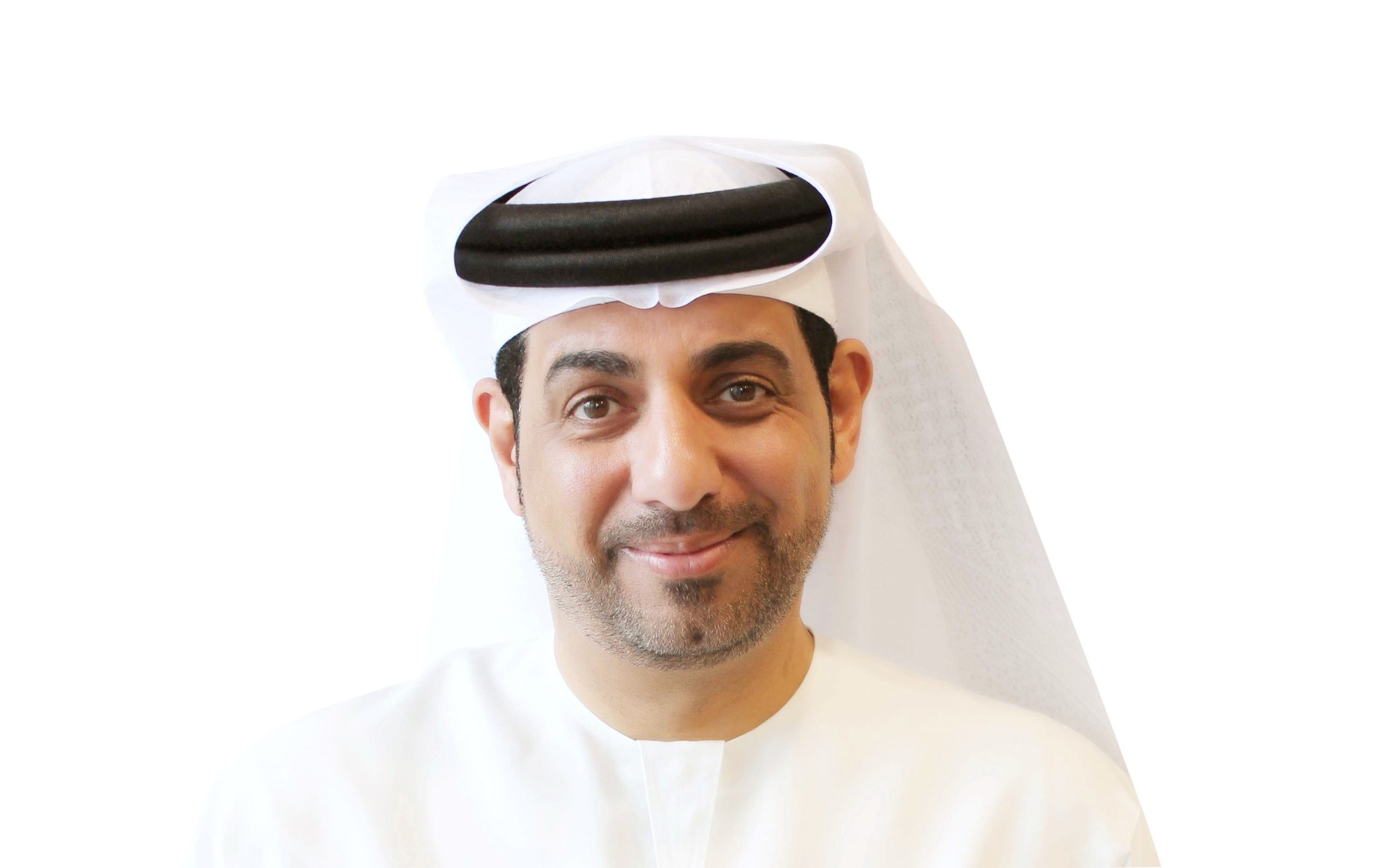
Dr. Mohammed Abdullah Al-Ali, CEO of TRENDS Research & Advisory, stated that the fifth strategic dialogue comes at a critical, highly sensitive moment to analyze the repercussions of the war and anticipate future scenarios. The Arab region has been witnessing an unprecedented escalation for more than a month because of the U.S.-Israel-Iran conflict, along with rapid repercussions affecting regional and international security, the global economy, energy markets, and maritime navigation.
Dr. Al-Ali explained that developments in the Middle East represent not merely a limited military confrontation but a strategic shift reshaping the rules of engagement in the region. He emphasized the importance of this dialogue as a rigorous intellectual platform that seeks to move beyond superficial interpretations and provide an in-depth understanding of the political, security, military, and economic dimensions of the conflict. This will be achieved through the participation of a distinguished group of media professionals, analysts, and specialized academics who will present evidence-based perspectives and future scenarios.
Anticipating War Scenarios
Dr. Mohammed Abdullah Al-Ali, CEO of TRENDS Research & Advisory, stated that the fifth strategic dialogue comes at a critical, highly sensitive moment to analyze the repercussions of the war and anticipate future scenarios. The Arab region has been witnessing an unprecedented escalation for more than a month because of the U.S.-Israel-Iran conflict, along with rapid repercussions affecting regional and international security, the global economy, energy markets, and maritime navigation.
Dr. Al-Ali explained that developments in the Middle East represent not merely a limited military confrontation but a strategic shift reshaping the rules of engagement in the region. He emphasized the importance of this dialogue as a rigorous intellectual platform that seeks to move beyond superficial interpretations and provide an in-depth understanding of the political, security, military, and economic dimensions of the conflict. This will be achieved through the participation of a distinguished group of media professionals, analysts, and specialized academics who will present evidence-based perspectives and future scenarios.
 Conflict Development Analysis
TRENDS CEO highlighted that think tanks, research institutions, and academic organizations play a pivotal role in analyzing crises and conflicts and have become essential partners in shaping future policy directions. He noted that the role of research centers is no longer limited to interpreting current developments but also includes providing alternatives, proactive visions, and evidence-based scenarios for potential theatres of escalation and de-escalation, as well as evaluating available strategic options at multiple levels.
He further said that the Middle East is currently experiencing a state of anticipation and reciprocal escalation between the United States and Israel on one side and Iran on the other, which poses greater risks of the conflict expanding to new fronts. He added that delays in understanding the nature of this conflict impose additional costs on regional and global economies and on human security.
The dialogue will therefore examine developments in oil prices, the impact on supply chains, the potential expansion of the conflict, and ongoing de-escalation efforts and negotiations aimed at reducing tensions. The discussion will also explore possible post-war outcomes.
Conflict Development Analysis
TRENDS CEO highlighted that think tanks, research institutions, and academic organizations play a pivotal role in analyzing crises and conflicts and have become essential partners in shaping future policy directions. He noted that the role of research centers is no longer limited to interpreting current developments but also includes providing alternatives, proactive visions, and evidence-based scenarios for potential theatres of escalation and de-escalation, as well as evaluating available strategic options at multiple levels.
He further said that the Middle East is currently experiencing a state of anticipation and reciprocal escalation between the United States and Israel on one side and Iran on the other, which poses greater risks of the conflict expanding to new fronts. He added that delays in understanding the nature of this conflict impose additional costs on regional and global economies and on human security.
The dialogue will therefore examine developments in oil prices, the impact on supply chains, the potential expansion of the conflict, and ongoing de-escalation efforts and negotiations aimed at reducing tensions. The discussion will also explore possible post-war outcomes.
Anticipating War Scenarios
Dr. Mohammed Abdullah Al-Ali, CEO of TRENDS Research & Advisory, stated that the fifth strategic dialogue comes at a critical, highly sensitive moment to analyze the repercussions of the war and anticipate future scenarios. The Arab region has been witnessing an unprecedented escalation for more than a month because of the U.S.-Israel-Iran conflict, along with rapid repercussions affecting regional and international security, the global economy, energy markets, and maritime navigation.
Dr. Al-Ali explained that developments in the Middle East represent not merely a limited military confrontation but a strategic shift reshaping the rules of engagement in the region. He emphasized the importance of this dialogue as a rigorous intellectual platform that seeks to move beyond superficial interpretations and provide an in-depth understanding of the political, security, military, and economic dimensions of the conflict. This will be achieved through the participation of a distinguished group of media professionals, analysts, and specialized academics who will present evidence-based perspectives and future scenarios.
Conflict Development Analysis
TRENDS CEO highlighted that think tanks, research institutions, and academic organizations play a pivotal role in analyzing crises and conflicts and have become essential partners in shaping future policy directions. He noted that the role of research centers is no longer limited to interpreting current developments but also includes providing alternatives, proactive visions, and evidence-based scenarios for potential theatres of escalation and de-escalation, as well as evaluating available strategic options at multiple levels.
He further said that the Middle East is currently experiencing a state of anticipation and reciprocal escalation between the United States and Israel on one side and Iran on the other, which poses greater risks of the conflict expanding to new fronts. He added that delays in understanding the nature of this conflict impose additional costs on regional and global economies and on human security.
The dialogue will therefore examine developments in oil prices, the impact on supply chains, the potential expansion of the conflict, and ongoing de-escalation efforts and negotiations aimed at reducing tensions. The discussion will also explore possible post-war outcomes.

