


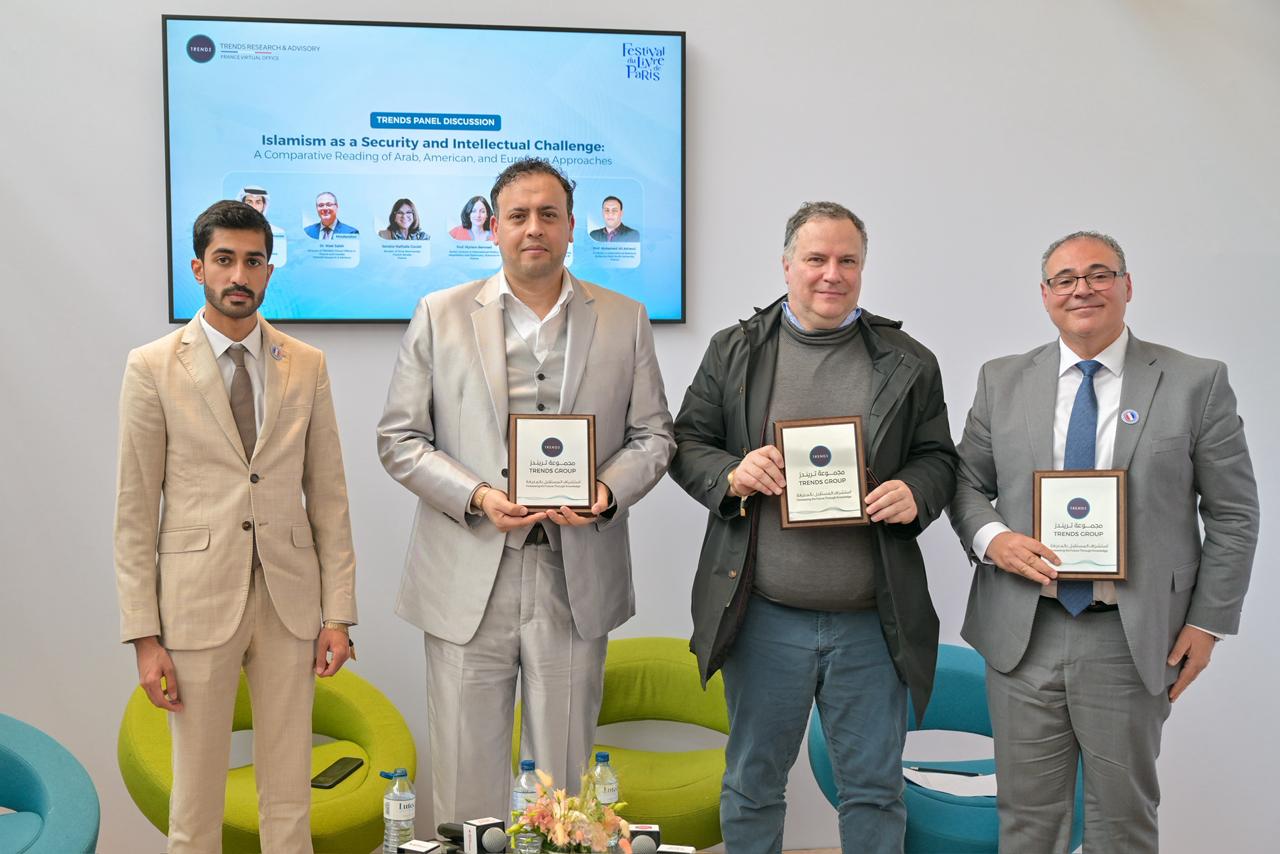
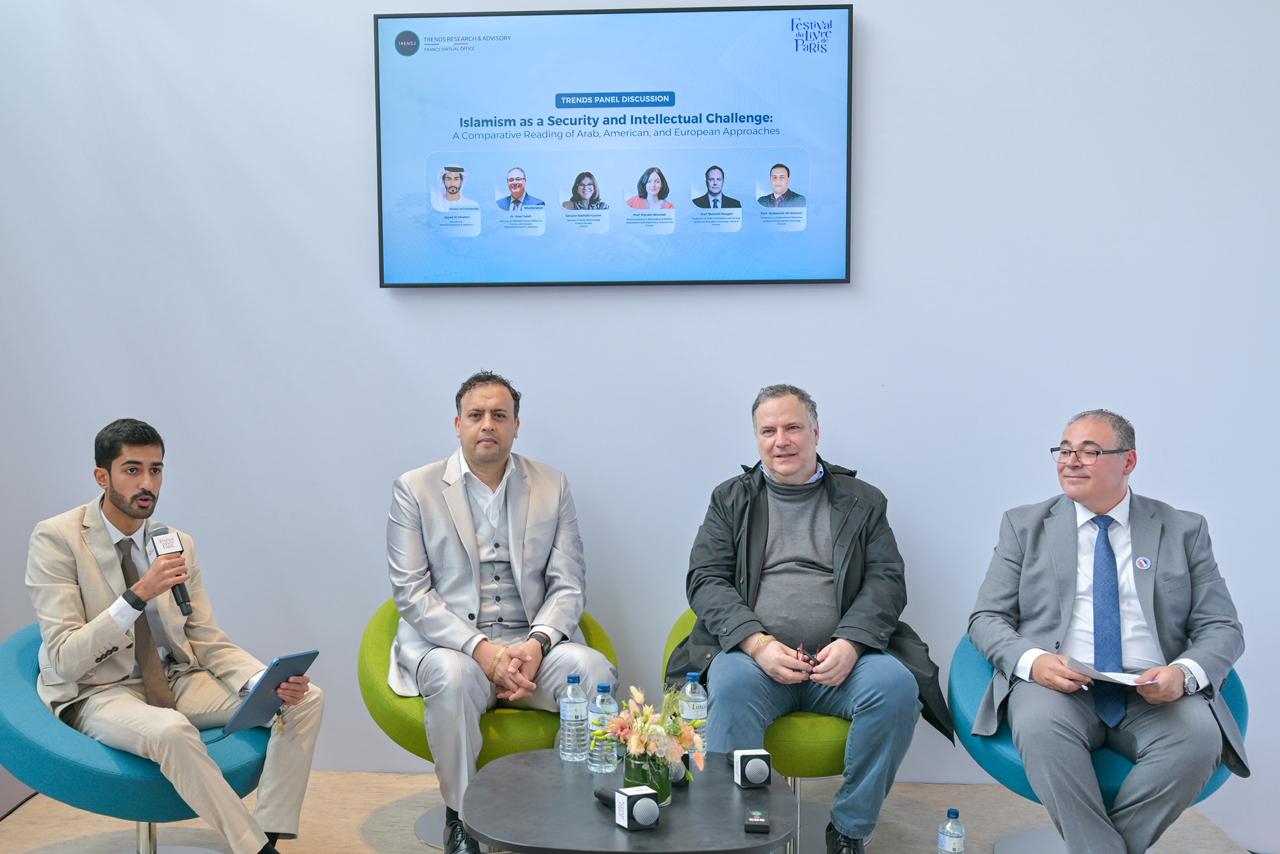
Through its Virtual Office in France, TRENDS Research & Advisory began its exceptional participation in the 2026 Paris International Book Festival, as a special guest, by organizing a panel discussion titled Islamism as a Security and Intellectual Challenge: A Comparative Reading of Arab, American, and European Approaches, with the participation of a group of international researchers and experts. The session was held at its joint pavilion with Mohammed Bin Zayed University for Humanities at the Grand Palais in Paris.
The session was introduced by Zayed Al-Dhaheri, Researcher at TRENDS, who stated that Islamism is a complex phenomenon that goes beyond the traditional security approach, combining both security and intellectual dimensions, and that it affects the institutional structure of the nation-state and the cohesion of societies at a deep level. He explained that Islamism cannot be reduced to manifestations of extremism, but reflects an organized ideological project that seeks to redefine the public sphere and reshape the relationship between religion and politics.
He noted that the session opens an in-depth analytical dialogue among three main approaches (Arab, American, and European), contributing to moving beyond single interpretations. The dialogue also seeks to build a more coherent analytical framework to understand the phenomenon as a structural challenge affecting societies and nation-states at both the institutional and value levels.
Intellectual and Epistemological Dimensions
Dr. Wael Saleh, Director of the TRENDS Virtual Offices in France and Canada, who moderated the session, emphasized that Islamism cannot be understood through a traditional security perspective, but requires a deeper analytical approach that takes into account its intellectual and epistemological dimensions, as an organized ideological project.
He noted that a growing number of Arab researchers are directing criticism at prevailing approaches within Western academic circles, particularly those that tend to interpret Islamism within unsuitable theoretical frameworks, such as conflating it with Islam as a religion. He added that such readings obscure the true nature of Islamism as a coherent ideological project.
He pointed to methodological deficiencies in some studies, including excessive reliance on the narratives of Islamist actors as a primary source of analysis, while marginalizing the study of foundational reference texts. He concluded that these issues require renewing analytical frameworks by incorporating the ideological and epistemological dimensions, enabling a more accurate and complex understanding of Islamism that is free from simplistic or reductionist interpretations.
The Muslim Brotherhood and States
Mohamed Ali Adraoui, Professor of International Relations at Sorbonne University – Paris, focused in his remarks on the historical geopolitical dimension of the relationship between the Muslim Brotherhood and several states, through analyzing the policies of the United States, Europe, and some Arab countries toward the movement. He explained that understanding this relationship requires attention to diplomatic archives, noting that the positions of some states toward the Muslim Brotherhood are variable, influenced by historical contexts and geopolitical transformations, making the relationship complex and multi-dimensional.
Prof. Adraoui highlighted the role of the academic field in producing knowledge about the Muslim Brotherhood, considering that the diversity of interpretations reflects the complexity of the academic debate surrounding the group, but also presents a challenge related to the need to develop precise analytical tools capable of accommodating the continuous transformations in the structure of the movement and its behavior across different contexts, to demonstrate the extent of its risks to societies and countries.
Reshaping Loyalties
Bernard Rougier, Professor of Arab Civilization and Society at Sorbonne Nouvelle University, presented an in-depth reading of Islamism as an integrated socio-political system that is not limited to being an ideology or a political movement, but represents an organizational structure capable of reshaping the social sphere from within through local networks and intermediary institutions, such as associations, mosques, and educational spaces, which contribute to creating supportive environments that gradually and continuously reshape behaviors and loyalties.
Prof. Rougier explained that the Islamist project is based on a close overlap between religious da’wah and politics, where religion is used as a tool to rebuild affiliations and direct them, while stressing the need for a strict analytical distinction between Islam as a religion and Islamism as an ideological project. He noted that some Western researchers struggle to understand the complexity of this phenomenon because they rely on inappropriate analytical tools.
Prof. Rougier stated that understanding Islamism requires moving beyond simplistic approaches and adopting analytical models that account for the interaction among social, ideological, and organizational factors, thereby enabling a more accurate interpretation of its contemporary dynamics.
