


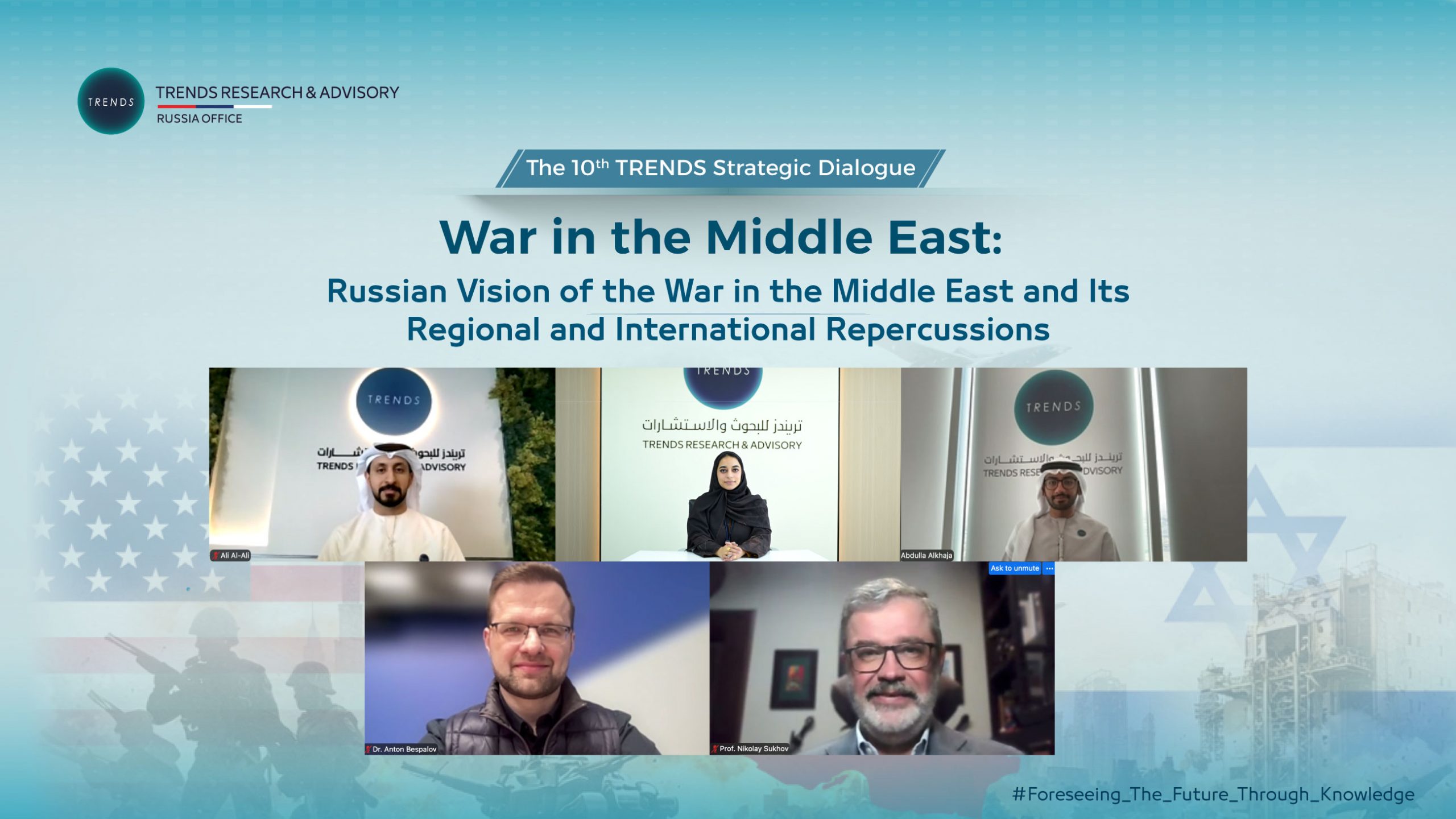
Participants of the 10th Strategic Dialogue, organized by TRENDS Group through its office in Russia, titled The War in the Middle East: The Russian Vision of the Conflict and Its Regional and International Repercussions, affirmed that Moscow has been keen, since the beginning of the conflict in the region, to keep channels of communication and strategic cooperation open with the Gulf capitals.
They also noted that Russia’s refraining from direct military intervention, its focus on political solutions, and the intensification of diplomatic efforts are consistent with the interests of the Arab Gulf states in avoiding a large-scale war and preserving regional stability.
The experts and researchers pointed out that Russia may indirectly benefit from the conflict in the Middle East, citing rising oil prices and Washington’s preoccupation with Europe. However, the price increase is merely a temporary fluctuation, and Russia faces long-term risks from accelerating energy transitions.
They explained that the conflict has disrupted a significant portion of the global energy sector’s supply and inflicted serious damage on aviation, shipping, tourism, and other vital industries. At the same time, the conflict in the Middle East is rewriting an important chapter in shaping the global balance of power.
Reshaping The International Alliances
The discussion, moderated by Abrar Al Ali, a researcher at TRENDS Group, began with opening remarks by Ali Abdullah Al Ali, a researcher and director of TRENDS’ Dubai office, who said that this discussion comes at a very important moment, as the ongoing war in the Middle East continues to reshape the dynamics of regional security, international alliances, and global energy markets.
He stated that the dialogue would address Russia’s views on this evolving crisis in the region, its definition of its role, and how its position affects the broader regional and international landscape. He added that the discussion would focus on three main axes: the Russian position on the war in the Middle East, specifically the balance between managing the conflict and pushing for political and diplomatic dialogue; the future of Russian-Gulf relations in the post-war phase; and how the war affects oil markets, including short-term price increases and the long-term need for stability and sustainable energy.
The Logic of Force
Prof. Nikolay Sukhov, a professor of Middle Eastern studies in Russia, confirmed that the Russian leadership’s position on the military confrontation between the United States and Israel on one side and Iran on the other represents a coherent framework that combines a strict legal assessment of what is happening, political support for Tehran, and a clear concern with controlling the limits of Russian involvement and avoiding confrontation.
He noted that official statements issued by the Russian Foreign Ministry describe the American and Israeli strikes as a violation of the UN Charter, adding that Russian discourse links this crisis to the decline in the effectiveness of international legal mechanisms and the rise of the logic of force in crisis management, while clearly rejecting attempts to change political systems from the outside.
Preserving Regional Stability
Sukhov explained that Russia seeks to maintain a balanced position that does not place it in a sharp regional alignment, through its political support for Iran on the one hand and its keenness to keep strategic cooperation channels open with Gulf capitals on the other. He noted that Moscow’s abstention from military intervention and its focus on political solutions are consistent with the interests of the Arab Gulf states in avoiding a large-scale war and preserving regional stability.
Regarding energy markets, Nikolay Sukhov explained that the war offers producing countries, including Russia, short-term gains because of higher oil prices, but at the same time imposes long-term risks, including disruptions to supply chains, higher transportation and insurance costs, and an acceleration of energy diversification policies.
Supporting Mediation Efforts
Abdullah AlKhaja, a researcher at TRENDS Group, discussed Russia’s strategic reading of the Middle East crisis, focusing in particular on Moscow’s diplomatic position, its relations with the Gulf states, and the repercussions of the war on global oil markets. He explained that Moscow has consistently called for an immediate cessation of hostilities and a return to dialogue, while criticizing the roles of the United States and Israel in escalating the crisis. At the same time, Russia has sought to maintain its diplomatic standing by maintaining effective lines of communication with Iran and supporting broader regional mediation efforts.
Regarding Russian-Gulf relations, AlKhaja noted that the post-war phase is likely to lead to deeper operational engagement, particularly in energy, trade, investment, and diplomatic dialogue. However, the Arab Gulf states will continue to hedge cautiously, as Russia’s close relationship with Iran limits the extent of strategic trust. Therefore, Russian-Gulf relations are expected to expand, but within clear political boundaries.
Speaking about the oil markets, Abdullah AlKhaja explained that Russia has benefited in the short term from higher oil prices and increased demand for its energy exports, while warning that prolonged instability could create long-term risks, including pressure on demand, threats to the cohesion of OPEC+, shipping insecurity, and an acceleration of diversification away from hydrocarbons.
He concluded that while Russia may benefit from the crisis conditions as an energy-exporting country, it does not benefit from a permanently unstable energy system, indicating that Moscow’s vision of the war in the Middle East is shaped by the dual objective of reducing escalation while using diplomacy and energy policies to maintain its influence in the emerging regional order.
Accelerating Energy Transitions
Dr. Anton Bespalov of the Valdai Discussion Club noted that some believe Russia is indirectly benefiting from the conflict in the Middle East, due to rising oil prices and Washington’s preoccupation with other geopolitical issues. Still, the price increases are merely temporary fluctuations, and Russia faces long-term risks from accelerating energy transitions.
He added that Moscow considers U.S. President Donald Trump a reliable negotiating partner regarding Europe, but President Trump’s actions against Iran have weakened him both domestically and internationally.
Strategic Autonomy
At the regional level, Bespalov argued that Middle Eastern states are rethinking their strategic positions and partnerships in the post-war period. Although the U.S.-Israeli axis will continue to influence the calculations of all regional actors in the long term, and regional states will maintain their core alliances with the United States, the trend toward greater strategic autonomy is likely to intensify. These approaches may include strengthening national deterrence capabilities or developing a comprehensive regional security architecture.
He explained that Iran’s direct attacks on oil and gas infrastructure in the Gulf states and the blockade of the Strait of Hormuz — which disrupted the global energy sector — have severely damaged aviation, shipping, tourism, and other vital industries. He added that the conflict has reached a strategic stalemate, and that negotiations may only yield a temporary truce before the next escalation. At the same time, these events represent a significant chapter in the broader reshaping of the global balance of power.

