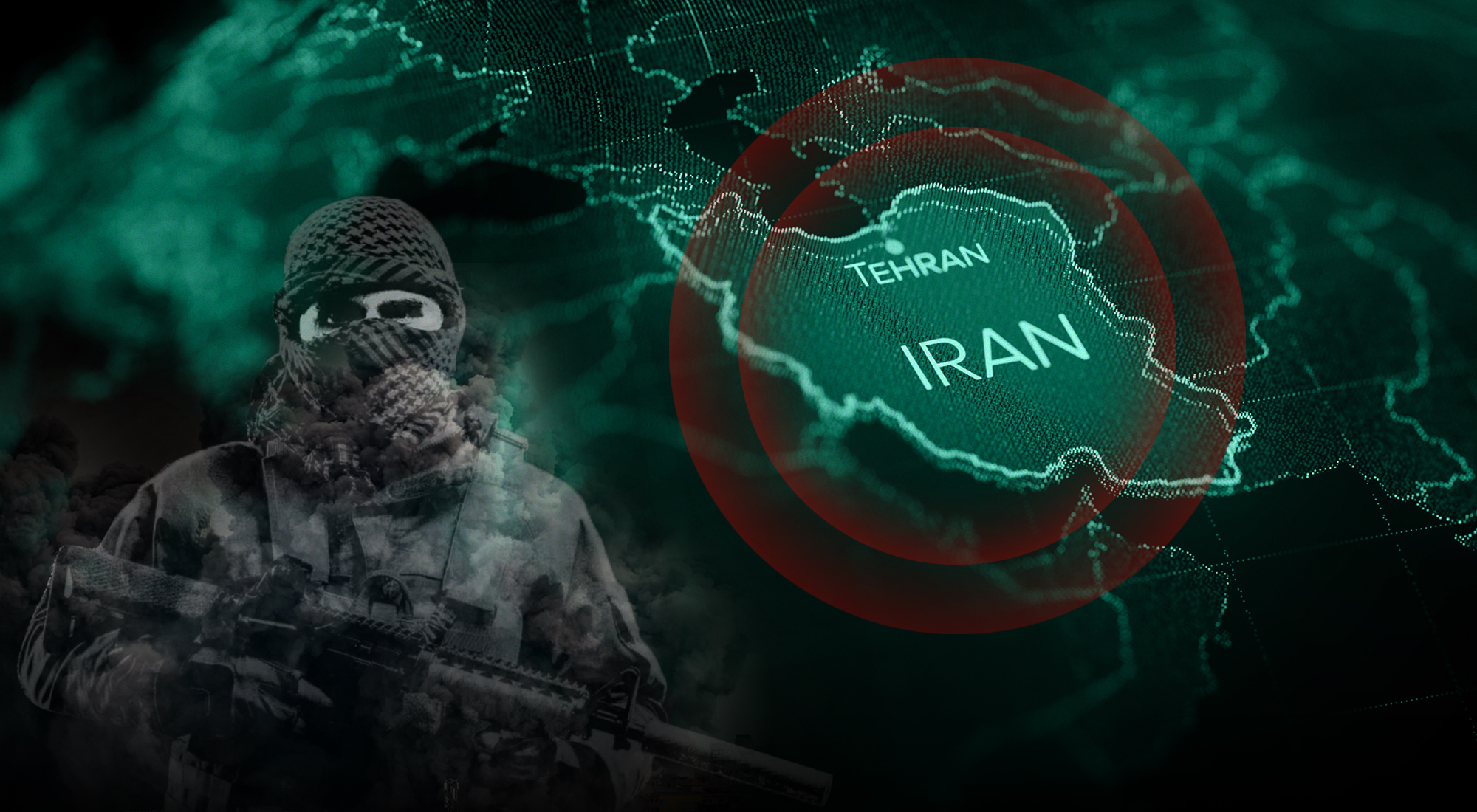
Between October 2023 and March 2026, the Islamic Republic of Iran’s “Axis of Resistance”—the network of proxy forces Tehran cultivated over four decades to project power across the Middle East—suffered a series of devastating, severe setbacks. The elimination of Hamas’s senior military leadership and the substantial degradation of its operational capacity in Gaza; the targeting of Hezbollah’s senior leadership, including the killing of Secretary-General Hassan Nasrallah in September 2024; the fall of the Assad regime in Syria in December 2024; the fractionalization of Iraq’s Shia militias; the joint U.S.-Israeli military campaign against Iran’s nuclear program beginning 28 February 2026; and the reported assassination of Supreme Leader Ali Khamenei—together, these events constitute one of the most significant degradations of a state-sponsored proxy architecture in recent decades.
This study argues that the collapse represents not merely a military development but a profound ideological failure. The doctrine of “resistance” (muqāwama) was always a project of political Islam—specifically the revolutionary Shia Islamist variant codified in the principle of wilāyat al-faqīh. Its disintegration invites a fundamental question: what alternative model is available to Muslim-majority states seeking security, prosperity, and dignity? This study contends that the Abraham Accords—and the broader ecosystem of normalization, economic integration, and interfaith coexistence pioneered by the United Arab Emirates—constitute the most credible and humane alternative. The UAE’s model prioritizes sovereignty, economic partnership, technological cooperation, and the recognition of shared Abrahamic heritage. It is, in essence, a return to the Qur’anic principle of taʿāruf—mutual acquaintance and cooperation among nations—against the Khomeinist doctrine of perpetual confrontation.
1. The Architecture of “Resistance”—Iran’s Proxy Network
1.1 The Revolutionary Export Doctrine
When Ruhollah Khomeini established the Islamic Republic in 1979, he grounded its governance in wilāyat al-faqīh—the principle that political authority derives from religious authority, and that a senior Shia jurist must serve as supreme custodian of both state and faith. This was a theological claim with inherent expansionist logic: if legitimate governance requires clerical supervision, then all Muslim-majority societies lacking it are improperly governed. The Islamic Revolutionary Guard Corps (IRGC), through its Quds Force, became the institutional mechanism for exporting this revolution abroad (Ostovar, 2016).
1.2 The Components
Hezbollah was Iran’s crown jewel. Under Nasrallah’s 32-year leadership, it evolved into the most formidable non-state armed group in the world, possessing an estimated 150,000 rockets and missiles and the capacity to project force across the Levant (Levitt, 2013). Hamas and Palestinian Islamic Jihad received funding, weapons, and training; Iran’s partnership with Hamas was transactional, experiencing strain during the Syrian civil war, yet instrumental in building the capabilities deployed on 7 October 2023 (Zweiri, 2006). The Assad regime in Syria provided the indispensable “land bridge” for Iranian arms shipments to Hezbollah. At its peak, Iran maintained 55 military bases and over 500 other installations in Syria (International Crisis Group, 2024). Iraqi Shia militias—Kata’ib Hezbollah, Asa’ib Ahl al-Haq, the Badr Corps—served as a corridor for Iranian power projection. The Houthis in Yemen, co-opted rather than created by Iran, demonstrated the outsized leverage even a secondary proxy could generate by interdicting Red Sea shipping.
1.3 The Financial Architecture
Through the Quds Force, Iran spent an estimated US$700 million annually on direct military support to proxies—not counting political patronage, media operations, and reconstruction commitments (Levitt, 2020). In Lebanon alone, Iran financed much of the post-2006 reconstruction, deepening Hezbollah’s social welfare monopoly and Lebanon’s structural dependency on Iranian largesse. In Syria, Iran extended billions in credit lines and oil shipments. The reimposition of U.S. sanctions under “maximum pressure” from 2018, followed by the snapback of UN Security Council sanctions, progressively constrained funding. The regime’s response—prioritizing proxy expenditures while cutting domestic social spending—generated precisely the popular resentment captured in the protest chant “Neither Gaza nor Lebanon, my life for Iran.”
2. How Hamas Triggered the Unravelling
On 7 October 2023, Hamas launched an unprecedented assault on southern Israel, killing approximately 1,200 people and taking over 200 hostages (Reuters, 2023). The attack triggered an Israeli military response of extraordinary scope that systematically dismantled not only Hamas but much of the broader proxy network. Senior military commanders were eliminated in successive targeted operations; tunnel networks, weapons facilities, and command infrastructure were methodically destroyed. By the October 2025 ceasefire framework, Hamas retained political relevance but had lost the operational capacity that made it a credible component of Iran’s deterrence architecture.
The attack set in motion a chain of escalation far beyond Gaza. Hezbollah’s decision to open a second front from southern Lebanon—displacing over 60,000 Israeli residents—provided Israel with justification for the devastating campaign against Hezbollah’s leadership that followed. The proxies conceived as shields became lightning rods. The “forward defense” doctrine contained the seeds of its own destruction. Evidence suggests Iran provided the training and strategic framework that made 7 October possible, but that the specific timing reflected Hamas’s own calculations (Carnegie Middle East Center, 2024). The proxy network’s most spectacular operation was the catalyst for its destruction, initiated by a client over whom Tehran’s control was incomplete.
3. The Decapitation of Hezbollah
In September 2024, Israel executed one of the most devastating intelligence operations in modern history. On 17–18 September, thousands of pagers and walkie-talkies used by Hezbollah operatives detonated simultaneously across Lebanon, shattering the organization’s confidence in its communications infrastructure (Bergman & Mazzetti, 2024). Israel then systematically eliminated Hezbollah’s senior military leadership: Fuad Shukr, Ibrahim Aqil, over a dozen other commanders, and—on 27 September—Hassan Nasrallah himself, killed alongside Ali Karki and IRGC deputy commander Abbas Nilforoushan in a strike on a bunker more than 60 feet underground.
The aftermath was catastrophic. The military command structure was decimated, communications compromised, and finances strained. Under the November 2024 ceasefire, Hezbollah withdrew north of the Litani River. Reports of an Iranian mole within Hezbollah’s security apparatus, allegedly responsible for the intelligence enabling the Nasrallah strike, suggested that even the most sensitive link in the proxy network had been compromised. Every other component—the Iraqi militias, the Houthis, Hamas remnants—was forced to confront the possibility that its own communications and leadership were similarly penetrated. The operational paranoia this generated was itself a form of strategic degradation.
The Lebanese public, already resentful after the 2020 Beirut port explosion, the economic collapse, and Hezbollah’s obstruction of accountability, was confronted with a stark reality: a decision taken by Hezbollah’s leadership in solidarity with Hamas—in service of Iran’s ideology rather than Lebanese national interests—had brought devastating consequences upon civilians. The social contract that sustained Hezbollah’s legitimacy was broken.
4. The Fall of Assad—Severing the Land Bridge
On 8 December 2024, the Assad regime collapsed in under two weeks. An offensive led by Hay’at Tahrir al-Sham swept through Aleppo, Homs, and Damascus with a speed that stunned Tehran and Moscow (Al Jazeera, 2024). Bashar al-Assad fled to Russia. The fall was enabled by Turkish support, the degradation of Hezbollah, Russia’s preoccupation with Ukraine, and Iran’s weakened state following Israeli strikes on IRGC facilities throughout 2024.
Syria was the keystone of the “Shia Crescent.” It provided the corridor through which Iran supplied Hezbollah with advanced weaponry. Its loss severed this lifeline. When opposition forces entered Damascus, the Iranian embassy was ransacked; portraits of Khamenei, Khomeini, Nasrallah, and Soleimani were torn from the walls. The new transitional government, led by Ahmed al-Sharaa, condemned Syria’s role as “a playground for Iranian ambitions.” By January 2025, Syria had banned Iranian citizens and goods from entering its territory. The “resistance” was not merely defeated in Syria; it was repudiated.
5. The Fraying Periphery: Iraq and Yemen
Iran’s Iraqi militia constellation did not collapse outright; it fractured. Some factions continued attacks on U.S. bases. Others—controlled by political brokers embedded in the Iraqi state—increasingly viewed confrontation as detrimental to domestic interests. Pro-Iranian politicians began liquidating assets, changing phones, and moving residences to avoid targeting. The Iraqi militias can no longer serve their designed function as a reliable corridor for Iranian power projection.
The Houthis represent a partial exception. As a pre-existing movement co-opted rather than created by Iran, their roots in Yemeni society give them resilience that purpose-built proxies lack. They continue to launch ballistic missiles and drones. However, their survival in diminished and localized form no longer serves Iran’s grand strategic design. The groups Iran created will wither without Tehran’s support; those whose existence predates the Islamic Republic’s involvement may endure, but only as local actors (Knights, 2024).
6. Operation Epic Fury and the Assault on the Center
On 28 February 2026, with the proxy network degraded beyond recovery, the United States and Israel launched Operation Epic Fury: a joint campaign targeting Iran’s nuclear infrastructure, ballistic missile production facilities, navy, and political-military leadership. The operation’s most consequential result was the assassination of Supreme Leader Ali Khamenei, whose compound was destroyed in the opening hours. An interim leadership council was convened, comprising President Masoud Pezeshkian, Chief Justice Gholam-Hossein Mohseni-Ejei, and Guardian Council member Ayatollah Alireza Arafi. The appointment of Mojtaba Khamenei as eventual successor prompted speculation that the regime would attempt continuity, but its capacity to project power abroad had been fundamentally shattered.
The strikes simultaneously degraded Iran’s nuclear program, destroyed much of its ballistic missile arsenal, and removed the supreme political authority that coordinated the proxy enterprise. Yet they did not eliminate the proxy network entirely. Hezbollah’s tunnel networks remained. Houthi missiles continued. Kata’ib Hezbollah stayed embedded in Iraqi institutions. The military campaign achieved a decisive shift, but the ideological infrastructure of “resistance” Islam would require a different kind of response.
7. The Theological Bankruptcy of “Resistance” Islam
The classical Shia scholarly consensus held that in the absence of the Twelfth Imam, no individual jurist possessed the authority to claim absolute political sovereignty. Khomeini’s radical reinterpretation, assigning the senior jurist comprehensive political power (wilāya muṭlaqa), was rejected by significant segments of the Shia scholarly establishment, including senior marjas in Najaf (Kadivar, 2011). The doctrine’s acceptance in Iran was a product of revolutionary politics, not scholarly consensus.
The impact observed by the “resistance” project poses a major challenge to its theological pretensions. In Syria, Iran’s intervention caused hundreds of thousands of deaths, millions of people displaced, and systematic sectarian engineering, including forced conversions and demographic manipulation. In Lebanon, Hezbollah’s domination hollowed out the state and subjected civilians to devastating bombardment as a consequence of decisions made in Tehran. In Yemen, Iranian support contributed to what the UN described as the world’s worst humanitarian crisis. The Qur’anic injunction that “whoever kills a soul—it is as if he has killed all of humanity” (5:32) stands as a permanent rebuke.
Survey data from GAMAAN (2021–2025) consistently show that 70–80 percent of Iranians would not vote for the Islamic Republic; 89 percent support a democratic political system. The protests spreading to all 31 provinces in late December 2025 represent the latest expression of a rejection building through the 2009 Green Movement, the 2017–18 protests, “Bloody November” in 2019, and the 2022–23 “Woman, Life, Freedom” uprising (Maleki, 2023). When Iranians chant “Neither Gaza nor Lebanon, my life for Iran,” they deliver a popular theological counter-argument: the regime’s foreign adventures have impoverished and brutalized the Iranian nation.
8. Abandoned by Allies: Iran’s Diplomatic Isolation
Russia, which intervened militarily to save Assad in 2015, offered only rhetorical support during the June 2025 twelve-day war and the February 2026 strikes. Reports emerged that Moscow withheld intelligence from Tehran and may have shared information with Israel. Russia’s preoccupation with Ukraine and its calculation that Iran was expendable left Tehran exposed at its greatest vulnerability.
China, while remaining Iran’s primary oil buyer at nearly 90 percent of exports, studiously avoided military entanglement. Beijing’s 2023 brokering of the Saudi-Iranian diplomatic restoration was motivated by stability for Chinese economic interests, not solidarity with the “resistance” axis (Calabrese, 2023). The “resistance” paradigm assumed Russia and China would counterbalance American power. The reality proved starkly different: both treated Iran as a tool to be used according to their own interests. The model generated enemies without generating durable allies.
9. The Abraham Accords: The UAE’s Counter-Model
Against the ruin of the “resistance” paradigm stands the model pioneered by the United Arab Emirates. The Abraham Accords, signed in September 2020 under UAE leadership, represented a paradigm shift in Middle Eastern politics: the recognition that peace, economic integration, and interfaith coexistence serve Muslim-majority populations far more effectively than perpetual confrontation (Yoel Guzansky, INSS, 2021).
The UAE’s approach has shown measurable outcomes in several areas the “resistance” model claimed to advance. Where Iran’s proxy wars destroyed economies, the UAE built the region’s most diversified and innovative economy, with GDP per capita exceeding US$50,000. Where the “resistance” doctrine deepened sectarian divisions, the UAE established the Abrahamic Family House in Abu Dhabi—a mosque, church, and synagogue sharing a single campus—as a living testament to coexistence. Where Iran’s ideology isolated Muslim states from the global economy, the UAE’s normalization unlocked billions in bilateral trade with Israel, technology transfer agreements, and joint investment in artificial intelligence, renewable energy, and space exploration (UAE Ministry of Economy, 2023).
The Abraham Accords framework recognizes a truth the “resistance” ideology systematically denied: that the welfare of Palestinian people is better served by diplomatic engagement that produces tangible concessions than by perpetual armed struggle that produces perpetual suffering. The UAE’s humanitarian aid to Gaza—exceeding US$200 million since October 2023—stands in contrast to Iran’s approach, which channelled resources to militant groups while civilian populations bore the consequences (WAM, 2024).
The Abraham Accords also provided a security architecture that the “resistance” model could never offer. The participating states operate within a framework of U.S. security guarantees, multilateral cooperation, and economic interdependence that provides genuine collective security. The Negev Forum, bringing together the foreign ministers of Israel, the UAE, Bahrain, Morocco, Egypt, and the United States, institutionalized diplomatic coordination at a level unprecedented in the region’s history. The contrast with Iran’s isolation—abandoned by Russia, kept at arm’s length by China, attacked by its nominal allies—illustrates a clear contrast.
10. Conclusion
The era of “resistance” Islam is ending—not because it was defeated by a single military campaign, but because it was defeated by reality. The doctrine promised Muslim dignity and delivered Muslim suffering. It promised liberation and delivered subjugation. It promised divine sanction and delivered failure. The Islamic Republic staked its legitimacy on the proposition that permanent confrontation with Israel and the West was a religious obligation and a strategic necessity. Four decades of evidence demonstrate it was neither.
The alternative is not capitulation; it is the model demonstrated by the UAE and its Abraham Accords partners—a model rooted in sovereignty, economic development, interfaith respect, and the recognition that the security of Muslim-majority states is best served by integration into the international order rather than permanent revolt against it. The Qur’an instructs: “O mankind, We have created you from male and female, and made you into nations and tribes, that you may know one another” (49:13). The Abraham Accords are the operational expression of this principle. The “Axis of Resistance” was its negation.
References
Al Jazeera (2024, December 8) “Syria’s Assad flees as rebels seize Damascus.” Available at: https://www.aljazeera.com.
Bergman, R. and Mazzetti, M. (2024, October) “Israel’s intelligence operations against Hezbollah communications.” The New York Times. Available at: https://www.nytimes.com.
Calabrese, J. (2023) “China’s mediation between Saudi Arabia and Iran: Motivations and implications.” Middle East Institute. Available at: https://www.mei.edu.
GAMAAN (2023) Iranians’ attitudes toward the political system: 2021–2025 survey series. Available at: https://gamaan.org.
Guzansky, Y. (2021) “The Abraham Accords: Strategic implications for the Middle East.” Institute for National Security Studies. Available at: https://www.inss.org.il.
International Crisis Group (2024) “Iran’s regional strategy and proxy networks.” Available at: https://www.crisisgroup.org.
Carnegie Middle East Center (2024) “Iran, Hamas, and regional escalation dynamics.” Available at: https://carnegie-mec.org.
International Court of Justice (2024) Application of the Convention on the Prevention and Punishment of the Crime of Genocide in the Gaza Strip (South Africa v. Israel), Order of 26 January 2024. Available at: https://www.icj-cij.org.
Kadivar, M. (2011) “‘Wilayat al-Faqih and democracy,’” in Amanat, A. and Griffel, F. (eds.) Shari’a: Islamic law in the contemporary context. Stanford: Stanford University Press.
Knights, M. (2024) “Iraq’s Iran-aligned militias and shifting dynamics.” The Washington Institute for Near East Policy. Available at: https://www.washingtoninstitute.org.
Levitt, M. (2013) Hezbollah: The global footprint of Lebanon’s Party of God. Washington, DC: Georgetown University Press.
Levitt, M. (2020) “Iran’s regional activities and proxy networks.” The Washington Institute for Near East Policy. Available at: https://www.washingtoninstitute.org.
Maleki, A. (2023) GAMAAN survey results: Iranians and the Islamic Republic. Amsterdam: GAMAAN.
Ostovar, A. (2016) Vanguard of the Imam: Religion, politics, and Iran’s Revolutionary Guards. Oxford: Oxford University Press.
Reuters (2023) “Hamas attack on Israel leaves about 1,200 dead and triggers war in Gaza.” Available at: https://www.reuters.com/world/middle-east/.
World Bank (2023) United Arab Emirates economic overview. Available at: https://www.worldbank.org.
Emirates News Agency-WAM (2024, March 15) “UAE humanitarian aid to Gaza exceeds AED 750 million.” Available at: https://www.wam.ae.
Zweiri, M. (2006) “‘The Hamas–Iran relationship: A strategic alliance?,’” Journal of South Asian and Middle Eastern Studies, 29(4), pp. 1–16.