


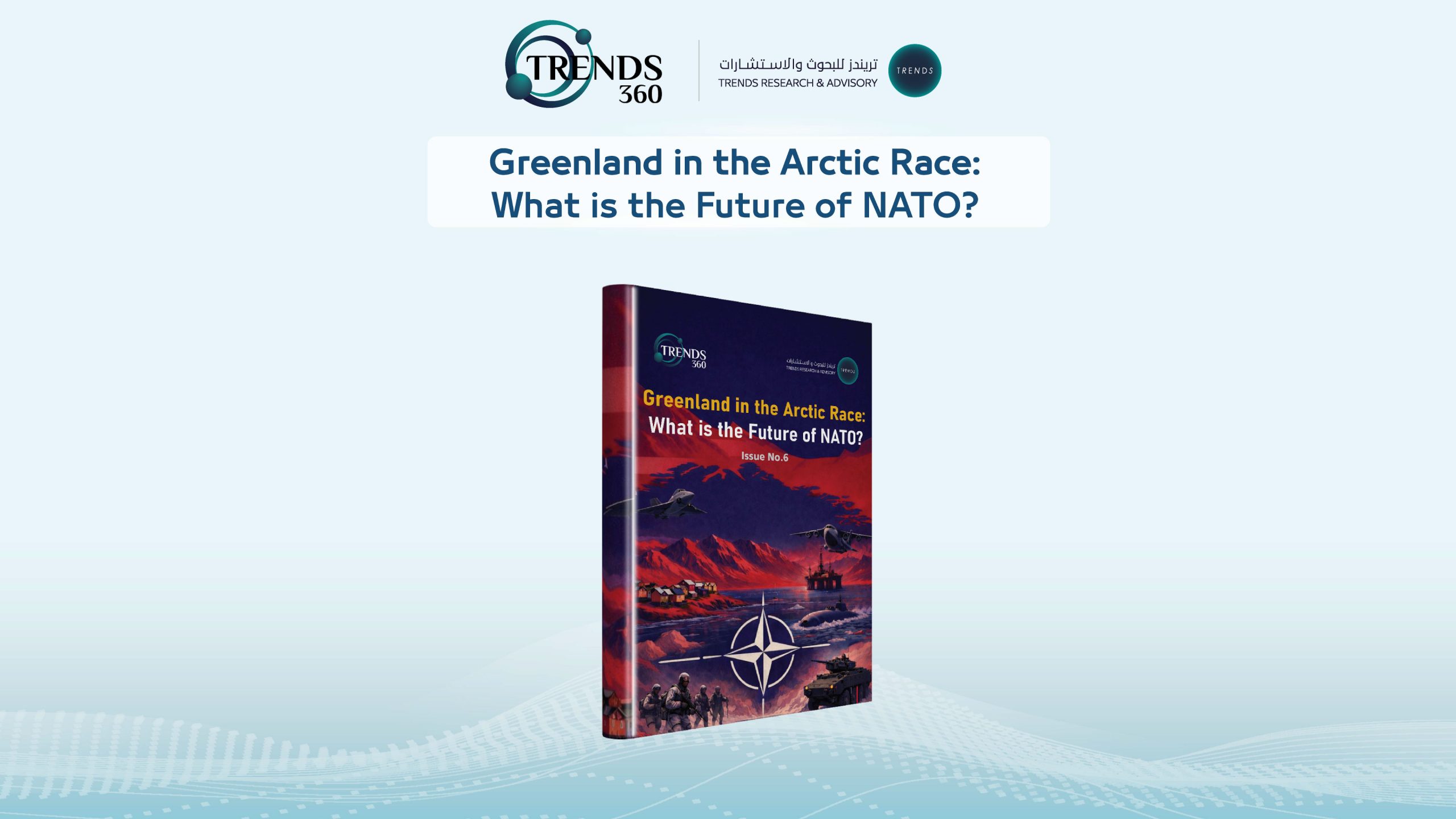
The Dubai branch of TRENDS has released the English-language edition of its monthly bulletin, “TRENDS 360,” titled “Greenland in the Arctic Race: What Future for NATO?”
The issue examines the growing geopolitical significance of Greenland amid renewed American interest during the administration of Donald Trump. It also explores how this interest is reshaping Arctic dynamics, great-power competition, and emerging security challenges affecting transatlantic relations and the strategic vision of NATO.
The edition examines Greenland’s position as a strategic flashpoint within the North Atlantic Treaty Organization (NATO), noting that the island’s importance extends far beyond the immediate political debate over renewed U.S. interest in acquiring it. It also presents Greenland as a central test case for how NATO, Denmark, and the United States manage overlapping pressures stemming from Arctic security, great power competition, alliance politics, and the principle of self-determination.
Western Security Architecture
The new issue of the newsletter—prepared by Abdulla Al Khaja and Gina Bou Serhal, researchers at TRENDS — reveals that Greenland occupies a pivotal position in the Western security architecture. Its geographic location connects the Arctic to North America and Europe, and its proximity to the Greenland–Iceland–United Kingdom (GIUK) gap makes it critical for monitoring maritime traffic in the North Atlantic.
The issue emphasizes that this geography has endowed Greenland with long-term strategic value for the United States and NATO, particularly in relation to Russian military activity. It highlights the role of Pituffik Space Base as a vital site for missile warning, missile defense, and space surveillance. In this sense, Greenland is not a peripheral territory, but rather a foundational pillar of Arctic and NATO defense.
Strategic Significance
The new edition of TRENDS 360 argues that Greenland’s strategic significance has expanded. Climate change and Arctic ice melt are making new shipping routes more viable, while increasing interest in the island’s rare earth minerals and its vast natural resource potential.
It further explains that these developments have placed Greenland within a broader sphere of great-power competition, involving not only the United States and Russia but also China. The issue notes that Greenland’s importance is now tied as much to economic competition, technological ambition, and future access to Arctic routes as it is to military positioning.
Legal and Political Dimensions
The issue also focuses on the legal and political dimensions of the Greenland question. It reviews the island’s historical status under Danish sovereignty, its framework of self-governance, and the United States’ existing military access through long-standing agreements with Denmark. It emphasizes that the people of Greenland have clearly opposed becoming part of the United States, making self-determination a central issue in any future scenario.
The issue concludes that Greenland has become a litmus test for NATO’s cohesion. The crisis is no longer merely about whether the island holds strategic value, but whether NATO can absorb escalating political pressures surrounding it without undermining trust, legal norms, and the broader stability of the Arctic order.

