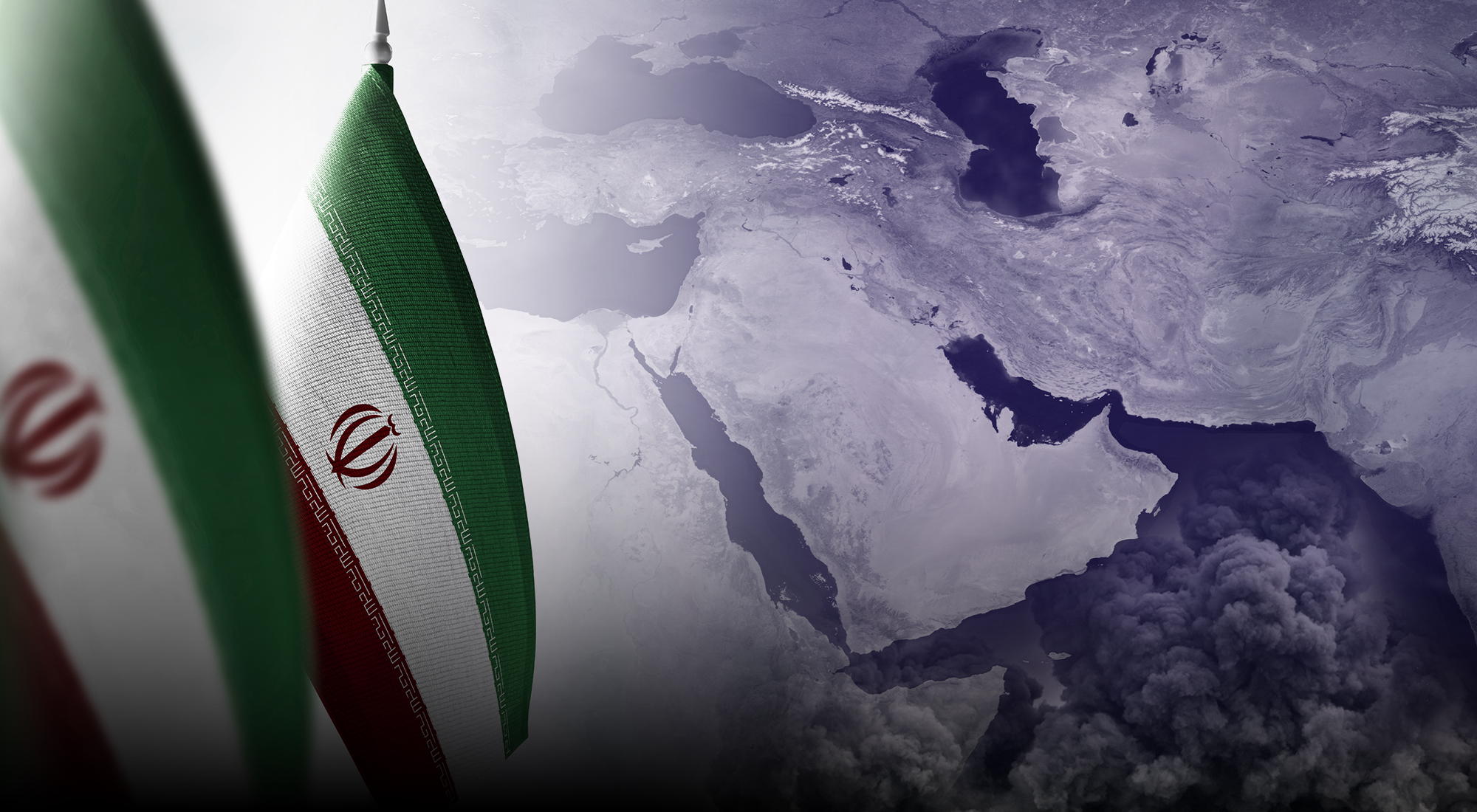


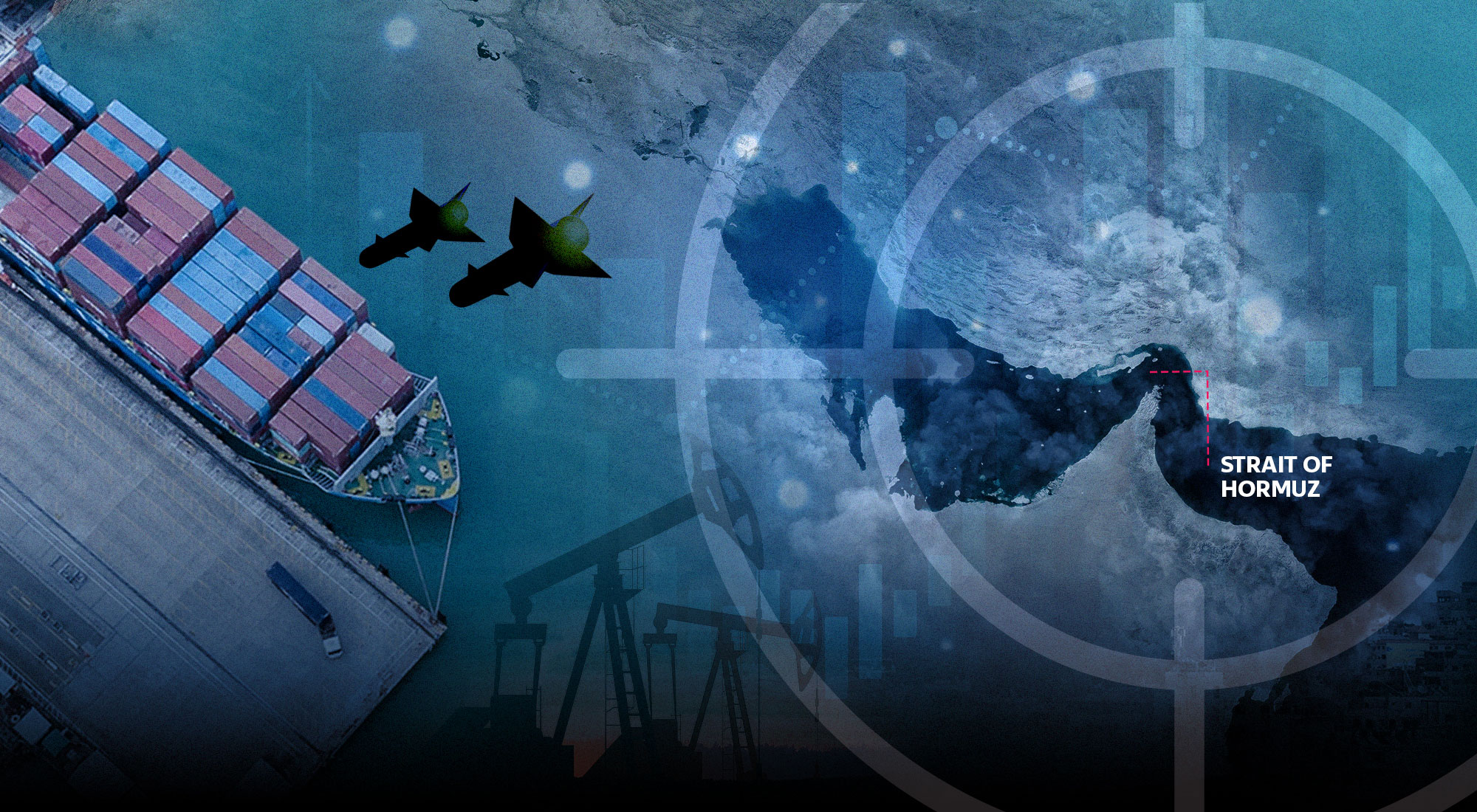



The conflict in the Middle East is going to have a direct bearing on the global economy. Geopolitical factors like elections and conflicts tend to influence many facets of the global economy, such as inflation and supply chains. The Middle East conflict will have a rather sharp and direct fallout on the global economy and is likely to affect countries like China, India, and Europe more in the short run. The longer the crisis drags on, the more effect it will have on many of the major world economies. The reason is simple: The Middle East is not just a rich energy source and a great investment opportunity for many; it also hosts some of the major global supply chains and ports in the world. One of the earliest indicators has been the rise in oil prices as ships came under attack near the Strait of Hormuz.[i]
Ports, Sea Routes and Supply Chains
Ports and sea routes are crucial for maintaining the world’s supply chains and keeping the global economy going. The Strait of Hormuz is one of the most important routes in the Middle East, with 20% of the world’s oil and gas passing through it. In the ongoing conflict, Iran has warned ships not to pass through the Strait of Hormuz, which affects not just the region but creates strong ripple effects for every country in the world today. The Strait of Hormuz is located between Iran on one side and the United Arab Emirates (UAE) and Oman on the other side. It’s 39km (24 miles) wide and connects the Arabian Gulf to the Arabian Sea. Most significantly, it is the only route to the open ocean for Gulf exports, which are then shipped to various parts of the world.
According to the U.S. Energy Information Administration (EIA), about 20 million barrels of oil, worth about $500 billion in annual global energy trade, transited through the Strait of Hormuz each day in 2024.[ii] The crude oil passing through the Strait comes from Iran, Iraq, Qatar, Saudi Arabia and the UAE. This further highlights how any conflict or tension in the region will not be confined to any single state actor but will spill over to all state actors globally. Going a step ahead, since this oil is primarily bound for countries like India, China, Japan and South Korea, among others, the disruption in supplies from the Strait will directly impact these Asian economies. This disruption will then lead to a spike in oil prices and finally to global inflation, including in Europe and the United States of America.
It is significant to note here that one of the major economies to be affected by the closure of the Strait of Hormuz will be Qatar and its supply of Liquefied Natural Gas (LNG) to the world. This will likely trigger the worst global gas supply crisis since the 2022 Russian invasion of Ukraine. Around 20 percent of global liquefied natural gas exports pass through the Strait of Hormuz, and ship tracking data now shows LNG traffic through the narrow waterway has nearly stopped. At least eleven LNG tankers traveling to or from Qatar have paused voyages to avoid the route.[iii]
Qatar’s state-owned oil company has already announced that it is shutting down the production of LNG, given the dangers while transiting through the Strait of Hormuz. That announcement alone was enough to send the price of natural gas in Europe soaring by 50%.[iv]
In times of conflict, exporters’ transaction costs are also increased further due to higher marine insurance premiums.
Impact on China, India, and Europe
The conflict in the Middle East, where sea routes, ports and airspace have all been targeted, has already shaken the markets in China, India and Europe.
China is the largest buyer of LNG from Qatar, sourcing nearly one-third of its LNG imports from the Gulf country, while India ranks second. Asian buyers collectively depend on Qatar for roughly a quarter of their LNG needs and are now seeking alternative cargoes.
China is the world’s manufacturing hub today and is, therefore, vulnerable to both energy price spikes and increased logistics drag. Higher oil costs raise production and shipping costs; prolonged shipping delays can disrupt just-in-time production lines and create shortages of intermediate goods. While China’s policymakers have more fiscal room than many others to absorb these shocks, protracted disruption will nevertheless depress industrial activity and global demand from the world’s largest goods exporter. China was also getting more than 13% of its oil imports from Iran, and this will now create problems for the Chinese economy.
Beijing’s strategic petroleum reserves offer some buffer, but prolonged disruption risks slower industrial output and higher consumer prices, thus undermining consumption-led recovery efforts.
India is, of course, another state actor watching the U.S.-Israel war with Iran closely. Indian markets are acutely sensitive to higher oil prices because of their import dependence. Higher crude lifts India’s import bill, weakens the trade balance and puts pressure on the rupee. In India, it also creates political pressures around fuel subsidies and consumer prices, which makes governments sensitive to such market shocks. Also, Indian exporters will face higher freight and insurance costs if Red Sea risks force carriers into taking longer routes or higher surcharges, and exporters have already warned of shipment delays and elevated logistics costs in the current episode.[v]
Of late, India has also turned more to the UAE and Saudi Arabia for its energy demands, in part to comply with American pressure to buy less from Russia. As the conflict continues, it will create additional problems of simple demand and supply for India. This will also get a political life of its own as people are quick to react to long queues outside gas stations and a sense that the price of essential commodities is rising.
Further, there is a large Indian diaspora, around nine million, that lives and works in the Middle East and sends remittances home to their families in India. In 2023–24, the UAE alone accounted for nearly 19% of India’s total inward remittances.[vi] A conflict that stretches into weeks will see a dip in these remittances, adding to the fiscal woes.
Europe faces a dual problem: energy price pass-through into inflation and the knock-on impact on trade. Although Europe sources a smaller share of its crude via the Gulf as compared to some Asian buyers, a global spike in oil will reverberate through energy markets, which will raise petrol, diesel and electricity costs. This will also complicate central bank efforts to balance inflation and growth. For Europe’s export-dependent economies, higher shipping costs and longer transit times also compress margins and slow trade volumes.
Global Repercussions
If the conflict in the Middle East drags on for weeks, then the global repercussions will be severe. As oil and gas sources are targeted and threatened, the rising oil prices will eventually lead to global inflation, which will decrease consumer spending. The United States is a little more insulated from these shocks compared to Asian economies and Europe. The U.S.’s shale oil supplies and its strategic petroleum reserves will provide it with short-term protection. But inflation will also impact the American markets if the conflict is not resolved soon. Former U.S. Treasury Secretary Janet Yellen has been quoted as saying that “the conflict could hit U.S. economic growth and fuel inflationary pressures, holding the Federal Reserve back from cutting rates.”[vii]
The impact on Japan and South Korea was visible as the stock market tumbled. South Korea’s benchmark Kospi index tumbled 12% on 3 March, with the country’s shipping stocks hammered by nervousness over higher fuel costs as well as restricted shipping through the Strait of Hormuz.
The Korea Exchange briefly suspended trading twice to cool volatility following sharp selloffs on both the main Kospi and the smaller tech-heavy Kosdaq markets.[viii] Shipping stocks were among the top decliners in Seoul.
Both the Japanese and South Korean economies depend heavily on the Middle East to meet their crude oil and LNG demands. As the supply gets restricted with the closure of the Strait of Hormuz, the stock markets reflect the growing concerns.
In Japan, analysts are already pointing out that a protracted Middle East conflict may push the Japanese economy toward recession.[ix]
Airports and Connectivity
In the ongoing conflict, it is clear that Iran chose to target not just military facilities but also economic hubs. The attack on the Saudi oil company Aramco was intended to convey the message that Iran was going to go on an economic offensive. Dubai International Airport (which handled 95 million international passengers in 2025), the busiest airport in the world, suspended flight operations. As airspace over the Middle East closed, thousands of passengers were left stranded at various airports. Tourism and the Airline industry globally have slowed down as the industry encounters higher costs and lower demands. As oil prices surge, fuel will get costlier and air travel more expensive. It doesn’t help the industry or the global economy, as the U.S., Israel, and Iran show no signs of a letup in hostilities. The Russia-Ukraine war has already tested the airline industry, and longer routes had to be taken for safety reasons. The Middle East conflict is likely to make matters worse. The share prices of big European airlines fell sharply when markets opened on the 2nd of March, with IAG, the owner of British Airways and other airlines, going down by 12%, and then partly recovered.[x]
Going Forward
If the conflict drags on, the damage to the global economy will become more pronounced. We live in a globalized world today, and hence, instability in one part will be reflected all around. The cancellation of thousands of flights, for instance, dampened the global aviation industry and tourism. For policymakers, the challenge going ahead will be to blunt the short-term cost shock without undermining long-term incentives for energy transition.
Two factors going forward will determine the effect on the global economy. One: the duration of the conflict, and two: the magnitude of the damage done. The rise in the price of oil in the coming weeks will also determine much of this economic cycle. If the price of oil per barrel climbs to $90-100, inflation will follow, which will lead to a decrease in consumer demand and eventually to an economic slowdown. However, if the situation were to de-escalate soon or the producers were to increase oil production to offset the shortages, inflation could be short-lived. But the jury is still out on the duration and magnitude of the conflict, as it currently shows no signs of slowing down.
[i] Daniel Thomas, Ben Hatton, Peter Hoskins, and Dearbail Jordan, “Oil and gas prices jump as conflict escalates,” BBC, March 2, 2026, https://www.bbc.com/news/articles/c75evve6l63o.
[ii] Priyanka Shankar and Reuters, “How US-Israel attacks on Iran threaten the Strait of Hormuz, oil markets,” Al Jazeera, March 1, 2026, https://www.aljazeera.com/news/2026/3/1/how-us-israel-attacks-on-iran-threaten-the-strait-of-hormuz-oil-markets.
[iii] “LNG Traffic halts at Strait of Hormuz as conflict shakes energy markets,” Business World, March 2, 2026, https://www.businessworld.in/article/lng-traffic-halts-at-strait-of-hormuz-as-conflict-shakes-energy-markets-595687.
[iv] Peter S. Goodman, “Global economy is facing the prospect of another profound shock,” The New York Times, March 3, 2026, https://www.nytimes.com/2026/03/03/business/us-iran-israel-economic-fallout.html#:~:text=A%20protracted%20conflict%20in%20the,energy%20prices%20and%20broader%20inflation.&text=In%20the%20most%20hopeful%20scenario,to%20produce%20oil%20and%20gas..
[v] PTI, “Middle East conflict exporters fear rise in logistics insurance costs impact on shipment,” The Week, February 28, 2026, https://www.theweek.in/wire-updates/business/2026/02/28/middle-east-conflict-exporters-fear-rise-in-logistics-insurance-costs-impact-on-shipments.html.
[vi] “Nearly 10m Indians in danger: How a wider Gulf conflict will hit close to home,” The Times of India, March 2, 2026, https://timesofindia.indiatimes.com/india/nearly-10m-indians-in-danger-how-a-wider-gulf-conflict-will-hit-close-to-home/articleshow/128946863.cms.
[vii] Anneik Bao, “Middle East conflict poses fresh test to central banks as oil shock fuels inflation,” CNBC, March 4, 2026, https://www.cnbc.com/2026/03/04/iran-israel-us-war-middle-east-conflict-oil-gas-lng-surge-central-banks-inflation-risk.html.
[viii] Ronnie Harui and Kwanwoo Jun, “Asian equities fall, oil rises amid ongoing Middle East conflict,” The Wall Street Journal, March 3, 2026, https://www.wsj.com/finance/stocks/asian-equities-fall-oil-rises-amid-ongoing-middle-east-conflict-2a9f2e6a.
[ix] Megumi Fujikawa, “Japan evacuates two nationals from Iran as regional tensions escalate,” Morning Star, March 3, 2026, https://www.morningstar.com/news/dow-jones/2026030313773/japan-evacuates-two-nationals-from-iran-as-regional-tensions-escalate.
[x] “Airlines take a hit from hostilities in the Middle East,” The Economist, March 2, 2026, https://www.economist.com/business/2026/03/02/airlines-take-a-hit-from-hostilities-in-the-middle-east.