

Developments in the Middle East since 7 October 2023, especially the attacks by Iran and Israel on Doha in 2025, have fundamentally reshaped regional politics. The increasing assertiveness and quasi-hegemonic ambitions of Israel, the undermining of international legal and normative systems with Gaza as the primary example, and the emerging crisis of confidence in the U.S. as a security provider have impacted every state in the region. However, there is one group of countries that is affected disproportionately negatively: small states.
Characterized by relatively small territory, population, economic output and modest military capacities,[1] small states have always been more exposed to changes in the international system. In the current Middle Eastern environment, where international legal concerns are often subordinate to power politics, smaller regional states are once again reminded of their vulnerability to the unilateral, forceful, and military actions of stronger and larger actors.
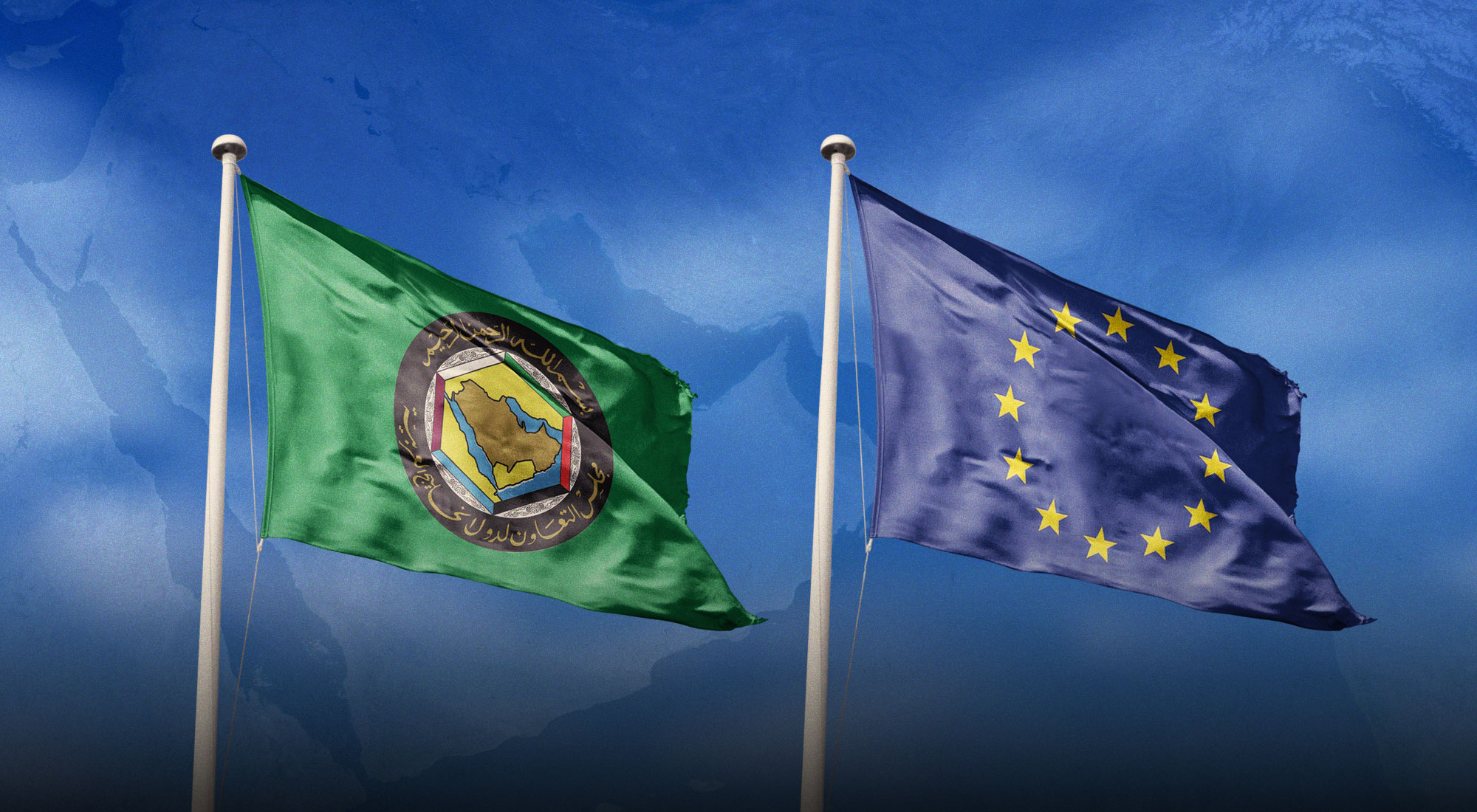
The rapidly evolving relationship between the European Union (EU) and the Gulf Cooperation Council (GCC) is being formulated in these circumstances. Although the two geopolitical blocs are different in size, internal mechanisms, and scope, both of them include a majority of small states. Therefore, their perspectives, concerns, and special interests should not be neglected. On the contrary, they should be put in the forefront.
To make EU-GCC ties more effective and meaningful, small states on both sides should coordinate more effectively to prevent the dominance of larger states in the collaboration. Additionally, the evolving framework of interregional cooperation should be shaped in a way that takes into consideration the particular position of small states. This way, joint projects would not only be more sustainable but can have a better international image.
The deteriorating status of small states in the Middle East
From a normative perspective, some contours of the now-defunct post-bipolar international order that emerged after the end of the Cold War were born in the Gulf. After the Iraqi invasion of Kuwait in 1990, the United States and its allies intervened to defend the small Gulf state from Iraq, its stronger and larger neighbor that attacked the country without any legal basis. American President George Bush framed this event as proof that a new world order is being created: “a world where the rule of law supplants the rule of the jungle, (…) the strong respect the rights of the weak,”[2] and “the strong are neither tempted nor able to intimidate the weak.”[3]
The two main pillars of this post-bipolar order included the quasi-hegemonic position of the United States in power politics and the projection of international liberal values like the prominence of international law, multilateral institutions, and peaceful settlements of conflicts. Although the realization of these values can easily be questioned (see the American-led invasion of Iraq in 2003), small states that had stable relations with the U.S. arguably enjoyed relative stability. During the 2000s and 2010s, the environment was characterized by the dominance of the United States and a globalized economic system, which created beneficial circumstances for the Gulf states to develop rapidly.
Even if the values of the “new world order” have never fully materialized, international politics in 2025 seem to be especially far away from them. Multilateralism, free trade, and globalization are threatened. Worryingly, it is clear that international organizations and international law cannot protect small states from larger and stronger ones. Russia has been at war with its smaller neighbors, including Georgia and Ukraine, since 2007. The decades-long conflict between Azerbaijan and Armenia ended not through diplomacy but by the stronger and larger side unilaterally changing the status quo on the ground. In Gaza, Sudan, or, previously, Syria, the most basic international legal obligations of states have been disregarded on a daily basis. In this new era of power politics, unilateralism has never seemed more prominent, and multilateralism has never appeared weaker than it does now.
This is especially true for the Middle East, where several informal conventions that had been largely respected by most regional players have been broken in recent years. First, with the direct attacks between Israel and Iran, traditional interstate armed conflicts reappeared in the region where, for decades, the most typical type of conflicts were transnational in nature. The former are more dangerous for small states, as the security deficit created by their small size becomes much more critical in a traditional conflict. Even if they are not directly targeted, the increasing tendency for large states to wage wars leads to greater instability and unpredictability.
Second, after 7 October 2023, Israel became a more assertive anti-status quo power, aiming to transform the regional balance of power. The rise of a revisionist state is usually menacing for small states, as they tend to favor a status quo that provides them with better chances of survival. Regardless of this actor being Israel, Iran, or any of the global powers, any actor that threatens a radical change in the status quo would be a source of concern to small states.
Third, the level of uncertainty sharply increased in the Middle East, not just in the face of Hamas’s surprise attack on 7 October and the following unprecedented Israeli retribution, but also fiercer global power competition. At the same time, the U.S.’s role has also changed. Although it remains the strongest military power in the Gulf, its willingness and ability to protect stability and security have been questioned. Recent developments showed not just that security cooperation with the U.S. does not provide sufficient deterrence but also that the U.S. does not uniformly react in a way that Gulf states want from a quasi-security guarantor.
Lastly, the Iranian and Israeli attacks on Qatar showed the limits of the protection that active neutrality offers for small states in a given conflict. Here, neutrality is used not in terms of a foreign policy strategy—which the smaller Gulf states cannot pursue due to their close collaboration with the U.S.—but rather a stance on a given crisis or war. In these cases, neutrality in general has long been considered one of the safer, albeit imperfect, strategies for resource-scarce entities, which can be coupled with either active contribution to ending conflicts (active neutrality) or an attempt to remain invisible to belligerent parties (passive neutrality).[4] However, the fact that Qatar, one of the key mediators between Israel and Hamas, was attacked twice served as a stark reminder that ultimately, the fate of small states is decided by developments outside their control.
In such an environment where “might is right”, small states are incentivized to rethink their strategies, look for new alternatives, and engage in meaningful collaboration. It is not surprising that the momentum behind EU-GCC ties has been strengthening in recent years, partly driven by both sides’ ambition to seek more political, economic, and security partnerships amidst growing uncertainties. However, despite these circumstances, we continue to think of the EU-GCC collaboration from the perspective of great powers, neglecting that of smaller states. By not recognizing this reality, we are missing a key component and potentially crucial driver of cooperation.
The EU and GCC—a coalition of the small…
While both the European Union and the Gulf Cooperation Council include real heavyweights like France and Saudi Arabia, small states constitute the slight majority in both groups. Building on a quantitative approach,[5] four out of the six GCC states (Bahrain, Kuwait, Oman, and Qatar) could be categorized as small, with the United Arab Emirates (UAE) as a middle-sized state and Saudi Arabia as a large state.
Compared to the GCC, the EU is a larger organization with 27 member states. Depending on the definition,[6] 15 or 16 members are small in all traditional metrics of state size, including Luxembourg, Portugal, Estonia, Latvia, Lithuania, Finland, Denmark, Croatia, the Czech Republic, Hungary, Slovakia, Bulgaria, Slovenia, Malta, Cyprus, and, potentially, Austria. This creates a solid 55% majority for small states in the EU’s decision-making system, compared to 67% in the GCC.
Even if this quantitative approach seems arbitrary, it is evident that many EU and GCC members share a small state identity. Bahrain and Qatar from the GCC; Cyprus, Estonia, and Malta from the EU; and San Marino, Montenegro, and Iceland from Europe are members of the World Bank’s Small State Forum.[7] The so-called Accountability, Coherence, and Transparency (ACT) Group, launched in 2013, which includes “small and mid-sized countries working to improve” the works of the UN Security Council, includes more than a third of all EU and GCC states.[8] The G-77, established in 1964 by developing countries of the Global South to represent their collective economic interests and enhance their negotiating capacity, includes all six GCC states and has representation in European capitals such as Vienna, Rome, and Paris.[9]
… For the small?
Even if the current international developments threaten the status of small states, that does not automatically mean that any integration and collaboration is beneficial to them. Based on their geopolitical situation, economic structure, and other variables, each small state adopts a strategy that attempts to balance the benefits and costs of deepening collaboration. Some countries may choose to bandwagon with a great power and seek political, economic, and security shelter, while others prefer alternative strategies, such as hedging (or maintaining good relations with multiple, often rival stakeholders) or neutrality (remaining uncommitted to either side). In practice, small states usually tend to implement a mixed strategy based on their own preferences and the costs associated with each option.[10]
At first glance, EU-GCC relations are based on a multilateral format that is often automatically regarded as beneficial for small states. However, if the agenda and practice of collaboration align with the interests of the largest states, this could generate additional costs and suboptimal outcomes for small states on both sides, making the framework less sustainable in the long term.[11]
A solution could be twofold. First, small states in the EU and the GCC need to recognize that they share an interest in countering the dominance of great powers in EU-GCC talks and strengthen coordination and dialogue independently of larger states. In this way, they can not only identify common goals but can also influence the agenda more effectively.
One of these goals could be keeping larger states of the EU and the GCC more accountable when it comes to respecting international law. Although both sides try to emphasize their adherence to the rule-based order, larger and more powerful states tend to disregard international legal considerations more often—consider the cases of the war in Gaza and Sudan. These occurrences not only negatively impact small states in both the Gulf and Europe but also undermine the normative foundations of EU-GCC collaboration and its external appeal (see later).
Second, for the whole cooperation, “small-state proofing,”[12] i.e., putting special emphasis on the needs and interests of small states, could be beneficial. Without an explicit focus on this aspect, there is a good chance that the interregional collaboration (both in terms of the agenda and practicalities) will be dominated by great powers. While it is understandable to some extent that France, Saudi Arabia, Germany, Italy, and the UAE have a greater influence on EU-GCC ties, this cooperation format concerns altogether 33 states with diverse interests, capabilities, and priorities. Making the collaboration more inclusive for small states would be beneficial for larger states, too, as it puts EU-GCC cooperation on a more durable and stable trajectory.
This idea may sound appealing in theory, but it is challenging to implement under current political realities. While the nascent relationship between the EU and the GCC offers limited guidance, insights from the GCC, the EU, and other multilateral institutions like the UN can inform small-state proofing efforts.[13]
Based on these, we can come to four recommendations. First, small-state proofing is as much about how to cooperate as it is about what to cooperate on. Currently, the agenda of EU-GCC cooperation encompasses a very broad, often competing portfolio that includes trade policy, investments, humanitarian collaboration, conflict management, AI, green transition, and maritime security, just to name a few. Although the enthusiasm is welcome, this agenda lacks clear prioritization and sequencing of various initiatives. Even though this could be a potential problem for the whole collaboration, it presents a challenge, especially for small states that have fewer diplomatic and institutional capabilities to prepare for each topic. Clear priorities and a focus on key topics could help ease this pressure and make negotiations more effective, while also providing room for small states to express their niche contributions in key fields.
Additionally, unequal access to information has been a burden for small states. Transparency, therefore, is essential for major projects and initiatives. This is an area where both sides could improve, especially when it comes to projects that involve collaboration between them. This would not only help small states navigate better but also increase the societal support behind EU-GCC collaboration and put it on a stable, long-term trajectory.
Second, a minimal level of institutionalization could also be beneficial for small states, not just in terms of facilitating information sharing but also shaping the agenda. This could include setting up a secretariat, a rotating chairing system for meetings, and allocating space for small states to express their particular needs. Additionally, Track II diplomacy, involving researchers, academics, and civil society organizations from smaller countries, should be explicitly supported. This should cover relations between small and small states (e.g., the Baltic states and Oman) and those between small and big ones (e.g., Saudi investments in Central and Eastern Europe).
Third, the agenda of collaboration should include and prioritize topics and perspectives that are essential for small states. For example, in the context of free trade, negotiations have already begun between the EU and the UAE, and, hopefully, soon other GCC states could join the negotiation table. Additionally, several misalignments that can cause problems in negotiations with larger Gulf states are not present in smaller ones;[14] therefore, their exclusion also lacks a political rationale. At the same time, even if negotiations were conducted on the GCC level, that would not necessarily solve the problem, as without proper considerations, the benefits and costs of free trade tend to be positively biased toward larger partners. Learning from similar initiatives worldwide,[15] the inclusion of non-trade-related elements (including broadening collaboration in data sharing, joint development initiatives, and compensation mechanisms supporting smaller markets) could make the playing field more equal.
Additionally, it is vital to create opportunities beyond plenary summits, in which smaller states can initiate and shape joint projects. From this perspective, the way in which the EU initiated separate strategic partnership agreements with individual Gulf states could be a good practice, as it allows Bahrain, Oman, Kuwait, and Qatar to shape their relations with the EU according to their interests independently. Within the EU, all member states will be required to ratify any agreement that exceeds EU competences, necessitating intense internal dialogue and consideration of the interests of small states as well.
Potential for EU-GCC joint international action
Lastly, the interests of small states should also affect the joint actions of the EU and the GCC in international politics. From this perspective, setting the strengthening of the international rule-based order as a key collective aim for both groupings would be a goal that benefits the smaller members of both geopolitical clubs. That being said, both sides need to lead by example, rather than just paying lip service to international law. In practice, instead of creating new tribunals and mechanisms, the EU and the GCC could work more closely to strengthen existing institutions, most importantly the International Court of Justice. Joint action to strengthen the Genocide Convention would also be an urgent endeavor, in which 31 out of the 33 members of the EU and the GCC are members.
Within the UN, several reform initiatives involving EU and GCC countries play a key role. The ACT Group and the G-77 have already been mentioned, but there are other groupings that aim to strengthen the General Assembly (GA) or limit the influence of great powers. For example, fueled by the inaction of the Security Council after the Russian invasion of Ukraine, the GA passed a resolution containing the so-called veto initiative in 2022. This gave a mandate to the GA to convene a formal meeting within 10 working days after at least one member of the Security Council exercises its veto power to block joint action on a given topic. The resolution was co-sponsored by the majority of EU member states, Qatar, and Kuwait (and all other EU and GCC countries supported it). Although the veto initiative does not circumvent the shortcomings of the current Security Council system, it does provide more accountability and transparency when a great power deprives the international community of acting with urgency. It is in the interest of both the EU and the GCC to implement the veto initiative in a meaningful manner in the coming years and initiate other reforms within the UN system.
From this perspective, the fact that Bahrain will be a non-permanent member in the UN Security Council in 2026-2027 and a chair from April 2026 could be a good opportunity to advance small state interests in the UN framework and also to put collaboration into practice with other small European and Gulf states (through sharing their similar experiences with Manama and assisting it diplomatically).
Beyond the international institutional order, political methods of peaceful conflict settlement would also be an ideal subject for enhanced collaboration. Several smaller members of the EU and the GCC, including Qatar, Oman, Finland, and Austria, have significant facilitation and mediation experience. Small states are not only interested in the success of such activities (as they can either prevent or significantly shorten the duration of conflicts) but also often have the necessary political capital to conduct mediation.
Given the increasing complexity of international crises, mediation can often be conducted more effectively by mediation coalitions than by individual states. For this purpose, Qatar has already signed memoranda of understanding with European countries, including Finland and Sweden,[16] but collaboration on the EU-GCC level should expand. The joint statement published following the first EU-GCC Summit in 2024[17] referenced the room for joint peacebuilding efforts in mediation and negotiations, which should be followed by action. For instance, in the case of Sudan, it seems that the Quartet—the United States, Egypt, Saudi Arabia, and the UAE—has faced challenges in reaching substantive results in ending the crisis, which warrants more engagement from small state mediators from the Gulf and Europe.
Naturally, in many cases, state-level collaboration could be more effective, especially given the diversity of conflicts that require an extent of flexibility and quick action that might be lacking on the multilateral level. That being said, both the EU and the GCC, as institutions, and the cooperation between them, can play either a complementary or specialized role. The Secretary General of the GCC, similar to the High Representative for Foreign and Security Policy of the EU, enjoys personal respect that could be useful in the mediation processes. There is room for the EU and the GCC to collaborate on conflict prevention and transformation, conduct joint research and innovation to make mediation more effective, and strengthen the usage of different digital tools in mediation and facilitation.[18]
Connected to conflict management, better coordination of humanitarian and development policy should also be on the agenda. Both small and large Gulf and EU countries play a vital role in this field in the broader Mediterranean; further dialogue could make these efforts more efficient in places like Syria, Palestine, Lebanon, Iraq, Yemen, and Sudan. Topics of common interest could also include strengthening the transparency of arms-trade records or financial ties with actors in armed conflicts.
With all these measures, leaders of the EU and the GCC can ensure that cooperation between them benefits both their large and small members. Although in its current form, neither the EU nor the GCC as institutions can provide security guarantees or a high level of deterrence against military threats, there are several areas where they can contribute to international peace and security. In addition to the mentioned measures, enhanced maritime security collaboration, joint preparedness against cyber threats, climate security, and joint climate diplomacy initiatives could be additional fields where cooperation is welcome.
Framing EU-GCC relations internationally
Strengthening the attributes of the international system that provide safety to small states would not only benefit EU and GCC members but also the whole international society. An international system safer for small states is safer for everyone, as it would rely on international law, dialogue instead of coercion, and bi- and multilateral cooperation instead of unilateral actions. Creating such a normative foundation for EU-GCC collaboration would not only make it more effective but also more attractive to third parties with whom other minilateral or multilateral initiatives could be launched.
Consider the case of the various interconnectivity projects, including the India-Middle East-Europe Economic Corridor (IMEC) or the Development Road Initiative in Iraq. While both have been discussed extensively with partners such as Turkey and India, feasibility is hindered by internal conflicts among stakeholders and the absence of a normative foundation. One selling point that could be a potential advantage of these projects vis-á-vis other similar initiatives would be more inclusivity for small state interests and perspectives. Contrary to China, the U.S., and India, the EU and the GCC can more authentically and inherently claim to represent states of all sizes.
If substantiated by practice, this can be a strong selling point in global political and economic cooperation that would be welcomed by many states that fear the return of great power competition. As a result, the evolving GCC-EU partnership can be a cornerstone of (inter)regional security, international efforts to strengthen global institutions and multilateral collaboration that benefits not just its participants.
[1] There is no universally accepted definition of small states in the literature. In the present analysis, smallness is defined in a quantitative (without the assumption that small states are necessarily weak) and relative way, which means that the cap of “smallness” is set by the regional average (see endnote 4).
[2] George H.W. Bush, “Address before a Joint Session of the Congress on the Gulf Crisis and the Federal Budget Deficit,” September 11, 1990, https://bush41library.tamu.edu/archives/public-papers/2217.
[3] George H.W. Bush, “Address before a Joint Session of the Congress on the State of the Union,” January 29, 1991, https://bush41library.tamu.edu/archives/public-papers/2656.
[4] Pertti Joennimi, “Neutrality beyond the Cold War,” Review of International Studies, Vol. 19 No. 3, 1993, pp. 289-304.; Jelena Radoman, Military Neutrality of Small States in the Twenty-First Century. The Security Strategies of Serbia and Sweden (Cham, Springer Nature, 2021).
[5] This categorization is based on using four dimensions of state size: territory, population, economic output (GDP), and military capacities in terms of the size of armed forces and the size of the military budget. The cap of smallness is a given region’s average, in this case, the Middle East (made up of sixteen states from Iran to Egypt). This means that small states are those whose capacities in all four dimensions are below the average. In this case, since 1970, Bahrain, Oman, and Kuwait showed scores below the average, whereas Qatar’s military budget surpassed the average since 2022. The United Arab Emirates can only be considered small in terms of territory and population, whereas Saudi Arabia is a large country in every category. See the background on the conceptual and definitional debates: Máté Szalai, The Foreign Policy of Smaller Gulf States: Size, Power, and Regime Stability in the Middle East (New York: Routledge, 2022). The source of data is “Databank,” World Bank, October 9, 2025, https://databank.worldbank.org/.
[6] Using the same categorization and taking the EU as the basis for calculating the average, 15 states are below the average in all categories. If we expand the region to include the immediate surroundings of the EU using the World Bank’s “Europe and Central Asia” classification, which includes 58 states (including the UK and the post-Soviet sphere), Austria also joins the group of small states.
[7] “Small States and Small States Forum Members (FY26),” World Bank Group, June 30, 2025, https://www.worldbank.org/en/news/statement/2024/06/26/small-states-and-small-states-forum-members.
[8] “Factsheet – The Accountability, Coherence, and Transparency Group – Better Working Methods for today’s UN Security Council,” Eidgenössisches Departement für auswärtige Angelegenheiten EDA, February 2022, https://www.mission-newyork.fdfa.admin.ch/en/publication?id=-r8Wxgizx28Y.
[9] “The Member States of the Group of 77,” The Group of 77 at the United Nations, https://www.g77.org/doc/members.html.
[10] Rasmus Pedersen, “Small State Shelter Diplomacy: Balancing Costs of Entrapment and Abandonment in the Alliance Dilemma,” Cooperation and Conflict 58, no. 4 (2023): 441-459.
[11] It is true that both organizations have internal mechanisms that aim to avoid the complete dominance of larger states. Yet these regulations do not change the fundamental imbalance between small and large members, especially when it comes to interregional dialogue. Decision-making in the GCC on substantive questions relies on unanimity, practically granting veto rights to every member state. In the EU, consensus-based decision-making remains in a few portfolios, especially in foreign and security policy, but even in decisions that only require a qualified majority, small states can come together to form a blocking minority (although it is much easier to do this by larger member states). See: Kristian Coates Ulrichsen, “Missed Opportunities and Failed Integration in the GCC,” Arab Center, Washington, DC, June 1, 2018, https://arabcenterdc.org/resource/missed-opportunities-and-failed-integration-in-the-gcc/.; Piotr Bajda, “The European Union after the Lisbon Treaty vs challenges for small Central European States,” In: Piotr Bajda (ed.), Small States within the European Union (Akademia Wymiaru Sprawiedliwości, Warsaw 2023): 105-126.
[12] Andrea Ó Súilleabháin, “Small States at the United Nations: Diverse Perspectives, Shared Opportunities,” International Peace Institute, May 2014, https://www.ipinst.org/wp-content/uploads/publications/ipi_e_pub_small_states_at_un.pdf.
[13] Anjali Dayal & Caroline Dunton, “The U.N. Security Council was Designed for Deadlock- Can It Change?,” United States Institute of Peace, March 1, 2023, https://www.usip.org/publications/2023/03/un-security-council-was-designed-deadlock-can-it-change.; Baldur Thorhallson & Anders Wivel, “Small States in the European Union: What Do We Know and What Would We Like to Know?,” Cambridge Review of International Affairs 19, no. 4 (2006): 651-668.; Máté Szalai, “The Evolution of the GCC from the Perspective of Small State Studies,” In: Juline Beaujouan (ed.), “GCC: Evaluation, Lessons Learned, and Future Prospects,” Global Policy 2019: https://www.globalpolicyjournal.com/projects/gp-e-books/gcc-evaluation-lessons-learned-and-future-prospects.
[14] Máté Szalai & Guido Lanfranchi, “A Critical Friendship needs no Courtship: Alignments and Misalignments in EU-UAE Relations,” Clingendael Institute, June 2, 2025, https://www.clingendael.org/publication/critical-friendship-needs-no-courtship-alignments-and-misalignments-eu-uae-relations.
[15] Maurice Schiff, “Regional Integration and Development in Small States,” The World Bank Development Research Group, February 2002, http://www.iatp.org/files/Regional_Integration_and_Development_in_Small_.pdf; Jonathon W. Moses, OPEN States in the Global Economy (London: Palgrave Macmillan, 2000).
[16] “Qatar’s Mediation Efforts,” Ministry of Foreign Affairs of the State of Qatar, https://mofa.gov.qa/en/foreign-policy/mediation/mediation.
[17] “1st European Union-Gulf Cooperation Council Summit Joint Statement,” October 16, 2024, https://www.consilium.europa.eu/media/k3wf2ewp/eu-gcc-joint-statement-final-2.pdf.
[18] These recommendations are based on: Antje Herrberg & Guy Banim, “Quo Vadis EU Peace Mediation? Maintaining the Skills of Peaceful Intervention in the Era of Strategic Competition,” College of Europe Policy Brief, October 2024, https://www.coleurope.eu/sites/default/files/research-paper/Banim_Herrberg_CEPOB_6-2024.pdf; Jusaima Moaid-Azm Peregrina, “Navigating the Intersection between Mediation and Digital Technology: Opportunities to Strengthen EU Peace Capacities,” Euromesco, February 2022, https://www.iemed.org/wp-content/uploads/2022/02/Policy-Brief-No117.pdf.