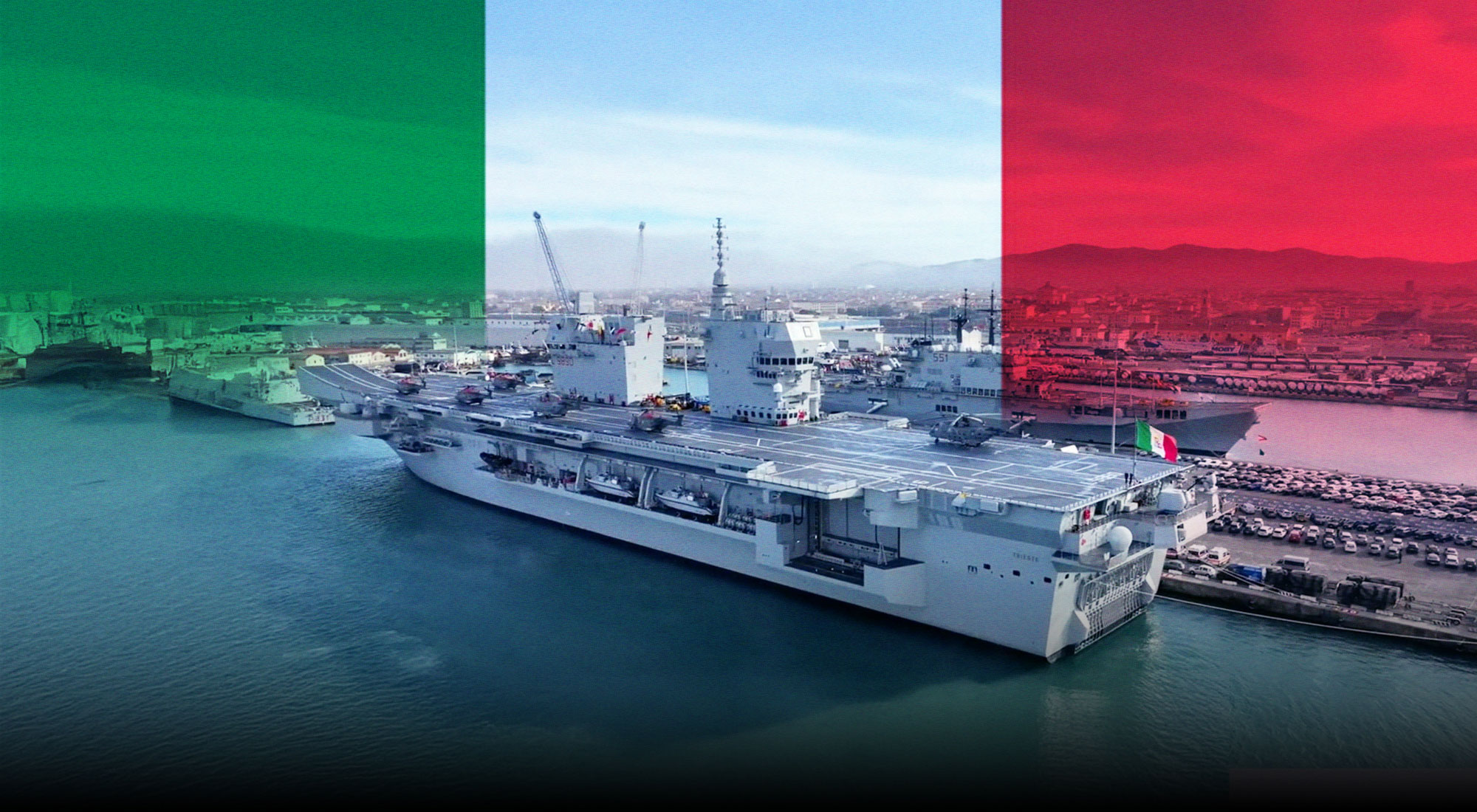



Italy’s defense-industrial base occupies a distinctive position within the global military economy: medium-sized in scale, yet marked by a high degree of specialization, export orientation, and institutional integration with national defense policy. At its core stands Fincantieri, Italy’s principal naval shipbuilder and one of Europe’s most active players in international naval markets. Over the past decade, the company has transformed from a predominantly domestic supplier into a global naval exporter, leveraging modular platform design, rapid delivery of in-service vessels, and a growing portfolio of joint ventures and industrial partnerships. This evolution has taken place against a backdrop of intensifying competition, technological disruption, and rising demand for naval capabilities linked to maritime security, underwater infrastructure protection, and autonomous systems.
Italian military-industrial complex
Italy’s military-industrial complex is a medium-sized yet strategically diverse industrial ecosystem anchored by a handful of large primes and supported by a network of specialized suppliers with strong export orientation. In 2023, the top 100 Italian defense firms, with revenues above €19 million and workforces of over 50 employees, recorded an aggregate turnover of about €40.7 billion, of which roughly 49 percent was directly attributable to defense activity. These firms employed over 181,000 people, with approximately 54,000 engaged directly in defense production in Italy, where state-controlled companies account for roughly 59 percent of total industry revenue.[1]
At the core of this industrial base are two state-linked giants. Leonardo, Italy’s largest aerospace and defense contractor, reported roughly US$19 billion in annual revenues and derives 72 percent of its business from defense activities, spanning electronics, avionics, helicopters and integrated systems. Fincantieri, the principal naval shipbuilder, reported total revenues exceeding US$8.7 billion in 2024, with around 34 percent from defense segments, and has rapidly expanded its military order backlog with multi-million procurement deals.[2]
Table 1: Italy’s Defense Industrial Profile in 2024
| Firm | Sector | Global Ranking | Arms revenues ($ m.) | Total revenues ($ m.) | Arms revenues as a % of total revenues |
| Leonardo | Aerospace | 12 | $13,830 | $19,210 | 72% |
| Fincantieri | Naval Shipbuilding | 53 | $2,990 | $8,790 | 34% |
Source: SIPRI, data elaborated by the author.
Leonardo and Fincantieri, together with a small number of peers, eight firms with revenues above US$1 billion, concentrate about 75 percent of the aggregate turnover of Italy’s military-industrial base. Beyond these primes, Italy’s defense industrial footprint includes dozens of specialized companies, including Avio Aero on aerostructures, the European MBDA on missile systems, and Beretta on firearms. Of the top 100 defense firms, 36 are foreign-owned, accounting for about 25 percent of sector turnover, while state-controlled entities contribute nearly 60 percent of revenue, underscoring a blend of sovereign industrial capacity and international integration.[3]
Shipbuilding as a Strategic Core
In the broader European defense industrial landscape, Italy’s military-industrial base lacks the scale of France or the platform breadth of Germany.[4] However, the Italian model leans on specialization, flexibility, and integration with national defense policy. At the heart of this is Fincantieri, a shipbuilding company with historical roots extending back over 230 years, industrial shipyards spanning across three continents with over 20,000 employees.
Table 2: Fincantieri’s Global Shipyard Presence
| Country | Subsidiaries | N. of shipyards |
| Italy | 40 | |
| Norway | Vard Seaonics | 6 |
| U.S. | Fincantieri Marine Vard | 5 |
| Romania | Vard | 3 |
| Canada | Vard | 2 |
| Vietnam | Vard | 1 |
| Brazil | Vard | 1 |
Source: Fincantieri, data elaborated by the author.
Structurally, Fincantieri operates a dual-use industrial shipbuilding capacity, with a portfolio spanning commercial cruise ships and ferries, offshore and specialized vessels for cable-laying, oil and natural gas exploration, and subsea construction, and military platforms. This breadth enables the company to leverage commercial scale to subsidize innovation and cross-sector technology flow, for example, on autonomous underwater systems and subsea infrastructure protection, which have become strategic growth areas under its 2023-2027 plan.[5]
When situating Fincantieri’s strategy within the broader global naval industrial landscape, comparing it with France’s Naval Group and South Korea’s shipbuilding ecosystem highlights contrasting state-industry coordination models and export dynamics that shape competitive positioning.
France represents a state-embedded naval industrial model, centered on Naval Group and closely aligned with the Direction Générale de l’Armement (DGA). French naval exports are typically pursued through government-to-government frameworks that emphasize sovereign design authority, technological depth, and long-term industrial partnership, albeit often at higher cost and longer delivery timelines. This model prioritizes strategic autonomy and political influence over volume and speed.[6]
South Korea, by contrast, exemplifies an export-driven, scale-oriented shipbuilding model. Firms such as HD Hyundai Heavy Industries and Hanwha Ocean leverage large commercial shipbuilding capacity, modular production, and strong government coordination to offer competitively priced, off-the-shelf naval platforms. Seoul increasingly promoted unified national bids and rapid delivery as core export advantages, particularly in Southeast Asia and allied markets.[7]
Fincantieri occupies an intermediate position. It is less state-embedded than France, but more institutionally integrated than South Korea, combining modular design, political acceptability, and export agility.
Two characteristics underscore Fincantieri’s competitive differentiation: platform modularization and institutional convergence. First, the company’s reliance on platform families enables tailoring to diverse operational requirements without incurring bespoke design costs. This is a critical advantage in markets where speed of delivery and operational versatility outweigh the premium on cutting-edge capabilities. Second, Fincantieri’s programs are tightly linked with Italian defense apparatuses, chiefly the Ministry of Defense and the Navy, and export support mechanisms. This institutional alignment has eased the penetration of regions traditionally beyond Italy’s primary security domains. Consequently, shipbuilding has become a strategic export pillar for Italian defense, serving not merely as revenue generation but as a conduit for diplomatic engagement and alliance consolidation.
A Global Naval Exporter
Fincantieri’s upward trajectory in global naval exports is rooted in four interlinked dynamics: product adaptability, state-level facilitation, market timing and embedding, as well as JV-friendly. Over the past decade, the company has transitioned from ad hoc exports to structured, long-term engagements that include not only vessel sales but also training support infrastructure, and lifecycle services, embedding the company into the long-term capability development and sustainment frameworks of client nations globally. A fifth, increasingly important element is the growing emphasis on advanced technologies, chiefly in the fields of unmanned and underwater systems.
Product Adaptability
It can reasonably be argued that one of the keys to Fincantieri’s success lies in its reliance on platform families rather than one-off designs, allowing a base design to be scaled, configured, and armed to meet diverse mission requirements. Two flagship products illustrate this strategy: the FREMM frigate family and the Offshore Patrol Vessel (OPV) project.
The FREMM frigate, developed under the OCCAR framework with France’s Naval Group (via the Orizzonte Sistemi Navali JV), has served as the centerpiece of Italy’s surface combatant exports.[8] These frigates can be designed to perform anti-surface, anti-air, and anti-submarine warfare, supported with advanced combat management, sonar, and integrated air defense systems.[9] The FREMM family’s modular architecture and proven operational performance have made it attractive to navies requiring credible multi-role platforms, including Egypt and Greece.[10] Ongoing evolutions of the FREMM family, through the FREMM EVO configuration, demonstrate continuous upgrades in sensors, cyber‑resilience, and unmanned systems integration, supporting long‑range, high‑end warfighting roles.[11]
Complementing high-end frigates, the OPV program has gained significant export traction in the Middle East and Southeast Asia. These platforms are particularly well-suited to navies focused on coastal defense and littoral warfare, which require reliable and versatile assets capable of operating in constrained maritime environments while being manned with relatively limited personnel.[12] At the same time, OPVs offer high-end capabilities, including advanced sensors, modular mission payloads, and networked combat systems, allowing smaller fleets to achieve credible operational effects in narrow and congested theaters.[13]
State-level Facilitation
While industrial capability and competitive platform design are necessary conditions for export success, Fincantieri’s global projection has been reinforced by Italian state backing and institutional linkages that accompany and de-risk its offers. In high-profile cases, such as the preliminary transfer agreement of two Italian Navy vessels to Greece, the deal was signed in the presence of senior officials from both defense ministries and the Italian Navy in September 2025,[14] underscoring a government-to-government diplomatic framework through which industrial cooperation and interoperability are advanced alongside sales.
This approach casts exported platforms as an instrument to deepen strategic cooperation rather than purely commercial transactions. Similarly, long-term partnerships, such as the joint venture between Fincantieri and EDGE, the UAE’s defense giant, reflect collaborations supported at the state level and aimed at broader regional engagement and capability building, arrangements that functionally embed Italian industrial presence within the defense ecosystems of host governments and create politically durable export pathways.
Market Timing and Embedding
Fincantieri’s ability to offer operational hulls already in service with the Italian Navy or nearing completion gives it a distinctive market advantage, offering a rapid delivery timeline that new builds cannot match. By repurposing vessels, such as in-service frigates and OPVs for export, Italy can deliver strong naval capabilities far faster than the typical new-build cycle, which often stretches several years. This approach has allowed partners facing urgent capability gaps, as seen in the transfers of Italian surface combatants to Egypt, Indonesia, and Greece,[15] to accelerate force modernization without waiting for fresh construction, reinforcing Fincantieri’s appeal in time-sensitive procurements.
Beyond platform sales, Fincantieri has secured long-term service and sustainment contracts that anchor industrial presence in customer countries. A notable example is Egypt, which in 2023 signed a €260 million ten-year support agreement with Fincantieri for two FREMM frigates, including training, logistics, in-service support, and maintenance.[16] These deals promote continuous engagement while strengthening interoperability and local workforce integration. Such lifecycle commitments, therefore, transform one-off sales into enduring institutional ties.
Joint Venture-oriented
Fincantieri has consistently leveraged joint ventures (JVs) to access new markets, share risks, and embed itself within local industrial ecosystems. Rather than pursuing purely direct sales, the company frequently partners with domestic firms in client countries, combining Italian design and production expertise with local knowledge, workforce, and political legitimacy.
Aside from Leonardo, with which it has co-led Orizzonte Sistemi Navali since 2002, France’s Naval Group has been the main strategic partner of the Italian shipbuilding company, as underscored by the launch of the JV Naviris in 2020 to pool design and construction capabilities for frigates, corvettes, and R&D.[17] This partnership builds on long-standing industrial cooperation, most notably the joint development and production of the FREMM frigate program, and aims to strengthen European naval competitiveness through shared design authority and coordinated export efforts.
Outside of Europe, a prominent example is the Maestral JV with the UAE’s EDGE. Launched in May 2024 to co-produce naval platforms and pursue third-market opportunities, the venture began with a €400 million contract to build a dozen 51-meter OPVs for the UAE Coast Guard.[18] Consolidating this strong trend, in early 2025, Maestral secured a five-year, €500 million contract to provide maintenance and upgrades for the UAE Navy fleet and, under a Fincantieri‑EDGE MoU, was tasked with the design, development, and construction of advanced underwater systems.[19]
Table 3: Joint Ventures Launched in 2025
| JV | Partner Company | Country | Launch | Focus |
| Maestral | EDGE | UAE | February 2025 | Fleet maintenance, underwater solution |
| Ingenium | Accenture | Ireland | April 2025 | Digital transformation in the cruise, defense, and port infrastructure sectors |
| n.k. | Kayo | Albania | November 2025 | Shipbuilding and maintenance |
Source: Fincantieri, data compiled by the author.
For Fincantieri, this JV-friendly approach allows it to reduce entry barriers, distribute investment risk, and deepen commercial pipelines, making its exports not just a transaction but an enduring institutional presence in the industrial-economic fabric of the partner nation. For partners, particularly states seeking sovereign industrial capacity, this JV-prone posture facilitates technology transfer, local workforce development, and embedded maintenance ecosystems, anchoring long‑term capability and interoperability with allied fleets.
New frontiers: underwater and automation
The underwater environment is rapidly emerging as a strategic sector for defense, telecommunications, critical infrastructure security, offshore energy, and underwater mining,[20] with Fincantieri seeking to gain a leading industrial position in this increasingly contested market.[21] The global market for underwater products is estimated to increase from 22 billion euros in 2026 to 43 billion euros in 2030. Currently, Fincantieri’s underwater segment generated about four percent of the group’s earnings in 2024, but it is expected to double by 2027, with projected revenues reaching about 820 million euros. To this end, Fincantieri launched the Underwater Technical Hub (Polo Tecnologico della Subacquea) in early 2025, an integrated industrial structure to coordinate all activities related to the civil, military, and dual-use applications of underwater technologies and systems.[22]
Fincantieri’s recent deal flow illustrates a deliberately diversified toolkit of industrial and commercial instruments, ranging from procurement contracts and acquisitions to MoUs, technical cooperation agreements, and minority equity investments. Rather than relying on a single export or partnership model, the group appears to be simultaneously hedging across maturity levels and risk profiles. Large procurement contracts, such as seabed rock-laying systems with Belgium’s Jan De Nul or heavyweight torpedoes for the Indian Navy, provide near-term revenue and industrial workload. In parallel, MoUs and technical cooperation agreements with firms such as Graal Tech, PT Prima Maju Mapan, and Thyssenkrupp Marine Systems open pathways for future programs, localization, or third-market access without immediate capital exposure. This layered approach allows Fincantieri to remain commercially active while preserving strategic flexibility in uncertain demand environments.
Table 4: Strategic Agreements in Underwater and Unmanned Sectors in 2025
| Type of agreement | Partner | Country | Time | Focus |
| Technical cooperation agreement | Maestral (EDGE) | UAE | February 2025 | Unmanned systems for critical underwater infrastructure, seabed mapping, new-gen submarines, drone-carriers, and light torpedoes |
| Convertible loan | WSense | Italy | April 2025 | A convertible loan, initially valued at €2.5 million, with an option to increase the investment by a further €2.5 million, for the development of underwater monitoring and communication technologies |
| Technical cooperation agreement | Thyssenkrupp Marine Systems | Germany | April 2025 | Provision of U212 NFS submarines for the Philippine Navy |
| MoU | Graal Tech | Italy | May 2025 | Development and commercialization of small- to medium-sized underwater unmanned vehicles; command and simulation systems; a national center for trial, qualification, and training |
| Technical cooperation agreement | PT Prima Maju Mapan | Indonesia | June 2025 | Solutions for unconventional underwater threats and protection of critical underwater infrastructure |
| Acquisition | Underwater armaments and systems | Italy | June 2025 | Leonardo’s division on underwater autonomous solutions |
| Procurement contract | Jan De Nul | Belgium | October 2025 | Design and procurement of a seabed rock-laying system |
| Cooperation agreement | WSense | Italy | December 2025 | Monitoring and early warning systems for maritime and port activities |
| Acquisition | Prysmian | Italy | December 2025 | A Prysmian-Fincantieri JV purchased Xtera, a company specialized in subsea networks and submarine cable solutions |
| Procurement contract | Indian Navy | India | December 2025 | Heavy-weight torpedoes (Black Shark Advanced), contract worth about US$200 million |
Source: Fincantieri, data compiled by the author.
Across these initiatives, cooperation agreements with Maestral and WSense target unmanned underwater systems, seabed monitoring, and early-warning capabilities, areas increasingly central to naval operations and maritime security. Minority investments, such as the convertible loan to WSense, signal optionality rather than control, enabling access to niche technologies while deferring full acquisition decisions.[23] At the other end of the spectrum, acquisitions and procurement contracts, such as the Prysmian-Fincantieri JV, anchor these capabilities industrially.[24] Taken together, the portfolio reflects a strategy of capability accumulation through multiple entry points, blending defense and commercial domains while embedding Fincantieri across emerging maritime value chains.
Alongside the development of underwater solutions, the integration of autonomous technologies has emerged as a central trend, with applications spanning both surface and underwater systems.
In October 2025, Fincantieri entered into a strategic cooperation agreement with Defcomm, an Italian start-up specializing in naval unmanned systems, to accelerate the industrialization and scaling of surface unmanned platforms that have already completed extended endurance and reliability trials. Designed primarily for intelligence, surveillance, and reconnaissance missions, these platforms offer flexible employment through autonomous, remotely controlled, or manned configurations.[25] In parallel, Fincantieri signed a memorandum of understanding with Next Geosolutions Europe to develop surface drones for offshore energy, subsea infrastructure, and telecommunications applications, including marine survey roles. Together, these partnerships illustrate how Fincantieri leverages collaborative structures to bridge defense and commercial domains while positioning unmanned systems as a scalable component of its future maritime offering.[26]
Shortly thereafter, Fincantieri launched its first underwater drones, known as DEEP, marking a significant milestone in the company’s efforts to accelerate the integration of automation and underwater technologies. Designed as a dual-use platform, the DEEP system can conduct civilian and military operations, from the monitoring of critical infrastructure to environmental protection and underwater security. It comprises a network of early-warning underwater sensors, a command-and-control center, multiple UUVs (Unmanned Underwater Vehicles), and an AI-based data analysis system.[27]
For Fincantieri, these partnerships provide strategic and technological advantages, including rapid access to mature unmanned technologies without the burden of in-house development, seamless integration with larger naval platforms and fleet architectures. More broadly, these agreements reflect a deliberate strategy to position unmanned systems as force multipliers within future naval concepts, aligning industrial innovation with evolving operational doctrines centered on distributed sensing and maritime domain awareness.
Global outreach
In recent years, Fincantieri has sharpened its global ambitions, seeking to extend its industrial and strategic reach beyond its traditional European base. While maintaining a strong transatlantic presence, the group is increasingly prioritizing the Middle East and Southeast Asia as key growth regions.[28] This shift reflects both rising naval investment in these markets and Fincantieri’s intent to position itself within emerging security and industrial ecosystems.
Middle East
Fincantieri has progressively consolidated its position as a major European naval shipbuilder in the Middle East, leveraging a combination of platform transfers, new-build contracts, industrial cooperation, and government-to-government frameworks. The region has become a central pillar of the group’s export strategy, reflecting both sustained naval investment by Gulf and regional actors and Fincantieri’s ability to deliver complex surface combatants on accelerated timelines.
Egypt represents one of Fincantieri’s most significant successes. In 2020-2021, Cairo acquired two FREMM-class frigates originally built for the Italian Navy,[29] followed by a broader package that included logistical support and discussions on follow-on surface combatants.[30] The deal was notable for its speed of execution and for anchoring a longer-term naval relationship, positioning Italy as a key European defense partner for Egypt at a time of rapid fleet expansion.[31]
In the Gulf, Qatar stands out as a flagship customer. Under a 2016 contract valued at approximately €4 billion,[32] Fincantieri delivered a comprehensive naval program comprising four Al Zubarah-class corvettes, two OPVs, and the LHD Al Fulk, Qatar’s first amphibious ship.[33] Beyond platforms, the program included combat systems integration, training, and long-term support.[34]
Table 5: Strategic Agreements with Gulf Arab Countries in 2025
| Type of engagement | Partner | When | Focus |
| Support contract | Maestral (Fincantieri-Edge JV), UAE | February 2025 | €500 million support contract for the UAE Navy |
| MoU | Edge, UAE | February 2025 | Development of underwater solutions through Maestral JV |
| MoU | Milaha, Qatar | May 2025 | Marine services, project management, and technology integration |
| MoU | Red Sea Authority, KSA | May 2025 | Maritime coastal development |
| MoU | Ministry of Industry and Mineral Resources, KSA | October 2025 | Tech and know-how transfer for the maritime industrial ecosystem |
| Workshop | Qatar | December 2025 | Underwater dual-use technologies |
| Implementation of MoU | King Abdullah University of Science and Technology (KAUST), KSA | December 2025 | Dedicated scholarship for research on maritime security, cyber-resilience, and emerging applied navigation technologies. |
Source: Fincantieri, data elaborated by the author.
Engagement with the United Arab Emirates has been more incremental but strategically significant, representing one of Fincantieri’s most comprehensive and sophisticated partnerships in the Middle East. Initial interactions centered on opportunities related to broader naval modernization programs, but cooperation has progressively evolved beyond traditional procurement contracts. The relationship has matured into joint industrial development through the establishment of the Maestral JV, which provides a structured framework for co-design, technology transfer, and localized production. This evolution reflects the UAE’s emphasis on industrial autonomy and long-term capability development rather than one-off acquisitions. At the operational level, Fincantieri has aligned its offering with Emirati priorities in unmanned and autonomous naval systems, as well as multi-domain integration. The UAE’s focus on advanced technologies, digitalization, and network-centric operations closely matches Fincantieri’s evolving portfolio, particularly its surface combatants designed for modularity, rapid capability insertion, and future upgrades. Through Maestral, cooperation increasingly encompasses system integration, lifecycle support, and innovation-driven shipbuilding, positioning the partnership as a reference model for complex defense-industrial collaboration in the region.
Saudi Arabia remains a market of high strategic interest for Fincantieri, albeit with more limited tangible outcomes to date in terms of major platform contracts. The company has engaged in discussions focused on corvettes and broader naval industrial cooperation, largely framed by Saudi Vision 2030 objectives and local content requirements. While large-scale agreements on surface combatants and fleet renewal have yet to materialize, Fincantieri has made more concrete progress through a series of MoUs aimed at accelerating industrial cooperation. These initiatives encompass cooperation on maritime security research,[35] technology-led shipbuilding,[36] and the development and management of coastal and port-related activities.[37]
Overall, Fincantieri’s Middle East engagement reflects a shift from transactional ship sales toward broader defense-industrial partnerships, combining naval diplomacy, rapid delivery of proven platforms, and alignment with regional modernization priorities.
Southeast Asia
In recent years, cooperation between Fincantieri and Indonesia has emerged as a key pillar of Jakarta’s naval modernization drive and a notable example of Italy’s growing defense-industrial footprint in Southeast Asia. The relationship has evolved from naval diplomacy and port visits into concrete transfers of advanced surface combatants and long-term industrial engagement.
A decisive step came in 2024, when Fincantieri signed a contract with Indonesia’s Ministry of Defense for the transfer of two OPVs, originally built for the Italian Navy.[38] The deal marked Indonesia’s acquisition of its most technologically advanced surface combatants to date, significantly enhancing the Indonesian Navy’s blue-water and multi-mission capabilities.[39] The first unit was formally handed over in mid-2025, followed by the second later in the year, underscoring the rapid pace of delivery and the strategic priority attached to the program.[40]
These transfers did not occur in isolation. Over the preceding years, Italian Navy vessels, including OPV-class ships, conducted port visits to Indonesia as part of operational deployments in the Indo-Pacific.[41] These visits played a key role in familiarizing Indonesian naval leadership with Italian ship design, mission flexibility, and systems integration, while reinforcing broader defense ties between Rome and Jakarta.
Beyond the OPV program, discussions have expanded to include new orders, technology cooperation, and lifecycle support, positioning Fincantieri not merely as a supplier but as a long-term partner.[42] In parallel, Indonesia has explored options related to the handover of the decommissioned Italian light aircraft carrier Giuseppe Garibaldi, potentially as a platform for training, helicopter operations, or future experimentation with unmanned and autonomous systems.[43] No final agreement has been announced to date. However, observers have raised questions regarding the financial sustainability of such an acquisition and the concrete operational advantages it would deliver to the Indonesian Navy, particularly in light of the costs associated with maintenance, crewing, and capability adaptation.[44]
Taken together, these developments reflect a broader convergence of strategic interests, with Italy leveraging naval diplomacy and industrial capability, and Indonesia accelerating fleet modernization amid growing regional maritime competition.
Constraints and competition
Finally, a number of structural limitations continue to shape, and in some cases constrain, Fincantieri’s international trajectory. Chief among these is intensifying competition within the global naval shipbuilding market, where established and emerging players increasingly challenge European incumbents. France’s Naval Group and Spain’s Navantia have leveraged strong government backing and competitive pricing to secure major surface combatant and submarine programs, particularly in Europe and the Middle East.[45] At the same time, in Asia, South Korea’s HD Hyundai Heavy Industries and Singapore’s ST Engineering have rapidly expanded their naval footprint by capitalizing on scale, cost efficiency, and accelerated production timelines, positioning themselves as formidable competitors in both export-oriented programs and strategic partnerships.[46]
These competitive pressures are compounded by growing complexity in naval procurement itself. Modern surface combatants are increasingly defined by sophisticated combat systems, digital integration, and evolving requirements for unmanned and autonomous capabilities. This raises execution risks for shipbuilders, especially when operating across different regulatory, industrial, and political environments. Fincantieri’s experience with the U.S. Navy’s Constellation-class frigate program illustrates these challenges.[47] Despite securing a strategically significant role through its Marinette Marine subsidiary, the program has been marked by cost overruns, design changes, and schedule delays,[48] ultimately leading to the cancellation of most of the originally planned vessels.[49]
Rather than representing an isolated failure, the Constellation-class setback reflects broader systemic tensions in global naval shipbuilding. These include mismatches between ambitious capability requirements and industrial capacity, the difficulty of adapting foreign designs to domestic standards, and the strain placed on supply chains by inflation and workforce shortages.[50] For Fincantieri, the episode underscores the limits of rapid market expansion and highlights the risks inherent in highly regulated, politically sensitive defense programs.
At the same time, these constraints appear to have prompted a reassessment of strategic priorities. Increasing emphasis is being placed on modular design, incremental innovation, and deeper industrial partnerships, particularly in regions seeking localized production and technology transfer. In this sense, Fincantieri’s recent focus on joint ventures, long-term cooperation agreements, and non-platform-centric engagement can be read as an adaptive response to a more contested and risk-intensive global shipbuilding environment.
Conclusion
Fincantieri’s international trajectory illustrates how a medium-sized defense-industrial actor can achieve global relevance through strategic specialization, institutional alignment, and adaptive export models. Rather than competing purely on scale or price, the company has carved out an intermediate position between state-embedded European models and volume-driven Asian shipbuilders, combining modular platform families, political acceptability, and rapid delivery. Its success in the Middle East and Southeast Asia underscores a shift away from transactional ship sales toward long-term defense-industrial partnerships, often anchored in joint ventures, technology transfer, and lifecycle services.
At the same time, growing competition, programmatic risks, and the complexity of modern naval procurement impose clear limits. Setbacks such as the U.S. Constellation-class frigate program highlight structural tensions between ambition, capacity, and execution that affect the entire global shipbuilding sector. Fincantieri’s response, greater emphasis on modularity, incremental innovation, and non-platform-centric engagement, suggests a deliberate recalibration rather than retrenchment.
Ultimately, Fincantieri’s evolution mirrors the broader Italian defense-industrial model: pragmatic, export-oriented, and increasingly focused on emerging maritime domains such as underwater systems and autonomy. As naval competition intensifies and maritime security expands beyond traditional surface warfare, this strategy positions Italy’s shipbuilding sector as both an industrial actor and a tool of strategic engagement in a changing global order.
[1] “Big italiane della Difesa, Stato controlla 59% dei ricavi. In mani straniere il 25%,” La Stampa, November 25, 2024, https://finanza.lastampa.it/News/2024/11/25/big-italiane-della-difesa-stato-controlla-59percento-dei-ricavi-in-mani-straniere-il-25percento/NjlfMjAyNC0xMS0yNV9UTEI.
[2] “The SIPRI Top 100 arms-producing and military services companies in the world, 2024,” SIPRI, https://www.sipri.org/visualizations/2025/sipri-top-100-arms-producing-and-military-services-companies-world-2024.
[3] Tom Kington, “Italy’s small defense firms ride high amid military spending boon,” Defense News, December 3, 2024. https://www.defensenews.com/global/europe/2024/12/03/italys-small-defense-firms-ride-high-amid-military-spending-boon/.
[4] Charlotte Le Breton, Tom Waldwyn, “French defence exports to Europe: past, present and future,” IISS, July 1, 2022, https://www.iiss.org/research-paper/2022/07/french-defence-exports-to-europe-past-present-and-future/.; Douglas Barrie and Ben Schreer, “Industrial defence of the realms,” IISS, December 16, 2024, https://www.iiss.org/online-analysis/military-balance/2024/12/industrial-defence-of-the-realms/.
[5] “Fincantieri Outlines Plan to Consolidate and Strengthen Shipbuilding Ops,” The Maritime Executive, December 17, 2025, https://maritime-executive.com/article/fincantieri-outlines-plan-to-consolidate-and-strengthen-shipbuilding-ops.
[6] Isabelle Chaperon, “Pour Naval Group, les succès à l’export sont vitaux au moment où les finances de la France sont en cale sèche,” Le Monde, September 1, 2025, https://www.lemonde.fr/economie/article/2025/09/01/pour-naval-group-les-succes-a-l-export-sont-vitaux-au-moment-ou-les-finances-de-la-france-sont-en-cale-seche_6638013_3234.html.
[7] “Korean Shipbuilding Giants Join Forces in Naval Export Market,” Naval News, February 25, 2025, https://www.navalnews.com/naval-news/2025/02/korean-shipbuilding-giants-join-forces-in-naval-export-market/. Eunhyuk Cha, “South Korea’s HD HHI Seeks Role in U.S. Fleet Expansion,” Naval News, April 6, 2025, https://www.navalnews.com/naval-news/2025/04/south-koreas-hd-hhi-seeks-role-in-u-s-fleet-expansion/.
[8] “OCCAR Delivers 10th FREMM -Emilio Bianchi- to Italian Navy,” OCCAR, July 30, 2025, https://www.occar.int/news/occar-delivers-10th-fremm-emilio-bianchi-to-italian-navy.
[9] “FREMM European Multimission Frigate, France / Italy,” Naval Technology, February 14, 2019, https://www.naval-technology.com/projects/fremm/.
[10] Nathan Gain, “Second Italian-Built FREMM Delivered To Egypt Reaches Alexandria,” Naval News, April 20, 2021, https://www.navalnews.com/naval-news/2021/04/second-italian-built-fremm-delivered-to-egypt-reaches-alexandria/; “Greece intends to buy four used Bergamini frigates from Italy,” Reuters, September 29, 2025, https://www.reuters.com/world/greece-intends-buy-four-used-bergamini-frigates-italy-2025-09-29/.
[11] Xavier Vavasseur, “Italian FREMM EVO program achieves Critical Design Review Milestone,” Naval News, January 8, 2026, https://www.navalnews.com/naval-news/2026/01/italian-fremm-evo-program-achieves-critical-design-review-milestone/.
[12] “Fincantieri delivers Italian Navy’s first PPA Thaon di Revel,” Naval Technologies, March 21, 2022, https://www.naval-technology.com/news/fincantieri-italian-navys-first-ppa/.
[13] Eric Wertheim, “Configuration Control: Italy’s Paolo Thaon di Revel–class Patrol Ships,” U.S. Naval Institute Proceedings Vol. 151/1/1,463, January 2025, https://www.usni.org/magazines/proceedings/2025/january/configuration-control-italys-paolo-thaon-di-revel-class-patrol.
[14] “Italy–Greece naval cooperation: Fincantieri at the core of the strategic agreement,” Fincantieri, September 29, 2025, https://www.fincantieri.com/en/newsroom/press-releases/2025/italy-greece-naval-cooperation-fincantieri-at-the-core-of-the-strategic-agreement.
[15] Tom Kington, “Italy in talks to sell frigates to Egypt,” Defense News, February 18, 2020, https://www.defensenews.com/global/europe/2020/02/18/italy-in-talks-to-sell-frigates-to-egypt/; Fincantieri, “Fincantieri: contract signed for the supply of two PPAs to Indonesia,” Fincantieri, March 28, 2024, http://fincantieri.com/en/newsroom/press-releases/2024/fincantieri-contract-signed-for-the-supply-of-two-ppas-to-indonesia; Tom Kington, “Frigate sale to Greece turns Italy’s active warships into fast cash,” Defense News, September 30, 2025, https://www.defensenews.com/global/europe/2025/09/30/frigate-sale-to-greece-turn-italys-in-service-warships-into-fast-cash/.
[16] “Fincantieri: support services contract with Egypt,” Fincantieri, November 22, 2023, https://www.fincantieri.com/en/newsroom/press-releases/2023/fincantieri-support-services-contract-with-egypt.
[17] “Naviris, the JV between Fincantieri and Naval Group is now fully operational,” Fincantieri, January 14, 2020. https://www.fincantieri.com/en/newsroom/press-releases/2020/naviris-the-jv-between-fincantieri-and-naval-group-is-now-fully-operational.
[18] “EDGE Group and Fincantieri Formalise MAESTRAL Shipbuilding Joint Venture and Announce 400 Million Euro Order for 10 Naval Vessels,” Fincantieri, May 20, 2024. https://www.fincantieri.com/en/newsroom/press-releases/2024/edge-group-and-fincantieri-formalise-maestral-shipbuilding-joint-venture-and-announce-400-million-euro-order-for-10-naval-vessels.
[19] Tom Kington, “Fincantieri, Edge nab $500M-plus maintenance deal for UAE Navy fleet,” Defense News, February 17, 2025. https://www.defensenews.com/industry/2025/02/17/fincantieri-edge-nab-500m-plus-maintenance-deal-for-uae-navy-fleet/; “EDGE and Fincantieri Sign MoU to Pioneer Underwater Solutions through MAESTRAL Joint Venture,” EDGE, February 24, 2025. https://edgegroupuae.com/news/edge-and-fincantieri-sign-mou-pioneer-underwater-solutions-through-maestral-joint-venture.
[20] Tobias Liebetrau and Christian Bueger, “Advancing coordination in critical maritime infrastructure protection: Lessons from maritime piracy and cybersecurity,” International Journal of Critical Infrastructure Protection 46, 2024, https://doi.org/10.1016/j.ijcip.2024.100683.
[21] Luca Peruzzi, “Fincantieri aims to become a leading player in the underwater domain,” EDR, August 11, 2025, https://www.edrmagazine.eu/fincantieri-aims-to-become-a-leading-player-in-the-underwater-domain.
[22] Celestina Dominelli, “Folgiero: «Fincantieri, pronto il polo tecnologico per la subacquea»,” Il Sole 24 Ore, January 18, 2025, https://www.ilsole24ore.com/art/folgiero-fincantieri-pronto-polo-tecnologico-la-subacquea-AGRtrKMC.
[23] “Fincantieri Group: Fincantieri Infrastructure Opere Marittime and WSense sign an agreement for the integration of advanced underwater monitoring and communication technologies in maritime infrastructures,” Fincantieri, December 11, 2025, https://www.fincantieri.com/en/newsroom/press-releases/2025/Fincantieri-Group-Fincantieri-Infrastructure-Opere-Marittime-and-WSense-sign-an-agreement-for-the-integration-of-advanced-underwater-monitoring-and-communication-technologies-in-maritime-infrastructures.
[24] “Prysmian led joint venture with Fincantieri to acquire Xtera, a leader in turnkey submarine telecom projects,” Prysmian, December 29, 2025, https://www.prysmian.com/en/media/press-releases/prysmian-fincantieri-acquire-xtera.
[25] “Fincantieri: accordo con Defcomm per il futuro di unità navali autonome e droni di superficie,” Fincantieri, October 20, 2025, https://www.fincantieri.com/it/newsroom/news-e-comunicati-stampa/2025/fincantieri-accordo-con-defcomm-per-il-futuro-di-unita-navali-autonome-e-droni-di-superficie.
[26] “Gruppo FincantierI: IDS e Next Geosolutions siglano un protocollo d’intesa per lo sviluppo di veicoli a guida autonoma,” Fincantieri, October 29, 2025, https://www.fincantieri.com/it/newsroom/news-e-comunicati-stampa/2025/gruppo-fincantieri-ids-e-next-geosolutions-siglano-un-protocollo-dintesa-per-lo-sviluppo-di-veicoli-a-guida-autonoma.
[27] “Fincantieri mette in acqua il primo sistema integrato di droni subacquei,” Fincantieri, October 23, 2025, https://www.fincantieri.com/it/newsroom/news-e-comunicati-stampa/2025/fincantieri-mette-in-acqua-il-primo-sistema-integrato-di-droni-subacquei.
[28] Celestina Dominelli, “Fincantieri, from Poland to Arabia: target 10 billion contracts,” Il Sole 24 Ore, August 10, 2025, https://en.ilsole24ore.com/art/fincantieri-poland-all-arabia-target-10-billion-contracts-AHdjH06B?refresh_ce.
[29] Jeremy Binnie, “Egypt’s second Italian FREMM arrives in Alexandria,” Janes, April 15, 2021, https://www.janes.com/osint-insights/defence-news/egypts-second-italian-fremm-arrives-in-alexandria.
[30] “Fincantieri: support services contract with Egypt,” Fincantieri, November 22, 2023, https://www.fincantieri.com/en/newsroom/press-releases/2023/fincantieri-support-services-contract-with-egypt.
[31] Flavia Troisi, “Egypt and the development of its national Navy: how Cairo is responding to the new challenges of the Mediterranean and the Red Sea,” CeSI, April 14, 2021, https://www.cesi-italia.org/en/articles/egypt-and-the-development-of-its-national-navy-how-cairo-is-responding-to-the-new-challenges-of-the-mediterranean-and-the-red-sea.
[32] “Italy’s Fincantieri signs 4 bln euro deal to build ships for Qatar,” Reuters, June 16, 2016, https://www.reuters.com/article/markets/italys-fincantieri-signs-4-bln-euro-deal-to-build-ships-for-qatar-idUSL8N1984VR/.
[33] Defence Industry Europe, “Fincantieri completes major naval programme for Qatar with the delivery of amphibious vessel Al Fulk,” Defence Industry Europe, November 30, 2024, https://defence-industry.eu/fincantieri-completes-major-naval-programme-for-qatar-with-the-delivery-of-amphibious-vessel-al-fulk/.
[34] Luca Peruzzi, “DIMDEX 2024 – Fincantieri’s training, support and shipbuilding opportunities in Qatar,” EDR, March 26, 2024, https://www.edrmagazine.eu/fincantieris-training-support-and-shipbuilding-opportunities-in-qatar.
[35] “Fincantieri and KAUST launch scholarship program to advance maritime security research in Saudi Arabia,” Fincantieri, December 4, 2025, https://www.fincantieri.com/en/newsroom/press-releases/2025/Fondazione-Fincantieri-e-Kaust-lanciano-in-Arabia-Saudita-una-borsa-di-studio-sulla-sicurezza-marittima.
[36] “Fincantieri and the Ministry of Industry and Mineral Resources of Saudi Arabia sign an agreement to develop the Kingdom’s maritime ecosystem,” Fincantieri, October 31, 2025, https://www.fincantieri.com/en/newsroom/press-releases/2025/fincantieri-and-the-ministry-of-industry-and-mineral-resources-of-saudi-arabia-sign-an-agreement-to-develop-the-kingdoms-maritime-ecosystem.
[37] “Fincantieri and Saudi Red Sea Authority sign agreement for maritime and coastal development,” Fincantieri, May 22, 2025, https://www.fincantieri.com/en/newsroom/press-releases/2025/fincantieri-and-saudi-red-sea-authority-sign-agreement-for-maritime-and-coastal-development.
[38] Gordon Arthur, “Fincantieri inks $1.3B deal with Indonesia for two patrol ships,” Defense News, March 29, 2024, https://www.defensenews.com/naval/2024/03/29/fincantieri-inks-13b-deal-with-indonesia-for-two-patrol-ships/.
[39] Alfin Febrian Basundoro, “Challenges Faced in Indonesia’s Naval Modernisation,” RSIS, October 10, 2024, https://rsis.edu.sg/rsis-publication/rsis/challenges-faced-in-indonesias-naval-modernisation/.
[40] “Indonesian Navy receives new frigate KRI Prabu Siliwangi-321,” Antara, December 23, 2025, https://en.antaranews.com/news/397453/indonesian-navy-receives-new-frigate-kri-prabu-siliwangi-321.
[41] David Scott, “On Wider Seas: Italian Naval Deployments and Maritime Outreach to the Indo-Pacific,” CIMSEC, March 5, 2025, https://cimsec.org/on-wider-seas-italian-naval-deployments-and-maritime-outreach-to-the-indo-pacific/.
[42] “Fincantieri and PMM sign strategic collaboration agreement in Indonesia,” Fincantieri, June 12, 2025, https://www.fincantieri.com/en/newsroom/press-releases/2025/fincantieri-and-pmm-sign-strategic-collaboration-agreement-in-indonesia.
[43] Tayfun Ozberk, “Indonesia Eyes Giuseppe Garibaldi Aircraft Carrier Procurement,” Naval News, June 21, 2025, https://www.navalnews.com/naval-news/2025/06/indonesia-eyes-giuseppe-garibali-aircraft-carrier-procurement/.
[44] Febry Triantama, “Why Indonesia Should Not Buy an Aircraft Carrier, At Least For Now,” The Diplomat, October 13, 2025, https://thediplomat.com/2025/10/why-indonesia-should-not-buy-an-aircraft-carrier-at-least-for-now/.
[45] “Navantia Rides a Wave of Spanish Sales to the Gulf,” The Maritime Executive, November 13, 2024, https://maritime-executive.com/article/navantia-rides-a-wave-of-spanish-sales-to-the-gulf; Dimitris Mitsopoulos, “Greece Commits to 4th FDI Frigate Procurement,” Naval News, September 19, 2025, https://www.navalnews.com/naval-news/2025/09/greece-commits-to-4th-fdi-frigate-procurement/.
[46] Gordon Arthur, “Singapore launches ‘Battlestar Galactica’-like warship with drones,” Defense News, October 24, 2025, https://www.defensenews.com/global/asia-pacific/2025/10/24/singapore-launches-battlestar-galactica-like-warship-with-drones/; Heejin Kim, “South Korea’s HD Hyundai Heavy in talks to buy US shipyard,” Reuters, September 18, 2025, https://www.reuters.com/world/asia-pacific/south-koreas-hd-hyundai-heavy-talks-buy-us-shipyard-2025-09-18/.
[47] Celestina Dominelli, “Fincantieri reshapes contract with US Navy,” Il Sole 24 Ore, November 26, 2025, https://en.ilsole24ore.com/art/fincantieri-remodels-us-navy-contract-AHYkFTxD.
[48] “From Constellation to Cutter – the US Navy’s gamble on delivery over capability,” Navy Lookout, January 13, 2026. https://www.navylookout.com/from-constellation-to-cutter-the-us-navys-gamble-on-delivery-over-capability/.
[49] “Fincantieri Marine Group to reshape the Constellation class program to better support evolving needs of the U.S. Navy strengthening strategic partnership,” Fincantieri, November 15, 2025, https://www.fincantieri.com/en/newsroom/press-releases/2025/Fincantieri-Marine-Group-to-reshape-the-Constellation-Class-program-to-better-support-evolving-needs-of-the-US-Navy-strengthening-strategic-partnership.
[50] Justin Katz, “What the Constellation-class frigate’s cancellation means for Navy, Fincantieri,” Breaking Defense, December 3, 2025, https://breakingdefense.com/2025/12/what-the-constellation-class-frigates-cancellation-means-for-navy-fincantieri/.