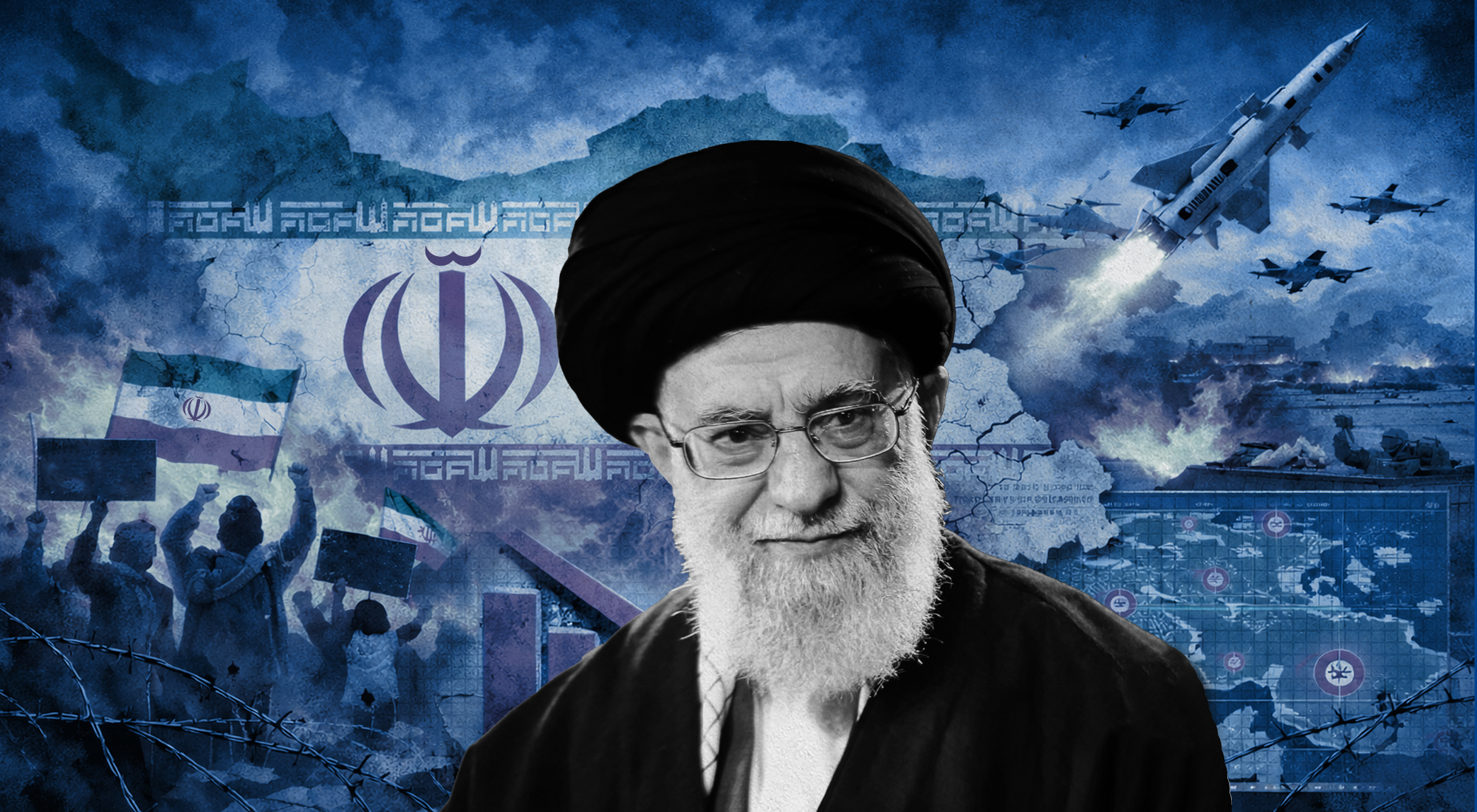
This study examines the historical origins, ideological architecture, and ongoing decline of Velayat-e Faqih—the doctrine of Guardianship of the Islamic Jurist—as the foundational legitimizing principle of the Islamic Republic of Iran. Drawing on verified historical scholarship and documented events through 2022, this paper traces how a theological concept developed over centuries of Shia jurisprudence was transformed by Ayatollah Khomeini into the ideological backbone of a modern theocratic state and how that transformation has produced, over time, the very conditions that now threaten the doctrine’s survival. The study analyzes the erosion of doctrinal legitimacy across its three foundational pillars—divine mandate, meritocratic selection, and popular welfare—and examines the cascading security implications of that erosion at the domestic, regional, and global levels. Three forward-looking analytical scenarios are presented: hybrid continuity under IRGC dominance, transformation into overt military authoritarianism, and systemic fragmentation.
GLOSSARY OF TERMS
Velayat-e Faqih: Guardianship of the Islamic Jurist: the doctrine granting a senior Shia cleric supreme political and religious authority during the Twelfth Imam’s occultation. In Khomeini’s absolute formulation, this authority extends over all branches of state without exception.
Faqih: A senior Islamic jurist qualified to issue rulings (fatwas) on matters of Islamic law. Under classical Shia jurisprudence, the faqih held religious and judicial authority; under Khomeini’s political theology, the faqih became the supreme ruler of the state.
Occultation: The central Shia belief that the Twelfth Imam, Muhammad al-Mahdi, entered a state of divine concealment in 874 CE and will return at the end of times. The question of who governs the community of believers in his absence is the theological foundation on which Velayat-e Faqih is constructed.
IRGC: Islamic Revolutionary Guard Corps: established in 1979 to protect the revolution, the IRGC has evolved into a sprawling military, intelligence, economic, and political institution whose power now rivals and in many respects exceeds that of the formal clerical establishment.
Assembly of Experts: An 88-member elected body of senior clerics, constitutionally empowered to appoint, supervise, and dismiss the Supreme Leader. In practice, candidates require Guardian Council vetting, making genuine independence from the leadership rare.
Axis of Resistance: The informal coalition of state and non-state actors aligned with Iran’s regional strategy, including Hezbollah in Lebanon, Hamas and Islamic Jihad in Gaza, various Iraqi Popular Mobilization Units, and the Houthi movement in Yemen. The ideological coherence of this network is partly sustained by shared allegiance to Velayat-e Faqih.
I. HISTORICAL EVOLUTION OF VELAYAT-E FAQIH
The doctrine of Velayat-e Faqih did not emerge fully formed from the mind of Ayatollah Khomeini. Its roots extend deep into the history of Shia jurisprudence, shaped over more than a millennium by theologians grappling with a fundamental question: in the absence of the infallible Imam, who holds legitimate authority over the community of believers? The earliest systematic treatment of this question appears in the works of al-Shaykh al-Mufid (d. 1022 CE), who argued that senior jurists could exercise limited guardianship over those incapable of managing their own affairs—orphans, the mentally incapacitated, those without proper male guardianship. This was a cautious, circumscribed claim, far removed from political sovereignty.[1] During the Safavid period, clerical authority expanded somewhat into public life: Muhaqqiq Karaki served effectively as the religious arm of the state under Shah Tahmasp I in the 16th century, lending doctrinal legitimacy to Safavid rule in exchange for royal patronage. But even here, the relationship was one of cooperation between two distinct power centers, not the fusion of religious and political sovereignty into a single office.
The most significant pre-Khomeini elaboration of the doctrine came from the 19th-century jurist Mohammad Mahdee Naraqi, whose treatise Awa’id al-Ayyam argued that the faqih’s guardianship extended beyond personal and religious matters into broader public affairs.[2] Naraqi’s argument was genuinely expansive for its time, but it still stopped short of claiming that jurists should hold supreme governmental power. The dominant tradition within Shia scholarship through the 19th and into the 20th century remained broadly quietist—skeptical of clerical entanglement with state power, preferring instead a role of moral guidance and social influence from a position outside formal governance.[3] Grand Ayatollahs who subscribed to this quietist tradition, most influentially in the 20th century figures such as Grand Ayatollah Borujerdi and later Grand Ayatollah Sistani in Iraq, argued that direct clerical rule risked corrupting both the clergy and the state and that the legitimacy of governance ultimately rested on popular consent rather than divine delegation.
It was against this intellectual backdrop that Khomeini’s contribution must be understood—not as an evolution of tradition but as a rupture with it. In his 1942 political tract Kashf al-Asrar, Khomeini began to articulate a vision of Islamic governance sharply at odds with Pahlavi secularism and with quietist clerical convention.[4] But it was in his 1970 lectures in Najaf, compiled and published as Islamic Government: Governance of the Jurist, that Khomeini set out the fully developed theory of absolute Velayat-e Faqih.[5] His central argument was stark: just as the Prophet Muhammad (peace be upon him) and the Imams had exercised governmental authority, so too must the senior jurist exercise such authority during the Imam’s occultation. To leave governance to secular rulers was not merely imprudent—it was a theological dereliction, a betrayal of Islam’s comprehensive claim over all aspects of human life, individual and collective. The faqih, in this formulation, was not a guide standing alongside the state but the state’s supreme and unchallengeable authority, whose rulings overrode those of all other institutions, including, in Khomeini’s later elaboration, even the requirements of secondary Islamic law when the interests of the Islamic order demanded it. This doctrine was enshrined in Articles 5, 107, and 110 of the 1979 Constitution of the Islamic Republic, making Iran the first and only state in history to be constitutionally governed by this principle.[6]
When Khomeini died in 1989 and Ali Khamenei assumed the Supreme Leadership, a new and structurally significant phase began. Khamenei lacked his predecessor’s religious credentials—he held the rank of Hojatoleslam rather than Grand Ayatollah at the time of his appointment, a fact that required post-hoc promotion and generated quiet but persistent clerical criticism. Unable to rely on Khomeini’s combination of charismatic authority and genuine scholarly eminence, Khamenei compensated through institutional consolidation. His Beyt-e Rahbari grew into an enormous parallel bureaucracy, embedding the Leader’s office in every significant domain of state—nuclear policy, intelligence, the judiciary, the media, the economy, and above all the IRGC.[7] Over three decades, what emerged was a hybrid system that scholars have described as a praetorian theocracy: one in which clerical legitimacy provided ideological cover for what was increasingly military-bureaucratic rule, and in which the IRGC’s institutional interests—its vast economic empire, its regional military operations, its domestic security role—became the true center of gravity of the system. The doctrine of Velayat-e Faqih survived formally intact, but its practical content was transformed: from a theological principle governing who should rule, into a legitimizing formula for an entrenched security-clerical complex that ruled by habit, coercion, and institutional inertia as much as by genuine religious authority.
II. THE LEGITIMACY CRISIS
The legitimacy of any political system, including one that grounds its authority in religious doctrine, rests ultimately on the relationship between its claims and the lived experience of those it governs. For Velayat-e Faqih, three claims have always been central: that the Supreme Leader governs as the deputy of the Hidden Imam (The Mahdi) and therefore with divine sanction; that the most qualified jurist is selected through a meritocratic clerical process; and that Islamic governance produces justice, welfare, and dignity for Muslim citizens. By the early 2020s, the credibility of all three claims had been profoundly and, in many respects, irreversibly damaged.
The divine mandate claim was eroded not by theological argument but by the visible behavior of the system’s officials. Corruption scandals implicating senior clerics, IRGC commanders, and their families—many amassing extraordinary wealth while ordinary Iranians faced economic collapse—made the language of divine trusteeship ring hollow to a population that experienced it as extraction rather than stewardship. The meritocratic claim suffered from the obvious reality that access to positions of power depended on political loyalty to the Supreme Leader and the IRGC rather than on scholarly attainment; indeed, the quietist tradition’s most eminent scholars, based in Qom and Najaf, pointedly refrained from endorsing the doctrine’s absolute political formulation, a dissent that the system managed by marginalizing rather than engaging them. The welfare claim collapsed most visibly in the economic domain: decades of mismanagement, compounded by international sanctions, produced chronic inflation, currency collapse, water scarcity severe enough to trigger rural displacement, and youth unemployment that left a generation economically stranded and politically alienated.
The protests that punctuated the 2010s and early 2020s documented this legitimacy collapse in real time. The 2009 Green Movement had still operated within the system’s frame of reference, appealing to constitutional norms and electoral fairness. The 2019 fuel protests were more nakedly economic in character, but their extraordinary violence—security forces killing hundreds of protesters in a matter of days—exposed the degree to which the state had abandoned even the pretense of popular accountability and now governed by fear alone. The 2022 Woman, Life, Freedom uprising represented a further and qualitatively distinct escalation.[8] Sparked by the death of Mahsa Amini in the custody of the morality police, the movement spread with a speed and geographic breadth that surprised even experienced Iran analysts, reaching cities, towns, and rural areas simultaneously and drawing in women, men, workers, students, and members of ethnic minorities who had long experienced the Islamic Republic as a doubly alien imposition—both theocratic and Persian-majoritarian. Crucially, the movement’s slogans did not appeal to reform within the system but called for the system’s end: “Death to the dictator,” “Death to Khamenei,” and—most pointedly for a doctrine premised on clerical rule—”Mullahs get lost.” These were not the demands of people who wanted a better version of the Islamic Republic. They were the demands of people who had withdrawn their consent from it entirely. The security apparatus suppressed the uprising, as it had suppressed its predecessors, but suppression is not legitimation. A state that can only maintain order through lethal force has already conceded the essential argument about its right to govern.
III. DOMESTIC, REGIONAL, AND GLOBAL SECURITY IMPLICATIONS
The erosion of Velayat-e Faqih’s legitimacy is not merely a matter of internal Iranian politics. It generates security consequences that radiate outward from Tehran across the region and into global strategic calculations, because the doctrine has for more than four decades served as the organizing principle not only of Iran’s domestic governance but of its entire foreign and security policy architecture.
Domestically, the most immediate consequence of declining legitimacy is the deepening dependence on coercion. A system that cannot generate voluntary compliance must compel it, and compulsion requires an ever-larger and more intrusive security apparatus. The IRGC’s expansion across Iranian society—into universities, media, the economy, and local governance—reflects this dynamic. But coercion has its own instabilities. Elite cohesion within the IRGC is not guaranteed; factionalism between commanders with different economic interests, regional assignments, and political alignments represents a persistent source of internal tension that a sufficiently severe crisis could activate. Beyond the IRGC, the clerical establishment itself is divided: the quietist tradition has never fully accepted Khomeini’s absolute formulation, and grand ayatollahs in Qom who dissent from the doctrine’s political application represent a source of alternative legitimacy that reform movements or succession crises could mobilize. At the popular level, recurring protest cycles—each one broader, angrier, and more explicitly directed at the system’s foundations than the last—suggest that the social contract underpinning the Islamic Republic has been exhausted for a significant portion of the population, particularly the young. The specific grievances of ethnic minority communities add a further dimension: for Kurds, Azerbaijanis, Baluchis, and Arab Iranians, the Islamic Republic’s legitimacy deficit is compounded by the experience of cultural and political marginalization, making demands for autonomy or self-determination a plausible response to prolonged central government weakness.
Regionally, the coherence of the ‘Axis of Resistance’ depends in ways that are often underestimated on the ideological and organizational functions that Velayat-e Faqih performs.[9] It is not only Iranian money and weapons that bind Hezbollah, the Houthis, and Iraqi militias to Tehran—it is a shared doctrinal framework that positions loyalty to the Supreme Leader as a religious obligation, not merely a political calculation. As that framework loses credibility domestically, its binding force on proxy actors is likely to weaken over time, producing proxy networks that are more autonomous, more driven by their own local political interests, and correspondingly less controllable by Tehran. An Iran that cannot reliably direct its proxies is both less powerful as a regional actor and more dangerous as a source of unpredictable violence—forces that were once instruments of Iranian strategy may pursue their own agendas in ways that generate regional escalation Iran itself cannot manage or de-escalate.
At the global level, the most consequential risk concerns Iran’s nuclear program. The Supreme Leader had historically served as the singular decision-making authority on nuclear matters, and while this centralization has made Iranian nuclear policy opaque and difficult to influence, it has at least provided a single authoritative interlocutor whose decisions, once made, could be relied upon to hold across the system.[10] A weakening Supreme Leader—or, in the most extreme scenario, a period of genuine leadership crisis—introduces uncertainty into this picture that is deeply uncomfortable for non-proliferation analysts.
The logic that has historically constrained Iran’s nuclear ambitions is partly strategic: the calculation that the costs of weaponization outweigh the benefits, given the severity of the international response it would provoke. But legitimacy pressure changes this calculus. A leadership that feels genuinely existentially threatened—by internal revolt, by external military action, by the collapse of its ideological authority—may conclude that nuclear weapons represent an insurance policy that no other tool can provide.[11] This is not a prediction; it is a risk that the erosion of Velayat-e Faqih’s legitimacy makes more, not less, plausible.
International diplomatic engagement with Iran—always difficult—becomes harder still when the system’s internal authority structure is contested, when officials cannot commit credibly on behalf of a leadership whose mandate is disputed, and when the IRGC’s institutional interests, which do not necessarily align with diplomatic compromise, are increasingly dominant in shaping policy.
IV. FORWARD SCENARIOS
Three principal analytical trajectories can be identified for the Islamic Republic in a context of continued and deepening legitimacy erosion, each carrying distinct implications for Iranian society and for regional and global security.
The first scenario—hybrid continuity—projects the persistence of the current system in modified form: the IRGC exercises increasing real power while clerical institutional forms are formally preserved, with the Supreme Leader serving more as a symbolic figurehead for a security state than as a genuine religious authority. This is the trajectory of least institutional disruption and, therefore, the most likely in the near term. It maintains a degree of governmental coherence and preserves the external architecture of the system, including the proxy networks and the nuclear program, while managing internal dissent through surveillance, intermittent repression, and economic patronage for loyal constituencies. Its fundamental weakness is that it resolves nothing of substance: the legitimacy deficit continues to accumulate, economic conditions are unlikely to improve significantly, and the succession question—though answered in name by Mojtaba Khamenei’s appointment on 8 March 2026—remains unresolved in every meaningful sense. Who he leads for, on what independent religious or popular basis, and whether a figure described by analysts as “an unknown quantity” who has never held a formal government position can command the authority the office requires, are questions a purely military-backed appointment cannot answer. Settling the succession by decree papers over the legitimacy crisis; it does not dissolve it.
The second scenario—military transformation—envisions a more explicit displacement of clerical authority by IRGC institutional power, producing a system that resembles in important respects the military-authoritarian states of the Arab world more than the clerical republic Khomeini envisioned. Velayat-e Faqih would survive in this scenario as ideological window dressing—ritually invoked, institutionally hollowed. This trajectory entrenches authoritarianism in ways that make political reform extremely unlikely, reduces Iran’s international diplomatic flexibility, and concentrates nuclear decision-making authority in the hands of military commanders whose strategic culture is significantly more hawkish than the clerical establishment’s.
The third scenario—fragmentation—represents the most disruptive and most dangerous possibility: accumulated legitimacy failures, sustained economic crisis, and the absence of credible succession mechanisms produce systemic breakdown, with different centers of power—regional IRGC commands, ethnic minority movements, reform factions, Qom-based clerical networks—pursuing their own agendas in the absence of functioning central authority. The regional consequences of Iranian state fragmentation would be severe: proxy networks operating without central direction, refugee flows, opportunistic interventions by neighboring states, and—most alarmingly—questions about the security of nuclear materials in a context of governmental collapse that would constitute a Category One international security emergency.
V. CONCLUSION
The doctrine of absolute Velayat-e Faqih faces a crisis that is both structural and self-generated. Khomeini’s revolutionary innovation—the transformation of a theological principle of clerical guardianship into a comprehensive claim to political sovereignty—was always in tension with mainstream Shia jurisprudential tradition, which had long counseled caution about direct clerical governance and emphasized the corruption that proximity to power tends to produce in religious institutions. Four decades of Islamic Republican governance have vindicated many of those concerns: an economy marked by chronic mismanagement and elite predation, a political system incapable of self-correction through peaceful means, a clerical establishment whose association with state power has damaged its own religious authority in the eyes of many Iranian Muslims, and a security apparatus whose coercive reach has grown in inverse proportion to the government’s capacity to generate genuine popular consent.
Authoritarian systems can persist for long periods in conditions of low legitimacy, sustained by institutional inertia, coercive capacity, divided opposition, and the absence of a credible alternative. But persistence is not stability, and a system that governs through fear rather than consent is perpetually vulnerable to the unexpected—an economic shock, a succession crisis, a protest movement that grows faster than the security apparatus can contain it—in ways that more legitimate systems are not. The security implications of this vulnerability are real and serious: for the Iranian people, who bear the primary cost of governance by a system that has substituted ideology for accountability; for the region, whose stability is partly a function of Iranian strategic behavior and whose own political orders are affected by the demonstration effects of Iranian governance; and for the international community, which must manage the nuclear, proliferation, and conflict risks that an Iran in prolonged legitimacy crisis generates. Understanding Velayat-e Faqih—its origins, its internal logic, and the sources of its current crisis—is therefore not merely a matter of academic interest. It is a prerequisite for serious analysis of one of the most consequential security environments of the contemporary world.
[1] Momen, Moojan, An Introduction to Shi’i Islam (New Haven: Yale University Press, 1985): pp. 189–192.
[2] Naraqi, Mohammad Mahdee, Awa’id al-Ayyam, Early 19th century. Discussed in “Velayat-e Faqih: Historical Roots,” Fanack.
[3] Islamquest.net, “The Authority of the Jurist in the Era of Occultation,” https://www.islamquest.net.
[4] Khomeini, Ruhollah, Kashf al-Asrar [Revealing of Secrets], 1942.
[5] Khomeini, Ruhollah. Islamic Government: Governance of the Jurist. Lectures delivered in Najaf, 1970, Al-Islam.org, https://al-islam.org/islamic-government-governance-jurist-sayyid-ruhullah-musawi-khomeini.
[6] Islamic Republic of Iran, Constitution of the Islamic Republic of Iran, Ratified 2–3 December 1979, Articles 5, 107, and 110.
[7] Saeid Golkar and Kasra Aarabi, “Unmasking the Bayt: Inside the Supreme Leader’s Office, the Hidden Nerve Center of the Islamic Republic,” 2026, https://www.unitedagainstnucleariran.com/sites/default/files/Unmasking%20the%20Bayt_Tue%2024%20Feb%2017.10.pdf.
[8] Dorsa Jabbari, “Women, Life, Freedom: The Chants of Iran’s Protests,” Al Jazeera, September 28, 2022, https://www.aljazeera.com/podcasts/2022/9/28/women-life-freedom-the-chants-of-irans-protests.
[9] Khalaji, Mehdi, “Iran’s Velayat-e Faqih and the Axis of Resistance,” Journal of Shi’a Islamic Studies, Taylor & Francis, 2014.
[10] Atlantic Council, “Iran’s Nuclear Program: Command, Control, and Strategic Decision-Making,” https://www.atlanticcouncil.org/programs/middle-east-programs/scowcroft-middle-east-security-initiative/iran-strategy-project/.
[11] Samore, Gary, ed., Iran’s Nuclear Future: Critical U.S. Policy Choices, Belfer Center for Science and International Affairs, Harvard Kennedy School, 2012.