


While Iran launches low‑cost missiles toward the Gulf, Abu Dhabi responds with a multilayer system of air superiority. A 96% interception rate, only three deaths despite hundreds of missiles: the UAE alliance network brings together the United States, South Korea and even Russia, combined with strong domestic technological and industrial capabilities.
Location: Abu Dhabi, 8 March 2026
In their retaliation for the U.S.-Israeli combined attacks of 28 February, the Iranians targeted the United Arab Emirates more than Israel. Despite the drastic imbalance in resources (both human and geographic) in favor of Iran, the Emirates—whose population is about 11 million people, with only around 10% being Emirati citizens—are demonstrating cutting‑edge deterrence and defensive capabilities.
This is not the result of luck or dependence on the defense provided by American bases on their territory. Rather, it is the outcome of a virtuous approach developed over the years, intertwining alliances based on balanced neutrality in international crises with a leadership strategic vision aimed at shifting from being a country that imports defense capabilities to one that develops advanced technological capabilities of its own national security and prosperity within the military domain.
The result of this combination of alliances and national capabilities has produced a multilayered defense architecture among the most sophisticated in the world, second only to Israel’s in the Middle East. With an annual defense budget of around 27 billion dollars—much of it dedicated to air defense systems, cyber capabilities and electronic warfare—Abu Dhabi has built a form of “networked deterrence” that combines cutting‑edge technologies, systemic integration and diversified international alliances based on a well-known trusted reputation.
The Six‑Layer Sky Shield
The most important pillar of the UAE’s resilience these days is represented by the national air defense system, which is organized into six interconnected and interdependent layers that integrate imported technologies with industrial capabilities developed domestically, as shown by the infographic.
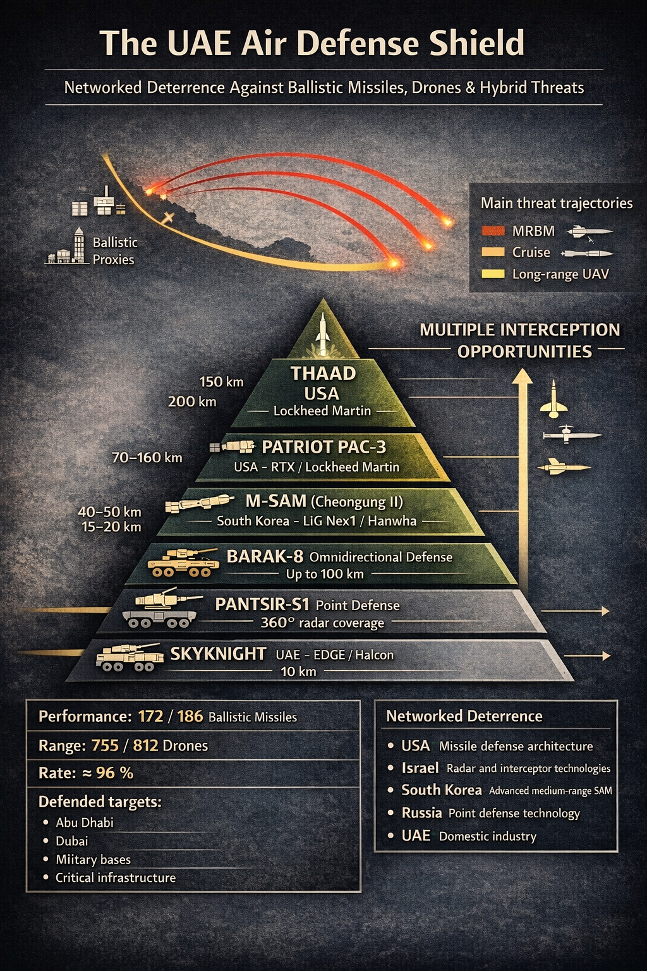
Infographic created by the Author
At the highest level, the system relies on the American THAAD (Terminal High Altitude Area Defense), capable of intercepting ballistic missiles in the terminal phase, either exo‑atmospheric or high endo‑atmospheric. It uses pure “hit‑to‑kill” kinetic impact technology without explosives in order to minimize debris. The second level relies on the American Patriot system (MIM‑104 PAC‑3), designed to intercept tactical ballistic missiles, cruise missiles and aircraft. It uses active radar guidance and is capable of operating even under saturation conditions. Levels three and four rely on South Korean M‑SAM (Cheongung II) and Israeli Barak 8 systems, capable of covering aircraft, cruise missiles and precision‑guided munitions. These systems are interoperable and extend the defensive network against multiple omnidirectional threats (360°) with a range of about 100 km. They are also used against helicopters, anti‑ship missiles, drones and ballistic/cruise threats. The medium‑low layer relies on the Russian Pantsir‑S1 system, capable of operating at short‑to‑medium range. This technology combines missiles and cannons to counter low‑altitude drones, rockets, artillery and mortars, and is particularly effective against UAV swarms. The final layer is based on purely Emirati technology through the SkyKnight system developed by the EDGE group. This technology has a range of up to 10 km, can track up to 80 targets simultaneously, and allows rapid launches (up to five missiles per second), integrated within Skynex systems for both fixed and mobile assets.
Multiple “Shot Opportunities”
The six‑layer structure creates a full‑spectrum air dominance capable of guaranteeing comprehensive interception resilience: if THAAD fails, Patriot intervenes; then M‑SAM or Barak 8; followed by Pantsir; and finally SkyKnight.
The result is enviable even for many advanced Western countries. Since 1 March 2026, Tehran has launched 186 ballistic missiles and 812 drones against Emirati targets: 172 missiles and 755 UAVs were intercepted, for an overall interception rate of 96%. The toll stands at three deaths and limited damage to civilian or critical infrastructure, mostly caused by debris resulting from interception collisions.
However, the real test will be the ability to sustain such a shield in a war of attrition. The main vulnerability lies in the stocks of Patriot and THAAD interceptors, which could be depleted in roughly seven days without immediate resupply from the United States. Global production of these systems is slow, and it takes years to rebuild significant stockpiles. Washington is already reinforcing batteries across the Gulf, but the supply chain bottleneck remains real. Nevertheless, from both a political and military standpoint, Emirati resilience sends a clear message: every Iranian failure erodes Tehran’s credibility, while every Emirati success amplifies Abu Dhabi’s weight in global markets and maritime routes. In a Middle East on fire, the United Arab Emirates are not only defending themselves; they are protecting the balance that sustains the global politics and economy.