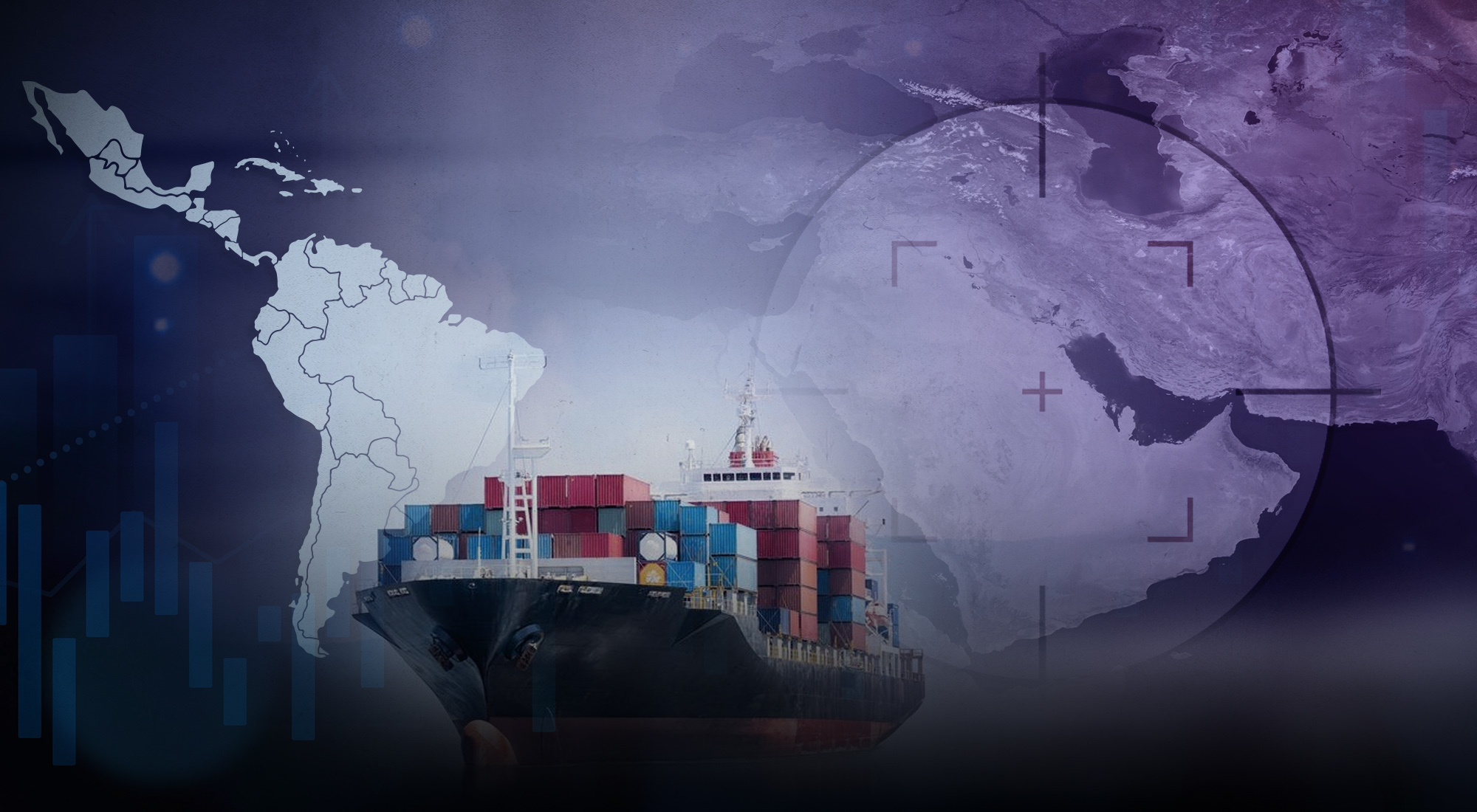




Four weeks after the start of military operations in the Gulf and with no concrete ceasefire or political agreement currently in place, the consequences of this conflict are being felt around the world.
In the case of Latin America, our geographical distance from the theatre of operations should not lead us to believe that there will be no impact whatsoever. In fact, some of these impacts are already being felt, such as the rise in fuel prices across the region and its knock-on effect on all economic activities.
Drawing on the immediacy of the situation, this paper will analyse factors to bear in mind when considering courses of action to minimise negative effects and take advantage of opportunities, should the need arise.
The economic impact of the Gulf War
So far, we have witnessed a steady escalation in the conflict, ranging from attacks on Iran’s leading military and political authorities and its most advanced military assets, such as missile launchers and drones, to its defence production infrastructure and infrastructure linked to its nuclear programme. More recently, attacks have targeted economic infrastructure, particularly in the hydrocarbons sector, and there have even been threats to attack energy infrastructure, which would have a significant impact on the lives of civilians.
Iran, for its part, has not only chosen to attack Israel and military bases and assets in the Gulf region, but has also directly attacked the Arab Gulf states, including their economic and civilian infrastructure. This is an attempt to destabilise them and, consequently, affect the entire global economy given the prominent role these countries play in the global gas and oil markets.
As if this were not enough, the closure of the Strait of Hormuz or disruption to maritime traffic through this vital waterway is beginning to impact these countries’ economies due to logistical difficulties, such as problems shipping out exports (particularly liquefied natural gas, oil, and its derivatives, including fertilisers) and receiving imports.
The rise in freight and insurance costs directly impacts domestic prices. Although an increase in international gas and oil prices might initially appear to benefit countries that are net exporters of these products, the truth is that any potential short-term benefits are completely outweighed by negative costs such as increased logistics costs, defence expenditure to counter Iranian aggression and the reconstruction of infrastructure damaged by attacks.
In short, the conflict and the rise in international hydrocarbon prices are not beneficial to the Arab Gulf states.
Current estimates suggest that the negative impact is already a reality for all states in the region, regardless of the duration of the conflict and the extent of damage to hydrocarbon infrastructure.
Another significant economic issue that will be affected by the conflict is the situation of foreign workers living in the Arab Gulf states. [1]
If the conflict drags on, there may well be changes in recruitment patterns in sectors such as tourism, construction and logistics services. Most of the affected workers come from the Indian subcontinent or other Arab countries, so there will be an impact on those economies due to potential changes in remittances sent home.
In short, although the end of the war and the conditions for ending it cannot yet be predicted, the main economic impact will be the need to diversify their economies further and create transport corridors and logistics systems capable of absorbing the impact of transit disruptions through the Strait of Hormuz.
In our view, while the economic impact is relatively easy to resolve — essentially a matter of money — nothing compares to the political rupture we are set to witness in the coming period.
The current conflict will generate heightened levels of tension and mistrust between the Arab countries and Iran — a rift that will have significant implications for the future of the regional order.
The economic impact of the war on Latin America
The consequences of the conflict affect different countries and sectors of Latin American economies in different ways.
However, rising international hydrocarbon prices directly impact the trade balances of importing countries and have an inflationary effect across all nations due to energy’s central role[2].
This combination of rising import costs and inflationary pressures significantly impacts the region’s economies, which will, at the very least, experience reduced growth expectations.
Latin America is a region that has previously experienced the negative economic effects of events such as the war in Ukraine[3] and the trade tensions between the United States and China[4]. Therefore, what is happening in the Gulf is merely confirmation of our region’s integration into the global economic system and the problems arising from the unintended consequences of certain developments.
Broadly speaking, the current crisis contains elements of the previous two crises: it affects international prices and the supply of hydrocarbons and food, as was the case in the conflict in Ukraine; and it affects global value chains and financial flows, as the case in the situation in China.
The intensification of the negative aspects of past crises highlights the complexities and difficulties we are currently facing.
Adding the crisis triggered by the 2020 pandemic to these two shows that Latin America is unable to establish frameworks for resilience or enhance its capacity to respond to global crises – a fact that should concern decision-makers in the region.
Food security
Food security is defined as “access to sufficient, safe and nutritious food for normal growth and development, and an active and healthy life” [5]. It is not exclusively linked to a state’s financial resources for purchasing such food, but also to other factors. These include the availability of food from a production perspective and the ability to deliver it to those who need it from a logistical perspective.
The current conflict could affect these two conditions in various ways. Firstly, the rise in fertiliser and fuel prices (around 50% since the start of the conflict) will directly impact food production costs. Fertilisers account for around 40% of crop production costs, so producers’ profit margins will be reduced if they are able to absorb these increases, or their production levels will be reduced if they are unable to do so[6].
Not all Latin American countries rely on fertiliser production sources in the Gulf to the same extent. Brazil is the country that will be hit hardest, as 40% of the urea it consumes comes from Gulf countries[7]. However, all producer countries will feel the impact of rising fuel prices on their production costs.
Furthermore, the logistical problems arising from the conflict are leading to cost increases, particularly in freight and insurance. Other considerations include the inability to reach destination ports safely due to insecurity or potential attacks.
A reduction in producers’ profit margins due to rising input prices, falling productivity levels, or an inability to reach customers would have significant consequences for net food producers and exporters in the region, such as Argentina, Brazil, Ecuador, Uruguay and Paraguay[8].
From the perspective of buyers of Latin American products, we cannot speak of a famine situation, but rather of rising food prices.
In recent years, we have witnessed a process of re-primarisation of economies in Latin America; that is, a return to the prominence of primary sectors (such as raw materials, agriculture and livestock) in countries’ GDPs. Any impact on these markets would hit Latin American economies hard, since agri-food sales represent a key source of income for countries such as Argentina and Brazil, causing instability in national accounts and all the consequences that this entails.
Although markets in the Middle East, particularly those in the Arabian Gulf, do not account for a significant proportion of Latin American agri-food exports — no more than 5–8 per cent —[9], a decline in exports of that magnitude, accompanied by lower production levels or profit margins, would put the region in a serious predicament.
Current events should prompt Latin American governments to consider alternative scenarios for exporting agri-food products and other goods, such as meat (from sheep, cattle, goats and poultry) and minerals. This would protect their economies from the effects of developments in Ukraine[10], the trade war between China and the United States, and the conflict in the Gulf.
Energy security
The current war in the Middle East is impacting the global hydrocarbon market, resulting in a sustained rise in prices. This is because the region is home to some of the world’s largest producers, including Saudi Arabia (3rd in oil and 9th in gas), Iraq (5th), the United Arab Emirates (8th and 13th, respectively), and Iran (9th and 3rd) [11].
Following the coordinated attack by the United States and Israel against Iran on 28 February, and Tehran’s subsequent counterattack, which included indiscriminate strikes on refineries, oil fields, and tankers in Gulf countries, the focus has shifted to the implications for global energy security. This is generally understood to mean the availability of sufficient resources at affordable prices.
However, this definition relates to ‘security of supply’, which is more characteristic of developed countries. It is not the same as the situation in hydrocarbon-exporting countries, which focus on the ‘security of demand’ for their products and ensuring they reach their destinations. For developing countries that import hydrocarbons, energy security is therefore linked to the stability of fuel prices. Therefore, this concept must always be understood within the broader framework of international relations[12].
In its March report, the International Energy Agency stated that, in the current context, the Americas as a whole will experience the least direct impact from the instability in the Middle East, thanks to a combination of strong local production and geographical isolation from the Strait of Hormuz[13].
Beyond the usual inflationary pressures, the effects of the conflict vary across Latin America and the Caribbean. Unlike East Asia and Europe, this region does not usually import significant amounts of oil and gas from the Middle East. The region itself is home to major producers such as Brazil (7th for crude oil worldwide), Mexico (13th), Venezuela (18th), Argentina (20th for crude oil and 25th for gas), and Colombia (21st). However, there are also net importers, such as Chile, Peru and the countries of Central America. In other words, the cost of the war is not being borne equally.
Brazil, the largest economy in the region, is forecasting higher growth and rising inflation due to the increase in oil prices caused by the war. According to estimates by the country’s Central Bank, in a scenario marked by sustained and severe disruptions to global supply, with an average oil price of $100 per barrel, the Brazilian economy could grow by up to 0.36 percentage points more than forecast (originally 2.3% of GDP for 2026) [14].
In Argentina’s case, if the price of Brent were to average 25% higher than in January (US$67 per barrel) for the rest of the year, as some international analysts suggest, the trade balance for the year would improve by around US$1.5 billion. Furthermore, a rise in the oil price of that magnitude would generate a transfer from consumers to the value chain of around US$3 billion[15].
As a net importer, Chile will undoubtedly experience an inflationary impact from the rise in fuel prices, but this will also put unexpected pressure on the Fuel Price Stabilisation Mechanism — a state subsidy designed to mitigate the impact of sharp rises in petrol prices on consumers. Finance Minister Jorge Quiroz stated that should oil prices remain above US$100 per barrel, the government could spend up to US$3 billion on transfers to offset the negative effects[16]. Meanwhile, the Central Bank has reduced this year’s projected growth by half a percentage point as a result of the war, bringing it down to 1.5–2.5% (down from 2–3% in December)[17].
Mexico, which imports half the fuel it consumes but is also the continent’s second-largest crude oil exporter, has begun applying the same containment subsidy logic. The small economies of Central America have also chosen this path, despite the pressure it places on their public finances[18].
As the conflict in the Middle East continues, it will generate additional revenue for producers and incur exceptional costs for importers in Latin America and the Caribbean, amid widespread inflationary pressures. The outcome will depend on the duration of the conflict and the extent of the damage to energy infrastructure. Goldman Sachs has estimated that, in a worst-case scenario, the price of a barrel of oil could remain close to US$100 until the end of 2027[19]. Consequently, the current situation should incentivise producers to increase their hydrocarbon output, while importers should be encouraged to accelerate the generation of their own renewable energy in order to reduce their reliance on oil and gas.
As the conflict in the Middle East continues, it will generate additional revenue for producers and incur exceptional costs for importers in Latin America and the Caribbean, amid widespread inflationary pressures. The outcome will depend on the duration of the conflict and the extent of the damage to energy infrastructure. Goldman Sachs has estimated that, in a worst-case scenario, the price of a barrel of oil could remain close to US$100 until the end of 2027. Consequently, the current situation should incentivise producers to increase their hydrocarbon output, while importers should be encouraged to accelerate the generation of their own renewable energy in order to reduce their economies’ reliance on oil and gas.
However, the transition to clean energy, with all its associated benefits, has yet to demonstrate its ability to neutralise the impact of Middle Eastern geopolitics on the oil and gas market. Access to energy, or the denial of it, will apparently continue to be an effective weapon of economic coercion in a world of competition between major powers and a greater propensity to use military force[20]. Ultimately, this is an integrated hydrocarbon market, so energy security for all depends on the stability of that market.
Waterways
Between late 2023 and 2024, the Yemen-based Houthi rebels escalated their attacks on commercial shipping passing through the Suez Canal. This caused spot market container rates on the main routes between Asia and Europe to skyrocket, rising from around US$2,000 to US$5,000. This was because some cargo ships were diverted around the Cape of Good Hope, which added to freight charges.
Drewry’s World Container Index (WCI), a weekly benchmark that measures spot rates for 40-foot container shipping on the main east-west trade routes, showed that while the rate was US$1,899 on 26 February (two days before the US-Israeli attack on Iran), it had risen to US$2,172 by 19 March, marking the third consecutive week of increases[21]. This moderate increase can be explained by the fact that the Strait of Hormuz is a strategic passageway for oil tankers rather than container ships. This is why shipping companies are adjusting their rates in response to rising fuel costs rather than the physical risk to their vessels. Consequently, the rise in freight rates will impact maritime trade in general, but specifically affect those transiting the Gulf. The same will apply to the insurance market[22].
As there are no direct commercial shipping routes between the Middle East and Latin America (the Atlantic and Pacific Oceans lie between them) and the region does not import hydrocarbons from these areas, no major disruptions are expected on the few existing routes. However, changes to specific flows could occur if Asian countries increase their demand for oil and gas from American producers as a temporary replacement for their suppliers in the Gulf.
Ricaurte Vásquez, the administrator of the Panama Canal, predicts that should the conflict in the Middle East persist, traffic through this interoceanic passage could increase to the extent that Asia seeks to purchase more liquefied natural gas from the east coast of the United States than from Qatar, the world’s sixth-largest producer. In Latin America, Trinidad and Tobago (24th largest producer in the world) and Argentina (25th largest producer in the world) also produce this fuel.
Taking all of this into account, the impact of the conflict in the Middle East on maritime routes connecting Latin America with the rest of the world is likely to be more evident in the form of increased freight and insurance costs, and in some cases, delays or potential losses due to supply chain disruptions.
Even if it is not directly affected, Latin America and the Caribbean should approach the unfolding conflict in the Middle East with caution. The region has three strategic maritime routes: the Panama Canal, the Strait of Magellan and the Drake Passage, and there is an underlying economic risk surrounding these. Governments and businesses will also have to adjust their plans in the face of widespread cost increases across global supply chains (freight and insurance), which tend not to disappear once conflicts end. Instead, they become embedded in the prices of goods transported by sea over time.
Gulf investments in Latin America
Sovereign wealth funds, development aid funds and large companies from the Arab Gulf states are growing in global significance.
While investment in Latin American countries has not yet been substantial, a change in the foreign policy priorities of the Arab Gulf states[23] could create opportunities for Latin American economies, particularly in sectors such as mining, agriculture and logistics.
These changes will mean that those funds will be used on the basis of financial considerations, rather than political ones, i.e. investing in countries with which one wishes to maintain levels of cooperation on a quid pro quo basis, or investing in friendly countries.
Changes to investment fund priorities could only benefit Latin America if countries in the region establish legal frameworks adapted to global conditions, as well as long-term policies that inspire confidence and provide predictability.
Given that the consequences of the conflict are almost entirely negative for Latin America, higher levels of investment are almost the only positive consequence, although this depends on changes among other actors and the introduction of reforms that would make such investments in these countries more attractive.
Conclusions
Latin America is being, and will continue to be, affected by the current events unfolding in the Middle East. We must not assume that, because of its geographical distance, there are no links or that these events have no influence on the region.
The consequences are overwhelmingly negative: rising prices for hydrocarbons and their by-products; increased logistics costs causing disruptions to international trade; and potential impacts on food production value chains, which have consequences for food security.
As we have mentioned, the current situation only allows us to glimpse certain trends, most of which are negative, for the economies of Latin American countries. In this regard, we must learn from the situation in order to limit these impacts as much as possible.
The diversification of energy sources, the consideration of alternatives to the most vulnerable maritime routes and the creation of legal frameworks and political conditions that encourage foreign investment are issues that must not be postponed on the national and regional agendas.
These events once again demonstrate the urgent need for Latin American countries to have access to analyses of developments in geopolitically significant regions, such as the Middle East. This would enable decision-makers to consult studies identifying potential threats and opportunities for our countries.
[1] De Bel-Air, Françoise, Conflict, Demographic Change, and Labor Restructuring in the GCC: Possible Effects of the 2026 War on Iran, Gulf Research Center, available at https://www.grc.net/single-commentary/364
[2] González, Anabela, et al., The Impact of the War in Iran, from Mexico to Argentina: Fuels, the Specter of Inflation and One Price in Particular, CNN en Español, March 20, 2026, available at https://cnnespanol.cnn.com/2026/03/20/latinoamerica/impacto-economico-guerra-iran-america-latina-orix
[3] ECLAC, Repercussions in Latin America and the Caribbean of the war in Ukraine: how to face this new crisis?, June 2022, available at https://www.cepal.org/es/publicaciones/47912-repercusiones-america-latina-caribe-la-guerra-ucrania-como-enfrentar-esta-nueva
[4] Shixue, J., Haiying, S., Yang, L., Weijun, W., Man, X., Min, Z.,… Jianhua, L. (2020). Understanding the impact of the US-led trade war on Latin American countries: A discussion moderated by Jiang Shixue. Revista de Ciencias Sociales, 11(38), 185-191. Available at RIDAA-UNQ, the Open Access Institutional Digital Repository of the National University of Quilmes: http://ridaa.unq.edu.ar/handle/20.500.11807/3576
[5] Anthem, Paul, Food security – what it means and why it matters, WFP, July 7, 2025, available at https://www.wfp.org/stories/food-security-what-it-means-and-why-it-matters
[6] WFP. 2025. WFP 2025 Global Outlook. Rome.
[7] “Global Fertilizers: Impact on Brazil from the Crisis in the Strait of Hormuz,” Agrolatam, March 19, 2026, available at https://www.agrolatam.com/actualidad-latam/comercio-agricola-brasil-fertilizantes-crisis-ormuz-impacto/
[8] Martinez Rull, Eva, “Fear of a global food insecurity crisis”, La Razón, March 27, 2026, available at https://www.larazon.es/medio-ambiente/temor-crisis-inseguridad-alimentaria-global_2026032769c643516b2f88359258bce8.html
[9] Botta, Paulo, Opportunities and Challenges in Latin America-GCC Relations, TRENDS, 22 de enero de 2025, disponible en https://trendsresearch.org/insight/opportunities-and-challenges-in-latin-america-gcc-relations
[10] Giordano, P., & Michalczewsky, K. (2022). The commercial impact of the war in Ukraine on Latin America and the Caribbean. https://doi.org/10.18235/0004336
[11] International Energy Agency. (2026). Oil Market Report. Retrieved March 12, 2026, from https://iea.blob.core.windows.net/assets/a25ddf53-cd6c-4910-ac90-16bfd28399e7/-12MAR2026_OilMarketReport.pdf International Energy Agency. (2026). Gas Market Report, Q1-2026. IEA. https://iea.blob.core.windows.net/assets/f746c0aa-03f3-47ba-a0d9-b45c3c758150/GasMarketReport%2CQ1-2026.pdf
[12] Foreign Affairs Latin America (2015). “To guarantee energy security”, Daniel Yergin, Vol. 6. No. 2, p. 118.
[14] Swissinfo, “Brazil expects higher growth and more inflation due to rising oil prices and the war in Iran”, March 22, 2026,https://www.swissinfo.ch/spa/brasil-prev%C3%A9-mayor-crecimiento-y-m%C3%A1s-inflaci%C3%B3n-por-el-alza-del-petr%C3%B3leo-con-guerra-en-ir%C3%A1n/91095693
[15] La Nación, “What impact will the conflict in the Middle East have on the Argentine economy?”, March 22, 2026, https://www.lanacion.com.ar/economia/que-impacto-tendra-en-la-economia-argentina-el-conflicto-en-medio-oriente-nid22032026/.
[16] CNN Chile, “Fuels: Finance Ministry clarifies tax pressure due to oil price increase and avoids confirming the end of the Mepco program”, March 16, 2026
[17] Central Bank of Chile. (2024). Monetary Policy Report (IPoM). https://www.bcentral.cl/areas/politica-monetaria/informe-de-politica-monetaria
[18] Forbes Central America, “Economic effects of the war on Mexico and Central America in the energy sector”, March 23, 2026, https://forbescentroamerica.com/2026/03/23/efectos-economicos-de-la-guerra-para-mexico-y-centroamerica-en-el-sector-energetico.
[19] Reuters. “Goldman Sachs flags upside risks to oil prices near term into 2027.” 19 March 2026. https://www.reuters.com/business/energy/goldman-sachs-flags-upside-risks-oil-prices-near-term-into-2027-2026-03-19/
[20] Foreign Affairs (2025), “The Return of the Energy Weapon”, Jason Bordoff y Meghan L. O’Sullivan, November-December, Vol.104, Núm. 6, p.59.
[21] Drewry. World Container Index, at https://www.drewry.co.uk/supply-chain-advisors/supply-chain-expertise/world-container-index-assessed-by-drewry. Accessed March 23, 2026.
[22] Partridge, Joanna and Kollewe, Julia. “Risk to London Shipping Industry from Iran War Could See Lloyds of London Premiums Soar,” The Guardian, March 20, 2026, https://www.theguardian.com/business/2026/mar/20/risk-london-shipping-industry-iran-war-lloyds-of-london-premiums.
[23] Lisa Monica, Ramdhani Pratama, Three Gulf states review $5T sovereign wealth fund strategy, IDN Financials, March 14, 2026, available at https://www.idnfinancials.com/news/62175/three-gulf-states-review-5t-sovereign-wealth-fund-strategy