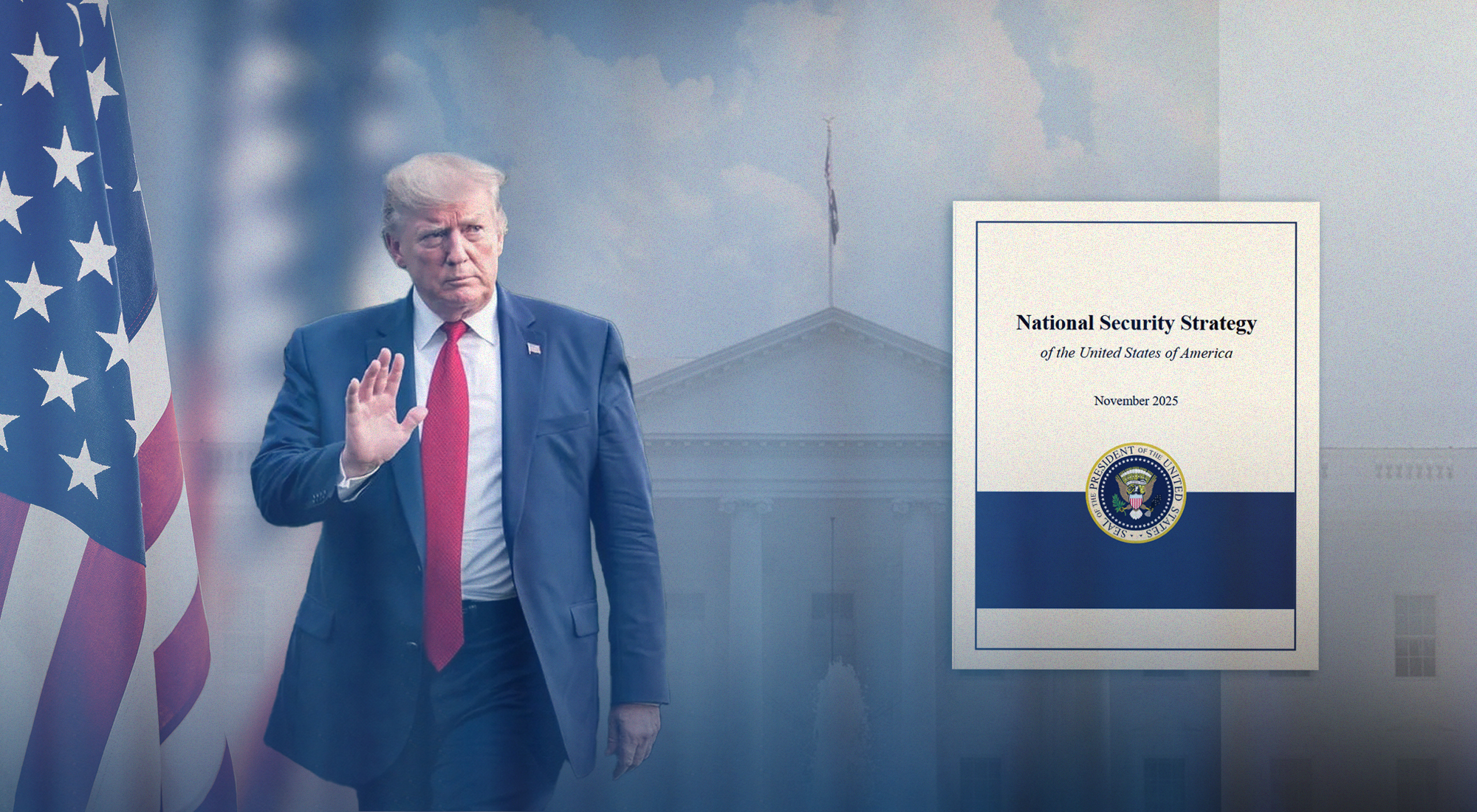



In his new National Security Strategy (NSS), U.S. President Donald Trump may seem like he is peddling ideas, concepts and objectives that are fundamentally different from those of his predecessors. In reality, though, his strategy shares several themes, policies, and methods with previous ones. You can blame his unapologetically blunt language for possibly making you think otherwise.
Here’s a big one, for example: “Peace Through Strength”—a term that permeates the NSS. Notice the cause and effect, so clearly articulated here: “America is strong and respected again—and because of that [my emphasis], we are making peace all over the world.”
Yet this isn’t anything new in U.S. foreign policy thinking. Even though President Ronald Reagan famously coined the phrase in the 1980s, it dates back to 1951 when President Harry Truman used it (Barry Goldwater did as well, a decade later). Since then, “Peace Through Strength” has been a favorite mantra of Republicans running for or in office.
If you’re a liberal internationalist, a realist, a traditional conservative, or a neoconservative, you will find much to disagree with in Trump’s NSS. But it’s almost like the authors anticipated that kind of criticism, devoting a whole section to an explanation of how this NSS uniquely and explicitly rejects ideological leanings or trappings of the past that led to disaster. They say that sheer pragmatism will rule the day in America’s dealings with the world. Indeed, anything that serves the U.S. national interest, no matter what its philosophical inspiration is, America will do it and won’t apologize for it.
Fair enough. But truly, is that fundamentally different from how the United States ran its foreign affairs in previous years, decades, and eras? Not necessarily. Even at the height of the Cold War, when the competition with the Soviet Union wasn’t just over influence and resources but also over values and norms, America on multiple occasions had to betray its belief system, exercise a healthy dose of pragmatism, and cooperate with its strategic rival, all in the interest of pursuing its own well-being.
The George W. Bush administration sincerely believed in the power of the Freedom Agenda around the world but was perfectly willing to bargain with various undemocratic nations to safeguard the U.S. national interest. The Obama and Biden administrations elevated human rights in their foreign policies but didn’t depart one bit from previous approaches. Presidents Barack Obama and Joe Biden pursued U.S. policies in the Middle East that clearly put energy security and U.S. arms sales above human rights.
So, while this NSS attacks its predecessors because they seemed to follow a certain political ideology, the truth is that they failed for a host of other reasons that had nothing to do with ideology. For example, America failed to prop up the post-9/11 Afghan and post-Saddam Iraqi governments after it occupied both nations, not because it was ideologically committed to grandiose ideas of nation-building and democracy promotion, but because it devised the worst possible plans for post-conflict governance and executed them in the worst possible way.
Let’s stay in the Middle East for a moment and see whether there is anything in the Trump NSS that’s really different. The document says that “we want to prevent an adversarial power from dominating the Middle East, its oil and gas supplies, and the chokepoints through which they pass while avoiding the “forever wars” that bogged us down in that region at great cost.”
The United States has been pursuing this goal in the region for at least the last eight decades. The difference the NSS authors wish to highlight is how the United States should go about this objective. No more open-ended military interventions and political reengineering missions that are supremely costly for the United States and end up failing, they say.
But again, the main reason why the United States got bogged down in Afghanistan and Iraq wasn’t because of liberal or neoconservative ideas being cooked in Washington but because of disastrous plans and even more disastrous implementation of those plans. Both failures could have been avoided had policymakers in Washington listened to advice from regional friends and stopped engaging in wishful thinking.
Beyond the Middle East, the immediate reaction of many commentators, who aren’t exactly fans of Trump to begin with, was that the administration is pursuing something dramatically different and uniquely dangerous: disengaging from the world, dumping traditional allies (especially the Europeans), and accommodating the interests of China and Russia.
None of these claims is convincing. Like every U.S. administration since the end of the Second World War, the current NSS sees America as having a global role, global interests, and global allies. If anything, the NSS suggests that the United States should expand its geographical interests and look more closely into the Americas. Does that sound like a retrenchment strategy? I don’t think so.
The NSS authors want you to believe that Trump is the only commander-in-chief who has concerns about free-riding behavior by various allies and partners. That is simply not true. Every administration since at least George W. Bush has raised this issue with allies and partners and tried to address it. All were largely unsuccessful. Maybe Trump will be more effective than his predecessors, maybe he won’t, but he isn’t the first and probably won’t be the last.
Critics of the NSS argue that it is more problematic than any before it because Trump wants a “reset” with Russia. But if memory serves, isn’t that exactly what Obama sought in 2009? How could one forget the infamous “RESET” red button that Secretary of State Hillary Clinton gave to her Russian counterpart, Sergei Lavrov? The English version of “RESET” was fine, but the Russian was not, saying “OVERLOAD” instead, due to two missing letters. The whole thing was a diplomatic embarrassment, and ultimately, the reset didn’t work. Will Trump succeed with Russia where others before him failed? We don’t know, but what we do know is that what he’s seeking is neither novel nor undesirable.
On China, many believe that Trump wasn’t hawkish enough, barely mentioning the country as an adversary that poses a significant threat to U.S. interests. But that’s only half true. In line with at least the last three strategies, the current NSS makes it quite clear that China is a big challenge. The problem is that it views that competition primarily from an economic lens, not a military one. That is a surprising and serious flaw in the document. Yet, contrary to what some surmised, Trump has kept the traditional U.S. commitment to Taiwan, stating that the United States “does not support unilateral change to the status quo in the Taiwan Strait.”
It’s true that the current NSS does not mention major power competition at all or view it as an organizing principle in foreign policy (like the last two strategies did, including Trump’s very own in 2017), but all the elements of that principle are right there. It’s rather ironic that those who vilified Trump in his first term for risking escalation with China and Russia because of his aggressive rhetoric are now criticizing him for allegedly being too soft and even conceding influence to America’s strategic adversaries.
There’s no question that Trump had some harsh words for the Europeans in the document, probably the harshest, but that doesn’t mean that he wants Europe to be weak. Quite the opposite. All you have to do is read the following to be convinced: “Europe remains strategically and culturally vital to the United States.” And then later: “Transatlantic trade remains one of the pillars of the global economy and of American prosperity.” That’s not exactly an unflattering U.S. view of or aggressive policy toward the Europeans.
The NSS’s blunt language, which reflects Trump’s communication style, might insinuate departures in U.S. foreign policy, but upon closer scrutiny, all that language does is mask some undisputable continuities. Give the NSS authors some credit because whether or not you agree with what they wrote, the document reflects quite clearly what Trump thinks and how he views the world. After all, this is his strategy, so it is important to know his concerns, his perspectives, and his priorities.
Needless to say, the current NSS, like all of its predecessors, is vocal on overall strategic guidance but silent on how resources should be allocated to implement the stated objectives. This is where national security strategies either fail or succeed. But to obtain that kind of detail, we have to wait for the release of the National Defense Strategy (NDS), which is currently under development. The NDS is expected to prioritize defending the U.S. homeland and deterring China in the Indo-Pacific. At the same time, the NDS will prioritize increasing burden-sharing with allies and partners around the world, strengthening those relationships and setting conditions for lasting peace. Does any of this sound like a departure from previous strategies? Again, not quite.