


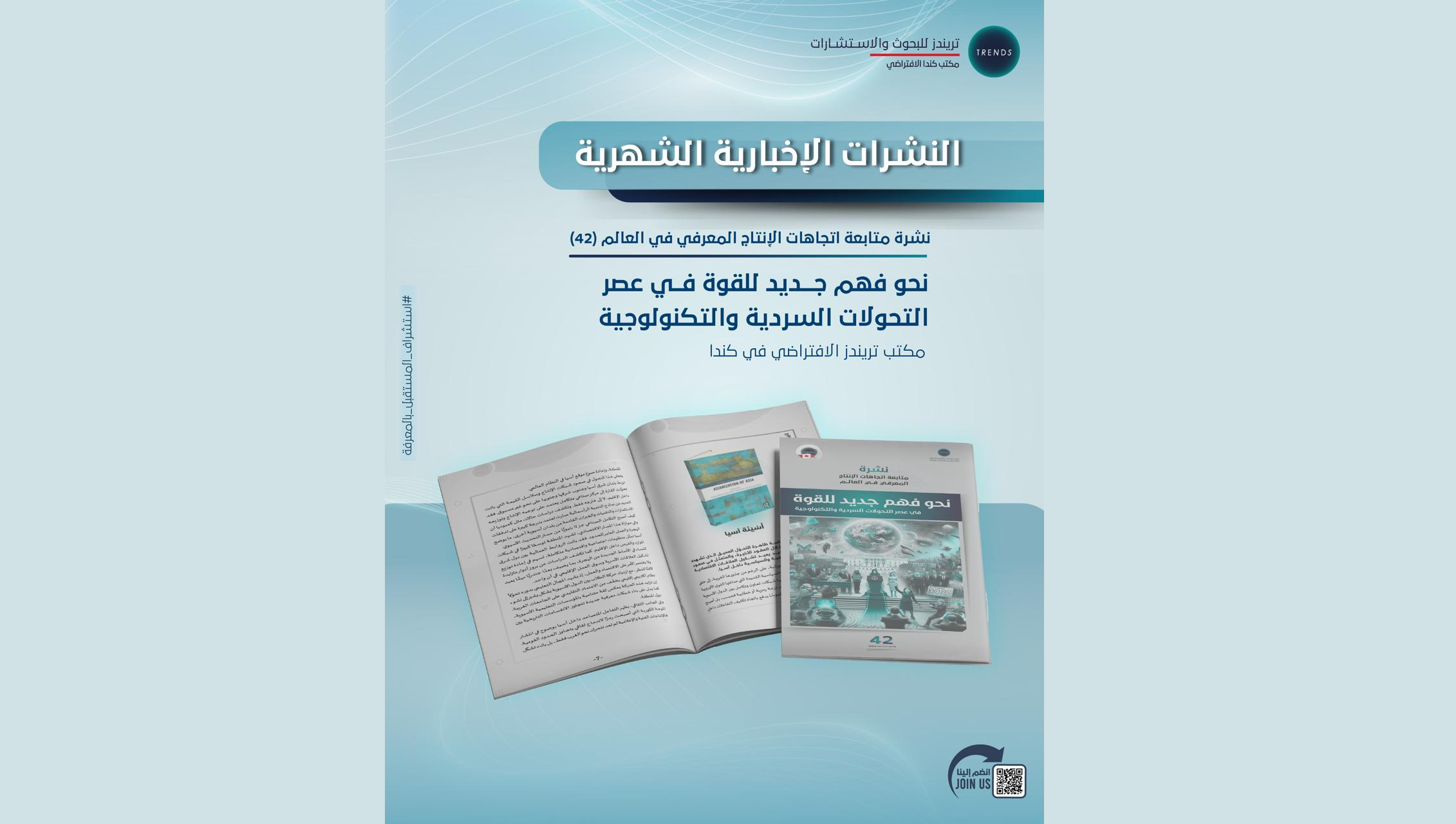
Against a global backdrop marked by rapid knowledge transformations, intersecting influences, and competing narratives, TRENDS Research & Advisory continues to deliver in-depth analyses of trends shaping global knowledge production through its periodic bulletin. The latest edition (No. 42) of the TRENDS bulletin, produced by its virtual office in Canada, offers a rigorous analytical exploration of shifting configurations of power and knowledge in the 21st century, amid the rising influence of AI, the spread of political disinformation, and the transformation of narratives into strategic instruments reshaping politics, society, and the economy at both national and international levels.
The issue presents an integrated intellectual reading of books and studies that may appear thematically diverse, yet converge on a single governing logic of the contemporary world: the struggle to shape the future through control of the collective imagination, the reconfiguration of perception, and command over the symbolic and organizational structures that define what is possible or desirable in modern societies.
It highlights how power is no longer exercised solely through laws and traditional institutions, but increasingly through the management of collective imagination and the manufacture of individual aspirations. This dynamic unfolds within what studies describe as “project societies,” where desires and hopes are reframed as tools for reproducing power, intersecting with theories of biopower and critiques of neoliberal capitalism.
The issue also addresses political disinformation as a direct threat to collective perception, not merely to factual truth. It argues that false narratives create alternative realities that marginalize lived experience, hollow out the substance of freedom, and turn citizens into actors operating within cognitively managed environments. From this perspective, today’s crisis is framed as a crisis of political imagination before it is a crisis of democratic institutions.
At the international level, the bulletin underscores that information has become a strategic weapon no less consequential than military force. It examines how narratives have been weaponized in contemporary conflicts, from the Russia-Ukraine war to crises across the Middle East and Africa, elevating cognitive security to a core pillar of the modern state’s future.
A substantial section is devoted to the implications of AI, stressing that its impact extends beyond economics and politics to the redefinition of human agency itself. The analysis explores prospects of crossing biological boundaries and the emergence of hybrid models, raising profound philosophical and ethical questions about cognitive sovereignty and human existence.
The issue concludes that the defining battle of the 21st century is not over territory or resources, but over the right to imagine and shape the future. It warns that losing the capacity for imagination or trust in shared truth amounts to surrendering societal destiny to external forces or cloaked ideologies. Reclaiming the collective imagination and building institutions that safeguard truth are therefore essential pathways to liberation in the age of AI.
