


#Experts and Analysts:
 In-depth Dialogues and Discussions
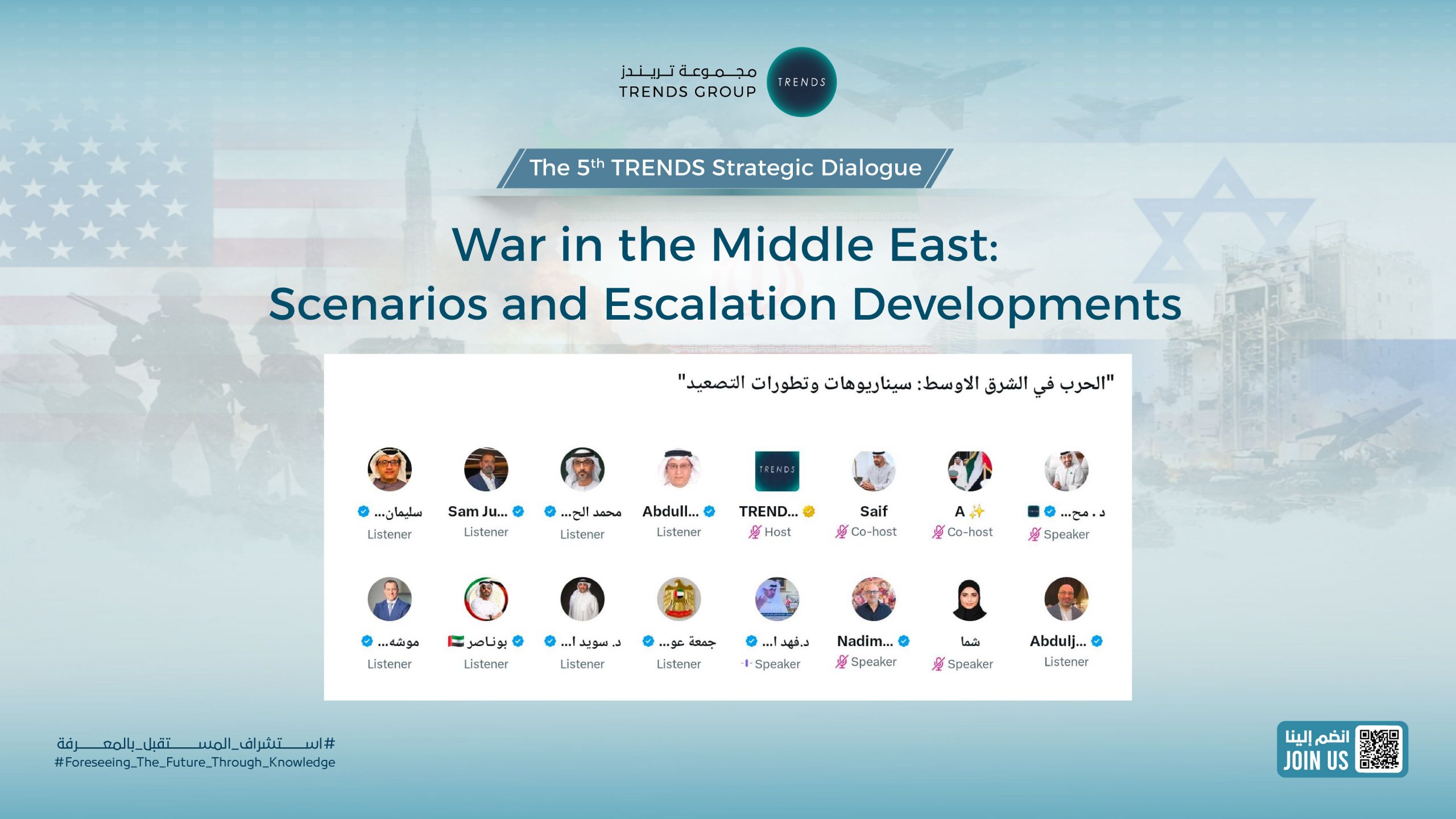
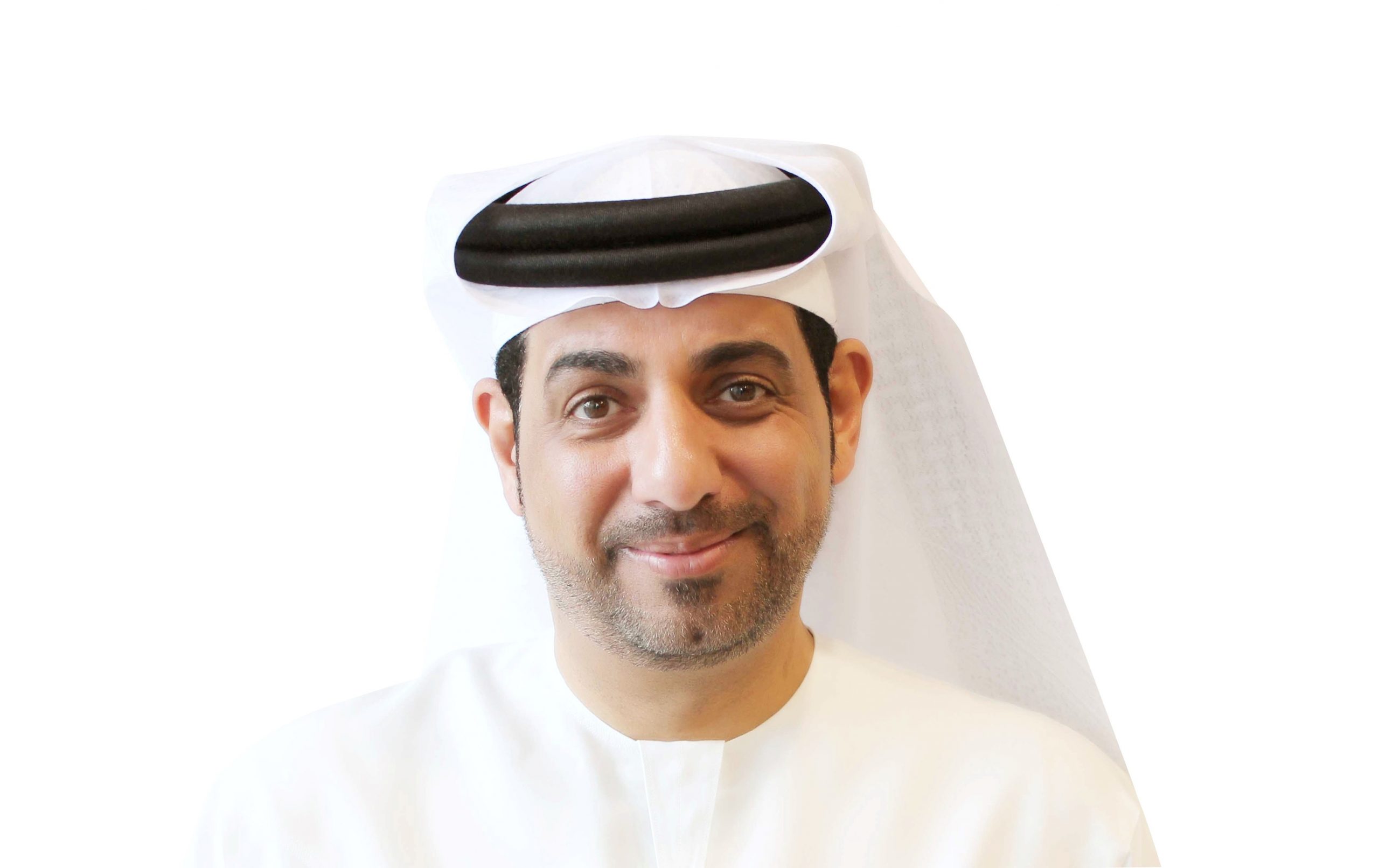
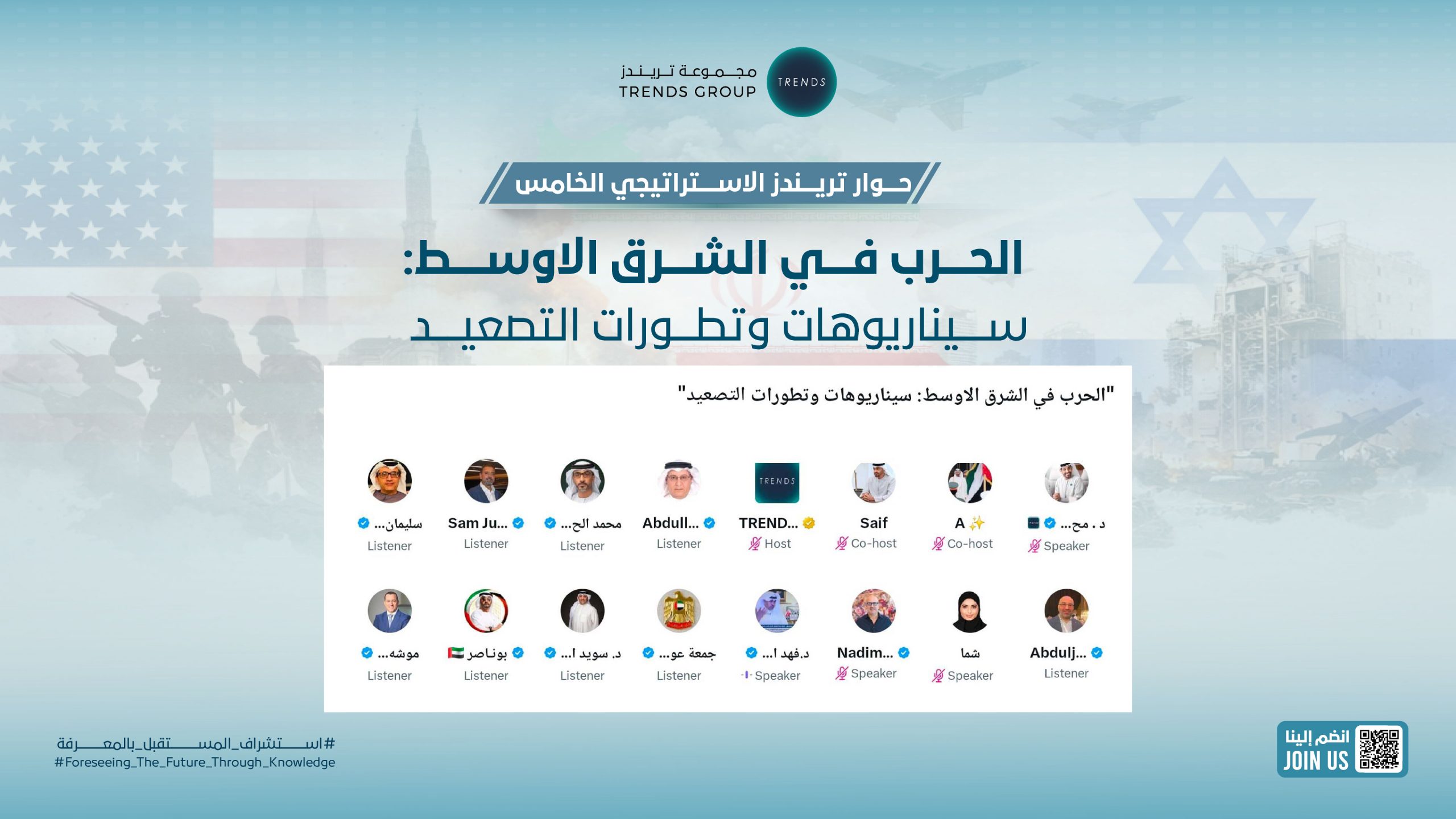
Dr. Mohammed Abdullah Al-Ali, CEO of the TRENDS Group, said that organizing the fifth strategic dialogue via the X platform was not merely a technical choice, but one that reflects the nature of the current moment. Events are unfolding rapidly, interactions are expanding, and audiences are seeking platforms that combine immediacy with depth. For this reason the decision was made to host the dialogue in a live, open, and borderless space, ensuring that conferences, discussions, and analysis are no longer confined to closed rooms, but instead reach a wider audience both within the region and beyond.
Dr. Al-Ali added that the TRENDS Group was keen to bring together a distinguished group of researchers, academics, analysts, and media professionals to share their insights and perspectives on the evolving escalation in the Middle East, the potential scenarios of the conflict, and expectations for the post-war phase. He noted that the current landscape is too complex to be understood from a single perspective, and instead requires a diversity of viewpoints and an integration of strategic analysis, political assessment, media coverage, and research expertise.
A Rapid Global Crisis
The dialogue began with Fahad Al Mahri, Senior Researcher at TRENDS, emphasizing that 11 regional countries were directly affected by the war and that more than 40 countries joined an international coalition to secure navigation through the Strait of Hormuz, through which approximately 20 percent of global oil consumption passes. The cost of maritime insurance also increased by up to 400 percent, leading to higher global shipping costs and higher basic commodity prices.
He stated that this war is not confined to a specific geographical area but has become an accelerating global crisis affecting energy security, food supply chains, and the economic stability of individuals worldwide. The dynamics of confrontation have become increasingly interconnected, posing both direct and indirect threats to the lives and security of approximately 8 billion people, making anticipation of the region’s future not an intellectual luxury but an urgent necessity for safeguarding security.
«Active Defense» Model
For his part, Dr. Fahd Al Shelaimi, Chairman of the Gulf Forum for Security and Peace, stated that war is fundamentally a political instrument that ultimately seeks to impose negotiations, arguing that the Gulf states have adopted the “Active Defense” model in the current conflict, which represents a rational option that balances deterrence while avoiding escalation into a comprehensive confrontation. He added that field experience has demonstrated the Gulf states’ ability to withstand and respond to threats without internal collapse, thereby enhancing confidence in their capabilities.
Al Shelaimi explained that the Gulf states’ decision to abstain from offensive escalation is a calculated measure to preserve channels for a political solution, as Iran transitions from being a regional challenge to a direct threat, owing to its geographical proximity and reliance on unconventional tools, including missile capabilities and covert operatives (sleeper cells).
He added that the war’s outcomes depend on internal Iranian decision-making, given the Revolutionary Guard’s dominance over military affairs. He also noted that the threat to close the Strait of Hormuz involves operational disruptions rather than a complete shutdown. He concluded that there is potential for diplomatic progress, contingent upon Iran’s recognition of the magnitude of its losses.
Military Escalation and Diplomacy
Journalist and political writer Nadim Koteich confirmed that U.S. President Donald Trump rejects the notion that military escalation and diplomacy are mutually contradictory, asserting that the two operate in a coordinated manner within a comprehensive pressure strategy to impose a political settlement on Iran that addresses its nuclear program and regional subversive capabilities.
Koteich pointed out that military escalation is not a goal in itself. Still, it is rather a means to create a new reality that pushes Iran toward negotiating on less favorable terms, indicating that the Arab Gulf states have already begun considering the post-war phase, focusing on the structure of the regional security system and mechanisms to ensure the conflict is not repeated.
He noted that the Strait of Hormuz is a central issue in any future settlement, along with the need to establish mechanisms to regulate Iranian behavior. He believes the Gulf states did not initiate the war, but that addressing it should result in a sustainable regional security system.
The Region Future Post-War
Journalist Mohamed Al Hammadi explained that the Arab Gulf states have demonstrated their strength and unity in this conflict and must consider the region’s post-war future by investing in their achievements and reshaping global perceptions of their defensive capabilities, indicating that the war constituted a real test of the Gulf states’ ability to withstand the crisis, manage it effectively, and confront both military and media campaigns, thereby facilitating their emergence as a regional power.
Al Hammadi noted that there is general Gulf unity, though it is not absolute, given natural differences in assessments and strategies toward Iran. However, the main objective of the Gulf states is to prevent a recurrence of Iranian attacks, which necessitates addressing the root causes of the threat rather than merely ending the war.
He also emphasized that Iran targeted civilian infrastructure across regional states, strengthening the justification for seeking post-war reparations, particularly as the Gulf states do not aim to expand the conflict but rather to contain it, distinguishing between the Iranian populace and the regime, with the fundamental issue being the regime’s conduct.
Adapting to Threats
Writer and political analyst Abdullah Al-Junaid presented an analysis of the conflict’s strategic structure, in which the scenario involves three main powers — the United States, Israel, and Iran — each with distinct objectives. However, the current phase should focus on the war’s outcomes rather than its process, particularly to ensure the crisis is not repeated. He argued that diplomacy should not be understood solely as a soft instrument but can also take a hard form, including the use of force when necessary.
Al-Junaid stressed that the Gulf states have demonstrated their ability to absorb setbacks and adapt to threats, and may even adopt an offensive posture if strategic interests necessitate it. He considered the Strait of Hormuz crisis to be the focus of the next phase, as any shift in control over it could alter regional power balances. He emphasized the need for the Gulf states to participate actively in negotiations, rather than merely receiving outcomes, reflecting a more autonomous regional role.
Reassessing Alliances
Researcher and media figure Dr. Sulaiman Al-Hattlan pointed out that the war, despite its adverse effects, revealed significant strengths of the Gulf Arab states, including confidence in their defensive capabilities and a reassessment of alliances grounded in pragmatic interests. He contends that the region will remain unstable unless neighboring countries implement governance reforms aimed at development and stability. He emphasized that the issue lies not with the Iranian populace but with the Iranian political system.
Al-Hattlan raised several strategic questions, particularly concerning the intentions of the U.S. President, including whether the objective is regime change or mere containment, and whether the war will be concluded or remain in a state of strategic suspension. He further questioned Iran’s decision-making centers, the role of the Islamic Revolutionary Guard Corps and Mojtaba Khamenei, and the potential continuation of the duality between moderate political discourse and hardline military behavior. He concluded his speech by stating that Iran is no longer an existential threat as in the past but will remain a strategic nuisance, impacting regional stability and development plans.
In-depth Dialogues and Discussions
Dr. Mohammed Abdullah Al-Ali, CEO of the TRENDS Group, said that organizing the fifth strategic dialogue via the X platform was not merely a technical choice, but one that reflects the nature of the current moment. Events are unfolding rapidly, interactions are expanding, and audiences are seeking platforms that combine immediacy with depth. For this reason the decision was made to host the dialogue in a live, open, and borderless space, ensuring that conferences, discussions, and analysis are no longer confined to closed rooms, but instead reach a wider audience both within the region and beyond.
Dr. Al-Ali added that the TRENDS Group was keen to bring together a distinguished group of researchers, academics, analysts, and media professionals to share their insights and perspectives on the evolving escalation in the Middle East, the potential scenarios of the conflict, and expectations for the post-war phase. He noted that the current landscape is too complex to be understood from a single perspective, and instead requires a diversity of viewpoints and an integration of strategic analysis, political assessment, media coverage, and research expertise.
A Rapid Global Crisis
The dialogue began with Fahad Al Mahri, Senior Researcher at TRENDS, emphasizing that 11 regional countries were directly affected by the war and that more than 40 countries joined an international coalition to secure navigation through the Strait of Hormuz, through which approximately 20 percent of global oil consumption passes. The cost of maritime insurance also increased by up to 400 percent, leading to higher global shipping costs and higher basic commodity prices.
He stated that this war is not confined to a specific geographical area but has become an accelerating global crisis affecting energy security, food supply chains, and the economic stability of individuals worldwide. The dynamics of confrontation have become increasingly interconnected, posing both direct and indirect threats to the lives and security of approximately 8 billion people, making anticipation of the region’s future not an intellectual luxury but an urgent necessity for safeguarding security.
«Active Defense» Model
For his part, Dr. Fahd Al Shelaimi, Chairman of the Gulf Forum for Security and Peace, stated that war is fundamentally a political instrument that ultimately seeks to impose negotiations, arguing that the Gulf states have adopted the “Active Defense” model in the current conflict, which represents a rational option that balances deterrence while avoiding escalation into a comprehensive confrontation. He added that field experience has demonstrated the Gulf states’ ability to withstand and respond to threats without internal collapse, thereby enhancing confidence in their capabilities.
Al Shelaimi explained that the Gulf states’ decision to abstain from offensive escalation is a calculated measure to preserve channels for a political solution, as Iran transitions from being a regional challenge to a direct threat, owing to its geographical proximity and reliance on unconventional tools, including missile capabilities and covert operatives (sleeper cells).
He added that the war’s outcomes depend on internal Iranian decision-making, given the Revolutionary Guard’s dominance over military affairs. He also noted that the threat to close the Strait of Hormuz involves operational disruptions rather than a complete shutdown. He concluded that there is potential for diplomatic progress, contingent upon Iran’s recognition of the magnitude of its losses.
Military Escalation and Diplomacy
Journalist and political writer Nadim Koteich confirmed that U.S. President Donald Trump rejects the notion that military escalation and diplomacy are mutually contradictory, asserting that the two operate in a coordinated manner within a comprehensive pressure strategy to impose a political settlement on Iran that addresses its nuclear program and regional subversive capabilities.
Koteich pointed out that military escalation is not a goal in itself. Still, it is rather a means to create a new reality that pushes Iran toward negotiating on less favorable terms, indicating that the Arab Gulf states have already begun considering the post-war phase, focusing on the structure of the regional security system and mechanisms to ensure the conflict is not repeated.
He noted that the Strait of Hormuz is a central issue in any future settlement, along with the need to establish mechanisms to regulate Iranian behavior. He believes the Gulf states did not initiate the war, but that addressing it should result in a sustainable regional security system.
The Region Future Post-War
Journalist Mohamed Al Hammadi explained that the Arab Gulf states have demonstrated their strength and unity in this conflict and must consider the region’s post-war future by investing in their achievements and reshaping global perceptions of their defensive capabilities, indicating that the war constituted a real test of the Gulf states’ ability to withstand the crisis, manage it effectively, and confront both military and media campaigns, thereby facilitating their emergence as a regional power.
Al Hammadi noted that there is general Gulf unity, though it is not absolute, given natural differences in assessments and strategies toward Iran. However, the main objective of the Gulf states is to prevent a recurrence of Iranian attacks, which necessitates addressing the root causes of the threat rather than merely ending the war.
He also emphasized that Iran targeted civilian infrastructure across regional states, strengthening the justification for seeking post-war reparations, particularly as the Gulf states do not aim to expand the conflict but rather to contain it, distinguishing between the Iranian populace and the regime, with the fundamental issue being the regime’s conduct.
Adapting to Threats
Writer and political analyst Abdullah Al-Junaid presented an analysis of the conflict’s strategic structure, in which the scenario involves three main powers — the United States, Israel, and Iran — each with distinct objectives. However, the current phase should focus on the war’s outcomes rather than its process, particularly to ensure the crisis is not repeated. He argued that diplomacy should not be understood solely as a soft instrument but can also take a hard form, including the use of force when necessary.
Al-Junaid stressed that the Gulf states have demonstrated their ability to absorb setbacks and adapt to threats, and may even adopt an offensive posture if strategic interests necessitate it. He considered the Strait of Hormuz crisis to be the focus of the next phase, as any shift in control over it could alter regional power balances. He emphasized the need for the Gulf states to participate actively in negotiations, rather than merely receiving outcomes, reflecting a more autonomous regional role.
Reassessing Alliances
Researcher and media figure Dr. Sulaiman Al-Hattlan pointed out that the war, despite its adverse effects, revealed significant strengths of the Gulf Arab states, including confidence in their defensive capabilities and a reassessment of alliances grounded in pragmatic interests. He contends that the region will remain unstable unless neighboring countries implement governance reforms aimed at development and stability. He emphasized that the issue lies not with the Iranian populace but with the Iranian political system.
Al-Hattlan raised several strategic questions, particularly concerning the intentions of the U.S. President, including whether the objective is regime change or mere containment, and whether the war will be concluded or remain in a state of strategic suspension. He further questioned Iran’s decision-making centers, the role of the Islamic Revolutionary Guard Corps and Mojtaba Khamenei, and the potential continuation of the duality between moderate political discourse and hardline military behavior. He concluded his speech by stating that Iran is no longer an existential threat as in the past but will remain a strategic nuisance, impacting regional stability and development plans.
 Negotiation Strategy
Writer and political analyst Mohammed Khalfan Al-Sawafi considered the Strait of Hormuz a central point in the current conflict, indicating that President Trump’s statements are part of a negotiating strategy combining military pressure and political maneuvering, signaling that the United States will not permit the closure of the strait, either through an international coalition or unilaterally, and that the current military buildup reflects genuine readiness to resolve the situation rather than merely a show of force.
He pointed to regional and international efforts to form a maritime alliance, warning against marginalizing the Gulf states’ role in managing the strait, as they should assume primary responsibility as the littoral states. He added that Iran is not realistically capable of closing the Strait but employs the threat as a pressure mechanism. He further contended that Tehran’s acceptance of U.S. conditions is unlikely, as it would entail the demise of the Iranian regime.
Negotiation Strategy
Writer and political analyst Mohammed Khalfan Al-Sawafi considered the Strait of Hormuz a central point in the current conflict, indicating that President Trump’s statements are part of a negotiating strategy combining military pressure and political maneuvering, signaling that the United States will not permit the closure of the strait, either through an international coalition or unilaterally, and that the current military buildup reflects genuine readiness to resolve the situation rather than merely a show of force.
He pointed to regional and international efforts to form a maritime alliance, warning against marginalizing the Gulf states’ role in managing the strait, as they should assume primary responsibility as the littoral states. He added that Iran is not realistically capable of closing the Strait but employs the threat as a pressure mechanism. He further contended that Tehran’s acceptance of U.S. conditions is unlikely, as it would entail the demise of the Iranian regime.
 Employing Political Discourse
Shamma Al Qutbah, a researcher at TRENDS, argued that the apparent discrepancy between U.S. and Iranian statements is deliberate, reflecting divergent approaches to political discourse. Trump’s speech is directed primarily at the U.S. public, aiming to reassure public opinion amid economic pressures.
Al Qutbah stated that Iranian discourse downplays the importance of negotiations to avoid being perceived domestically as a concession or weakness, while seeking to project an image of strength and sovereignty to its internal audience. She added that both sides employ discourse to serve internal priorities rather than to convey an accurate representation of the negotiating reality. Understanding the conflict requires reading between the lines of official statements, as what is expressed does not always reflect the actual developments.
Employing Political Discourse
Shamma Al Qutbah, a researcher at TRENDS, argued that the apparent discrepancy between U.S. and Iranian statements is deliberate, reflecting divergent approaches to political discourse. Trump’s speech is directed primarily at the U.S. public, aiming to reassure public opinion amid economic pressures.
Al Qutbah stated that Iranian discourse downplays the importance of negotiations to avoid being perceived domestically as a concession or weakness, while seeking to project an image of strength and sovereignty to its internal audience. She added that both sides employ discourse to serve internal priorities rather than to convey an accurate representation of the negotiating reality. Understanding the conflict requires reading between the lines of official statements, as what is expressed does not always reflect the actual developments.
- The Gulf Arab states’ stance as “Active Defender” is a wise decision… entering the war is a dangerous step
- Political and diplomatic solutions are still possible under the international and regional efforts to stop the war
- The Strait of Hormuz is the main element of the next phase, and the war has practically reached its final stages
- Iran no longer poses the same real threat as it did before this war, but it will remain a strategic nuisance
- The Gulf states need to develop the Peninsula Shield Force to be a forward force in confronting crises
In-depth Dialogues and Discussions
Dr. Mohammed Abdullah Al-Ali, CEO of the TRENDS Group, said that organizing the fifth strategic dialogue via the X platform was not merely a technical choice, but one that reflects the nature of the current moment. Events are unfolding rapidly, interactions are expanding, and audiences are seeking platforms that combine immediacy with depth. For this reason the decision was made to host the dialogue in a live, open, and borderless space, ensuring that conferences, discussions, and analysis are no longer confined to closed rooms, but instead reach a wider audience both within the region and beyond.
Dr. Al-Ali added that the TRENDS Group was keen to bring together a distinguished group of researchers, academics, analysts, and media professionals to share their insights and perspectives on the evolving escalation in the Middle East, the potential scenarios of the conflict, and expectations for the post-war phase. He noted that the current landscape is too complex to be understood from a single perspective, and instead requires a diversity of viewpoints and an integration of strategic analysis, political assessment, media coverage, and research expertise.
A Rapid Global Crisis
The dialogue began with Fahad Al Mahri, Senior Researcher at TRENDS, emphasizing that 11 regional countries were directly affected by the war and that more than 40 countries joined an international coalition to secure navigation through the Strait of Hormuz, through which approximately 20 percent of global oil consumption passes. The cost of maritime insurance also increased by up to 400 percent, leading to higher global shipping costs and higher basic commodity prices.
He stated that this war is not confined to a specific geographical area but has become an accelerating global crisis affecting energy security, food supply chains, and the economic stability of individuals worldwide. The dynamics of confrontation have become increasingly interconnected, posing both direct and indirect threats to the lives and security of approximately 8 billion people, making anticipation of the region’s future not an intellectual luxury but an urgent necessity for safeguarding security.
«Active Defense» Model
For his part, Dr. Fahd Al Shelaimi, Chairman of the Gulf Forum for Security and Peace, stated that war is fundamentally a political instrument that ultimately seeks to impose negotiations, arguing that the Gulf states have adopted the “Active Defense” model in the current conflict, which represents a rational option that balances deterrence while avoiding escalation into a comprehensive confrontation. He added that field experience has demonstrated the Gulf states’ ability to withstand and respond to threats without internal collapse, thereby enhancing confidence in their capabilities.
Al Shelaimi explained that the Gulf states’ decision to abstain from offensive escalation is a calculated measure to preserve channels for a political solution, as Iran transitions from being a regional challenge to a direct threat, owing to its geographical proximity and reliance on unconventional tools, including missile capabilities and covert operatives (sleeper cells).
He added that the war’s outcomes depend on internal Iranian decision-making, given the Revolutionary Guard’s dominance over military affairs. He also noted that the threat to close the Strait of Hormuz involves operational disruptions rather than a complete shutdown. He concluded that there is potential for diplomatic progress, contingent upon Iran’s recognition of the magnitude of its losses.
Military Escalation and Diplomacy
Journalist and political writer Nadim Koteich confirmed that U.S. President Donald Trump rejects the notion that military escalation and diplomacy are mutually contradictory, asserting that the two operate in a coordinated manner within a comprehensive pressure strategy to impose a political settlement on Iran that addresses its nuclear program and regional subversive capabilities.
Koteich pointed out that military escalation is not a goal in itself. Still, it is rather a means to create a new reality that pushes Iran toward negotiating on less favorable terms, indicating that the Arab Gulf states have already begun considering the post-war phase, focusing on the structure of the regional security system and mechanisms to ensure the conflict is not repeated.
He noted that the Strait of Hormuz is a central issue in any future settlement, along with the need to establish mechanisms to regulate Iranian behavior. He believes the Gulf states did not initiate the war, but that addressing it should result in a sustainable regional security system.
The Region Future Post-War
Journalist Mohamed Al Hammadi explained that the Arab Gulf states have demonstrated their strength and unity in this conflict and must consider the region’s post-war future by investing in their achievements and reshaping global perceptions of their defensive capabilities, indicating that the war constituted a real test of the Gulf states’ ability to withstand the crisis, manage it effectively, and confront both military and media campaigns, thereby facilitating their emergence as a regional power.
Al Hammadi noted that there is general Gulf unity, though it is not absolute, given natural differences in assessments and strategies toward Iran. However, the main objective of the Gulf states is to prevent a recurrence of Iranian attacks, which necessitates addressing the root causes of the threat rather than merely ending the war.
He also emphasized that Iran targeted civilian infrastructure across regional states, strengthening the justification for seeking post-war reparations, particularly as the Gulf states do not aim to expand the conflict but rather to contain it, distinguishing between the Iranian populace and the regime, with the fundamental issue being the regime’s conduct.
Adapting to Threats
Writer and political analyst Abdullah Al-Junaid presented an analysis of the conflict’s strategic structure, in which the scenario involves three main powers — the United States, Israel, and Iran — each with distinct objectives. However, the current phase should focus on the war’s outcomes rather than its process, particularly to ensure the crisis is not repeated. He argued that diplomacy should not be understood solely as a soft instrument but can also take a hard form, including the use of force when necessary.
Al-Junaid stressed that the Gulf states have demonstrated their ability to absorb setbacks and adapt to threats, and may even adopt an offensive posture if strategic interests necessitate it. He considered the Strait of Hormuz crisis to be the focus of the next phase, as any shift in control over it could alter regional power balances. He emphasized the need for the Gulf states to participate actively in negotiations, rather than merely receiving outcomes, reflecting a more autonomous regional role.
Reassessing Alliances
Researcher and media figure Dr. Sulaiman Al-Hattlan pointed out that the war, despite its adverse effects, revealed significant strengths of the Gulf Arab states, including confidence in their defensive capabilities and a reassessment of alliances grounded in pragmatic interests. He contends that the region will remain unstable unless neighboring countries implement governance reforms aimed at development and stability. He emphasized that the issue lies not with the Iranian populace but with the Iranian political system.
Al-Hattlan raised several strategic questions, particularly concerning the intentions of the U.S. President, including whether the objective is regime change or mere containment, and whether the war will be concluded or remain in a state of strategic suspension. He further questioned Iran’s decision-making centers, the role of the Islamic Revolutionary Guard Corps and Mojtaba Khamenei, and the potential continuation of the duality between moderate political discourse and hardline military behavior. He concluded his speech by stating that Iran is no longer an existential threat as in the past but will remain a strategic nuisance, impacting regional stability and development plans.
Negotiation Strategy
Writer and political analyst Mohammed Khalfan Al-Sawafi considered the Strait of Hormuz a central point in the current conflict, indicating that President Trump’s statements are part of a negotiating strategy combining military pressure and political maneuvering, signaling that the United States will not permit the closure of the strait, either through an international coalition or unilaterally, and that the current military buildup reflects genuine readiness to resolve the situation rather than merely a show of force.
He pointed to regional and international efforts to form a maritime alliance, warning against marginalizing the Gulf states’ role in managing the strait, as they should assume primary responsibility as the littoral states. He added that Iran is not realistically capable of closing the Strait but employs the threat as a pressure mechanism. He further contended that Tehran’s acceptance of U.S. conditions is unlikely, as it would entail the demise of the Iranian regime.
Employing Political Discourse
Shamma Al Qutbah, a researcher at TRENDS, argued that the apparent discrepancy between U.S. and Iranian statements is deliberate, reflecting divergent approaches to political discourse. Trump’s speech is directed primarily at the U.S. public, aiming to reassure public opinion amid economic pressures.
Al Qutbah stated that Iranian discourse downplays the importance of negotiations to avoid being perceived domestically as a concession or weakness, while seeking to project an image of strength and sovereignty to its internal audience. She added that both sides employ discourse to serve internal priorities rather than to convey an accurate representation of the negotiating reality. Understanding the conflict requires reading between the lines of official statements, as what is expressed does not always reflect the actual developments.
