


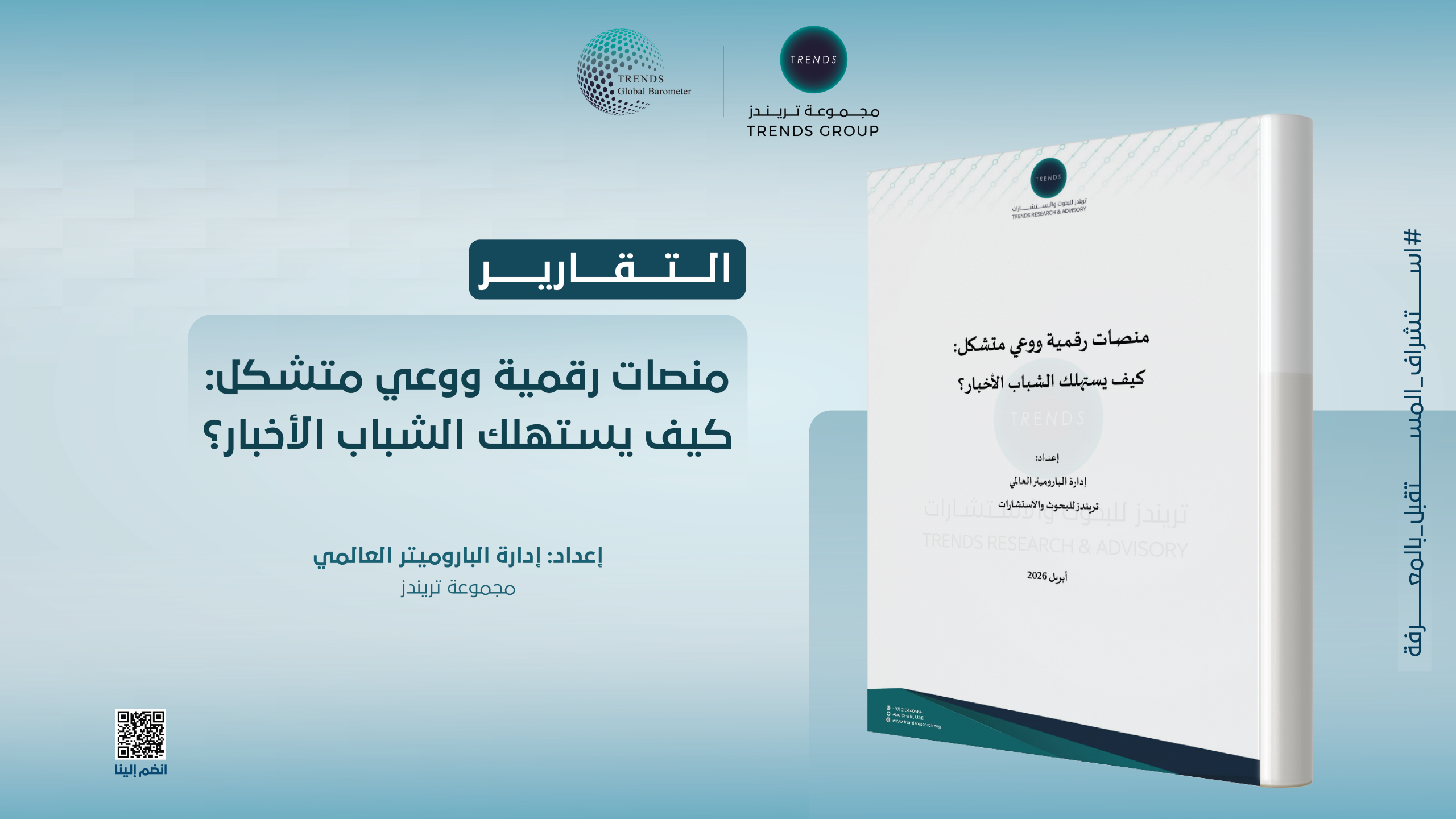
TRENDS Group’s Global Barometer Sector has released a report titled Digital Platforms and Shaped Awareness: How Do Youth Consume News?, which examines the structural transformation of youth news consumption patterns. The report focuses on the roles of digital platforms, algorithms, and incidental exposure as central factors in shaping the new information environment.
The report analyzes the shift in youth news consumption patterns, which reflects a structural transition in the media system. Digital platforms are no longer merely intermediaries for transmitting information; rather, they have become the framework through which news is reshaped and its priorities determined.
It explains that this transformation has shifted the center of influence from traditional media institutions to fast-paced, continuous digital environments, making news consumption part of daily activity rather than a separate or periodic practice.
 Spread of Misinformation
The report confirms that this reality has created challenges regarding the quality and credibility of information. The erosion of traditional editorial controls, coupled with the ease of producing and disseminating content, has contributed to the spread of misinformation and increased the cost of verification for users. As a result, access to news is no longer the primary challenge; rather, the ability to evaluate it and understand its context has become paramount.
The report indicates that algorithms now play a central role in this equation, reshaping the news consumption experience by personalizing content based on digital behavior. While this model enhances access efficiency, it may also narrow exposure to information by reinforcing informational silos that limit diversity and shape perceptions of public issues.
At the same time, the report notes that the digital environment has created greater space for public participation, as young people have become more active in sharing and engaging with news. This expansion in participation strengthens their presence in public discourse, but it remains closely linked to the quality of the information environment in which they operate.
Enhancing Media Literacy
The report stresses that addressing this transformation requires an integrated approach focused on three interconnected pillars: empowering individuals by enhancing media literacy, developing policies that ensure platform transparency and accountability, and supporting professional media institutions to guarantee the continued production of reliable content and in-depth analysis.
The report further notes that news consumption is no longer always intentional; a significant portion of exposure to news content occurs incidentally during everyday browsing. This means that awareness is sometimes shaped without the user’s direct realization. This pattern redefines the relationship between audiences and news, raising questions about the depth of understanding and the level of information verification.
As for decision-making, the report highlights that the importance of this transformation lies in the fact that news sources are no longer neutral or static; rather, they are dynamic and algorithmically driven. This directly affects levels of trust and how young people engage with political and social issues, particularly in the context of rapidly evolving crises.
Spread of Misinformation
The report confirms that this reality has created challenges regarding the quality and credibility of information. The erosion of traditional editorial controls, coupled with the ease of producing and disseminating content, has contributed to the spread of misinformation and increased the cost of verification for users. As a result, access to news is no longer the primary challenge; rather, the ability to evaluate it and understand its context has become paramount.
The report indicates that algorithms now play a central role in this equation, reshaping the news consumption experience by personalizing content based on digital behavior. While this model enhances access efficiency, it may also narrow exposure to information by reinforcing informational silos that limit diversity and shape perceptions of public issues.
At the same time, the report notes that the digital environment has created greater space for public participation, as young people have become more active in sharing and engaging with news. This expansion in participation strengthens their presence in public discourse, but it remains closely linked to the quality of the information environment in which they operate.
Enhancing Media Literacy
The report stresses that addressing this transformation requires an integrated approach focused on three interconnected pillars: empowering individuals by enhancing media literacy, developing policies that ensure platform transparency and accountability, and supporting professional media institutions to guarantee the continued production of reliable content and in-depth analysis.
The report further notes that news consumption is no longer always intentional; a significant portion of exposure to news content occurs incidentally during everyday browsing. This means that awareness is sometimes shaped without the user’s direct realization. This pattern redefines the relationship between audiences and news, raising questions about the depth of understanding and the level of information verification.
As for decision-making, the report highlights that the importance of this transformation lies in the fact that news sources are no longer neutral or static; rather, they are dynamic and algorithmically driven. This directly affects levels of trust and how young people engage with political and social issues, particularly in the context of rapidly evolving crises.

Spread of Misinformation
The report confirms that this reality has created challenges regarding the quality and credibility of information. The erosion of traditional editorial controls, coupled with the ease of producing and disseminating content, has contributed to the spread of misinformation and increased the cost of verification for users. As a result, access to news is no longer the primary challenge; rather, the ability to evaluate it and understand its context has become paramount.
The report indicates that algorithms now play a central role in this equation, reshaping the news consumption experience by personalizing content based on digital behavior. While this model enhances access efficiency, it may also narrow exposure to information by reinforcing informational silos that limit diversity and shape perceptions of public issues.
At the same time, the report notes that the digital environment has created greater space for public participation, as young people have become more active in sharing and engaging with news. This expansion in participation strengthens their presence in public discourse, but it remains closely linked to the quality of the information environment in which they operate.
Enhancing Media Literacy
The report stresses that addressing this transformation requires an integrated approach focused on three interconnected pillars: empowering individuals by enhancing media literacy, developing policies that ensure platform transparency and accountability, and supporting professional media institutions to guarantee the continued production of reliable content and in-depth analysis.
The report further notes that news consumption is no longer always intentional; a significant portion of exposure to news content occurs incidentally during everyday browsing. This means that awareness is sometimes shaped without the user’s direct realization. This pattern redefines the relationship between audiences and news, raising questions about the depth of understanding and the level of information verification.
As for decision-making, the report highlights that the importance of this transformation lies in the fact that news sources are no longer neutral or static; rather, they are dynamic and algorithmically driven. This directly affects levels of trust and how young people engage with political and social issues, particularly in the context of rapidly evolving crises.
