


The event aims to provide an analytical reading of the evolving crisis and examine its implications for regional and international security and stability.
TRENDS Research & Advisory will organize a high-level international strategic dialogue on Wednesday, March 11, evening at its headquarters in Abu Dhabi, titled The War in the Middle East: Regional and International Implications and Future Trajectories.
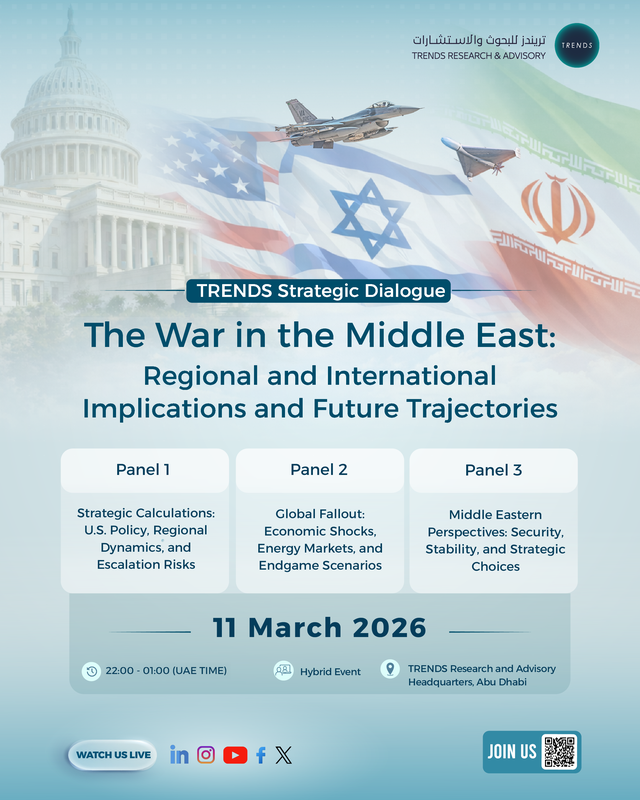
The event will bring together a distinguished group of senior officials and strategic experts from leading global think tanks, as part of TRENDS’ efforts to promote informed academic discussion on the geopolitical transformations taking place in the region.
The dialogue comes at a critical moment for the Middle East, amid escalating regional tensions and growing political, economic, and security repercussions of the ongoing conflict. The event aims to provide an in-depth analytical reading of the evolving crisis, explore its potential trajectories, and examine its implications for regional and international security and stability.
The dialogue will be held in a hybrid format (in-person and virtual), bringing together officials, experts, and researchers from several prominent international think tanks, including the International Crisis Group, the Atlantic Council, The Washington Institute for Near East Policy (WINEP), experts from Chatham House – The Royal Institute of International Affairs, the Arab Gulf States Institute in Washington (AGSIW), and Derasat – Bahrain Center for Strategic, International and Energy Studies.
The event will also feature experts from the Gulf Forum for Peace and Security, the Information and Decision Support Center (IDSC) of the Egyptian Cabinet, the Scandinavian Gulf Studies Center, and several TRENDS researchers. The dialogue will open with a welcoming address by Dr. Mohammed Abdullah Al-Ali, CEO of TRENDS Research & Advisory, followed by three specialized discussion sessions addressing the key dimensions of the current crisis.
The first session will focus on U.S. policy toward the ongoing crisis and the dynamics of regional alliances, providing an assessment of the likelihood of the conflict expanding and its potential impact on the region’s strategic balance.
The second session will address economic shocks and energy security, examining the economic repercussions of the war and its possible effects on oil and gas markets, global supply chains, and international trade routes, as well as the inflationary pressures that may threaten the stability of the global financial system.
The third session will conclude the dialogue by discussing the options available to Arab and regional governments to manage the repercussions of the conflict, including balancing domestic priorities with rising security challenges, and by exploring opportunities for regional cooperation and mechanisms for conflict management amid the prevailing uncertainty in the region.
Dr. Mohammed Al-Ali emphasized that organizing this dialogue reflects TRENDS’ commitment to providing objective analytical insights that deepen understanding of the drivers shaping the current conflict’s trajectory.
He explained that the dialogue seeks to explore possible diplomatic pathways to contain the crisis and to raise fundamental questions about the ability of current international approaches to prevent the region from sliding into a broader confrontation, thereby strengthening strategic dialogue and supporting efforts to achieve regional and international security and stability.
