


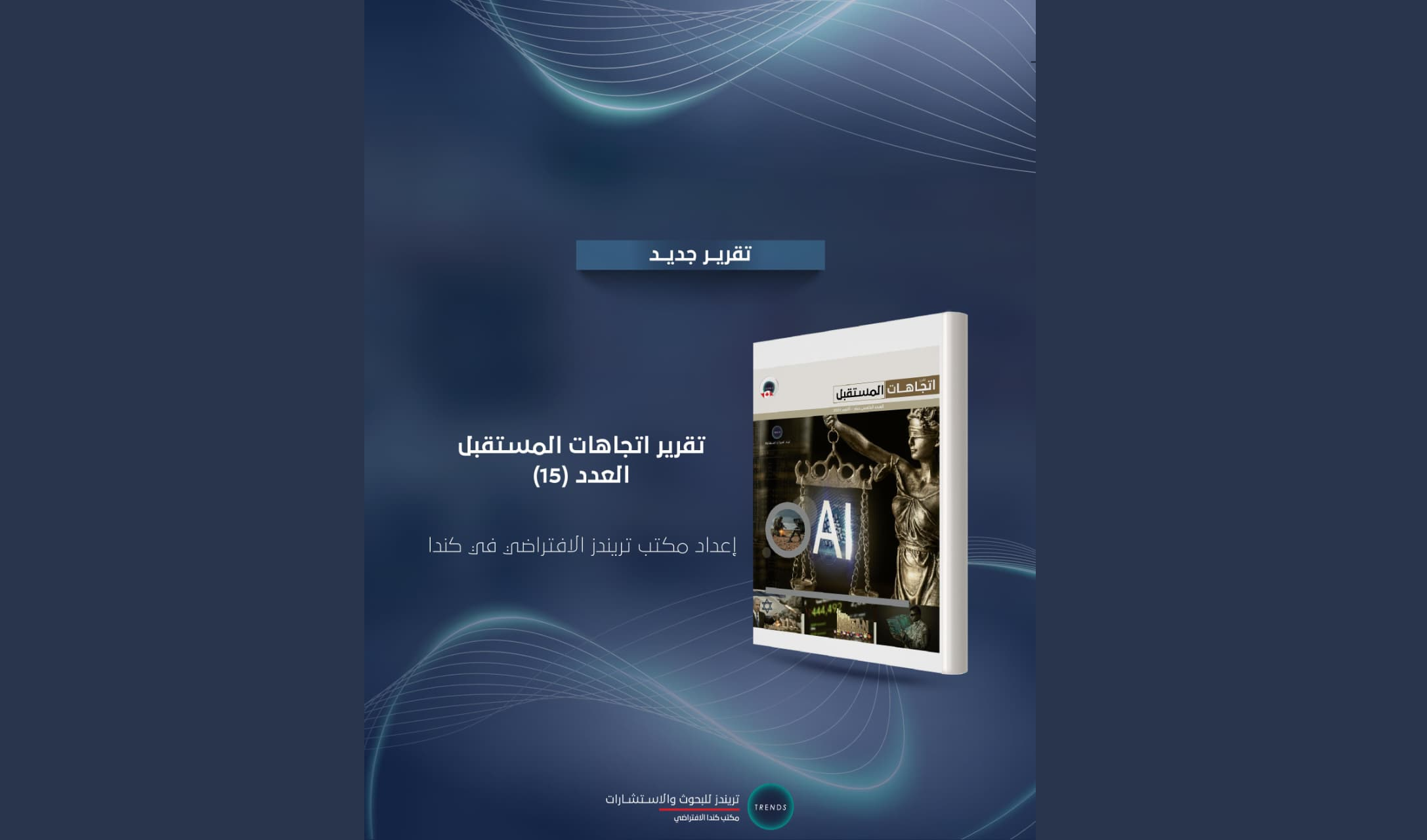
Through its virtual office in Montreal, Canada, TRENDS Research & Advisory has released the 15th edition of its periodic report Future TRENDS, which focuses on AI as a major geopolitical and military transformative force shaping the modern global order.
The report highlights AI’s evolution from a technological tool into a geo-strategic actor redefining global power dynamics; its influence now extends far beyond technology, reaching into international politics, security, and economics. It notes that the militarization of AI poses significant ethical and legal challenges that call for sound global governance. At the same time, it offers developmental and economic opportunities for nations pursuing digital sovereignty strategies and local algorithmic innovation.
The report further underscores that AI has become a driving force of a new data—and knowledge-based geopolitical landscape. It calls for a proactive approach that balances technological progress with ethical responsibility to ensure AI remains a force for stability and human understanding rather than a source of tension and conflict.
The publication in Arabic and English provides an in-depth analysis of AI’s role in reshaping the global order through multiple lenses, including military dynamics, political economy, and governance challenges.
Air and Military and Cyber Escalation
The report includes an applied study on language models and the escalation factor, revealing the risks of employing large language models (LLMs) in military and diplomatic decision-making. Multi-party simulations demonstrated that LLMs tend toward escalation, exhibiting aggressive behavior driven by deterrence and preemptive strike logic, even in neutral environments. This underscores the urgent need for strict oversight and continuous auditing of LLMs’ use in sensitive contexts.
Another study, How is AI transforming military and strategic dynamics: the examples of Ukraine and Gaza, examined the use of AI technologies in modern conflicts. It documented how AI has been deployed in Ukraine to guide UAVs and identify targets, and in Gaza to analyze massive amounts of surveillance data and suggest potential targets for later review by human analysts. The study raised serious ethical and legal concerns regarding accountability and civilian protection.
In this context, another study warned of the growing threat of Military AI Cyber Agents (MAICAs).
These autonomous systems can independently plan and execute complex cyberattacks targeting critical infrastructure such as energy, water, and telecommunications. Their ability to self-replicate and move across digital networks makes them a transnational threat that is extremely difficult to contain.
Political Economy and Governance Transformations
Under this theme, the report features a study on Algorithmic Capitalism, illustrating how algorithms have become central organizing forces reshaping production, value, and exploitation systems. It argues that data extraction now serves as a new mechanism for transferring value from the Global South to the Global North, representing a new form of cross-border dependency.
The report also examines digital sovereignty and labor market challenges, predicting that the acceleration of AI-driven automation could result in the loss of 40–50% of jobs, including those in knowledge-based sectors, by 2040. It warns of the declining role of multilateral organizations as states seek to assert technological sovereignty and control over digital infrastructure, which may lead to institutional weaknesses in managing the turbulence caused by AI and mounting geopolitical tensions.
Conversely, a study on trade enhancement finds that AI clearly contributes to expanding trade volumes and fostering regional economic integration, emphasizing the need for supportive policies and advanced technological infrastructure to unlock its full potential in global commerce.
Prospects for the New Geopolitical Landscape
In this section, the report presents a study on geopolitical risk assessment, calling for an integrated approach that combines scenario-based planning and horizon scanning with AI-powered tools to improve the precision and agility of responses to international shifts.
It also explores the evolution of critical geopolitics, highlighting the growing influence of non-state actors, including civil organizations and extremist groups, in shaping global political trends. The report further notes that climate-related threats, such as extreme weather events and resource scarcity, are increasingly framed within national security paradigms, signaling a significant shift in conceptualizing security and stability.
The 15th issue of “Future Trends” offers a comprehensive perspective on the increasing role of AI in reshaping the global order. It warns of the potential risks of uncontrolled AI advancement, while urging the adoption of responsible global governance frameworks to ensure safe and responsible use of AI technologies across both civilian and military domains.
Overall, the report emphasizes that the future of AI will depend on humanity’s ability to direct it toward advancing human welfare and preserving global stability.
