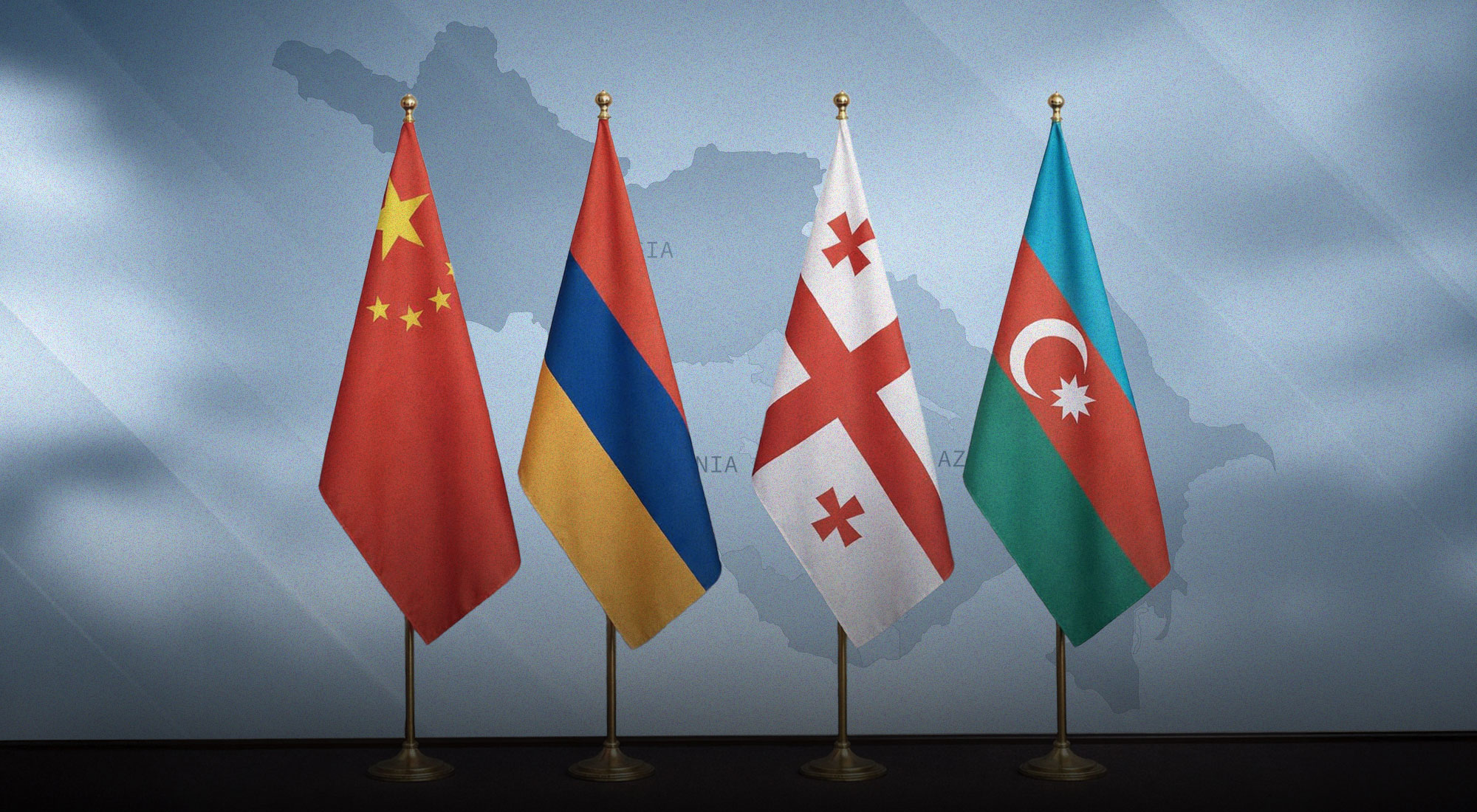

Since ancient times, the South Caucasus has been a strategic bridge between East and West, as well as between North and South. Located at the crossroads of the historic Silk Road land route linking China and Central Asia with Europe, the region played a vital role in international trade. This advantageous position not only increased its economic and transit importance but also made it a point of competition among major powers. Rich in natural resources and characterized by a diverse cultural heritage, the South Caucasus remains one of the most geopolitically and historically significant areas in Eurasia.
Relations between the South Caucasus and China date back to ancient times. The passage of the Silk Road through the region contributed to the development of economic, cultural, and commercial ties between China and the peoples of the South Caucasus, enhancing mutual exchange and connectivity across Eurasia. China’s interest in the South Caucasus is closely linked to the Belt and Road Initiative (BRI). Announced by Chinese President Xi Jinping in 2013 during his official visit to Kazakhstan, the BRI aims to strengthen infrastructure development, trade connectivity, and economic cooperation across Asia, Europe, and Africa. China, which views the BRI as a modern revival of the ancient Silk Road, recorded unprecedented engagement under the initiative in 2024, reaching a record US$70.7 billion in construction contracts and approximately US$51 billion in investments. Since the initiative was launched in 2013, China’s total BRI-related engagement has reached US$1.175 trillion.[1]
Despite its geographic location, the South Caucasus had long remained relatively unattractive for BRI trade flows. This situation changed after the outbreak of the Russia-Ukraine war in 2022. Until then, the Northern Corridor was the most heavily used overland freight route between China and Europe. Passing through Kazakhstan, Mongolia, Russia, and Belarus, the route facilitated cross-border trade along a 12,000-km railway network. The popularity of the Northern Corridor stemmed from fewer border crossings and customs procedures, reducing bureaucracy, minimizing the risk of delays, and providing more predictable transit times.
Russia’s war in Ukraine has demonstrated the need to diversify trade routes and strengthen economic resilience. This has increased interest in the Middle Corridor as an alternative route to avoid relying on Russia. The Middle Corridor, also called the Trans-Caspian International Transport Route (TITR), is an important part of efforts to revive the historic Silk Road. It starts in China, passes through Central Asia using rail and road networks, crosses the Caspian Sea via Kazakhstan and Turkmenistan, goes through Azerbaijan and Georgia, and continues through Türkiye to reach Europe.
The Middle Corridor offers a faster, more cost-effective, and safer alternative compared to the Northern Corridor. Being approximately 2,000 km shorter and more favorable in terms of climatic conditions, it reduces the transportation time between China and Europe to around 18 days.
The growing significance of the Middle Corridor has also created important opportunities for deepening relations between China and the South Caucasus countries and for the implementation of joint infrastructure projects. Azerbaijan and Georgia, which form the core of the South Caucasus segment of the Middle Corridor, and Armenia, which has shown growing interest in joining regional projects, have elevated their relations with China to the level of a strategic partnership.[2]
According to a Eurasian Development Bank report, over the past decade, China’s foreign direct investment (FDI) portfolio in the South Caucasus has increased 2.5 times, reaching US$690 million in the first half of 2025. Most of the Chinese investments in the region are concentrated in Azerbaijan, which accounts for around 60%, followed by Georgia with approximately 40%. Manufacturing and energy remain the priority sectors for these investments.[3]
China-Azerbaijan partnership
Azerbaijan and China established diplomatic relations in April 1992, following Azerbaijan’s independence from the Soviet Union in 1991. Over the past thirty-three years, bilateral relations have deepened significantly in areas such as increasing trade volume, intensified cultural contacts, and diversified mutual investments. In 2025, both countries elevated their bilateral relations to a new stage by signing a Joint Statement on Comprehensive Strategic Partnership in Beijing. This significant development took place during the official visit of the President of the Republic of Azerbaijan, Ilham Aliyev, conducted at the invitation of the President of the People’s Republic of China, Xi Jinping. China and Azerbaijan aim to deepen cooperation not only in political and diplomatic relations, but also in trade, renewable energy, technology, transportation, logistics, as well as humanitarian and cultural fields.
According to publicly available data, the trade volume between the two countries increased significantly. In the January-November 2025 period, the bilateral trade turnover amounted to US$4.2 billion. This figure is US$816.1 million, or 24% higher, compared to the same period in 2024. With 9.45% of Azerbaijan’s total trade volume, China ranked fourth among Azerbaijan’s largest trading partners.
In the first eleven months of 2025, Azerbaijan’s exports to China amounted to US$79.6 million, an increase of US$66.6 million, or 4.8 times, compared to the corresponding period of last year. The main export products include chemical and processing industry goods, as well as food products and other non-oil goods. Azerbaijan began exporting goods to China by rail for the first time in 2024, sending cargo from Baku to Xi’an via the Middle Corridor. This significant development has made exports to China easier, faster, and more cost-effective. In recent years, Azerbaijan has increased business missions, participated in major Chinese exhibitions, and expanded contacts through the Invest in Azerbaijan platform. Additionally, through trade and wine houses, the country has been successfully promoting its domestic products in China’s vast market.
During the same period, imports from China to Azerbaijan totaled US$4.1 billion, representing an increase of US$749.4 million, or 22.2%, compared to the same period in 2024. As a result, China ranked first among Azerbaijan’s largest sources of imports during the reporting period.[4] From China’s perspective, Azerbaijan has become a key player within the BRI, especially as the strategic importance of the Middle Corridor has grown. After China announced the BRI in 2013, Azerbaijan was among the first countries to support it.
President Ilham Aliyev has emphasized that Azerbaijan’s support for the BRI is not limited to political backing but also includes active and comprehensive investments in the project. According to Aliyev, Azerbaijan is one of the countries that has invested the most in this initiative, both domestically and abroad, after China. One of Azerbaijan’s most significant projects under the BRI is the Baku-Tbilisi-Kars (BTK) railway, which facilitates transportation between the East and the West.
Construction of the BTK railway line began on 27 November 2007, and it was officially inaugurated on 30 October 2017. The railway, which is approximately 850 km long, passes through more than 500 km of Azerbaijani territory. The BTK represents the shortest and most reliable route connecting China, Central Asia, and Europe. Its operation has increased Azerbaijan’s logistical capacity along the Middle Corridor, and the main financing for the project has come from Azerbaijan.
The first freight transport from China via the Middle Corridor and the BTK railway was carried out in March 2024, with the first container block train reaching Baku from Xi’an, China, in approximately 11 days. Furthermore, in November 2024, Azerbaijan sent its first export block train from Baku to China via the Middle Corridor, further expanding the use of this route for two-way rail freight transport between Azerbaijan and China.[5]
In 2024, the volume of cargo transported from China through the Middle Corridor increased more than 25 times compared to 2023, surpassing 27,000 containers. Azerbaijani Railways also completed the modernization of the Georgian section of the BTK line, boosting its annual capacity from 1 million tons to 5 million tons.[6] Another key component of Azerbaijan-China trade is the Baku International Sea Trade Port (Alat Port), which serves as the main gateway for Chinese goods entering the South Caucasus.
In 2024, Azerbaijan and China, together with Kazakhstan, established a joint venture to build a new Intermodal Cargo Terminal at the Port of Baku. The terminal is designed to handle containers and various types of cargo transported from China to Europe and other destinations. Its initial annual handling capacity is expected to reach 300,000-350,000 containers.[7]
Cooperation between the two countries is not limited to trade and transport. Both countries are also strengthening their partnership in the field of renewable energy. Azerbaijan’s main objective in this area is to meet its domestic energy demand from renewable sources, increase energy efficiency, and thereby export its natural gas resources to international markets. The agreements signed between Azerbaijan and China include the implementation of solar and wind energy projects in Azerbaijan, the establishment of energy storage systems, and the strategic planning of the electricity sector to support the development of the country’s renewable energy resources. Within this framework, the agreements concluded to date are expected to create a total renewable energy generation capacity of 6,500 MW in Azerbaijan by 2030. Azerbaijan’s first large-scale wind power project—Khizi-Absheron wind farm with a capacity of 240 MW—is implemented by Chinese companies. Chinese companies also plan to build a solar panel manufacturing plant with an annual capacity of 3 GW in the Alat Free Economic Zone using their own investments.[8]
Azerbaijan has also signed a partnership agreement with Chinese electric vehicle manufacturer BYD to modernize its public transportation system and promote environmentally friendly transportation.[9] To develop an electric bus fleet through local production, the Azerbaijani-Chinese joint venture Azerbaijan Energy Automotive Factory LLC has been established, with a planned annual production capacity of 500 buses.[10] The first domestically produced 12-meter bus has a capacity of 82 passengers and can travel up to 350 km on a single charge. Electric buses manufactured under the BYD brand will initially focus on meeting domestic demand, with exports planned for the next phase. Starting in 2026, the partnership will expand to the production of low-tonnage electric trucks, utility vehicles, and electric passenger cars. From 2028 onward, the cooperation will also include the assembly of batteries for energy storage systems.
Chinese companies are playing an active role in reconstruction, digital transformation, infrastructure development, and green energy projects in the regions of Azerbaijan liberated from the occupation. The Chinese telecommunications company Huawei, one of the world’s leading providers of information and communication technologies, was among the first foreign companies invited to participate in the reconstruction of Karabakh.[11]Huawei’s AirPON technology was used to establish the digital infrastructure of Aghali, the first smart village built in Azerbaijan’s Zangilan district. This technology reduces the fiber-optic cable installation distance from 10 km to 1 km, shortening network deployment time and lowering costs.
China also supports Azerbaijan’s humanitarian demining efforts. The threat posed by landmines and explosive remnants of war (ERWs) planted by Armenia in Azerbaijan’s formerly occupied territories remains one of the most serious challenges facing the country today.[12] Within the framework of the Memorandum of Understanding on Humanitarian Mine Clearance signed by the heads of state, China provided financial assistance of US$285,000 to Azerbaijan.[13]
Both countries aim to expand cooperation in different areas, with special focus placed on people-to-people contacts and cultural exchange. Under a recently reached agreement, holders of valid Chinese and Azerbaijani ordinary passports are allowed to enter, exit, or transit through each other’s territory without visas. According to official data, more than 57,000 Chinese visitors traveled to Azerbaijan between January and October 2025, representing a 49% increase compared to the same period in 2024. Azerbaijan is keen to unlock its tourism potential for Chinese travelers. In November 2025, the “China Visitors Summit” was held in Baku for the first time, bringing together representatives from the tourism industries of both China and Azerbaijan.[14]
China-Georgia cooperation
Thanks to its strategic geographical location and its role as a natural transit point between East and West, Georgia has become increasingly important for China. As an active participant in China’s BRI, Georgia plays a key transit role in facilitating the transportation of Chinese goods to European markets through its ports, railway infrastructure, and the BTK railway line. With the strategic partnership agreement signed between the two countries in 2023, Georgia became the first country in the South Caucasus to establish such a high-level partnership with China.[15]
For many years, membership in the European Union had been the main priority of Georgia’s foreign policy. The country officially applied for EU membership on 3 March 2022, and following the evaluation process, the European Council granted Georgia candidate country status on 14 December 2023. However, due to tensions between the Georgian government and the EU, the membership process has been de facto halted. In this context, China is emerging as an important alternative partner for Georgia in terms of diversifying its economic and political relations.[16]
After the Georgia-China Free Trade Agreement came into effect in January 2018, trade between the two countries has grown steadily. According to data from the National Statistics Office of Georgia, trade turnover between the two countries reached US$2.08 billion during the January-November period of 2025, representing an increase of 8.6% compared to the same period in 2024. During the same period, China’s exports to Georgia increased by 21.3%.[17]
Accounting for approximately 9% of Georgia’s economy, China remains the country’s fourth-largest trading partner, following Türkiye, the United States, and Russia. While China primarily exports manufactured and industrial goods to Georgia, Georgia supplies the Chinese market mainly with raw materials, selected agricultural products, and niche goods.
Cooperation between China and Georgia in the fields of infrastructure and transportation has deepened significantly in recent years. Within this framework, numerous large-scale projects related to transportation, logistics, and port infrastructure are either being implemented or are in the development stage. These projects aim to boost Georgia’s transit capacity, support economic growth, and improve the functionality of the Middle Corridor.
In this context, the Georgia Railway Modernization Project, carried out by Chinese companies, was put into service at the end of 2025. The railway is in central Georgia, starting from the city of Zestaponi and ending in the city of Khashuri, with a total length of 43.9 km. It serves as the main line for transportation between the east and the west of the country. Once operating at full capacity, the line is expected to increase travel efficiency by 37% and double its annual freight transport capacity. [18]
As a result of China-Georgia cooperation, another major transport project of strategic importance for the Middle Corridor was completed at the end of 2025.[19] Construction of the Rikoti Pass Highway began in 2019. The project was financed by three international donors—the Asian Development Bank (ADB), the World Bank, and the European Investment Bank (EIB)—while construction was awarded to several Chinese companies. The Rikoti Highway is a critical segment of Georgia’s transport infrastructure. As an integral part of the European transit route E60, it serves as a vital link between Europe and Asia, significantly improving transit connectivity, trade flows, and investment opportunities.
The E60 corridor is Europe’s second-longest transport route, stretching from Brest, France, to Irkeshtam on the border between Kyrgyzstan and China. Within Georgia, the E60 extends for 392 km, connecting the Azerbaijani border in the east to the Black Sea coast in the west. One of the most technically challenging sections of the Rikoti Pass Highway was completed in the summer of 2025 by the China State Construction Engineering Corporation (CSCEC).[20]
Amid rising demand for alternative cargo routes due to the war in Ukraine, Georgia hopes to restart construction of the long-delayed Anaklia Port. In 2024, the Georgian government opened a new tender for the construction and operation of the Anaklia deep-sea port, announcing that a China-Singapore consortium had won the bid.[21] The agreement covers the first phase of the port’s development, involving an investment of US$600 million.
Under the project, the Georgian state-owned company “Anaklia Deep Sea Port” will hold a 51% stake, while the consortium will own 49%. However, more than a year has passed, and the parties have yet to sign an official agreement. Some political commentators suggest that global geopolitical shifts and regional risks may have slowed the project’s progress.
According to Georgia’s former ambassador to China, Davit Aptsiauri, the project’s complexity and its sensitivity beyond mere economic cooperation may have prompted the Chinese state firm China Communications Construction Company to conduct additional risk assessments.[22] It is also known that the United States opposes China’s involvement in the port’s construction. Once completed, Anaklia Port will not only be Georgia’s largest port but also the country’s only deep-sea port. The port is expected to significantly boost Georgia’s shipping capacity, accommodate large vessels, and handle approximately 600,000 containers of mixed cargo annually.
China-Armenia relations
After the collapse of the Soviet Union, Armenia and China established diplomatic relations and, in 2025, signed a strategic partnership agreement. China’s growing engagement with the South Caucasus has also created an important opportunity for Armenia to deepen its ties with Beijing. With this development, Armenia became the last South Caucasus country to elevate its relations with China to the level of a strategic partnership. For landlocked Armenia, whose borders with Türkiye and Azerbaijan have remained closed for many years, building strong relations with China is of great importance both economically and politically, particularly in terms of diversifying its foreign relations.
Despite its strategic location and potential to become a key transit country on the east–west route, Armenia remains outside the officially designated routes and corridors of the BRI. The primary reason for this was the Karabakh conflict, which started in the late 1980s and lasted for over thirty years. The occupation of Azerbaijani territories by Armenia led to the closure of borders and the cutting of diplomatic relations with Azerbaijan and Türkiye. As a result, Armenia was excluded from major large-scale infrastructure and transport projects developed in the region.
Following the 2020 Karabakh War, the normalization process between Azerbaijan and Armenia entered a new phase when the parties initialed a peace agreement in Washington in August 2025, with the participation of U.S. President Donald Trump. Although the final peace agreement has not yet been signed, many significant steps have been taken between the two countries.[23] In this context, in October 2025, Azerbaijan lifted restrictions on cargo transit from its territory to Armenia, allowing grain shipments from Russia and Kazakhstan to reach Armenia via Azerbaijan.[24]
One of the important provisions of the Washington Declaration concerns the 42-km Trump Route for International Peace and Prosperity (TRIPP), which plans to establish a connection between Azerbaijan and its exclave, Nakhchivan. According to Azerbaijan, the opening of this route would transform Armenia into a transit country and create an alternative east-west transportation route. However, the technical and financial details of the TRIPP route have not yet been clarified. In particular, uncertainty remains over who will finance the planned railway line along the Iran-Armenia border. Nevertheless, this route has become a focal point of growing interest from regional and global powers since the 2020 war.[25]
Although Armenia has attracted the least direct Chinese investment among the three South Caucasus countries since independence, economic relations between the two countries have developed considerably. China is Armenia’s second-largest trading partner after Russia. In the January-November period of 2025, bilateral trade volume reached US$2.1 billion, representing a 9.1% decline compared to the same period in 2024. Despite this decrease, China maintained its position as Armenia’s second-largest source of imports after Russia. Exports from China to Armenia increased by 20.9% to US$1.1 billion, while Armenia’s exports to China declined by 42.2%.[26][27]
Chinese companies are also contributing to infrastructure projects in Armenia. A significant LG27 section of the North-South Trade Corridor, which is planned to connect Georgia’s Poti Port with Iran’s Bandar Abbas Port via Armenia, has been completed by a Chinese company.[28]
Construction of the North-South highway began a decade ago with the goal of creating a 556-km route, originally scheduled for completion in 2019. However, due to a combination of geographical, technical, financial, and political challenges, work is still ongoing. Some sections of the highway are now planned to be finished in the 2030s. As of today, approximately 80.7 km has been completed, representing 17.5% of the total route.[29]
Political consultations between Armenia and China are also continuing with mutual visits. Armenian Prime Minister Nikol Pashinyan participated in the Victory Day parade marking the end of World War II, held in Beijing. During that visit, Pashinyan attended the Shanghai Cooperation Organization (SCO) meeting held in the Chinese city of Tianjin too. Like Azerbaijan, Armenia has also applied for membership in the SCO.
Both countries are also taking steps to strengthen cultural ties and people-to-people exchanges. In 2019, they lifted visa requirements, and direct flights between Armenia and China began on 3 September 2024. In 2024, Armenia welcomed 32,826 Chinese tourists—a 65% increase compared to 2023. The first Confucius Institute in the South Caucasus was established at Yerevan State University in Armenia in 2008 as part of China’s efforts to promote the Chinese language and culture in the region.
Conclusion
The growing strategic importance of the South Caucasus presents significant opportunities for the countries of the region while also bringing serious risks. As a geography where the interests of major powers intersect, the region is increasingly exposed to geopolitical competition, and power struggles among external actors are directly felt in the South Caucasus. For this reason, it is crucial for regional countries to strengthen their relations, improve regional cooperation, and adopt a balanced foreign policy. The steps taken toward the normalization of relations between Armenia and Azerbaijan play a critical role in ensuring regional stability.
Deepening relations with China provide Azerbaijan, Armenia, and Georgia with opportunities to diversify their foreign policies and reduce dependence on a single power center. China’s policy of not interfering in other countries’ internal affairs provides a more flexible and appealing way to cooperate, especially for the geopolitically sensitive and developing countries of the South Caucasus. This approach contributes to building cooperation on a more stable and predictable basis.
The countries of the South Caucasus view China’s Belt and Road Initiative (BRI) as an important opportunity to develop their infrastructure and expand cooperation in various fields. Cooperation with China, not only in infrastructure but also in areas such as renewable energy, agriculture, logistics hubs, the digital economy, and industrial parks, would make a significant contribution to the economic development of the region and to sectoral diversification. However, the fact that China’s exports significantly exceed those of the region in bilateral trade highlights the need to make trade relations more balanced. A more balanced trade structure would both encourage domestic production and enable the countries of the region to gain more effective access to the vast Chinese market.
Closer cooperation among Azerbaijan, Armenia, and Georgia, with each playing complementary roles, will be key to fully using the region’s geographical advantages and ensuring the long-term stability and development of the South Caucasus.
[1] Christoph Nedophil Wang, “China Belt and Road Initiative (BRI) Investment Report 2024,” Green Finance and Development Center, February 27, 2025, https://greenfdc.org/china-belt-and-road-initiative-bri-investment-report-2024/ (Accessed: November 15, 2025)
[2] “China, Armenia form strategic partnership at SCO summit,” TRT World, August 31, 2025, https://www.trtworld.com/article/50ac9761ad24 (Accessed: November 20, 2025)
[3] “China’s investment stock in Eurasia exceeds US $66 billion: a new report by the EDB,” Eurasian Development Bank, December 25, 2025, https://eabr.org/en/press/news/china-s-investment-stock-in-eurasia-exceeds-us-66-billion-a-new-report-by-the-edb/ (Accessed: December 29, 2025)
[4]“Trade turnover with China exceeds $4 billion,” AzerNews, December 18, 2025, https://www.azernews.az/business/251785.html (Accessed: December 20, 2025)
[5] “First Railway Export to China: A New Chapter in Azerbaijan’s International Trade Prospects,” ADY, November 24, 2024, https://corp.ady.az/en/2/news/news/first-railway-export-to-china-a-new-chapter-in-azerbaijans-international-trade-prospects (Accessed: December 1, 2025)
[6] “Azerbaijan Becomes a Transportation Hub: ADY’s Key Achievements in International Corridor Development in 2024,” ADY, January 10, 2025, https://corp.ady.az/en/2/news/news/azerbaijan-becomes-a-transportation-hub-adys-key-achievements-in-international-corridor-development-in-2024 (Accessed: December 1, 2025)
[7] “Azerbaijan, Kazakhstan and China Set Up JV to Construct New Cargo Terminal at Port of Baku in Alat,” Azerbaijan Investment Holding, November 12, 2024, https://aih.gov.az/media/press-releases/azerbaijan-kazakhstan-and-china-set-up-jv-to-construct-new-cargo-terminal-at-port-of-baku-in-alat-221?lang=en (Accessed: December 1, 2025)
[8] “China-backed wind energy project set to boost Azerbaijan’s renewable power,” Trend.az, December 25, 2025, https://www.trend.az/business/4134447.html (Accessed: December 25, 2025)
[9] “New resident in Sumgayit Chemical Industrial Park,” Ministry of Economy of the Republic of Azerbaijan, March 19, 2025, https://economy.gov.az/en/post/2339/sumqayit-kimya-senaye-parkinda-yeni-rezident (Accessed: December 12, 2025)
[10] “China-Azerbaijan joint venture starts production of electric buses,” Report.az, October 3, 2025, https://report.az/en/industry/china-azerbaijan-joint-venture-starts-production-of-electric-buses (Accessed: December 12, 2025)
[11] Vusal Guliyev, “Azerbaijan’s Digitalization Efforts, Revitalization of the Liberated Territories, and Role of China’s Huawei,” Caucasus Strategic Perspectives Journal 4, no. 2, (Winter 2023), https://cspjournal.az/uploads/files/Summer%202022/(8)%20Vusal%20Guliyev.pdf (Accessed: December 12, 2025)
[12] Konul Shahin, “The Role of International Assistance in Mine Action: The case of Azerbaijan” Caucasus Strategic Perspectives, 6, no. 1, (Summer 2025), https://cspjournal.az/uploads/files/(6)%20Konul%20Shahin(1).pdf (Accessed: December 29, 2025)
[13] “China allocates $285,000 for mine clearance in Azerbaijan’s liberated territories,” Apa.az, December 25, 2025, https://en.apa.az/foreign-policy/china-allocates-285000-for-mine-clearance-in-azerbaijans-liberated-territories-487400 (Accessed: December 29, 2025)
[14] ““China Visitors Summit” held in Baku,” State Tourism Agency of the Republic of Azerbaijan, November 17, 2025, https://tourism.gov.az/en/news/china-visitors-summit-held-in-baku (Accessed: December 27, 2025)
[15] Full text: Joint Statement of the People’s Republic of China and Georgia on Establishing a Strategic Partnership, Embassy of the People’s Republic of China in Georgia, August 7, 2023, https://ge.china-embassy.gov.cn/eng/xwdt/202308/t20230807_11123383.htm (Accessed: December 28, 2025)
[16] Emil Avdaliani, “Eurasian Pivot in the South Caucasus,” ChinaObservers.eu, November 2024, https://chinaobservers.eu/eurasian-pivot-in-the-south-caucasus/ (Accessed: December 27, 2025)
[17] “External Merchandise Trade in Georgia, (January-November 2025),” NATIONAL STATISTICS OFFICE OF GEORGIA, DECEMBER 19, 2025, https://www.geostat.ge/media/75916/External-Merchandise-Trade-of-Georgia-in-January-November-2025.pdf (Accessed: December 28, 2025)
[18] “Georgian Railway Modernization Project Officially Put into Operation, Adding a New Highlight to the Belt And Road Initiative,” China Daily, January 3, 2026, https://www.chinadailyhk.com/hk/article/626422 (Accessed: January 3, 2026)
[19] “Construction of Rikoti Pass highway is complete,” 1TV.ge, December 29, 2025, https://1tv.ge/lang/en/news/construction-of-rikoti-pass-highway-is-complete/ (Accessed: January 3, 2026 )
[20] “Right carriageway of the E60 Highway (F1 section ) in Georgia officially opened to traffic,” China State Construction, July 17, 2025, https://en.cscec.com/CompanyNews/CorporateNews/202507/3885155.html (Accessed: January 3, 2025)
[21] “Georgian Economy Ministry: Chinese-Singaporean Consortium involved in Anaklia Port not subject to sanctions,” 1TV.ge, May 30, 2024, Available at: https://1tv.ge/lang/en/news/georgian-economy-ministry-chinese-singaporean-consortium-involved-in-anaklia-port-not-subject-to-sanctions/
[22] Natiko Taktakishvili, “Has China Lost Interest in Anaklia? – Davit Aptsiauri’s Opinion,” Business Media, November 13, 2025, https://bm.ge/en/news/has-china-lost-interest-in-anaklia-davit-aptsiauris-opinion ( Accessed: January 3, 2026 )
[23] Könül Şahin, “Azerbaijan-Armenia Normalization and Regional Impact,” TRENDS Research & Advisory, September 8, 2025, https://trendsresearch.org/insight/azerbaijan-armenia-normalization-and-regional-impact/?srsltid=AfmBOopCo82ebfwHG0WztemeoE-1nL4rXsegG0y2quG4qStZ7icWAVhB (Accessed: January 4, 2026)
[24] Onnik James Krikorian, “Azerbaijan Permits Transit of Commercial Goods to Armenia,” The Jamestown Foundation, November 7, 2025, https://jamestown.substack.com/p/azerbaijan-permits-transit-of-commercial (Accessed: January 4, 2025)
[25] Onnik James Krikorian, “Armenia Balances Between the TRIPP and Zangezur Corridor,” The Jamestown Foundation, October 15, 2025, https://jamestown.substack.com/p/armenia-balances-between-the-tripp (Accessed: January 4, 2026)
[26] “Armenia’s foreign trade turnover fell by 37.1% over the first 10 months, amounting to $16.5 billion: Russia is ahead of China and the UAE in the top three,” Arka.am, December 8, 2025, https://arka.am/en/news/economy/armenia-s-foreign-trade-turnover-fell-by-37-1-over-the-first-10-months-amounting-to-16-5-billion-rus/ (Accessed: January 3, 2026)
[27] “Decline of exports and imports in Armenia in October due to gradual cessation of re-exports – WB,” Arka.am, December 23, 2025, https://arka.am/en/news/economy/decline-of-exports-and-imports-in-armenia-in-october-due-to-gradual-cessation-of-re-exports-wb/ (Accessed: January 6, 2026)
[28] “Key section of Armenia’s North-South Highway opens dual lanes,” PowerChina, April 1, 2025, https://en.powerchina.cn/2025-04/01/c_828900.htm (Accessed: January 3, 2026)
[29] “A Road Without an Endpoint: The North-South Program Keeps Dragging On,” Ampop Media, June 21, 2025, https://ampop.am/en/a-road-that-stretches-for-years-the-north-south-program-without-an-endpoint/ (Accessed: January 4, 2026)