

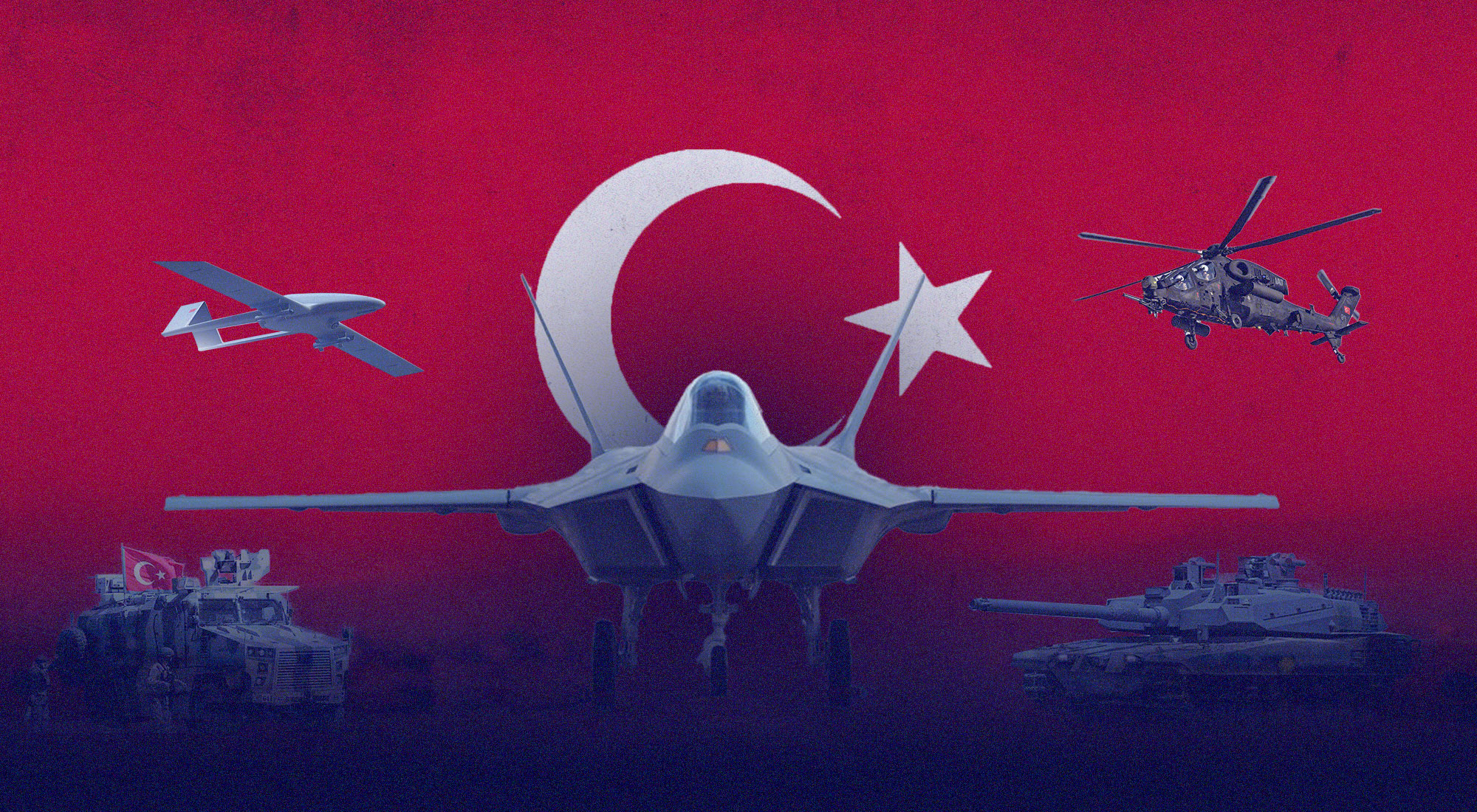

Over the last decade, the development of Turkey’s defense industry has become a crucial aspect of its soft power diplomacy in both regional and global politics. The country has made significant efforts to invest heavily in the development of its indigenous defense industry, reducing its dependence on imports and becoming a leading defense exporter in global markets.[1] The rapidly changing regional and global geopolitical landscape, particularly after the Arab uprisings, has prompted Ankara to expand the country’s defense industry and reduce its reliance on overseas arms procurement and international supply chains.
Since the ruling AKP government came to power, the country’s indigenous defense industry has undergone a significant transformation, steadily becoming the twelfth-largest arms exporter, according to the Stockholm International Peace Research Institute (SIPRI).[2] Given the regional instability marked by violent uprisings and sectarian conflicts, Türkiye’s pursuit of defense industry development can be understood as a primarily threat-driven strategy. This approach reflects an effort to enhance national defense capabilities and ensure strategic autonomy in response to both external security challenges and internal vulnerabilities. The close alignment with the West during the Cold War era helped Türkiye secure itself and gain access to the U.S. and NATO military-industrial complex and advanced weapons systems, which played a major role in the transformation of the local defense industry.
Another important reason for Ankara’s efforts to boost its defense industry is the quest for strategic autonomy, allowing the country to redefine its security parameters in the post-Cold War era. However, the persistent regional challenges in Türkiye’s immediate vicinity, such as the long-term fight against the Kurdistan Workers’ Party (PKK) terrorist organization, have underscored the country’s diverging priorities from its transatlantic partners. The internal and external threats, including geopolitical rivalries and risks stemming from the PKK and Islamic jihadist groups, have slightly turned Türkiye into an “island surrounded by potential sources of instability,” thus emboldening it to achieve greater autonomy in terms of arms procurement.[3]
Development of Türkiye’s Arms Industry
The proliferation of unmanned aerial systems, precision-guided munitions, and advanced ISR (intelligence, surveillance, and reconnaissance) capabilities has transformed the nature of warfare by prioritizing precision, persistence, and autonomy. In response, Türkiye has treated defense industrial capacity as a strategic priority, substantially increasing state support for national champions, namely Turkish Aerospace Industries (TAI), ASELSAN, ROKETSAN, and Baykar. This policy push has accelerated domestic R&D and production, reduced external dependence, and positioned these firms to compete more effectively in global defense markets.[4]
Another driver of Ankara’s sustained backing for domestic firms is ecosystem building: cultivating a dense network of local suppliers that can produce critical subsystems and components while pursuing joint ventures, licensing, and offset agreements with top-tier foreign contractors. The aim is to strengthen supply chain resilience and sovereign control over key technologies, accelerate technology transfer, and facilitate know-how absorption through co-development and integration into global production networks.
As a result of enormous efforts since 2010, the local industry has begun to bear fruit in the form of technologically sophisticated products, including combat drones, armored vehicles, artillery ammunition, and air defense systems. In this vein, the most well-known Turkish defense product, the Bayraktar TB-2 combat drone, was introduced in 2014 and has been in service with the Turkish army in fighting the PKK and its affiliates in Syria and northern Iraq.[5] Undoubtedly, Türkiye’s successful use of its indigenous combat drones against terrorist organizations stirred debates in the West about whether other regional states may follow suit by developing their own national drone programs. Shortly after the official deployment, Turkish Bayraktar drones emerged as game changers in the Second Karabakh War between Armenia and Azerbaijan in 2020, demonstrating that UAVs can decisively shape ground warfare even without achieving air superiority.[6] While Bayraktar UAVs were widely credited with shaping battlefield dynamics in Karabakh in Azerbaijan’s favor, their high-visibility deployment also acted as a credibility signal—stimulating procurement interest, easing export clearances, and catalyzing co-production and partnership deals that enabled Türkiye’s defense industry to expand across Europe, the Middle East, Africa, and Asia.[7]
The Russo-Ukrainian war that erupted in February 2022 also opened new horizons for Turkish defense exports. Since the Russian intervention, Ukraine significantly strengthened its military partnership with Türkiye by acquiring dozens of sophisticated weapons, including Bayraktar TB-2s, Mini-Bayraktar reconnaissance UAVs, TRLG-230 guided multiple rocket launchers (MRLs), electronic warfare equipment, BMC Kirpi MRAPs, mortars, and ammunition, among other items.[8] Indeed, the protracted war in Ukraine, with heavy use of drones, smart ammunition, air defense systems, and long-range missiles, dramatically changed the perception of modern conventional warfare among the transatlantic community.
Considering the new realities, NATO’s new deterrence concept centers on drone technologies and electronic warfare capabilities, focusing on a vision of a multi-layered “defense dome” that effectively covers the skies and seas.[9] Unsurprisingly, the new concept sheds light on Türkiye’s successful development of the defense industry, marked by its rising technological superiority in drones and electronic warfare capabilities. Consequently, the strong commitment and positive results position Türkiye as a reliable partner in burden-sharing. Moreover, the protracted Russo-Ukrainian war dramatically increased defense expenditures in Europe, as the Trump administration pushed the alliance “to allocate 5 percent of GDP to defense spending, with 3.5 percent on core military expenditures and 1.5 percent on broader security-related investments.”[10] In this vein, Türkiye swiftly became one of the few member countries that was able to meet defense spending commitments. While such indicators make Türkiye NATO’s vital security guarantor in Europe, the Trump administration’s security narratives toward Europe diminish the U.S.’ reliability.
Türkiye’s increasingly prominent role in the global arms market and European defense architecture has emboldened countries beyond the region, particularly in the Gulf and Central Asia, to establish deep ties. In 2023, during Turkish President Recep Tayyip Erdoğan’s visit to Saudi Arabia, a US$3 billion defense deal was signed, envisioning the export of Baykar-made Akıncı combat drones to the kingdom, marking a landmark development that reshapes military power in the Middle East.[11] Indeed, Saudi Arabia’s official decision to turn to Türkiye in terms of defense procurement underscores its strategic determination to diversify its defense partnerships away from Western technologies and is reportedly now pursuing US$6 billion worth of new defense deals.[12] Moreover, in July 2025, the Saudi media reported that Saudi Arabian Military Industries (SAMI) had signed technology transfer-focused agreements with three leading Turkish defense firms to accelerate the localization of advanced land systems manufacturing in the Kingdom.[13]
In addition to Riyadh, between 2015 and 2019, the United Arab Emirates (UAE) was the leading recipient of Turkish arms, accounting for 18 percent of Türkiye’s exports during this period, followed by Qatar and Pakistan.[14] The growth of defense partnerships with leading regional states and partners beyond the region over the last two decades has naturally led to increased investment, technology transfers, licensing, joint product development and production, and access to new markets. Building on this momentum, although Ankara aimed to make additional inroads into the wealthy Gulf market following the agreements with Saudi Arabia, other potential markets also emerged on the horizon in recent years. For instance, since 2021, African states such as Libya, Ethiopia, Angola, Somalia, Djibouti, Mali, Burkina Faso, Niger, and Nigeria have acquired Turkish-made Bayraktar combat drones, which were mainly used against notorious radical jihadist organizations, namely Boko Haram, al-Shabab, Ansaru, Jama’at Nusrat al-Islam wal Muslimeen (JNIM), and Islamic State in the West African Province (ISWAP).[15]
In this context, Libya became the first regional country to receive Bayraktar TB-2 drones due to Ankara’s alliance with the internationally recognized Government of National Unity (GNU) during the civil war, allowing it to flood the battlefield with newly produced drones.[16] It is noteworthy that the African continent contributes the largest chunk of these exports, as Ankara exports defense products to 18 local countries, representing a 103 percent increase.[17]
Undoubtedly, Türkiye acknowledges the importance of Africa as a growing market, alongside the Middle East. Indeed, core reasons that make Turkish defense products attractive to buyers are that they are more affordable compared to U.S. and Israeli-made weaponry, and Türkiye’s arms export control mechanisms are less formalized and stringent than those in Western countries. Such prospects enabled Türkiye to become the world’s largest drone exporter, holding a 65% market share, surpassing China and the United States, and granting Ankara an additional foreign policy instrument.[18] Strengthened regional positioning and the calibrated deployment of soft power have enabled Türkiye to forge geopolitical alignments across the Middle East, Africa, the Caucasus, and Central Asia, consolidating its status as a consequential middle power.
Türkiye’s Defense Industrial Outreach to Eurasia
With Russia’s strategic failures in Ukraine since 2022, a power gap has deepened in the Eurasian region, particularly in Central Asia, paving the way for Türkiye’s expansion. Although Türkiye has long sought to establish a presence in the Caucasus and Central Asian regions, Russia’s traditional dominance in these energy-rich areas has prevented Ankara from establishing a long-term presence. However, the Russian intervention in Ukraine exacerbated Moscow’s declining leverage and hegemonic status in the South Caucasus and Central Asia and facilitated the emergence of a new Türkiye-Azerbaijan-Kazakhstan geopolitical axis with a particular focus on defense partnership.[19] For example, Türkiye’s technological advancements in the military/defense field have become a vital instrument for Baku and Astana to modernize their navies, including shipbuilding partnerships and joint exercises.
In this regard, Kazakhstan has focused extensively on building new ships and strengthening its fleet and coastal defense lines. In 2023, Türkiye’s Asfat and YDA Group, along with Kazakhstan’s Uralsk Plant “Zenit” JSC, agreed to produce naval vessels, including main surface combat ships.[20] During the period from 2020 to 2024, Kazakhstan became one of the top destinations for Turkish arms exports amid Russia’s declining role as the country’s primary arms supplier, which accounted for 88% of Kazakh purchases.[21] For Russia, alienation in the wider Eurasian region, due to the war of attrition in Ukraine and its harsh confrontation with the West, poses a challenge to existing Eurasian security frameworks, including the Collective Security Treaty Organization (CSTO) and the Shanghai Cooperation Organization (SCO), presenting an alternative to the former Soviet states.
Although Kazakhstan has traditionally represented the principal market for Türkiye’s defense exports, since 2021, Uzbekistan has also emerged as an increasingly significant partner and destination within this sector. Consequently, the rapidly deepening strategic alignment between Tashkent and Ankara, as well as between Tashkent and Baku, has sparked debates in Turkish media circles concerning the prospect of Uzbekistan acceding to the Shusha Declaration, signed by Türkiye and Azerbaijan in 2021 following the 2020 war. However, official statements from Tashkent have consistently dismissed such speculations.[22] Nevertheless, as Russia’s regional influence has declined, Uzbekistan, following Kazakhstan’s example, has sought to cultivate a deeper military partnership with Türkiye. This strategic move reflects Tashkent’s efforts to enhance its defense and combat capabilities in response to evolving security challenges, particularly those stemming from instability in Afghanistan and China’s expanding influence in Central Asia.[23]
In January 2025, media sources reported that Türkiye is training the military personnel of Uzbekistan, including providing assistance in manufacturing drones at a recently built military facility. According to the sources, the facility boasts a full range of specialized technological equipment, as well as a testing laboratory designed for drone production, assembly, repair, and maintenance. As a result, Uzbekistan gained access to Türkiye’s cutting-edge expertise, thereby accelerating the development of its domestic drone industry.[24]
The incorporation of Turkic states into Türkiye’s sphere of influence through a defense partnership has strategic implications for nearly all regional actors. For example, Azerbaijan, Ankara’s key strategic ally, provides access to the Caspian basin and Central Asia, prompting it to forge new geopolitical alliances. Hence, enhancing soft power influence through defense exports, maintenance, and modernization, based on a shared Turkic identity and culture, raises concerns in Russia and Iran, as both view the region as their geopolitical backyard. On the other hand, Moscow and Tehran’s concerns stem from the fact that Türkiye’s growing defense exports and military partnership with the Central Asian region could bolster executive control within the Organization of Turkic States (OTS) platform. Notably, the growing partnership dynamics within the OTS platform facilitated the establishment of multilateral defense industry cooperation between Türkiye and the organization in 2025 on the sidelines of the International Defense Industry Fair (IDEF) in Istanbul.[25]
Türkiye’s expanding influence in Central Asia, particularly through enhanced military and defense cooperation, has generated significant concern not only in Russia but also among other major powers such as Iran and China. For Iran, which is traditionally invested in maintaining a regional balance of power along its northern periphery in the Caucasus and Central Asia, Ankara’s growing engagement raises apprehensions regarding the potential promotion of Pan-Turkism among Turkic-speaking states. Tehran perceives this as a strategic maneuver that could marginalize its role and diminish its influence in these geopolitically significant regions. Furthermore, Türkiye’s sustained military presence, coupled with its increasing defense exports and partnerships in Central Asia, could provoke a cautious or even adverse response from China, which remains sensitive to shifts in the regional power balance that might challenge its own strategic and economic interests.[26]
Despite certain constraints on the influence of external actors in these fragile regions, Türkiye has nonetheless managed to expand its presence beyond its immediate neighborhood and secure a foothold in the Western defense market. The demonstrated effectiveness of Turkish-made defense systems in both conventional and unconventional conflicts across diverse theaters has significantly enhanced Ankara’s defense profile. This success has, in turn, facilitated Türkiye’s deeper integration into the European defense landscape, particularly as European states seek to bolster their industrial capacities and accelerate production in response to the mounting security challenges posed by Russia.[27]
Simply put, Eastern European countries apprehend the existing gap in defense production. The European Commission’s white paper titled “European Defence – Readiness 2030” clearly calls on member states to carry out at least 40 percent of their procurement jointly while urging them to deepen the integration of the European market to establish an internal market for arms, specifically to boost the production of artillery systems, drones, and air defense systems.[28] Türkiye has production capabilities in these areas, pushing the Eastern European and Balkan countries to become top importers of Turkish weaponry. For example, in November 2024, the Romanian Defense Ministry signed an agreement worth 857 million euros with Turkish systems manufacturer OTOKAR to import 1,059 COBRA II 4×4 armored vehicles, which will be locally manufactured in Romania.[29]
Conclusion
Türkiye’s extensive efforts in building and modernizing its defense industry and security sector aim to make the country one of the world’s premier defense and security providers. In the last decade, Türkiye has evolved from a predominantly import-dependent actor into a dynamic defense exporter capable of competing in multiple regions and operational environments. Ongoing conflicts in Ukraine and Gaza underscore the relevance of a strong defense industry and self-sufficiency, as well as the global diffusion of drone-centric warfare. In this regard, Türkiye finds itself at a juncture where its defense industry and technology could play a vital role in its relations with the immediate neighborhood and beyond.
Nonetheless, despite groundbreaking results, the country’s defense industry still faces challenges in becoming a key player in the global arms market. Specifically, Türkiye has not yet been successful in launching mass production of locally developed engines, remaining at a disadvantage. Therefore, the current achievements and gains cannot be taken for granted, given the changing nature of conventional warfare and the emergence of new arms producers. Moreover, Turkish defense companies do not yet command any single market on their own, despite the number of exporting countries. For that purpose, the country must compete in an increasingly crowded global arms market with emerging exporters like Ukraine, South Korea, and the UAE. Such intense competition emphasizes the need for Ankara to continue investing in the defense industry and strengthening NATO interoperability to preserve its position in the global arms market.
[1] Saban Kardas, “Evolution of Türkiye’s Defense Industry: Drivers and Its Nexus with Foreign Policy,” Raddan Security and Defense Institute, accessed [n.d.], https://rsdi.ae/en/publications/evolution-of-turkiyes-defense-industry-drivers-and-its-nexus-withforeign-policy.
[2] Ali Bakir, “Türkiye’s Defense Industry Is on the Rise. The GCC Is One of Its Top Buyers,” Atlantic Council, accessed [n.d.], https://www.atlanticcouncil.org/blogs/menasource/turkiye-defense-baykar-gcc-gulf/.
[3] Merve Seren, “Türkiye’s Military Spending Trend: A Reflection of Change in Defense Policy,” Insight Türkiye 22 (September 2020): 183–214.
[4] Galip Dalay, “Emerging Threats and New Trends in Turkish Foreign Policy,” Center for American Progress, 2016, https://www.americanprogress.org/article/emerging-threats-and-new-trends-in-turkish-foreign-policy/.
[5] Burak Ege Bekdil, “Türkiye Launches ‘Aggressive’ Defense Export Campaign,” Defense News, January 19, 2017, https://www.defensenews.com/global/2017/01/19/turkiye-launches-aggressive-defense-export-campaign/.
[6] Alex Gatopoulos, “Syria’s War News: Battle for Idlib: Türkiye’s Drones and a New Way of War,” Al Jazeera, 2020, https://www.aljazeera.com/news/2020/3/3/battle-for-idlib-turkiyes-drones-and-a-new-way-of-war.
[7] Kerem Alkin, “Turkish Defense Industry at the Global Super League,” Politics Today, 2025, https://politicstoday.org/turkish-defense-industry-at-the-global-super-league/.
[8] Oryx, “The Stalwart Ally: Türkiye’s Arms Deliveries to Ukraine,” 2022, https://www.oryxspioenkop.com/2022/11/the-stalwart-ally-turkiyes-arms.html.
[9] Military Affairs, “NATO Adopts New Eastern Flank Strategy Focused on Drones and Automation,” accessed [n.d.], https://voennoedelo.com/en/posts/id3314-nato-updates-deterrence-strategy-with-drones-and-ai-weapons.
[10] Politico, “Trump Suggests Booting ‘Laggard’ Spain from NATO over Defense Spending,” 2025, https://www.politico.eu/article/trump-suggests-booting-laggard-spain-from-nato-over-defense-spending/.
[11] Girish Langanna, “Inside Saudi Arabia’s $3 Billion Turkish Drone Gamble,” Mathrubhumi, 2023, https://english.mathrubhumi.com/features/specials/saudi-arabia-turkiye-akinci-drone-deal-military-shift-xxzmwodn.
[12] Matthew Hoare, “Defence Diplomacy: How Türkiye Is Arming Itself, and the World,” The New Arab, 2025, https://www.newarab.com/analysis/defence-diplomacy-how-turkiye-arming-itself-and-world.
[13] Mohammad al-Kinani, “Saudi Arabia Inks Turkish Defense Deals to Accelerate Localization of Land Systems,” Arab News, 2025, https://www.arabnews.com/node/2609295/business-economy.
[14] Turkish Minute, “Türkiye’s Arms Exports Up 103 Pct from Previous 5-Year Period,” 2025, https://turkishminute.com/2025/03/10/turkiyes-arms-export-up-103-pct-from-previous-5-year-period-sipri1/.
[15] Center for Preventive Action, “Violent Extremism in the Sahel,” 2025, https://www.cfr.org/global-conflict-tracker/conflict/violent-extremism-sahel.
[16] ADF, “As Drone Warfare Expands in Africa, Türkiye Increases Share of the Market,” February 2025, https://adf-magazine.com/2025/02/as-drone-warfare-expands-in-africa-turkiye-increases-share-of-the-market/.
[17] Turkish Minute, “Türkiye’s Arms Exports Up 103 Pct from Previous 5-Year Period: SIPRI,” 2025, https://turkishminute.com/2025/03/10/turkiyes-arms-export-up-103-pct-from-previous-5-year-period-sipri1/.
[18] TRT Africa, “Türkiye Leads Global Drone Exports, Surpassing US and China,” 2025, https://trtafrika.com/article/18210556.
[19] Fuad Shahbazov, “Russia’s Exclusion from Joint Caspian Drills Shows Regional Shift,” November 2025, https://jamestown.org/program/russias-exclusion-from-joint-caspian-drills-shows-regional-shift/.
[20] Defense Turk, “ASFAT ve Kazakistan Arasında İş Birliği,” 2023, https://www.defenceturk.net/asfat-ve-kazakistan-arasinda-is-birligi.
[21] Eurasianet, “Kazakhstan Makes Top 40 List of Arms Importers – Survey,” 2025, https://eurasianet.org/kazakhstan-makes-top-40-list-of-arms-importers-survey.
[22] Kun.uz, “Uzbekistan Refutes Claims of Joining Türkiye–Azerbaijan Military Alliance,” 2025, https://kun.uz/en/news/2025/05/26/uzbekistan-refutes-claims-of-joining-turkiye-azerbaijan-military-alliance.
[23] Times of Central Asia, “Uzbekistan and Türkiye to Develop Military and Technical Cooperation,” 2024, https://timesca.com/uzbekistan-and-turkiye-to-develop-military-and-technical-cooperation/.
[24] Institute for Intelligence Studies, “Ankara Secretly Sponsors Drone Development in Uzbekistan,” January 2025, https://vandeman.org/en/ankara-tajno-sponsiruet-razrabotku-bespilotnyh-letatelnyh-apparatov-v-uzbekistane/.
[25] Special Eurasia, “Türkiye and the Defence Industry Cooperation Among Turkic States Promoted at the IDEF 2025,” 2025, https://www.specialeurasia.com/2025/07/31/defence-industry-turkiye-ots/.
[26] Nordic Monitor, “Turkish Intelligence Suggests Weakening Chinese Economy Could Benefit Türkiye amid US–China Tensions,” 2024, https://nordicmonitor.com/2025/02/turkish-intelligence-suggests-weakening-chinese-economy-could-benefit-turkiye-amid-us-china-tensions/.
[27] Matthew Hoare, “Türkiye Eyes Bigger Role in EU Defence Strategy as Europe Rearms,” The New Arab, 2025, https://www.newarab.com/news/turkiye-eyes-bigger-role-eu-defence-strategy-europe-rearms.
[28] European Commission, “Acting on Defence to Protect Europeans,” 2025, https://commission.europa.eu/topics/defence/future-european-defence_en.
[29] Otokar, “Otokar Signed an 857 Million Euro Contract to Deliver COBRA II 4×4 Armored Tactical Light Vehicles to Romanian Ministry of Defense,” November 2024, https://www.otokar.com.tr/news/daily-news/otokar-signed-euro857-millioncontract-to-deliver-cobra-ii-wheeled-armored-vehicles-to-romanian-mod.