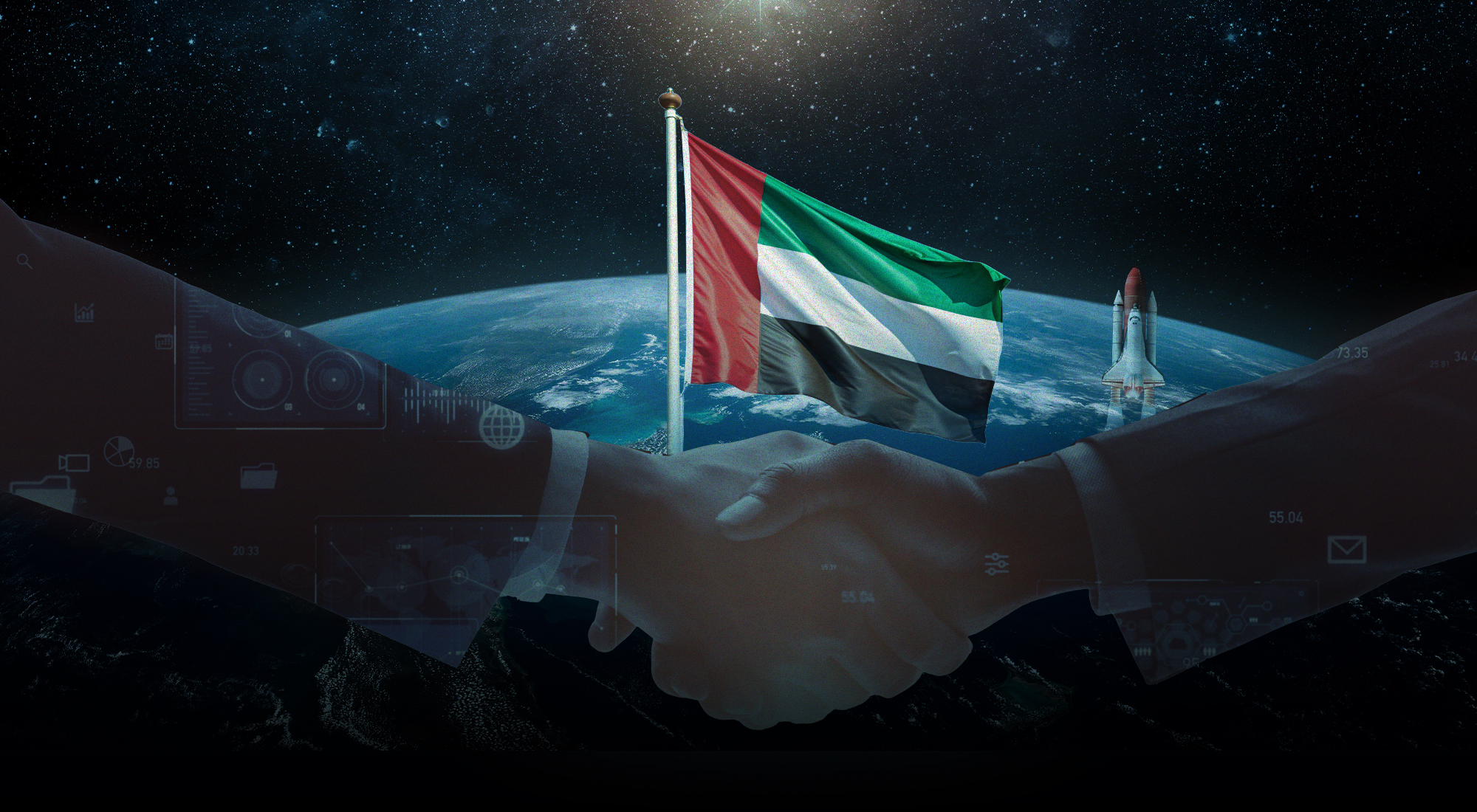
Over the past decade, the United Arab Emirates (UAE) has transformed its space ambitions into a powerful instrument of diplomacy and soft power. The country’s investments in space exploration—beginning with the establishment of the UAE Space Agency in 2014 and culminating in the Mars Hope Probe’s successful journey to Mars in 2021—have positioned the UAE as a regional pioneer in scientific innovation and cooperation.[1] Beyond their technical and scientific achievements, these milestones have conveyed a message of regional leadership, optimism, and shared advancement across the Arab world.
This insight explores how space diplomacy—the use of space activities to advance mutual understanding and collaboration—has emerged as a new tool for building trust among governments in the Arab region. The UAE’s experience provides an illustrative case of how a capable nation can use science and technology initiatives to foster political goodwill and shape a cooperative regional order. By aligning its national space program with broader goals of dialogue, education, and partnership, the UAE demonstrates how technological progress can reinforce diplomacy, confidence, and stability.
At the core of this study lies a practical question: What key factors shape the implementation and effectiveness of space diplomacy in building trust between states? The UAE’s experience offers compelling insights into this inquiry.[2] Its strategy demonstrates that diplomatic success in space depends not only on technological capability but also on how cooperation is structured, communicated, and sustained. The establishment of the Arab Space Cooperation Group (ASCG) in 2019 under Emirati leadership embodies this approach.[3] By uniting fourteen Arab nations around shared objectives in satellite development, data exchange, and joint missions, the UAE has created a framework where collaboration replaces competition, and scientific ambition transcends political divides. The ASCG thus represents more than an institutional milestone—it is a living model of how coordinated, knowledge-based initiatives can transform mutual interests into lasting intergovernmental trust.
The UAE’s achievements—such as the Hope Probe, the astronaut program, and partnerships with Saudi Arabia, Bahrain, Egypt, and others—have elevated its international profile while encouraging neighboring states to pursue similar ambitions. Space initiatives now operate as platforms for policy coordination, talent exchange, and regional pride. They also serve an educational purpose, inspiring a new generation of Arab scientists through initiatives like the Arab Space Pioneers Program, launched to train and mentor young researchers.[4]
Space diplomacy, as practiced by the UAE, is not limited to launching rockets or satellites. It is about projecting values—cooperation, inclusivity, and peaceful scientific pursuit—into a domain that symbolizes the future. By extending invitations for partnership, sharing resources, and supporting others’ capabilities, the UAE has built a narrative of trust that transcends politics.[5] Its space activities have also diversified the economy, nurtured innovation ecosystems, and supported the country’s vision for a knowledge-based society beyond dependence on hydrocarbons.[6]
As the Arab region faces complex geopolitical and developmental challenges, the UAE’s model of space diplomacy offers a practical framework for confidence-building and soft-power engagement.[7] It underscores how scientific collaboration can complement traditional diplomacy and provide a neutral, forward-looking platform for cooperation. In doing so, the UAE has not only advanced its national interests but also strengthened the prospects for collective Arab progress in one of the most strategic domains of the 21st century—outer space.[8]
Space diplomacy as a mechanism for building intergovernmental trust
Space diplomacy has emerged as a distinctive avenue for advancing peaceful collaboration and building trust among nations—encompassing joint missions, satellite projects, and research exchanges as instruments for strengthening bilateral and multilateral relations. For the UAE, space diplomacy has become a deliberate and catalytic policy tool that combines soft power with scientific achievement.
The UAE recognized early on that science and technology could serve not only as engines of national development but also as channels of international engagement. By investing in an ambitious space program anchored in transparency, inclusivity, and peaceful intent, the UAE has sought to build credibility and mutual respect in the Arab region and beyond.[9] The country’s leadership envisioned that cooperation in space exploration could transcend political fault lines that have long characterized Middle Eastern relations. The success of the Hope Probe to Mars in 2021 symbolized this ambition: it was not merely a national milestone but a regional one, inspiring pride across Arab societies and signaling the UAE’s willingness to share knowledge and opportunity.[10]
Space diplomacy operates at the intersection of soft power and strategic confidence. Soft power, understood as the ability to shape others’ preferences through attraction and persuasion,[11] finds a tangible expression in scientific leadership and technological competence. When a country like the UAE conducts successful space missions, trains astronauts, and invites regional partners to participate in research programs, it projects reliability, foresight, and capability—all traits that generate trust.[12]
This trust is operational rather than abstract. Space projects demand sustained collaboration, data exchange, and technical transparency. They require states to coordinate launch schedules, share data, and align research goals.[13] These processes create habits of cooperation that can gradually extend into other sectors of foreign policy. For example, the UAE’s collaboration with Saudi Arabia and Bahrain on satellite projects, and with Egypt on establishing a satellite assembly and testing center in Cairo,[14] demonstrates how scientific partnerships can evolve into diplomatic synergies.
Moreover, space cooperation humanizes diplomacy. When Emirati astronauts Hazza Al Mansouri and Sultan Al Neyadi participated in International Space Station missions, they represented not just the UAE but the broader Arab region.[15] Their achievements were celebrated across national boundaries and covered extensively in regional media, strengthening identification with a shared Arab scientific narrative.[16] This emotional resonance—the sense that progress in space belongs to all—serves as a unique form of confidence building.
Several lessons emerge from the UAE’s experience. First, space diplomacy thrives on consistency. Governments must ensure stable budgets, coherent policies, and long-term institutional support to prevent collaboration fatigue.[17] Second, trust requires visibility: the achievements of joint missions should be publicly celebrated and shared across media to sustain public interest and legitimacy. Third, inclusivity amplifies effectiveness. The more partners perceive ownership—whether through co-authored research, co-developed satellites, or shared training opportunities—the more durable the trust becomes.
Space diplomacy should not be confined to the space sector alone. It can inform broader regional cooperation in energy transition, climate monitoring, and digital connectivity.[18] By demonstrating that high-technology collaboration is possible even among politically diverse states, the UAE’s model offers a replicable framework for science-based diplomacy across the Global South. In regions where political mistrust runs deep, shared scientific endeavors can provide neutral ground for engagement, enabling governments to rebuild confidence incrementally.[19]
Finally, as space becomes increasingly crowded and competitive, maintaining trust will depend on transparency, data protection ethics, and adherence to international norms.[20] The UAE’s practice of aligning national projects with global frameworks such as the United Nations Committee on the Peaceful Uses of Outer Space (UN-COPUOS) strengthens the credibility of its diplomatic posture.[21] This alignment reassures partners that collaboration will not compromise sovereignty or security but rather enhance collective resilience in an era where outer space underpins everything from communications to climate monitoring.
The Arab Space Cooperation Group (ASCG) as a regional trust-building model
The ASCG, established in March 2019 under the UAE’s leadership, represents a turning point in the evolution of Arab scientific cooperation. Launched by the UAE Space Agency (UAESA) and endorsed by fourteen Arab nations—including Saudi Arabia, Egypt, Bahrain, Jordan, Algeria, Morocco, Kuwait, Sudan, and Oman—the ASCG was conceived as a platform for collective capacity building in space technology and research.[22] Its primary aim is to strengthen Arab participation in the global space economy while also fostering trust and collaboration among member states traditionally divided by differing political and economic interests.[23]
From its inception, the ASCG was grounded in the idea that shared scientific goals can bridge political divides.[24] By focusing on practical projects—satellite design, joint research, and training programs—the UAE sought to institutionalize cooperation around common challenges such as climate monitoring, resource management, and technological innovation. The group was also designed to promote a new regional identity rooted in knowledge diplomacy rather than competition.[25] The ASCG provided a platform through which Arab states could interact beyond politics and rediscover common ground through peaceful scientific ambition.[26]
The ASCG’s most emblematic initiative is the “813 Satellite Project,” named after the year 813 CE—considered a golden age of Arab scientific discovery during the Abbasid Caliphate. The project symbolizes a revival of Arab scientific cooperation in the modern era and serves as a tangible example of trust-building through science diplomacy.[27] Funded and hosted by the UAE, the 813 satellite is a joint Earth-observation mission designed and developed at the National Space Center (NSSTC) at the UAE University in Al Ain, with contributions from technical teams across the Arab world.[28] Its objective is to collect environmental data to support sustainable development and climate resilience—a domain where cooperation has immediate, non-political benefits.[29] Member states participate through data-sharing agreements, personnel exchanges, and research coordination, effectively operationalizing multilateralism in a field that demands transparency and precision. ASCG meetings provide a new diplomatic venue where scientific credibility replaces political mistrust and where progress is measurable, cooperative, and forward-looking.[30]
From a policy perspective, the ASCG demonstrates that regional cooperation thrives when science is depoliticized and institutionalized. The focus on environmental monitoring, disaster management, and training avoids contentious themes while providing tangible societal benefits. By aligning projects with global frameworks such as the UN-COPUOS and the UN Sustainable Development Goals (SDGs), the ASCG reinforces the legitimacy of Arab cooperation within international norms, enhancing both internal and external trust.[31]
Ultimately, the UAE’s orchestration of the ASCG underscores how science and diplomacy can coexist as mutually reinforcing pillars of regional stability. The group’s achievements—particularly the 813 Satellite Project—illustrate that practical collaboration in high-technology domains can transcend politics and inspire collective confidence in the Arab world’s capacity to innovate together.[32]
Policy Recommendations
The UAE’s experience demonstrates that space and science diplomacy can be established as enduring pillars of foreign policy. Governments seeking to replicate this success must embed scientific cooperation within national decision-making frameworks rather than treat it as an ad hoc initiative. Establishing inter-ministerial councils—linking foreign affairs, higher education, and innovation portfolios—ensures that technical achievements align with diplomatic objectives.
The UAE’s decision to appoint an Assistant Minister of Foreign Affairs for Advanced Science and Technology Affairs is a precedent worth emulating.[33] It formalized the intersection between innovation and diplomacy, signaling that scientific advancement is part of the country’s external identity and soft-power projection. For other countries, creating similar institutional roles would strengthen coordination, foster policy continuity, and embed the norm that science is a legitimate vector of international engagement.
Inclusivity is the main driver of regional credibility and sustainability, ensuring that even resource-constrained countries experience tangible benefits from collaboration.[34] Governments can enhance the durability of trust by institutionalizing transparency mechanisms—open access to scientific data, shared research protocols, and regular joint reviews.[35] The credibility of cooperation also depends on visible public communication: joint launches, conferences, and regional prizes reinforce the perception of collective ownership.[36]
The UAE’s science-diplomacy model offers a template for cross-sectoral regional cooperation. Its structure—anchored in technical collaboration, institutional credibility, and public visibility—can be adapted to other strategic arenas.
- In energy transition, countries could establish a “Regional Renewable Innovation Network” modeled after ASCG, pooling R&D on solar storage, hydrogen, and grid integration.
- In climate diplomacy, joint satellite data and AI analytics could underpin an Arab Climate Early-Warning System, providing shared resilience benefits.
- In digital transformation, a coordinated framework for cybersecurity norms and space-based connectivity could mirror the cooperative ethos of ASCG.
By broadening science diplomacy to encompass sustainability, digital governance, and food-water security, Arab countries would transform scientific engagement into a comprehensive regional trust architecture—aligning with the UN’s Space2030 Agenda and the SDGs.[37] Additionally, long-term trust depends on people-to-people connectivity. Programs such as the Arab Space Pioneers—launched by the UAE in 2020 to train young Arab researchers—have proven the effectiveness of youth-focused scientific collaboration.[38] Within two weeks of its launch, the program received more than 37,000 applications across the Arab world, demonstrating the regional demand for knowledge exchange and shared purpose.[39]
Governments should therefore integrate education diplomacy into their regional strategies. Joint scholarships, research hubs, and exchange fellowships in aerospace, engineering, and climate science would cultivate a generation that views cooperation—not rivalry—as the regional norm. Public universities could coordinate curricula around regional scientific challenges, while think tanks and academies build a science-policy interface to translate research into actionable governance insights. These measures would turn fragmented national efforts into a coherent Arab science-diplomacy ecosystem—a dynamic framework through which trust, innovation, and sustainable growth reinforce one another.
The UAE’s leadership in space diplomacy has set a precedent for how emerging powers can use technology to cultivate confidence and peace.[40] The imperative ahead is to evolve the model—to extend science diplomacy into an inclusive regional architecture where knowledge becomes the new currency of trust. This is no longer a luxury for advanced nations but a necessity for developing ones; it is the bridge that transforms ambition into credibility. By institutionalizing this principle, governments can shift from reactive politics to proactive cooperation—charting a future where innovation, integration, and interdependence define the next chapter of multilateralism.
Concluding perspectives
The rise of space diplomacy in the Arab world—led by the UAE—has redefined how regional cooperation can be conceived and practiced. What began as a national pursuit of scientific excellence has evolved into a structured diplomatic mechanism that fosters trust, credibility, and collaboration among Arab states. The ASCG stands as a tangible expression of this transformation: a platform where science has become both a language of unity and an instrument of collective progress.
The UAE’s approach shows that technological advancement and diplomacy are interdependent. By embedding innovation into its foreign policy, the UAE has turned scientific capability into a form of soft power that attracts regional participation. Projects such as the Hope Probe, the astronaut program, and the ASCG’s 813 Satellite have transformed technical success into diplomatic capital, proving that trust can be built through transparency, shared achievements, and the promise of mutual benefit.
For emerging countries, the UAE’s experience underscores that science diplomacy can institutionalize trust when supported by continuity, communication, and youth engagement. Programs like the Arab Space Pioneers illustrate how long-term cooperation can be rooted in education and human capital. Extending this model beyond the space sector—to renewable energy, climate action, and digital transformation—could turn scientific collaboration into a cornerstone of regional stability and sustainable development. The policy challenge ahead lies in translating this trust into structure—creating legal, ethical, and institutional frameworks that ensure predictability and fairness. Formalizing cooperation under Arab League or GCC mechanisms, aligned with global norms such as the UN-COPUOS and Space2030 Agenda, would consolidate science diplomacy as a durable regional practice.
Ultimately, engagement in space diplomacy marks a shift from resource-based power to knowledge-based influence. It demonstrates that in a fragmented geopolitical landscape, science remains the most universal language of trust. By institutionalizing cooperation and expanding it across emerging sectors, governments can redefine regional unity around innovation, integration, and shared discovery—charting a future where ambition becomes credibility and knowledge becomes the foundation of peace.
[1] UAE Space Agency, “Emirates Mars Mission – Hope Probe,” UAE Space Agency, October 27, 2025, https://space.gov.ae/en/about-us/initiatives-and-projects/initiatives-and-projects-listing/emirates-mars-mission-hope-probe.
[2] Torsten Kriening, “UAE Offers Ambitious Vision for Arab Space Cooperation Group,” SpaceWatch.GLOBAL, November 29, 2019, https://spacewatch.global/2019/11/uae-offers-ambitious-vision-for-arab-space-cooperation-group/.
[3] Naser A. Bin Hammad, “Does Space Diplomacy Have a Significant Role in Developing Trust Between Governments? The Establishment of Arab Space Cooperation Group” (Geneva School of Diplomacy, 2024), 131–36.
[4] Hammad, “Does Space Diplomacy Have a Significant Role in Developing Trust Between Governments?,” 148.
[5] “القوة الناعمة لدولة الإمارات,” Al Bayan, October 29, 2018, https://www.albayan.ae/opinions/articles/2018-10-29-1.3395178.
[6] Hammad, “Does Space Diplomacy Have a Significant Role in Developing Trust Between Governments?,” 116.
[7] Ibid., 201.
[8] Ibid., 155–56.
[9] Ibid., 190.
[10] Dr. Mohamed Al Ahbabi, “UAE Space Agency,” October 2021.
[11] Steven Lukes, “Power and the Battle for Hearts and Minds,” Millennium 33, no. 3 (2005): 477–93, https://doi.org/10.1177/03058298050330031201.
[12] Hammad, “Does Space Diplomacy Have a Significant Role in Developing Trust Between Governments?,” 121–22.
[13] Kai-Uwe Schrogl, “Nandasiri Jasentuliyana Keynote Lectures – IISL – International Institute of Space Law,” International Institute of Space Law, 2016, https://iisl.space/nandasiri-jasentuliyana-keynote-lectures/.
[14] Hammad, “Does Space Diplomacy Have a Significant Role in Developing Trust Between Governments?,” 18.
[15] Ibid., 128.
[16] N. Bin Hammad, “How the UAE Is Working to Promote International Collaboration on Space Programmes,” ITU News, October 3, 2019, https://news.itu.int/how-the-uae-is-working-to-promote-international-collaboration-on-space-programmes; Hammad, “Does Space Diplomacy Have a Significant Role in Developing Trust Between Governments?,” 133.
[17] Abdulla Matar Al Mazrouei, “MoFAIC’s Department of Arab Affairs,” March 2022, phone interview.
[18] Bin Hammad, “How the UAE Is Working to Promote International Collaboration on Space Programmes,” 118.
[19] Ibid., 116.
[20] Dr. Michael Kiwanuka, “Building Trust and Reciprocity through Citizen Participation and Transparency: Lessons from Municipal Governments of Uganda and Thailand,” International Journal of Economics, Business and Management Research 6, no. 5 (2022): 50–63, https://doi.org/10.51505/ijebmr.2022.6505; Bin Hammad, “How the UAE Is Working to Promote International Collaboration on Space Programmes,” 126, 147.
[21] Bin Hammad, “How the UAE Is Working to Promote International Collaboration on Space Programmes,” 93.
[22] Ibid., 173–74.
[23] Dr. Mohamed Al Ahbabi, “UAE Space Agency,” October 2021; Bin Hammad, “How the UAE Is Working to Promote International Collaboration on Space Programmes,” 189.
[24] Marga Gual Soler, “Science Diplomacy in Latin America and the Caribbean: Current Landscape, Challenges, and Future Perspectives,” Frontiers in Research Metrics and Analytics 6 (June 2021), https://doi.org/10.3389/frma.2021.670001; Bin Hammad, “How the UAE Is Working to Promote International Collaboration on Space Programmes,” 90, 124.
[25] Dr. Mohamed Al Aseeri, “Bahrain National Space Authority,” January 2022, phone interview.
[26] Bin Hammad, “How the UAE Is Working to Promote International Collaboration on Space Programmes,” 142.
[27] David Bridge and Simon Radford, “Teaching Diplomacy by Other Means: Using an Outside-of-Class Simulation to Teach International Relations Theory,” SSRN Scholarly Paper no. 2203120 (Social Science Research Network, January 18, 2013), https://doi.org/10.2139/ssrn.2203120; Hammad, “Does Space Diplomacy Have a Significant Role in Developing Trust Between Governments?,” 133.
[28] Hammad, “Does Space Diplomacy Have a Significant Role in Developing Trust Between Governments?,” 134, 148.
[29] Ibid., 133.
[30] Ibid., 148.
[31] Ibid., 202.
[32] Eytan Gilboa, “Global Communication and Foreign Policy,” Journal of Communication 52, no. 4 (2002): 731–48, https://doi.org/10.1093/joc/52.4.731; Hammad, “Does Space Diplomacy Have a Significant Role in Developing Trust Between Governments?,” 202.
[33] Hammad, “Does Space Diplomacy Have a Significant Role in Developing Trust Between Governments?,” 92.
[34] Ibid., 96.
[35] Ibid., 96.
[36] Hans N. Tuch, Communicating with the World: U.S. Public Diplomacy Overseas (New York: St. Martin’s Press, 1990), http://archive.org/details/communicatingwit00tuch; Hammad, “Does Space Diplomacy Have a Significant Role in Developing Trust Between Governments?,” 184.
[37] “UNISPACE+50 Outcome Document: The Space2030 Agenda – Space as a Driver of Sustainable Development,” UN Office for Outer Space Affairs, 2025, https://www.unoosa.org/oosa/en/ourwork/space4sdgs/space2030agenda.html.
[38] Hammad, “Does Space Diplomacy Have a Significant Role in Developing Trust Between Governments?,” 18.
[39] Ibid., 134–35.
[40] Ibid., 205.