
Central Asia’s enormous resources and substantial oil and gas reserves make it a potential transit hub that may connect the entire Eurasian region. The region’s strategic and transformative potential is underlined by various proposals tabled by government officials, including possibly extending the $62 billion China-Pakistan Economic Corridor into its territory to maximize regional connectivity and benefit from potential economic dividends.[1]
The year 2025, however, is characterized by alarming global trends, including disruptions to bilateral trade, crass protectionism, pernicious tariffs imposed by the Trump administration, great power rivalries in the South China Sea and Russia’s protracted war in Ukraine. Amid prevailing uncertainty, countries continue to seek economic stability, with prospective regional connectivity via Central Asia being increasingly viewed as an attractive and strategically viable geopolitical pivot.
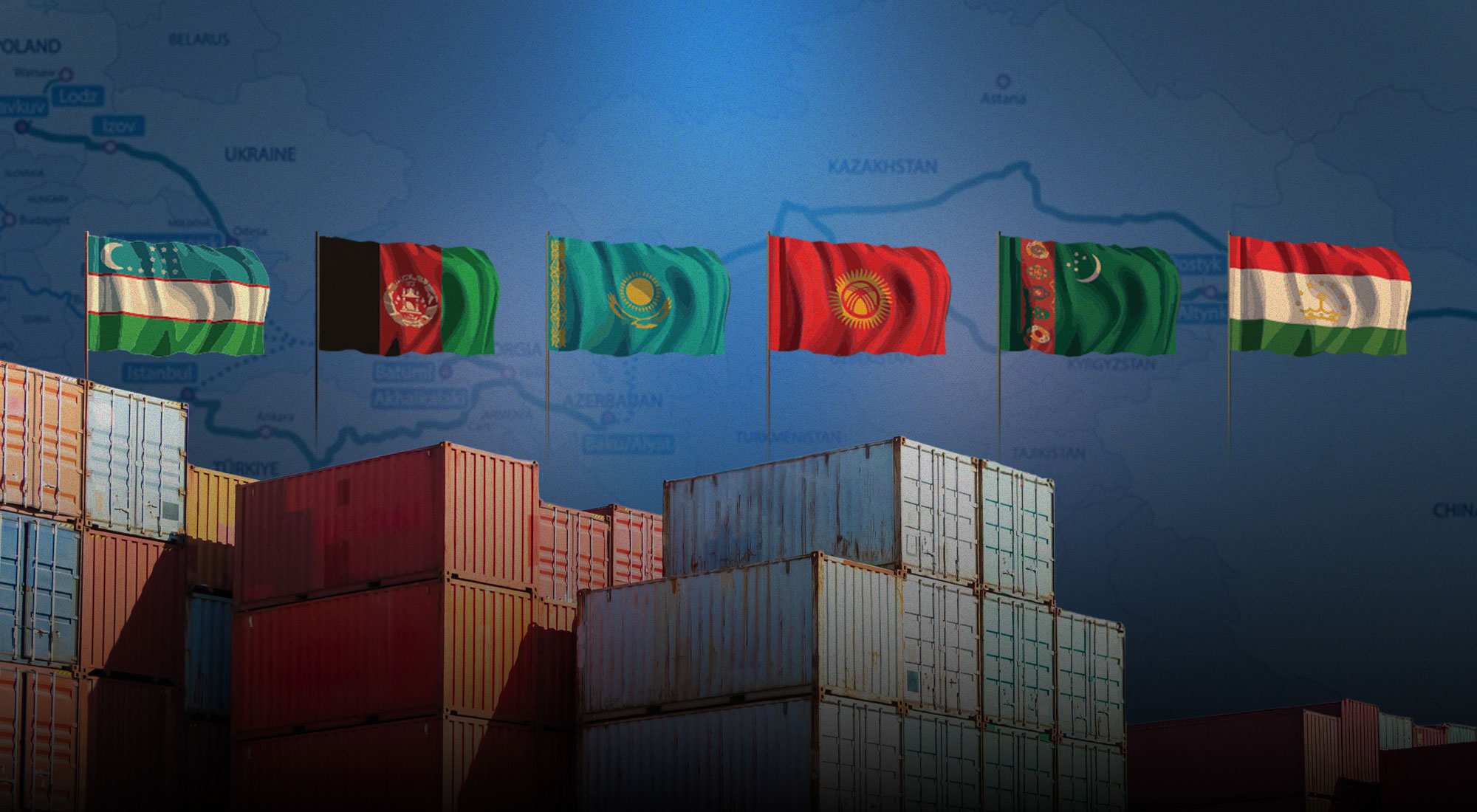
To hedge against global shockwaves, emphasis is being placed on leveraging the ‘Middle Corridor’, a multimodal transportation framework encompassing railway linkages, sea transport facilities, road infrastructure and logistics. Spanning 6,500 to 7,000 km, the corridor links China’s northwestern states with Kazakhstan, the Caspian Sea, Azerbaijan, Georgia, Türkiye and Europe.[2] Its materialization carries economic and strategic implications for Central Asian states. Its ability to become a strategic game changer for a region with prior experience of regional initiatives, such as the China-Central Asia-West Asia Economic Corridor, warrants a closer examination.[3] Also, whether the Middle Corridor differs from current initiatives impacting Central Asia such as the International North-South Transport Corridor, linking India, Azerbaijan and the Russian Federation via railways, land routes and shipping lanes, also remains to be seen.[4]
This paper addresses whether the Middle Corridor can become a strategic game changer for Central Asia. In doing so, the structure of the paper moves logically through the global geopolitical context, Central Asia’s historical corridor experiences, the strategic potential of the Middle Corridor, endorsements from external actors, benefits, challenges, and recommendations.
I. The Corridor’s Significance Amid Regional and International Interest
While Central Asian states have previous experiences with regional corridors passing through their territory, none of them account for the regional dynamics having unfolded in 2025. This includes Russia’s war in Ukraine continuing unabated, Trump’s protectionism drive, and prevailing global economic uncertainties plaguing Central Asia’s domestic economies in the form of disruptions to supply chain management, geopolitical shockwaves, and uncertainty regarding traditional transporting routes via Russia and Iran.
Renewed regional and international interest in the Middle Corridor’s completion in 2025, however, brings optimism for Central Asian states. Trilateral meetings held in 2025 between Azerbaijan, Kazakhstan, and Georgia have sought to coordinate the initiative’s Multimodal Joint Venture to convert geographical proximity into systemic interdependence between member states.[5] Additionally, Kazakhstan’s construction of a port terminal in Poti, Georgia, is part of the Middle Corridor’s operationalization drive and geared at securing a safer alternative for transporting goods into Europe rather than through previous, riskier routes involving Russia and Iran amid Western sanctions.[6] Additionally, Turkish company Orta Asya Investment Holding’s execution of definitive agreements with the Kyrgyz Ministry of Energy for hydroelectric initiatives reveals the seriousness with which regional capitals view the Middle Corridor as a strategically rewarding and economically viable alternative in 2025.[7]
II. Mixed Results from Previous Corridors/Initiatives
For Central Asian states, regional interest in 2025 in the Middle Corridor’s completion is beneficial, given mixed results derived from previous investments and initiatives. Located at the confluence of Russia, China and a restive Afghanistan in the South, the landlocked republics have not witnessed universal economic prosperity from current investments. Take the Belt and Road Initiative (BRI) from China as an example, with the latest trends in 2025 indicating that financing in the region places Kazakhstan as the region’s leading economic beneficiary, with $23 billion worth of investments out of Central Asia’s overall pool of $25 billion from the BRI in July 2025 alone. Investments in Kazakhstan constitute 92% of all BRI investments in the region in 2025, with 8% being shared between Turkmenistan, Tajikistan, Uzbekistan and Kyrgyzstan.[8] BRI investments in Kazakhstan also have limitations, where, according to a 2025 report co-published by Griffith University in Australia and the Beijing-based Green Finance and Development Center, investments in Astana have been limited to domestic copper and aluminum mining initiatives, while further construction contracts remain in the pipeline.[9]
III. Economic Perils and Overreliance
Central Asian states benefiting from investments, initiatives and corridors have not been immune to economic problems typical of landlocked states in 2025.
Turkmenistan’s case is relevant in this regard. At the Third UN Landlocked Developing Countries Conference in August 2025, UN Secretary of State Antonio Guterres stated that landlocked countries such as Turkmenistan, with tremendous natural resources, endure high transportation costs and limited access to global markets, which stifle their domestic economic potential.[10] Countries such as Turkmenistan also constitute 7% of the world’s population while representing over 1% of global economic output and trade. This warrants the swift implementation of alternate, viable transport corridors for countries such as Turkmenistan and its regional counterparts, to realize their true potential.
Then there are the perils of overreliance for Central Asian states. China’s BRI investments and transport corridors in the region make Central Asian states economically dependent on domestic dynamics and spending priorities in Beijing. BRI investments, for example, remain a small component of several projects, corridors and investments pursued by China in Asia and Africa. This makes Central Asia’s economic prosperity dependent on the budgeting priorities of the Chinese government. Beijing’s decision to enact inward-looking financial policies at its annual Two Sessions in March 2025, for example, demonstrates China’s domestic prioritization of stimulating consumer spending and optimizing investment utilization instead of funding corridors overseas.[11]
IV. Pragmatism, Possibilities and Challenges
To Central Asia’s credit, regional states have pursued foreign policies anchored in pragmatism and multi-vector approaches, which involve good relations with all regional countries and great powers. Kazakhstan and Kyrgyzstan, for example, have good to normal relations with the United States, Russia and China and pursue an official policy of neutrality in the absence of camp politics, while focusing on prioritization of investments. States also participate in the annual C5+1 Summit with the U.S. Secretary of State to discuss job growth, counterterrorism, trading ties and connectivity prospects in the region.[12] They are active in the Eurasian Shanghai Cooperation Organization, featuring both China and Russia, with countries such as Tajikistan benefiting from bilateral interagency cooperation agreements with Russia.[13]
Such multi-vector approaches have helped the region become less reliant on one dominant power, which remains critical as the year 2025 presented challenges warranting strategic rethinking. Donald Trump’s protectionism, drive to contain China in Asia and enactment of punitive measures against countries such as India for purchasing Russian oil and S-400 missile systems from Moscow, are impacting and taking place in close geographical proximity to Central Asian borders.[14] The status quo on the Ukraine war remains unchanged, with the Alaska Summit in August 2025 between the United States and Russia failing to yield an everlasting ceasefire.[15] Such developments clearly entail that, despite having independent foreign policies, Central Asia will continue to face potential geopolitical economic shocks.
In light of this, the Middle Corridor provides economic incentives that cater to Central Asia’s drive for alternative and strategic viability. Russia’s invasion of Ukraine and subsequent Western sanctions on Moscow, for example, dealt severe blows to their domestic economies, which are heavily reliant on traditional export-import relationships with Russia. This includes disrupted supply chains and higher inflation in domestic markets.[16] Many of these trends are slated to continue beyond 2025 and into 2026, given Russia’s unabated war on Ukraine.[17]
The Middle Corridor, however, provides economic benefits that can offset such economic downturns. According to the World Bank, the corridor’s operationalization entails a reduction in transport time for both Central Asian and Eurasian states, with a projected increase in freight volumes amounting to 11 million tons annually by 2030.[18] Analyst Hicheme Lehmici corroborates this massive economic potential by stating that routing goods through the Middle Corridor is better than the sea route through the Suez Canal, with transportation expected to take 12-15 days instead of the usual 30-40 days to their final destination.[19]
The Middle Corridor also brings prospects for universal prosperity, which has so far eluded the region. Lesser developed Central Asian states such as Tajikistan, which remain impoverished despite the presence of regional initiatives, stand to benefit from the Corridor’s eventual materialization. While not formally part of the initiative, the landlocked state can avail residual effects, including logistical connectivity and reduced reliance on Russia for its transit trade.[20] This complements Dushanbe’s impressive progress witnessed in 2025, where, despite socioeconomic challenges, notable surges in freight transport volumes between January and June 2025, amounting to a total of 66.6 million tons of cargo, were witnessed.[21] Kyrgyzstan, too, with similar socioeconomic challenges such as poverty and corruption, can benefit from the corridor’s operationalization as its domestic economy potentially shifts away from exporting raw materials to high-value manufacturing.[22]
Such positive trends include economic independence and sustainability, which the Middle Corridor offers. Developments in 2025 further suggest that the corridor is maturing with varied strategic implications for Central Asia as it navigates a complex geopolitical, regional and global landscape.
V. Apolitical International Endorsement and Global/Regional Optimism
Given the Middle Corridor’s route bypassing both Russia and Iran and hedging against geopolitical shockwaves from Russia’s war in Ukraine, the initiative has gained increased traction in Western policymaking circles. Its passage through Central Asia gives the region added strategic relevance as a hub for global economic connectivity, making it the fastest trade route between China and Europe.[23]
There is an absence of Western skepticism of the corridor’s routes, economic potential and strategic implications for member states. Such active endorsement came from the UK Parliament in 2025, where the corridor was hailed as a resilient route for supply chain management and an excellent hedging strategy against Russia’s war in Ukraine. At a high-level conference on Caspian transport connectivity in London, UK Trade Envoy to Azerbaijan and Central Asia, Lord John Alderdice, lauded the initiative’s potential and underlined tangible steps taken by the UK to boost regional connectivity in Central Asia. This includes raising $10 billion through sovereign bonds on the London Stock Exchange via assistance to Kyrgyzstan and Kazakhstan.[24] Lord Alderdice also called on member states to prioritize the corridor’s development as a critical alternative to traditional maritime shipping lanes.
Such support from London stems from the Middle Corridor’s ability to reroute freight from Russia’s railways and deny Moscow transit revenues. Regardless of the UK’s motivations, however, endorsement from London is a cause for optimism for Central Asia as it increases prospects for foreign direct investment and support from other Western countries as the UK’s allies. This, in turn, opens up institutional funding, encourages transit trade, promotes digitalization, upgrades railway infrastructure, develops customs procedures and supports local businesses with Central Asia as the transit hub.
Also, Western endorsement of the Middle Corridor is not limited to the UK. The European Union, which remains embroiled in a geopolitical rivalry with Moscow over the Ukraine war, has been extremely receptive to its implementation. In 2025, the bloc announced investments worth 12 billion euros at the first EU-Central Asia Summit in April 2025 to develop infrastructure related to the corridor, including deepening cooperation on raw materials, energy and digital connectivity.[25] The European Investment Bank also signed a loan worth 200 million euros with the Development Bank of Kazakhstan to promote transport, green initiatives, support for farmers, small businesses, and assist sectors affected by the pandemic, which fits into the broader agenda of the Middle Corridor’s materialization.[26]
For Central Asian states, endorsement from the UK and Europe is ideal for domestic economic stability. This, coupled with EU investments in solar-powered logistics centers in July 2025, makes the Middle Corridor a ‘greener alternative’, aligned with climate change and sustainable development goals.[27] Such investments boost the region’s profile as a potential net contributor to green development, making it attractive for investments from environmentally sensitive global firms. European companies such as French Expertise and GIZ Germany are already focusing on the Middle Corridor’s digitalization and efforts to reduce cargo times in Eurasia, which further demonstrates the corridor’s importance in Europe’s geopolitical, strategic calculus.[28]
VI. Rare Endorsement from Both Beijing and Washington
The Middle Corridor benefits from rare endorsement from both the United States and China despite their geopolitical rivalry over subjects such as Hong Kong, the South China Sea and tariffs.
American interest is more indirect, with no official opposition from Washington, D.C., to the Middle Corridor. In August 2025, the Trump administration struck a peace agreement between Armenia and Azerbaijan while giving the U.S. exclusive developmental rights to the planned ‘Zangezur Corridor’ or the Trump Route for International Peace and Prosperity (TRIPP), which links countries through rail and energy cooperation.[29] Such developments are positive signs for Central Asian states as Zangezur’s operationalization can potentially open up new trade routes in Eurasia, potentially complementing the Middle Corridor in the process. Also, while trade relations with non-market economies of the former Soviet Union and the U.S. were restricted by the 1974 Jackson-Vanik Amendment, including with Central Asian states and Azerbaijan, U.S. Secretary of State Marco Rubio in 2025 hinted at discarding the amendment, which, amid Trump’s push for regional corridors to offset tensions and quest to gain access to rare earth minerals to counter China, bodes well for the future of both Central Asia and the Middle Corridor as potential transit hubs.[30]
Direct endorsement from China also increases the corridor’s relevance as a win-win instead of a zero-sum strategy. Beijing’s interest in 2025 includes investments in the construction of deep-sea ports on Georgia’s Black Sea Coast. Such investments are aimed at achieving a 20% share in China-EU maritime trade through the Middle Corridor in 2025.[31] Additionally, China’s endorsement is anchored in the corridor’s potential to become an alternate conduit to routes passing through the Malacca Strait, thereby reducing Beijing’s reliance on sea-based trade. This, alongside potential trade efficiency and expanded economic cooperation, makes the Middle Corridor an attractive proposal for China.
VII. Advantages and Prospects for Central Asia
For the Central Asian states, nonpartisan international approval and the corridor’s materialization bring varied strategic benefits and prospects.
Firstly, the corridor’s completion boosts container traffic for all countries along the China-EU route with its multimodal approach as a joint project between Azerbaijan, Georgia and Kazakhstan already witnessing participation from key entities such as China’s Railway Transport Containers to achieve that goal.[32] This entails increased volume of transit trade and revenue generation, which is then further complemented by the planned laying of a $50 million digital fiber optic cable along the Caspian Sea floor as agreed in March 2025 between Kazakhstan and Azerbaijan. This allows the region to benefit from a distributed digital platform, improved access to global markets, increased prospects for e-commerce, cloud computing, foreign direct investments in smart logistics and real-time adaptive coordination.[33]
The Middle Corridor also provides opportunities to identify and address logistical bottlenecks for Central Asian states through increased transparency and monitoring mechanisms. Stakeholders such as railway operators from Azerbaijan, Georgia and Kazakhstan guaranteeing delivery time and agreeing on multimodal freight movement along the EU-China route will prevent delays in freight movement along the corridor’s route. It will also provide practical delivery assurances, which remain critical for Central Asia’s aspiration to become a global transit hub.[34]
The corridor also guarantees a safe conduit for landlocked countries such as Turkmenistan, which lack the requisite infrastructure for exporting gas to Europe. This is further exemplified in Azerbaijan’s agreements with regional states such as Turkmenistan and Uzbekistan when President Aliyev hosted Uzbek President Shavkat Mirziyoyev in July 2025. The meeting resulted in the signing of twenty-five bilateral agreements between all sides, including providing Ashgabat with the required land route to transport gas to Europe via Azerbaijan.[35]
Countries in Central Asia, such as Kyrgyzstan, which faced socioeconomic challenges in 2025, also have a lot to gain from the corridor’s maturing. The initiative includes multiple projects complementing its planned route, including the China-Kyrgyzstan-Uzbekistan (CKU) railway, worth $8 billion and 573 km in length.[36] The CKU’s materialization reduces transit time between China and Europe, with Bishkek benefiting from lower costs for exporting goods and raw materials. It also allows Kyrgyzstan to earn transit tariffs, customs fees, attract foreign investment in manufacturing and build on its domestic construction and industrial capacities.[37]
There is plenty of positive momentum to capitalize on. Initial results based on the Middle Corridor’s maturing in 2025 indicate that total operational cargo turnover has been increasing by 8.6% on its route in the first half of the year, as global companies diversify trading routes and prevent supply chain disruptions from Russia’s war in Ukraine.[38] The increase in cargo volume is further complemented with member states such as Azerbaijan, Georgia, Türkiye and Central Asian states urging harmonization and digitalization of transit and border documents, allowing the region to benefit from enhanced transparency, adequate monitoring of the flow of goods and services, reduction in pervasive corruption and an increase in the capacity, efficacy and competitiveness of existing initiatives.[39]
The Middle Corridor also opens up regional markets in Türkiye and the Caucasus, bringing with it prospects of rising trade volumes, imports of pharmaceuticals, consumer goods and access to high-value markets beyond Russia. Furthermore, prospective growth in warehouses, trucking and customs services enhances opportunities for job creation in the region, with investors from Türkiye, China and EU development banks prospectively increasing capital inflows and technological transfers for economic development.
Even for remote areas in the region, the Middle Corridor brings with it prospects of rail electrification and smart customs systems, which can potentially usher in equitable economic development that has previously eluded the region.
VIII. Challenges and Limitations
While international endorsement, regional efforts to implement policies conducive to the corridor’s operationalization and Western approval suggest that the Middle Corridor’s maturing can potentially become Central Asia’s strategic moment in 2025, it is not without its challenges.
Impediments include prospective maritime operations being gravely affected by declining water levels in the Caspian Sea in 2025. This increases logistical and cargo capacity costs for key conduits such as the Baku port.[40] As a result, investments in financing the port remain heavily dependent on whether shallowing in the Caspian Sea is prevented.
Another factor is the difference between capacity and demand from key stakeholders such as China and the European Union. If operationalized, the Middle Corridor will only facilitate 20% of overland trade between Beijing and Brussels, which translates into limited return on investments (ROIs) for Central Asian states.[41] This indicates a wide difference between the corridor’s vision and actual potential to yield economic dividends for the region.
Additionally, the corridor offering viable alternatives to riskier routes passing through Russia and Iran does not prevent Moscow from exercising political and economic leverage on the region to obstruct progress. This can be done via Russia-led unions such as the Eurasian Economic Union, which includes Kazakhstan and Kyrgyzstan as key members. Russia’s geopolitical environment in 2025 suggests that it will be intent on keeping its economic leverage in Eurasia in the face of Western sanctions and the continuation of the Ukraine war. The Putin administration would be unwilling to cede strategic leverage to corridors bypassing its territory or curb Russian freight traffic, as it runs contrary to Moscow’s economic interests and hedging strategies against Western sanctions.
Central Asia also has a long way to go before becoming a unified region with unified policymaking on initiatives affecting the entire region. Historical factors and grievances have prevented states from demonstrating joint political will on matters of strategic importance, such as the operationalization of viable, alternate strategic corridors.
While tensions over border disputes between Kyrgyzstan and Tajikistan and Kyrgyzstan and Uzbekistan have been resolved with the signing of the Khujand Treaty in 2025, sustainable peace, adherence to the treaty’s central tenets, clauses, and prevention of the reemergence of years-old disputes remain to be seen.[42] Any violation of the treaty can easily stifle foreign investments, jeopardize the corridor’s progress and jolt corporate sentiment, boding ill for the region and the initiative.
Another impediment is the security quagmire confronting the Eurasian region, which directly affects the corridor’s implementation. Central Asia remains prone to drug trafficking, political instability and security quagmires emanating from restive Afghanistan. The 2025 seizure of drugs by authorities in Bishkek, Tashkent, Astana, Dushanbe and Ashgabat, for example, underlines the existential threat from synthetic drugs and opium production emanating from Kabul to Central Asia.[43]
Compounding the drug trafficking issue is the existential threat of terrorism, which has not subsided in the region. The transnational Islamic State in the Khorasan province continued to have a presence in Afghanistan in 2025, and according to Associate Fellow at the International Centre for Counter-Terrorism, Adrian Shtuni, the group was operating under a hybrid model in 2025 while prioritizing flexibility and security over centralized control.[44] This makes the group’s activities difficult to detect and prevent, and while Central Asia’s pursuit of joint border patrols and intelligence sharing is important for the security of the corridor’s planned routes, the motivations of terrorist groups such as the IS-K to attack the Middle Corridor are difficult to ascertain.[45]
Nevertheless, the existential threat of terrorism emanating from Afghanistan and its ability to jeopardize regional connectivity prospects warrant robust security measures from the region, including potential outreach toward the Taliban government in Kabul for security assurances.
Bureaucratic hurdles are another major impediment to the corridor’s eventual operationalization. Such hurdles exist in all Central Asian countries, including a lack of effective trade facilitation, lax border management, under-par service delivery mechanisms and insufficient intermodal transfer services in the region.[46] This, coupled with logistical inefficiencies, financing challenges, shortages of vessels, and pricing instability, needs to be overcome for the corridor’s successful materialization.[47]
It’s also important to note that while the corridor boasts a multimodal strategy of enhancing trade, it also adds a layer of logistical complexity. Projects falling within the ambit of the Middle Corridor, such as the China-Kyrgyzstan-Uzbekistan (CKU) railway project, for example, remain in their nascent stages with expected completion scheduled for 2031.[48] This suggests that the promise of the Middle Corridor’s potential to resolve Trans-Caspian logistical challenges, such as bureaucratic hurdles and infrastructure gaps, is dampened.
Additionally, the Trump administration’s interest in the Zangezur corridor in 2025 may boost prospects for the Middle Corridor, but it is not directly related to it. Azerbaijan’s peace agreement with Armenia and Baku’s push to build on Zangezur easily make it a rival corridor despite Baku’s endorsement of the latter. With connectivity through the Middle Corridor in Central Asia remaining a low priority for the Trump administration, Central Asian states may not reap dividends from direct U.S. endorsement of the corridor, given Washington, D.C.’s differing priorities on initiating peace agreements between conflicting sides, imposing tariffs and containing Russia and China.
There are also notable divergences between political optimism, goodwill, commitments and actual implementation of the corridor, which need to be factored in prior to coming up with preconceived notions on its completion, translating into Central Asia’s strategic moment. While member states at forums such as the Shanghai Cooperation Organization have repeatedly emphasized implementing the Middle Corridor to boost regional connectivity, the project suffers from structural issues, which, if left unaddressed, will prevent its eventual operationalization.
Conclusion
Despite challenges, the Middle Corridor’s maturing in 2025 through international diplomatic endorsement, development of nascent but concerted regional infrastructural initiatives and a renewed push by regional countries, Europe and the UK to seek alternate strategic routes to hedge against Iranian and Russian influence, potentially makes it a strategic game changer for Central Asia with a few important caveats.
The following recommendations are suggested for the corridor’s swift operationalization and for Central Asian states to maximize strategic dividends from it:
- Regional states require unified governance structures monitoring the Middle Corridor’s implementation. This needs to be complemented with securing a single tariff regime and implementing robust digital systems to speed up cross-border trade, implement accountability mechanisms and address, nab and prevent financial corruption and bureaucratic hurdles.
- States such as Azerbaijan and Kazakhstan need to upgrade their existing infrastructure to include intermodal transit points that complement the corridor. This can be achieved by attracting financing from the Asian Development Bank and securing domestic funding.
- Investor climates need to be improved in Central Asian states via the provision of subsidies, tax incentives and liberalization of financial regimes. For countries and regions that have a stake in the corridor’s operationalization, long-term contracts need to be awarded and signed with Central Asian states by Turkish, Chinese and EU corporations for it to become successful.
- The existence of conflicts despite temporary halts, ceasefires or ceasefire attempts in the region warrants contingency planning from Central Asian states. Forums such as the SCO can be used to allay Russian concerns and ensure that border disputes among regional states do not resurface. This is important as the Middle Corridor cannot progress amid lingering geopolitical instability as a recurring trend beyond 2025.
- Central Asian states must strengthen regional industrial cooperation between member states and promote value-added commercial zones on the Middle Corridor’s route in key cities such as Khorgos in Kazakhstan and Navoi in Uzbekistan. Establishing a Central Asia Middle Corridor Council to increase interoperability among member states in areas such as pricing, customs, and digitalization can help regional industrial cooperation.
- While existing goodwill and interest from Western countries such as the UK are promising, Central Asian states, alongside Azerbaijan, should continue to build everlasting international partnerships by engaging with the EU’s Global Gateway and China’s BRI to secure funding on a transparent and consistent basis. This needs to be complemented with political will to secure green financial initiatives via the corridor to align with the EU’s climate goals and global SDGs.
References
[1] “The New, and Low, Normal in U.S.-Pakistan Relations,” The Daily CPEC, May 15, 2025, https://thedailycpec.com.
[2] Karel Valansi, “Why the Middle Corridor Matters Amid a Geopolitical Resorting,” Atlantic Council, June 2, 2025, https://www.atlanticcouncil.org.
[3] Yu Hongjun, “Silk Road Pathways: The China–Central Asia–West Asia Economic Corridor,” Baku Dialogues, Summer 2025, https://bakudialogues.idd.az.
[4] Ashok Sajjanhar, “India–Central Asia Connectivity and the Role of the International North–South Transport Corridor (INSTC),” Chanakya Forum, March 16, 2025, https://chanakyaforum.com.
[5] “New Momentum for the Middle Corridor: Chinese Firm Joins Azerbaijan–Georgia–Kazakhstan Joint Venture,” AZERTAC, August 7, 2025, https://azertag.az.
[6] Dana Omirgazy, “Poti Trans Terminal Launch Marks Key Step for Middle Corridor Trade,” The Astana Times, June 10, 2025, https://astanatimes.com.
[7] Abdullo Janob, “Turkish-Backed Kyrgyz Energy Infrastructure to Boost Zangezur and Middle Corridors,” Trend News Agency, August 11, 2025, https://www.trend.az.
[8] Assel Satubaldina, “Central Asia Attracts $25 Billion as China’s Belt and Road Investment Hits Half-Year Record,” The Astana Times, July 19, 2025, https://astanatimes.com.
[9] Satubaldina, “Central Asia Attracts.”
[10] “Geography Shouldn’t Define Destiny: UN Summit on Landlocked Nations Opens in Turkmenistan,” Global Issues, August 5, 2025, https://www.globalissues.org.
[11] Arendse Huld, “Key Takeaways from China’s 2025 Two Sessions: Policy Priorities, Annual Budget, and Legislative Plans,” China Briefing, March 19, 2025, https://www.china-briefing.com.
[12] Nicholas Castillo, “C5+1 in the New Year,” Caspian Policy Center, August 1, 2025, https://www.caspianpolicy.org.
[13] “Tajik and Russian Foreign Ministers Sign 2025–2026 Interagency Cooperation Program,” The Caspian Post, February 14, 2025, https://caspianpost.com.
[14] “India’s Purchase of Russian Oil Has to Stop, Says US Trade Adviser,” Al Jazeera, August 18, 2025, https://www.aljazeera.com.
[15] Lilia Rzheutska, “For Ukraine, the Alaska Summit Was a Complete Disappointment,” DW, August 16, 2025, https://www.dw.com.
[16] Annette Bohr, “Playing Both Sides: Central Asia between Russia and the West,” Chatham House, March 26, 2025, https://www.chathamhouse.org.
[17] Ricardo Barrios et al., Central Asia: Implications of Russia’s War in Ukraine (Washington, DC: Congressional Research Service, June 9, 2023), CRS Report no. R47591, https://www.congress.gov.
[18] Middle Trade and Transport Corridor: Policies and Investments to Triple Freight Volumes and Halve Travel Time by 2030 (Washington, DC: World Bank, 2023), https://www.worldbank.org.
[19] Jean George, “Middle Corridor: A New Key Hub for Central Asia,” Vision and Global Trends, April 9, 2025, https://www.vision-gt.eu.
[20] “Tajikistan Strengthening Participation in Middle Corridor Development,” Report.az, June 25, 2025, https://report.az.
[21] “Tajikistan’s Freight Volumes Surge 9.2% in Early 2025,” The Caspian Post, August 7, 2025, https://caspianpost.com.
[22] “Incomplete Trade Expansion: Why Central Asian Countries Must Diversify and What Stands in Their Way,” POLITIK, January 13, 2025, https://politik.uz.
[23] Paulo Aguiar, “The Middle Corridor: A Route Born Out of the New Eurasian Geopolitics,” Geopolitical Monitor, January 23, 2025, https://www.geopoliticalmonitor.com.
[24] Dana Omirgazy, “UK Parliament Sees Middle Corridor as Strategic Route for Resilient Global Supply Chains,” The Astana Times, July 4, 2025, https://astanatimes.com.
[25] Alastair King, “The Middle Corridor: The Future of Central Asian Growth and Cooperation,” Asia House, July 22, 2025, https://www.asiahouse.org.
[26] Nagima Abuova, “Kazakhstan’s Middle Corridor Is a Game Changer, Says EIB VP,” The Astana Times, July 7, 2025, https://astanatimes.com.
[27] “EU–Central Asia Summit: EIB Global Expands Strategic Investments in Sustainable Projects,” European Investment Bank Group, April 4, 2025, https://www.eib.org.
[28] “European Companies Lead Digital Overhaul of Middle Corridor,” Report.az, March 24, 2025, https://report.az.
[29] “Iran’s President Visits Armenia for Talks on US-Backed Azerbaijan Corridor,” Al Jazeera, August 18, 2025, https://www.aljazeera.com.
[30] Karel Valansi, “Why the Middle Corridor Matters Amid a Geopolitical Resorting,” Atlantic Council, June 2, 2025, https://www.atlanticcouncil.org.
[31] Emil Avdaliani, “The Middle Corridor Remains Supplementary to Major Trade Routes between the EU and China,” Central Asia–Caucasus Analyst, April 30, 2025, https://www.cacianalyst.org.
[32] “China Railway Container Subsidiary Enters Middle Corridor Joint Venture,” RailFreight.com, August 8, 2025, https://www.railfreight.com.
[33] “Reviving the Silk Road with a New Digital Link,” News Central Asia, August 19, 2024, https://www.newscentralasia.net.
[34] “China Railway Container Subsidiary Enters Middle Corridor Joint Venture,” RailFreight.com, August 8, 2025, https://www.railfreight.com.
[35] Derya Soysal, “Azerbaijan: Gateway and Driver of the Middle Corridor,” EU Reporter, August 7, 2025, https://www.eureporter.co.
[36] “China–Kyrgyzstan–Uzbekistan Railway Agreement Signed,” Railway Gazette International, June 17, 2025, https://www.railwaygazette.com.
[37] Syed Fazl-e Haider, “The China–Kyrgyzstan–Uzbekistan Railway: China’s Strategic Expansion in Russia’s Backyard,” Central Asia–Caucasus Analyst, January 16, 2025, https://www.cacianalyst.org.
[38] Saniya Sakenova, “Middle Corridor Declaration Time Reduced from Eight Hours to Thirty Minutes,” The Astana Times, July 31, 2025, https://astanatimes.com.
[39] Realizing the Potential of the Middle Corridor (Paris: OECD Publishing, 2023), https://www.oecd.org.
[40] Nailia Bagirova, “Azerbaijan Sounds the Alarm over Shallowing of the Caspian Sea,” Reuters, August 25, 2025, https://www.reuters.com.
[41] Sally White, “The Middle Corridor: Rising Trade, Strategic Uncertainty, and the Long Road Ahead,” Investor.ge, June 25, 2025, https://www.investor.ge.
[42] Temur Umarov and Alibek Mukambayev, “Central Asian States Have Put Aside Their Territorial Disputes. Why Now?” Carnegie Endowment for International Peace, April 9, 2025, https://carnegieendowment.org.
[43] Giuliano Bifochi, “Central Asia’s Emerging Problem with Narcotics Trafficking,” Special Eurasia, July 10, 2025, https://www.specialeurasia.com.
[44] Adrian Shtuni, “The Islamic State in 2025: An Evolving Threat Facing a Waning Global Response,” International Centre for Counter-Terrorism, July 11, 2025, https://www.icct.nl.
[45] “Intelligence Agencies and Security in Central Asia,” Special Eurasia, April 29, 2025, https://www.specialeurasia.com.
[46] Aibarshyn Akhmetkali, “World Bank Identifies Ten Steps to Address Middle Corridor Bottlenecks,” The Astana Times, April 25, 2024, https://astanatimes.com.
[47] Shyngys Zipatolla, “Rethinking EU Strategy in Central Asia: Achieving Long-Term Success for the Middle Corridor,” German Council on Foreign Relations, May 14, 2025, https://dgap.org.
[48] “China–Kyrgyzstan–Uzbekistan Railway Project Commencement Ceremony Held in Kyrgyzstan,” Global Times, December 27, 2024, https://www.globaltimes.cn.