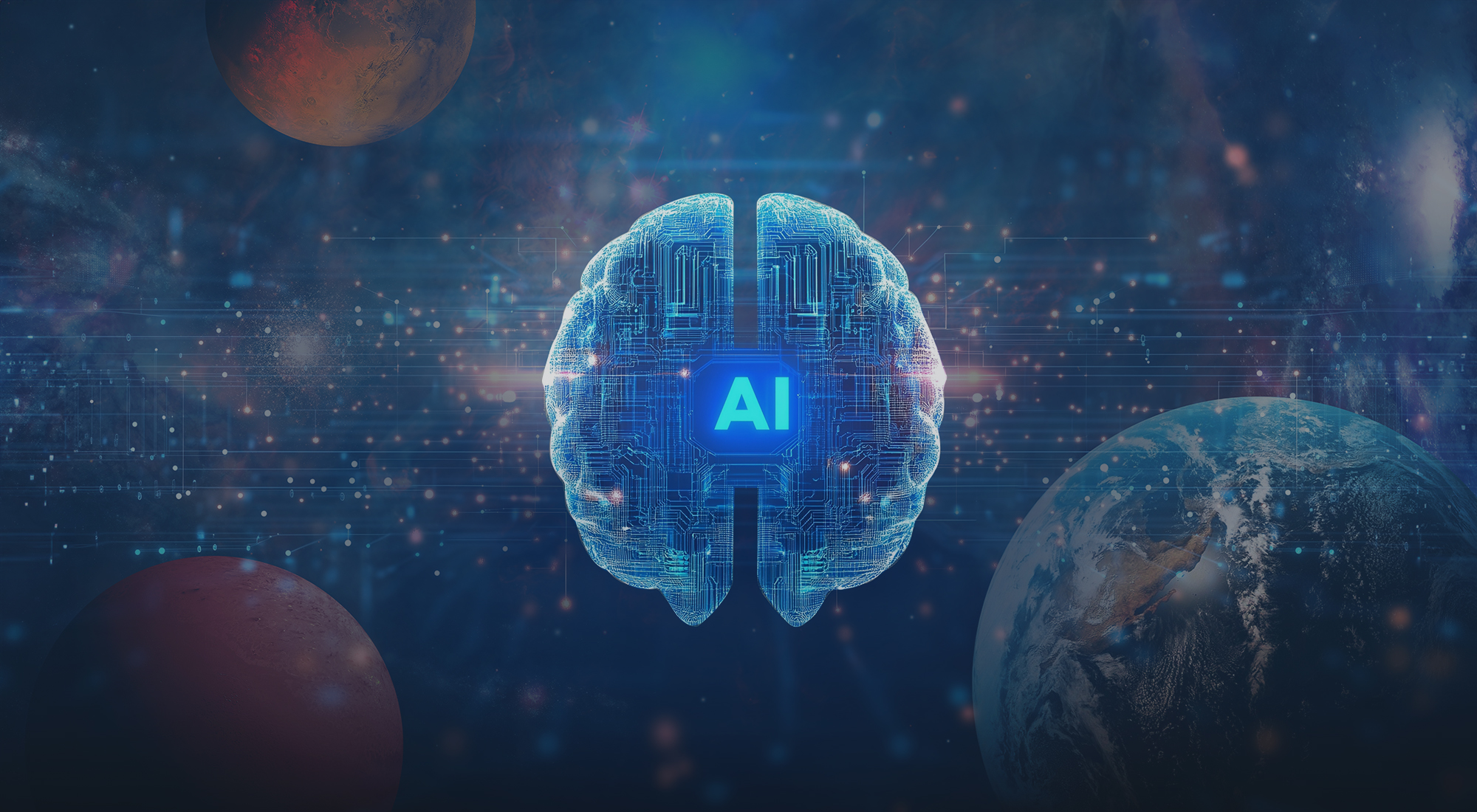
The latest developments in artificial intelligence (AI) have drastically altered modern astronomy. They have given researchers tools to spot and study cosmic phenomena in ways that were hard to imagine just a decade ago. The Oxford Model in Modern Astronomy, developed at the University of Oxford in October 2025, is a perfect example of this transformation. The model was publicly introduced recently after an AI breakthrough that enabled astronomers to identify cosmic events using only a handful of examples.[1]
The Oxford Model applies “few-shot learning” and “simulation-informed training” to detect rare events using a small amount of data. Unlike older systems that relied on large, labeled datasets, this approach learns from minimal examples and realistic simulations to achieve high accuracy and speed. Furthermore, the model integrates directly with instruments that face real-world observing constraints, such as changing weather conditions and shifting telescope priorities.
This combination makes discovery faster, more reliable, and more accessible (especially for research groups without the resources to curate enormous datasets or run large-scale analyses). In practice, the Oxford Model is opening the door to wider participation in scientific discovery. It is also reshaping the relationship between humans and machines: AI is becoming a genuine collaborator that augments human judgment rather than replacing it.
This insight explores how the Oxford Model’s use of few-shot learning and simulation-informed training moves astronomy away from data-heavy methods and toward a more flexible, inclusive, and efficient future for astrophysics.
Mechanisms and innovations of the Oxford AI model in astronomy
How does the Oxford AI system utilize few-shot learning to detect rare cosmic events?
Few-shot learning (FSL) enables the Oxford system to detect rare cosmic events by generalizing from better-represented, related phenomena. As detailed in the arXiv publication on textual interpretation of transient image classifications using large language models (LLMs).[2] The model embeds examples into a shared feature space, grouping instances of the same kind close together. This proximity allows the system to classify correctly even when labeled examples are scarce.[3] This idea is not unique to astronomy. It is similar to approaches used for spotting rare animal species or diagnosing uncommon diseases, where models learn to group related cases tightly and reduce within-class variation.
What matters here is the interplay between feature embedding and transfer learning. By transferring patterns learned from common events and pulling related examples together in feature space, the system overcomes the usual handicap of data scarcity in astrophysical detection. That said, improving embedding strategies remains important if we want better detection rates for truly rare phenomena in real-world surveys.[4]
In what ways does simulation-informed training enhance the model’s capabilities?
Simulation-informed training strengthens the model by combining deliberate practice, targeted feedback, and repeated exposure to realistic scenarios. These ingredients are well known in fields like clinical training, where they build technical skill and judgment in tandem.[5] For the Oxford model, high-fidelity simulations create controlled, repeatable examples of complex or transient phenomena. That makes it easier for the model to learn subtle patterns it might never see in real data alone.[6]
Simulations also let developers tailor learning to specific needs. You can focus on improving raw detection accuracy, or on handling messy, ambiguous cases that require more nuanced decision-making. The result is a model that not only performs technical tasks better but also behaves more reliably when facing varied, real-world conditions. In short, the mix of simulation, practice, and expert feedback raises both the model’s technical performance and its practical usefulness in live observing situations.[7]
What are the technical differences between the Oxford model and past data-intensive AI systems in astronomy?
The practical gap between the Oxford model, systems like Gemini, and older data-heavy approaches comes down to data needs, adaptability, and ease of adoption. Classic architectures such as convolutional neural networks typically require very large, labeled datasets and frequent retraining to stay accurate. That process is slow, costly, and demands a lot of human labeling effort.[8] Gemini and the Oxford model take a different path. By using few-shot learning, Gemini can perform well with as few as fifteen example triplets and a short set of human instructions, which dramatically reduces the need for exhaustive dataset curation.[9]
That efficiency makes model development faster and allows quick updates when scientific needs change: you add a few new examples or tweak instructions rather than retrain the whole model. Past systems often had to rely on techniques like domain adaptation or active learning to cope with low-data regimes, but models that integrate LLMs can generalize across surveys with less extra engineering.[10] Put simply, the field is moving toward systems that are leaner and more adaptable, which lowers operational costs and helps future-proof research workflows.
Implications and transformations in astronomical research
How does the Oxford model enable real-time detection and what are the implications for observational astronomy?
Real-time detection becomes possible when fast anomaly detection and hardware-level corrections act together. The Oxford model processes incoming telescope data quickly and flags candidate events for immediate follow-up.[11] When that detection is coupled with adaptive optics that correct for atmospheric turbulence on the fly, we can preserve image quality and capture transient phenomena that would otherwise be lost.[12]
The combined effect is a shift in practice: telescopes and teams can act proactively, responding to events as they appear instead of analyzing them after the fact. That change improves the chance of catching short-lived events and turns observational astronomy into a faster, more responsive discipline. To sustain this capability, we need continued investment in both the computational methods and the engineering required to integrate them tightly with telescope systems.
In what ways does this AI advancement contribute to the democratization of astronomical research?
AI, together with machine learning and high-performance computing, makes powerful analysis tools more broadly available. Frameworks that open computational proposals and share processing resources spread opportunities beyond a handful of well-funded centers.[13] For example, building national computational capacity and supporting open collaboration helps countries like India develop local expertise and take part in major projects rather than merely consuming results produced elsewhere.[14]
Faster analysis of large datasets also helps smaller teams keep up with the growing volume of observations. If we pair these technical advances with transparent proposal review and fair access to computing, the effect is a more inclusive research ecosystem. That is not automatic; it requires deliberate policy, investment, and governance to ensure new tools benefit a wide range of institutions and researchers.
How is the relationship between human astronomers and machine intelligence evolving due to this model?
The interaction between astronomers and AI models is becoming more reciprocal. As systems offer clearer explanations for their outputs, astronomers gain confidence and can more effectively validate machine suggestions.[15] At the same time, human oversight remains essential because even high-performing models can produce unexpected or misleading results. The best outcomes come when people and machines work together: astronomers guide and correct models, and models scale human expertise across far larger datasets than any team could handle on its own.[16]
This iterative feedback loop improves both parties. The model learns from corrections and guidance, and astronomers gain new leads and ways to frame their questions. Preserving this balance requires transparency, sound evaluation procedures, and ongoing channels for human feedback.
Conclusion
The Oxford AI model represents an important step forward for modern astronomy. Few-shot learning and simulation-informed training help the model detect rare events with fewer labeled examples, addressing a key constraint in astrophysical research. High-fidelity simulations and structured expert feedback increase the model’s technical accuracy and its readiness for real observational contexts. The model’s lighter data demands and ability to adapt quickly set it apart from older, resource-intensive systems, and the addition of real-time detection with adaptive optics points toward a more reactive and capable observational practice.
At the same time, we must be mindful of limits. Training on simulated data risks embedding biases if the simulations do not capture real complexity. Interpretability is also an ongoing concern, since users need to understand why the model makes the decisions it does. Future work should focus on improving simulation realism, extending validation across more data types, and building clearer interpretive tools so researchers can trust and interrogate model outputs. With those priorities in view, the Oxford AI model takes us toward a more intelligent, inclusive, and responsive era in the study of the cosmos.
[1] University of Oxford. AI breakthrough helps astronomers spot cosmic events with just a handful of examples. (October 8, 2025) retrieved October 23, 2025, from www.ox.ac.uk/news/2025-10-08-ai-breakthrough-helps-astronomers-spot-cosmic-events-just-handful-examples.
[2] Stoppa, F., Bulmus, T., Bloemen, S., Smartt, S., Groot, P. Textual interpretation of transient image classifications from large language models. (October 8, 2025) retrieved October 23, 2025, from www.nature.com/articles/s41550-025-02670-z.
[3] Gharoun, H., Momenifar, F., Chen, F. Meta-learning approaches for few-shot learning: A survey of recent advances. (n.d.) retrieved October 23, 2025, from dl.acm.org/doi/abs/10.1145/3659943.
[4] Doersch, C., Gupta, A. CrossTransformers: spatially-aware few-shot transfer. (n.d.) retrieved October 20, 2025, from proceedings.neurips.cc.
[5] Dion, P., Singh, K., Coleby, J., Beckett, A. Blood transfusion training for prehospital providers: a scoping review. (n.d.) retrieved October 23, 2025, from link.springer.com/article/10.1186/s13049-025-01440-0.
[6] Ibid.
[7] Oliver, N., Edgar, S., Mellanby, E., May, A. The Scottish Simulation ‘KSDP’ Design Framework: a sense-making and ordered approach for building aligned simulation programmes. (n.d.) retrieved October 23, 2025, from link.springer.com/article/10.1186/s41077-024-00321-3.
[8] Stoppa, F., Bulmus, T., Bloemen, S., Smartt, S., Groot, P. Textual interpretation of transient image classifications from large language models. (n.d.) retrieved October 23, 2025, from www.nature.com/articles/s41550-025-02670-z.
[9] Ibid.
[10] Ibid.
[11] (PDF) Large Language Models Enable Textual Interpretation of …. (n.d.) retrieved October 23, 2025, from www.researchgate.net.
[12] Wavefront Sensing and Adaptive Optics with First Light Imaging …. (n.d.) retrieved October 21, 2025, from andor.oxinst.com.
[13] Sharma, P., Vaidya, B., Wadadekar, Y., Bagla, J. Computational astrophysics, data science and AI/ML in astronomy: A perspective from Indian community. (n.d.) retrieved October 21, 2025, from link.springer.com/article/10.1007/s12036-025-10049-9.
[14] Ibid.
[15] Hassija, V., Chamola, V., Mahapatra, A., Singal, A. Interpreting Black-Box Models: A Review on Explainable Artificial Intelligence. (n.d.) retrieved October 23, 2025, from link.springer.com/article/10.1007/s12559-023-10179-8.
[16] Ibid.