

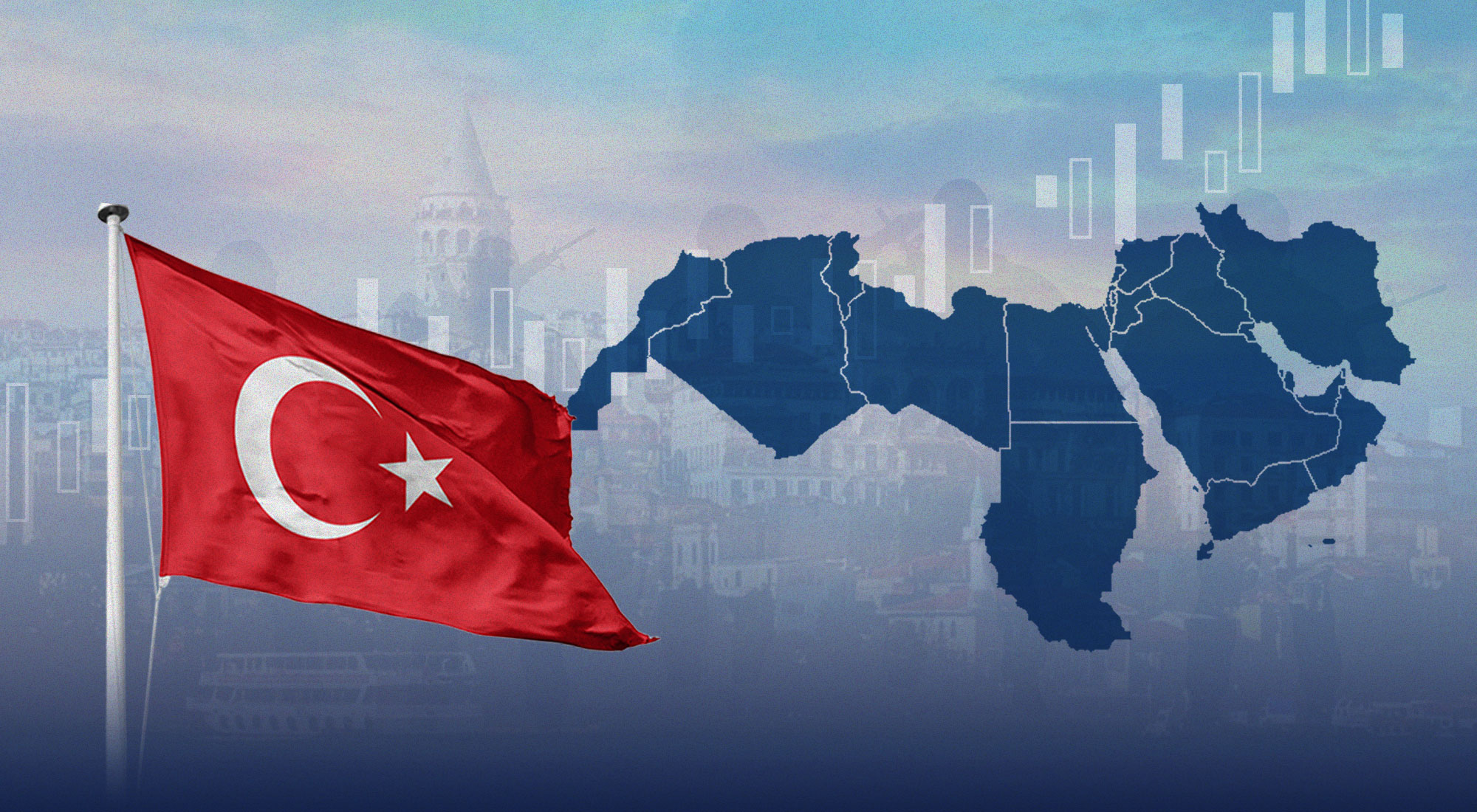
On 12 February 2026, TRENDS Research & Advisory’s Türkiye Office convened a high-level panel symposium at its Abu Dhabi headquarters titled “Türkiye-MENA Relations: Economics, Security, Strategy”. Hessa Abdulla AlNuaimi served as Master of Ceremonies, while Dr. Mohammed Abdullah Al-Ali, CEO of TRENDS Research & Advisory, delivered the keynote address. Moderated by Najla AlMutassim Al Midfa, the symposium brought together a distinguished group of speakers, including Dr. Serhat S. Çubukçuoğlu, Senior Fellow in Strategic Studies and Director of the TRENDS Türkiye Office; Dr. Kadir Temiz, President of ORSAM (Center for Middle Eastern Studies) in Ankara; Sara Al Neyadi, Researcher at TRENDS; Kanat Kutluk, President of the Turkish Business Council in Dubai and the Northern Emirates; and Batu Coşkun, TRENDS Non-Resident Contributor in Ankara.
The discussion took place against the backdrop of a rapidly shifting regional and global landscape. The Middle East is no longer defined by rigid alliances or hegemonic dominance. Instead, it is increasingly shaped by multipolar competition and regional agency, where middle powers such as Türkiye and the United Arab Emirates (UAE) are actively shaping economic connectivity, diplomatic outcomes, and security frameworks. Panelists emphasized that this shift marks a transition from reactive crisis management toward proactive partnership and re-alignment, anchored in shared economic interests, connectivity ambitions, and risk-containment imperatives.
From tactical adjustment to strategic convergence
Türkiye’s relations with the Middle East and North Africa (MENA) are undergoing a profound transformation, reflecting both structural changes in the regional order and Ankara’s evolving strategic outlook. Türkiye-Gulf relations illustrate this broader trend.
In his opening remarks at the symposium, Dr. Mohammed Abdullah Al-Ali underscored that Turkish-Middle Eastern relations are experiencing a qualitative shift, supported by clear empirical and digital indicators, signaling a transition from complex competition toward the construction of strategic partnerships grounded in mutual interests. He pointed out that the model relationship between the UAE and Türkiye clearly highlights this transformation, not only at the level of political discourse, but also through tangible economic and investment results.
Economic and institutional integration between Türkiye and the UAE has accelerated significantly in recent years. Bilateral trade, estimated at approximately US$44 billion, increased by around 12 percent in 2025 compared with the previous year,[1] driven by strategic investments, currency swap agreements, and the expanding presence of companies from both countries across each other’s markets.[2] Dr. Al-Ali noted that several key indicators underscore this trajectory, including the launch of a US$10 billion UAE investment fund to support strategic sectors of the Turkish economy and the UAE’s direct investment stock in Türkiye exceeding US$6 billion by 2025. The combined value of Turkish projects in the UAE now exceeds US$17.8 billion, a figure that makes the UAE the 10th-largest recipient of Turkish investment globally.[3]
Türkiye and the UAE signed several important agreements over the past three years, including a US$4.9 billion (18 billion AED) currency swap arrangement, aimed at strengthening financial and commercial stability between the two countries. This is complemented by the presence of around 600 Emirati companies operating in the Turkish market, alongside the expanding footprint of more than 700 Turkish firms in Dubai alone, reflecting a 14% increase in just one year.[4] Together, these developments reflect a shift from managing political differences toward building structural economic interdependence, thereby creating durable incentives for long-term stability and cooperation.
Dr. Al-Ali pointed out that these figures reflect the shift in UAE-Turkish relations from a framework centered on managing differences to one focused on building structural interdependence across key sectors, including the economy, energy, defense, and advanced technology. He noted that this digital-strategic trajectory enhances political confidence, signals stability to international markets, and supports the region’s transition toward long-term partnerships capable of navigating geopolitical and economic uncertainty. He further observed that, when viewed in their broader strategic context, these trends indicate that Turkish-Middle Eastern relations are entering a more mature phase, characterized by pragmatic cooperation.
The economic convergence reflects a deeper strategic logic. As traditional external security guarantors—most notably the United States—adopt a more selective and calibrated engagement, regional actors are increasingly relying on pragmatic diplomacy, diversified partnerships, and economic integration to manage risks and secure their strategic autonomy. The strengthening Türkiye-UAE partnership exemplifies this shift toward regional solutions rooted in connectivity, technological cooperation, and shared development goals.[5]
At the same time, Türkiye’s role extends beyond bilateral relationships. Ankara has emerged as a strategic hinge linking Europe, Asia, and the Middle East, combining its NATO membership, geographic position, and diversified economic ties to navigate an increasingly fragmented geopolitical environment. This multidimensional positioning enables Türkiye to simultaneously pursue economic integration, security stabilization, and diplomatic mediation across multiple theaters. Against this backdrop, the panel discussion identified three key dynamics shaping Türkiye-MENA relations: the institutionalization of economic integration, the emergence of flexible security coordination based on risk containment, and Türkiye’s evolving role as a strategic stabilizer and connectivity hub linking regional and global systems.
Economic integration and connectivity
One of the most significant outcomes of the panel discussion was the recognition that Türkiye-MENA cooperation is no longer limited to traditional sectors such as construction or financial services. Instead, it has expanded into advanced industries, technology, infrastructure, and strategic connectivity projects. This economic integration is driven by structural complementarities. Gulf states provide capital, financial infrastructure, and global investment networks, while Türkiye contributes industrial capacity, manufacturing expertise, and geographic connectivity linking regional markets to Europe and Asia. As a result, economic cooperation increasingly serves as the foundation for broader strategic alignment.[6]
There is growing emphasis on moving beyond traditional trade cooperation toward partnerships in fintech, high-technology industries, and advanced value chains. This shift reflects both Türkiye’s expanding industrial and technological capabilities and the Gulf’s ambition to position itself as a global hub for innovation and capital flows. Africa has emerged as a promising arena for joint Gulf-Türkiye initiatives, with financial centers such as Dubai and Abu Dhabi serving as platforms to mobilize investment, facilitate project financing, and promote cross-border economic integration.
Panelists also highlighted the growing importance of regional connectivity projects, which represent the physical manifestation of this shared strategic vision. Both the UAE and Türkiye are heavily invested in regional infrastructure such as the Iraq-Turkey Development Road (DRP) and the transit corridors of the South Caucasus, including the “Trump Route for International Peace and Prosperity” (TRIPP), also known as the “Zangezur Corridor.”[7] These initiatives aim to connect Gulf economies with Mediterranean, European, and Caucasian markets through integrated transport, logistics, and energy corridors, effectively bypassing traditional bottlenecks and reinforcing the region’s role as a vital node in global supply chains. By integrating their logistics networks, Ankara and Abu Dhabi are fostering a corridor of “prosperity” that seeks to stabilize the region through inclusive growth and shared economic interests.[8]
UAE-Türkiye relations have evolved significantly over the last five years, moving from a phase of de-escalation toward more structured diplomatic engagement and strategic councils that have strengthened the institutional foundation of bilateral cooperation. Mutual investments have emerged as a central driver of this transformation, with expanding collaboration across defense industries, advanced technology, artificial intelligence, renewable energy, and logistics connectivity projects. In parallel, joint humanitarian coordination—including support for Gaza—has reflected converging strategic outlooks and a shared commitment to promoting regional stability. The entry into force of the UAE-Türkiye Comprehensive Economic Partnership Agreement (CEPA) has already provided a roadmap for market access and long-term commercial planning. By prioritizing innovation, resilience, and mutual respect, the Türkiye-UAE partnership offers a model for 21st-century diplomacy that seeks to chart a new, stable course for the entire MENA.[9]
Beyond bilateral integration, Türkiye and Gulf partners are increasingly coordinating their investments across third regions, particularly in Central Asia. These joint initiatives leverage Gulf financial capacity and Türkiye’s logistical and operational expertise to expand influence and economic opportunities. Emirati companies such as DP World have expanded operations in Kazakhstan and Uzbekistan,[10] investing in dry ports, logistics hubs, and multimodal connectivity that link directly to Türkiye’s rail and port infrastructure.[11] Similarly, Turkish construction firms build airports, roads, and hospitals, while UAE sovereign wealth funds finance logistics, energy, and renewable projects. This collaborative approach reflects a shift toward collective regional economic engagement rather than competitive expansion, and a shared recognition that economic connectivity is essential not only for growth but also for long-term geopolitical stability.
Flexible security coordination without formal alliances
The panel discussion emphasized that the regional order is no longer shaped by a single dominant power but by overlapping spheres of influence involving the United States, Russia, China, and assertive regional actors. Within this fluid environment, Türkiye was portrayed not simply as a traditional bridge, but as a strategic hinge—an actor that actively connects global power dynamics with regional agency and helps translate systemic shifts into concrete geopolitical outcomes.
Speakers highlighted that security cooperation between Türkiye and MENA partners is evolving toward a flexible, risk-containment model rather than formal alliances. This approach reflects both structural constraints and strategic preferences. Türkiye and Gulf states, especially, share common concerns about escalation risks involving Iran, disruptions to energy flows, maritime insecurity, and the proliferation of non-state armed actors. These shared vulnerabilities have encouraged closer coordination aimed at preventing escalation and preserving regional stability.
This is perhaps most evident in the changing dynamics of Syria and the South Caucasus. The rollback of non-state armed actors, specifically the dismantling of YPG-dominated structures in Syria, has brought Türkiye’s security objectives into closer alignment with the Gulf’s preference for state-centric stabilization. Consequently, Syria is gradually shifting from a theater of proxy rivalry into a testing ground for managed convergence among regional actors. Gulf-Türkiye cooperation is likely to advance along pragmatic, functional lines rather than through overt political alignment, driven by shared interests in stabilization and connectivity. However, constraints related to governance capacity in Damascus, the sequencing of reconstruction, and unresolved questions of legitimacy mean that early coordination will remain concentrated in transactional domains—particularly logistics, transit corridors, border trade, infrastructure rehabilitation, and connectivity linking the Gulf to the Eastern Mediterranean.
From a GCC perspective, this shift reduces the risks of fragmentation and creates more favorable conditions for Syria’s gradual reintegration into regional economic and political frameworks, with Türkiye increasingly viewed as an operational enabler rather than a spoiler. Under these conditions, Syria is evolving from a theater of regional rivalry into a testing ground for managed convergence among middle powers, where cooperation is driven less by formal political agreements and more by shared interests in stabilization, connectivity, and economic normalization. Similarly, the UAE has emerged as a major investor and host for peace talks in the South Caucasus between Azerbaijan and Armenia, reflecting a coordinated effort to fill the vacuum left by traditional power brokers like Russia and Iran.
Türkiye’s evolving role as a strategic stabilizer and connector
Panelists highlighted that Türkiye’s coordination with GCC countries to discourage American or Israeli escalation over Iran reflects a broader Gulf shift toward greater regional agency and escalation management in an environment where U.S. crisis control has become increasingly selective and reactive. In this context, Ankara has positioned itself as a balancing middle power, aligned with Gulf stability concerns while deliberately avoiding overt confrontation with external actors.
As a result, institutionalization of such coordination is likely to remain limited, informal, and issue-specific, relying primarily on flexible diplomatic engagement rather than formalized mechanisms or alliance-style arrangements. This coordination reflects a broader regional trend toward diversified partnerships rather than exclusive security alignments. To ensure this momentum leads to a sustainable regional architecture, panelists advocated for deeper engagement through dialogue between think tanks and the development of joint early-warning mechanisms to shield economic ties from political shocks.
Addressing intensifying global competition in the region, panelists highlighted Türkiye’s strategy of “responsible balancing” among the United States, Russia, and Iran, aimed at preserving strategic maneuverability while safeguarding its core security and economic interests. Türkiye’s engagement in Syria and Iraq was described as combining hard security measures with reconstruction and state-building initiatives, reflecting a comprehensive approach that links stabilization, inclusive governance, and counterterrorism to the broader objective of preserving territorial integrity and preventing renewed conflict.
Participants further noted that the Middle East is undergoing profound structural transformations that are reshaping the regional balance of power. In response, Türkiye is pursuing a long-term strategic vision grounded in what was described as its “hybrid identity”: simultaneously a pivotal regional actor, a NATO member embedded in Western security structures, and an economy deeply interconnected with Central Asia, Europe, and the Middle East. This multidimensional positioning enhances Türkiye’s ability to navigate geopolitical competition while expanding its role as a stabilizing and connective power across multiple strategic theaters.
Conclusion
The panel discussion organized by TRENDS Research & Advisory’s Türkiye Office highlighted that Türkiye-MENA relations are entering a new phase defined by strategic convergence, institutionalized economic integration, and pragmatic security coordination. This transformation reflects deeper structural shifts in the regional order, as Middle Eastern actors increasingly assume greater responsibility for shaping their own economic and security environment amid more selective engagement by external powers.
Economic integration has emerged as the primary driver of this convergence. Expanding bilateral trade, cross-investment, and joint infrastructure initiatives—particularly between Türkiye and Gulf states such as the UAE—are fostering structural interdependence that strengthens both economic resilience and political stability. Strategic connectivity projects linking the Gulf to Europe and the Caucasus through Türkiye are reinforcing Ankara’s role as a critical logistical and economic hub, reshaping regional supply chains and enhancing long-term growth prospects.
At the same time, security coordination is evolving toward a flexible, risk-containment model rather than formal alliances. Türkiye and its regional partners are prioritizing informal, issue-specific cooperation to manage escalation risks, preserve strategic autonomy, and promote stability without constraining diplomatic maneuverability. This approach reflects a broader regional preference for pragmatic cooperation over bloc-based alignments.
Within this emerging regional architecture, Türkiye is consolidating its role as a strategic stabilizer and connective power. Its geographic centrality, economic capacity, and multidimensional diplomacy position it as a key actor linking regional and global systems. As Türkiye-MENA relations—particularly with the GCC—continue to deepen, economic interdependence, connectivity, and pragmatic coordination are likely to form the foundation of a more resilient, autonomous, and regionally driven order
[1] Thani Al Zeyoudi, “What Have the Past Two Years of UAE-Turkey Cepa Trade Taught Us?,” The National, October 8, 2025, https://www.thenationalnews.com/opinion/comment/2025/10/08/uae-turkey-cepa-2-years/.
[2] “Türkiye, UAE Deepen Ties as Trade and Investment Surge,” Region, Türkiye Today, February 15, 2026, https://www.turkiyetoday.com/region/turkiye-uae-deepen-ties-as-trade-and-investment-surge-3214574.
[3] Al Zeyoudi, “What Have the Past Two Years of UAE-Turkey Cepa Trade Taught Us?“
[4] “DMCC Reports 14% Growth in Turkish Companies as UAE-Türkiye Trade Passes CEPA Target,” Government of Dubai, Media Office, November 12, 2025, https://mediaoffice.ae/en/news/2025/november/12-11/dmcc-report.
[5] Editorial, “Continued Strength of UAE-Turkey Ties Is Good for the Middle East,” The National, July 17, 2025, https://www.thenationalnews.com/opinion/editorial/2025/07/17/continued-strength-of-uae-turkey-ties-is-good-for-the-middle-east/.
[6] Esra Karataş Alpay, “Seven Pillars of Partnership: Türkiye and UAE Enter Era of Transformative Cooperation,” TRT World, July 22, 2025, https://www.trtworld.com/article/607e1fd310e5.
[7] Sinem Cengiz, “The Growing Turkey-UAE Partnership in the South Caucasus,” Peninsula / Diplomacy, Amwaj.Media, August 8, 2025, https://amwaj.media/en/article/the-gist-of-turkey-uae-camaraderie-in-the-south-caucasus.
[8] Editorial, “Continued Strength of UAE-Turkey Ties Is Good for the Middle East.”
[9] Karataş Alpay, “Seven Pillars of Partnership: Türkiye and UAE Enter Era of Transformative Cooperation.”
[10] “DP World and Tashkent Invest to Develop Multimodal Logistics Terminal in Uzbekistan,” DP World, October 10, 2025, https://www.dpworld.com/en/news/dp-world-and-tashkent-invest-to-develop-multimodal-logistics-terminal-in-uzbekistan.
[11] Aygul Ospanova, “Kazakhstan Set To Boost Eurasian Trade, Thanks To UAE’s DP World Partnership,” Caspian News, June 20, 2017, https://caspiannews.com/news-detail/kazakhstan-set-to-boost-eurasian-trade-thanks-to-uaes-dp-world-partnership-2017-6-19-20/.