
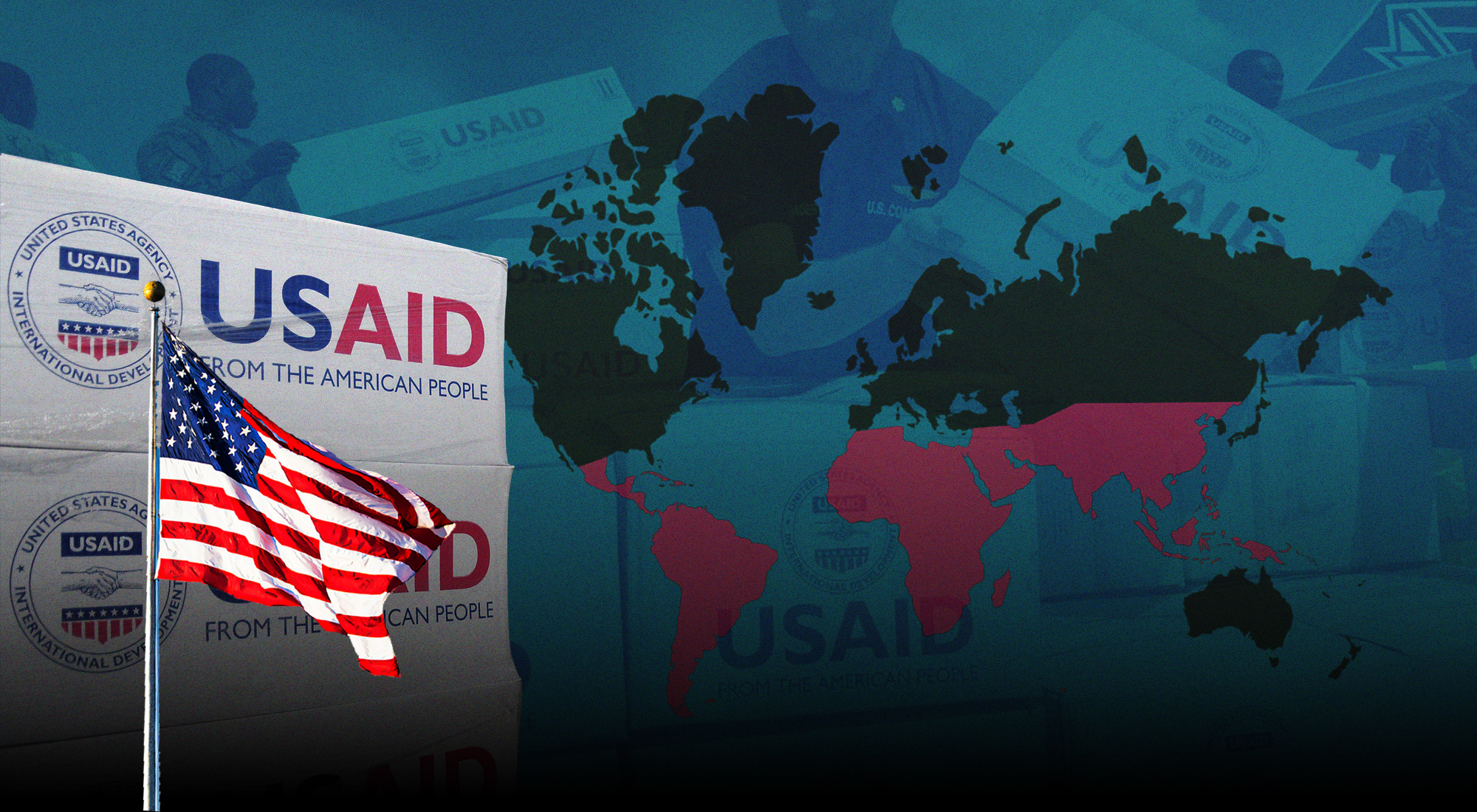

U.S. President Donald Trump froze much of the work carried out by the U.S. Agency for International Development (USAID) by the end of January 2025.[1] USAID was America’s strongest international assistance and development arm, spending about $40-70 billion in 100+ countries annually.[2]
The key positions of the responses to the aid suspension that emerged can be summarized in four camps—two against and two in favor. Firstly, many mourned the stoppage of “life-saving aid.” Secondly, a largely non-partisan population worried that Russia or China would “fill the vacuum” left by the United States vacating “its role in international development and humanitarianism.”[3] Thirdly, some supporters of the freeze appreciated that fewer funds would be wasted on projects perceived not to benefit Americans.[4] Finally, the fourth camp comprises those who have been wishing for USAID’s total dismantlement for decades, as it arguably represents “one of the arms of US imperialism.”[5]
These camps face several puzzles. Notably, while the common public and aid workers are often well-intentioned people who want to contribute to global humanitarianism, USAID’s upper-level administration sees it as a tool to bolster power.[6] In addition to the historical development of USAID as an entity that projected soft power,[7] this priority was also reflected in the discourse after USAID funding was frozen, where many politicians and USAID administrators begrudged the decision because they believed it would erode America’s global image.[8] Yet, getting rid of USAID is not itself the solution to decolonizing global humanitarian and development aid. Rather, the freezing of USAID represents a critical juncture that offers the strongest opportunities in years to decolonize aid. Nonetheless, the sudden pause is also harmful in the short run as it impedes the work of life-saving health and sustenance programs.[9]
However, these measurements of the “good” of USAID’s humanitarianism and the “harm” from its pause are also debatable concepts. Many consider USAID beneficial because it includes immediate life-saving programs,[10] helps countries in various sectors of development,[11] and provides other forms of social support, like gender equality, education,[12] and journalism.[13] However, USAID’s work in many sectors has often overshadowed local expertise and infrastructure to maintain a dependency on its benevolence in many sectors—infrastructure, healthcare, education, and beyond.[14] Meanwhile, the U.S. itself has created the conditions requiring aid in countries like Iraq and Afghanistan through violence.[15] Its funding of journalism in other countries also amounts to a form of interference rather than undisputed good—contributions to “democracy.”[16]
Ultimately, what we observe is that USAID’s benefits are stressed through an emphasis on its short-term measured outcomes that ignore its non-recorded outcomes: those that amount to neoimperialism, drowning out local expertise, and often,[17] the politics of exaggerating progress reports.[18] This Issue Brief tackles these complexities with a focus on the immediate material concerns of the life-saving components of the aid and USAID’s overall perception as an arm of imperialism. The ultimate question of interest is, if the USAID’s collapse is beneficial for the Global South, but its humanitarian freeze is hurting communities in need, how can the international community leverage this moment while minimizing its negative impact? I argue that USAID’s now unreliable image can be leveraged through the pursuit of the tenets of the Global South’s long-standing demand for the New International Economic Order (NIEO): The NIEO is a decolonial vision, first formally articulated at the United Nations (UN) in the 1970s, that aims to restructure the international political economy to make global trade, development assistance, and international finance more equitable and fair for the Global South.[19] Under the current global political economy, the Global North continues to extract resources from the Global South through and beyond the established institutions.[20] Over time, the NIEO has included more details about how this can be achieved, the specifics of which are discussed in the policy recommendations of this paper.
A Brief History of USAID
Foreign aid and assistance have been a crucial pillar of U.S. foreign policy. Its policies were properly codified during the Cold War through the 1961 Foreign Assistance Act as a political strategy of “small” soft power investments to “help save billions more in US hard power.”[21] As Andrew Natsios, a former USAID administrator, writes, the institution’s emergence during the Cold War helped export American values and institutions and fight communism; and in more recent years, helped counterbalance Russian and Chinese influence and maintain the perception of America’s moral high ground.[22] Indeed, even Trump has used pulling foreign aid as a strategy to pursue the U.S.’s international goals.[23] This strategy, even for “humanitarian aid,” has occurred across administrations. More broadly, the U.S. also uses multiple forms of aid for vote-buying at the United Nations.[24]
Nonetheless, U.S. administrations have also been concerned about minimizing waste and fraud in foreign aid since the 1970s.[25] These historical moments highlight how, though Trump’s freeze was a bold action, the premises have been marinating for decades now. Notably, the Republicans cut USAID’s budget and tried to absorb it into the Department of State (DoS) in the early 1990s. Between 1995 and 2000, its staff was cut by almost 30%.[26] Although after 9/11, the U.S. once again pivoted to projecting global power, resulting in USAID’s resurgence.[27] Not many major changes followed, except for the creation of a Director of Foreign Assistance portfolio in 2006 to streamline American foreign aid functionality.[28] Several policy papers continued proposing reforms in the coming years. In June 2009, the Institute for National Security and Counterterrorism assessed the possibility of integrating the USAID with the DoS, noting an “inherent connection” between their missions.[29] A Brookings Institution working paper in 2014 included a call for increased accountability and collaboration with locals to better ensure that “core U.S. national interests” were being met.[30] Meanwhile, a National Security and Defense Program memorandum from the Council on Foreign Relations in 2016 included a recommendation to focus on “strategically important countries” and bureaucratic reform.[31]
The lack of significant reform from 2006 to 2017 was a long gap, compared to preceding decades, with policy papers proliferating in parallel. Thus, in his first administration, Trump took up the mantle of reforming USAID, coupled with his nationalist agenda, and attempted to cut USAID’s budget by nearly 33%—a proposition that Congress, however, blocked, as USAID’s soft power received bipartisan support.[32] Trump also cut other forms of foreign aid to be in better bargaining positions with other countries: his first administration suspended aid programs in Guatemala, Honduras, and El Salvador over migration issues.[33] These histories set the stage, along with Trump’s policy approach, for more forceful change. A large-scale reconfiguration of USAID was overdue.
USAID During the Second Trump Administration
Trump is better equipped in his second term with a team of seasoned officials and a grasp over executive orders, allowing him to take swifter action.[34] The administration claims that one of its core objectives is to reduce government size for efficiency: in this context, USAID’s budget is seen as “vastly bloated.”[35] USAID’s humanitarian and development rhetoric, despite its underlying strategic objectives, is interpreted as undue weight on the U.S. in taking care of the world[36] and as a “liberal agenda.”[37] At other times, they claimed that USAID programs fund those “who hate America” and promote “ideas in foreign countries that are directly inverse to harmonious and stable relations internal to and among countries.”[38] Overall, their intention is to cut over 90% of USAID’s foreign aid contracts, freeing up almost $60 billion in funding.[39]
In the ongoing debates, many commentators emphasize that the U.S.’s departure from the global aid industry will help Russia and China.[40] NBC News reported that many experts they contacted, including a former senior USAID official, noted that Russia and China can improve their world image by enhancing their involvement in aid where the U.S. has just withdrawn.[41] Another former official claimed that America’s partners will suffer, which allegedly allows “America’s enemies” to “rejoice.”[42] However, such claims often misunderstand China’s aid program and intentions, as there is little evidence to suggest that China will fill the gap to mirror America’s role: the Chinese aid program is more focused on infrastructural development than social programs.[43] China’s contribution to global problems is also largely channeled through international organizations rather than unilateral aid programs.[44] Alternatively, several entities are also invoking the humanitarian rhetoric in their appeals, some with a genuine short-run focus on life-saving and others with its gains for U.S. national security. Among the former group, for example, the Institute for Security Studies notes that “Trump’s aid cuts could push 5.7 million more Africans into extreme poverty next year.”[45] As such, many organizations oppose aid cuts and instead highlight alternative reform proposals like funding local organizations directly.[46] Their primary goal is to preserve USAID’s soft power role while reforming it for efficiency and immediate humanitarian impact. The localization suggestion is best attuned to enhancing USAID’s humanitarian impact, but even its ambitious target only sought to achieve 25% localization.[47]
However, the Trump administration’s foreign policy is rather unilateral, as is the case with populist governments.[48] Essentially, Trump has a more personalistic and isolationist governance style that ignores most other voices.[49] U.S. foreign policy across the board has also seen a tilt toward more explicit economic and security competition that reduces emphasis on humanitarianism entirely.[50] It seems that the Trump administration will likely succeed in reducing the size of USAID, though ambiguity remains, as, at the time of writing, Congress has yet to step in; many lawyers believe that the USAID freeze is unconstitutional and requires Congressional intervention.[51] Moreover, the courts, too, have only commented thus far on money already owed rather than the future of USAID.[52] While the complete removal of foreign aid is on the horizon, it may be the case that the Trump administration will refocus its finances on more direct national security programs, enabling a USAID and DoS merger.[53] Indeed, Marco Rubio, Secretary of State, exclaimed, “Every dollar we spend, every program we fund, and every policy we pursue must be justified with the answer to three simple questions: Does it make America safer? Does it make America stronger? Does it make America more prosperous?”[54] Jim Risch, the chair of the Senate Foreign Relations Committee, also explained that merging USAID into the DoS would “better” serve American national interests.[55]
Finally, in conjunction with Trump’s nationalist approach to foreign policy,[56] these dynamics also reflect a more aggressive policy shift. Essentially, Trump is also less likely to pay attention to calls for the preservation of soft power tools as he would rather exercise more direct forms of power. Indeed, such a prediction was already made in 2003 contingent on the obstruction of America’s aspirations.[57] In other words, Trump does not want to play the long game with USAID’s soft functions while adopting a harsher policy approach,[58] which might seem helpful at a time when both liberalism[59] and the American influence are waning.[60] Other commentators note that such a strategy will hurt America’s global image and moral high ground without even freeing up much of its budget.[61] Thus, in such a scenario, the departure of USAID compels the Global South to break free from its reliance on USAID and develop its own systems. Yet, such domination politics seem relatively irrelevant to many who believe that, despite the facets of the U.S.’s problematic approach, people were able to leverage the USAID system to provide various forms of assistance to communities in need by framing it as soft power to policymakers.[62] Humanitarianism still stands as a captivating appeal for many. However, data also shows that the puzzle presented in the introduction may not actually stand as the “effectiveness” calculations of such aid obscure its counterpositives.
How Effective Was USAID?
The sudden freeze of USAID funding has indeed put numerous populations at risk.[63] It is natural for the abrupt suspension to trigger a humanitarian turmoil for these reasons. However, USAID has caused more harm by creating dependencies and using such dependencies as bargaining chips.
Essentially, USAID recipient populations can be better off without USAID than with it in the long run.[64] While it seems as though the aid agency’s benevolence is necessary today, its institutionalization over time has privileged Western contractors who drowned out local expertise and triggered brain drain in the aid and development sectors.[65] For example, USAID accompanied a neoliberal agenda in Kenya, which replaced the state’s role in ensuring universal healthcare with NGOs dependent on foreign funding, creating negative long-term consequences.[66] In other cases, the much-emphasized “life-saving” disease funding that relies on foreign donors often has priorities that “do not always align with African needs.”[67]
There are also cases where the “need” for USAID programs was created by the U.S. itself.[68] USAID’s post-conflict operations have also hurt many recipient communities through counterinsurgency and top-down development in places like Afghanistan.[69] Its top-down, self-centered approach is also why only about 3% of its project evaluation reports meet reliability standards.[70] The former World Bank economist William Easterly noted that such aid models lack accountability and thus claims of “success” are actually spurious relationships.[71] Many other recent analyses also question the impact of Western poverty alleviation and humanitarian aid.[72] Such “life-saving” contributions have historically been held hostage, too: In 1967, the U.S. refused famine relief to India until it passed liberal agricultural reforms.[73] Parallel to these narratives, there is also the idea that these aid models have passed their maturity age as the world’s political and economic configurations have shifted.[74] Essentially, the Global North development aid model emerged in the 1960s to assist countries in industrializing and reducing poverty while navigating decolonization and the Cold War.[75] Those contexts no longer persist, and surmounting that is North-South distrust and the rejection of the harsh divides between “developed” and “developing” country labels.[76] Acknowledging these dynamics, the Overseas Development Institute (ODI) is leading an inquiry into alternative models of aid that do not argue against the existence of aid but seek to reimagine the forms of engagement in global aid, one in which it is not a “developed world” leading projects in a “developing world.”[77]
The Way Forward
The Global South can leverage this moment to fast-track pursuing the New International Economic Order (NIEO). The NIEO is essentially a counterproposal to the Washington Consensus that first emerged in the 1970s but has been developed multiple times since. It comprises a set of demands that call for political non-interference, the right to social and economic sovereignty, international trade and global finance reform, greater industrialization assistance to prevent developing countries from being locked as raw material exporters, and better South-South cooperation on trade, markets, and collective self-reliance.[78] It has been adopted at UN General Assembly meetings whenever it was put to a vote, where the Global North has routinely voted against it.[79] The current moment is relatively ripe for the pursuit of the NIEO through the following suggestions.
Redefining Aid Effectiveness: The first recommendation is an epistemological one. On aid “effectiveness,” it is important to note that numeric data is often referred to as unquestionably “objective,” a claim that blurs the subjective decisions that go into picking, generating, and representing numbers.[80] Given USAID’s past and present records, such a reflection can uncover data highlighting USAID’s harms and paying attention to the opportunity costs of the “life-saving” aid.[81] This proposition does not invalidate the ongoing crisis faced because of the suddenness of the aid freeze. However, it draws attention to how the Global South can develop its own systems and protect its humanitarian agencies from getting suppressed by the U.S. aid industrial complex, ultimately saving even more lives.[82] Such developments will also allow Global South governments to enhance people’s trust and relationships with them.
Development of Stronger Global South Organizations: Further development of organizations led by the Global South can be instrumental in developing collective self-reliance. Such multilateral forums also provide countries with an organizing space to reduce dependency on the Global North, such as by increasingly using Global South currencies to make settlements.[83] Indeed, Trump’s hostility toward BRICS for sidelining the dollar signals the move’s effectiveness in waning America’s hegemony.[84] Countries like India are also positioned with the potential to seize this moment to better represent the Global South. India’s current philosophy is one of multi-alignment, where it claims to maintain beneficial relations with various poles of power.[85] This includes enhancing relations with the West but also the Global South. To that end, India inaugurated the first Voice of the Global South Summit in 2023 with philosophies of strength in unity and Vasudhaiva Kutumbakam (the world is one family).[86] A press release regarding the 3rd Voice of the Global South Summit noted that “the Summit is a reflection of India’s sincerity and commitment in advancing the collective developmental journey of the Global South.”[87] However, in many other ways, India is seen to be pursuing a greater Westward tilt than a balanced multi-alignment, inferred through actions that amount to an “economic realignment toward the West,”[88] its participation in anti-China security pacts,[89] absence at Non-Aligned Movement summits, and continued diplomatic stalemate with China and other neighbors.[90] India can make better inroads with its goals of global leadership by better pursuing those aspects of its multi-alignment that increase partnerships and representation of the Global South.[91]
The development of stronger Global South organizations also requires greater solidarity between such organizations. The Global North will not voluntarily give up its international political and financial privileges; thus, the Global South needs to collectively build alternative institutions and leverage to convey to the Global North that the power structure has changed. Accordingly, a report from the 2025 World Governments Summit provides helpful suggestions. It recommends that Global South organizations should not develop in isolation but work on institutionalizing inter-organization solidarity, as such forms of solidarity need to transcend discourse and include a tangible charter, plan of action, and financial institutions that enhance their bargaining power.[92] For example, a joint effort by BRICS and the African Union can enhance food security, an important humanitarian component.[93] While commentators are mourning USAID by citing Africa, many scholars reaffirm the African Ubuntu social cohesion and self-reliance spirit.[94] These suggestions also support the objectives and measures of the Program of Action on the Construction of a NIEO by Progressive International, an international platform for decolonial scholars, activists, and organizations in pursuing the NIEO tenets.[95]
Negotiating with China: Within Western international relations and the Global South, an anxiety about the role of China in the changing world order continues to exist. In many ways, the uneasiness around Chinese global leadership is the result of Western perceptions of international relations, which project the West’s political domination onto China’s perceived goals.[96] Thus, a separate proposition is extended here to serve as a safety net for such anxieties, though I believe that a rethinking of international relations in security policy circles is imminent: a focus on multilateralism in the former recommendations on developing Global South institutions can prevent uneven agreements that may emerge in unbalanced negotiations. For example, countries in the Association of Southeast Asian Nations (ASEAN) find themselves disadvantaged bilaterally when signing Belt and Road Initiative (BRI) deals with China, as they do not leverage ASEAN’s collective bargaining power.[97] The nature of BRI agreements is also one of soft law, where governments sign quasi-legal instruments (cooperation agreements and memorandums of understanding), enabling flexibility at different points in time.[98] Yet, there remains an unequal power dynamic between China and most participating countries, as they tend to be economically poorer and would thus lack bargaining power.[99]
Thus, the Global South can ensure that China is not just unwilling but also unable to unilaterally act or project its power in political and economic leadership by increasingly diverting asymmetric bilateral negotiations to regional partnerships. Such partnerships can be routed through regional organizations or other collectives. This can be crucial and effective for China’s BRI projects, whose success partly relies on contiguity and interconnectedness in a globalized world, but has also proven to be effective for other forms of development. For example, African leaders increasingly engage in health development and vaccine procurement efforts through the African Union and the Africa Centres for Disease Control and Prevention. This mode of collaboration aggregates the continent’s demands,[100] enhances collective power,[101] and ensures better price negotiation with global partner organizations and countries.[102] These practices regarding the health industry can also be extended to other forms of negotiations for similar bargaining benefits and leverage.[103]
Conclusion
Trump’s impulsiveness and unpredictability have shaken international relations and the business-as-usual of many communities. However, this insight suggests that restoring the status quo with USAID is not the ideal solution by contextualizing USAID through a reading of the U.S.’s history of neoimperialism. There is also a push to rethink epistemologically what the “effectiveness” of USAID means, as much data shows that it has been net negative in the long run. Therefore, Trump’s attitude toward USAID essentially disarms a component of global U.S. influence. While USAID’s future remains ambiguous, such a scenario provides opportunities for the Global South to catalyze its pursuit for greater agency in its own development affairs. This insight has provided some non-exhaustive policy suggestions to that end: rethinking measuring “effectiveness” and Western international relations theories, developing Global South institutions, and building collective Global South bargaining power.
[1] Tom Bateman, “How a US freeze upended global aid in a matter of days,” January 29, 2025, BBC, https://www.bbc.com/news/articles/c3604r84zjyo. Retrieved February 27, 2025.
[2] Ibid.; Frank Langfitt, “Judge tells Trump administration it has less than 2 days to resume USAID funding,” NPR, February 25, 2025, https://www.npr.org/sections/goats-and-soda/2025/02/25/g-s1-50701/usaid-freeze-judge. Retrieved February 27, 2025.
[3] Peter Taylor, “The turbulence and the toll of the USAID freeze,” Institute of Development Studies, February 3, 2025, https://www.ids.ac.uk/opinions/the-turbulence-and-the-toll-of-the-usaid-freeze/. Retrieved February 27, 2025.
[4] Tom Bateman, January 29, 2025.
[5] Vijay Prashad, [@vijayprashad]. I fully support the shutting down of USAID – one of the arms of US imperialism [Post]. X, February 2, 2025, https://x.com/vijayprashad/status/1886134518651736331. Retrieved February 27, 2025; Vijay Prashad, Washington Bullets: A history of the CIA, coups, and assassinations, Monthly Review Press, September 2020, https://nyupress.org/9781583679067/washington-bullets/.
[6] Ann Vogel, “Who’s making global civil society: philanthropy and US empire in world society,” The British Journal of Sociology 57, no. 4 (2006): 635-655, https://doi.org/10.1111/j.1468-4446.2006.00129.x; Lisa Bhungalia, “On USAID, soft power, and American globalism,” Dialogues in Human Geography 6, no. 1 (2016): 88-90. https://doi.org/10.1177/2043820615609495.
[7] U.S. Global Leadership Coalition, “Here’s why foreign assistance is important,” January 4, 2016, https://www.usglc.org/blog/heres-why-foreign-assistance-is-important/. Retrieved March 1, 2025.
[8] Peter Taylor, February 3, 2025.
[9] Bright Simons, “Why the crisis in global aid is bigger than Trump,” ODI Global, February 19, 2025, https://odi.org/en/insights/why-the-crisis-in-global-aid-is-bigger-than-trump/.
[10] Karoun Demirjian, Michael Crowley, Edward Wong, and Stephanie Nolen, “Lifesaving Aid Remains Halted Worldwide Despite Rubio’s Promise,” The New York Times, February 12, 2025, https://www.nytimes.com/2025/02/12/us/politics/usaid-waivers-rubio.html. Retrieved March 26, 2025.
[11] Jakkie Cilliers, “Data modelling reveals the heavy toll of USAID cuts on Africa,” Institute for Security Studies, February 28, 2025, https://issafrica.org/iss-today/data-modelling-reveals-the-heavy-toll-of-usaid-cuts-on-africa. Retrieved March 2, 2025.
[12] “Trump administration lays off nearly all USAID workers, halting global education and health programs,” The Times of India, February 5, 2025, https://timesofindia.indiatimes.com/education/news/trump-administration-lays-off-nearly-all-usaid-workers-halting-global-education-and-health-programs/articleshow/117949946.cms. Retrieved March 26, 2025.
[13] Reporters Without Borders, “USA: Trump’s foreign aid freeze throws journalism around the world into chaos,” February 3, 2025, https://rsf.org/en/usa-trump-s-foreign-aid-freeze-throws-journalism-around-world-chaos. Retrieved March 4, 2025.
[14] Zoe H. Robbin, “Foreign Aid Was Supposed To Help Nations In Need. It Has Instead Enriched Western Contractors,” New Lines Magazine, May 30, 2023, https://newlinesmag.com/argument/foreign-aid-was-supposed-to-help-needy-nations-but-has-instead-enriched-western-contractors/. Retrieved March 2, 2025.
[15] Ibid.
[16] Reporters Without Borders, February 3, 2025.
[17] Zoe H. Robbin, May 30, 2023.
[18] Siobhan McDonough, “The US spends billions on foreign aid. But it doesn’t know how much good our money is doing,” Vox, August 1, 2022, https://www.vox.com/future-perfect/23274306/usaid-foreign-aid-effectiveness-evidence-grants. Retrieved March 4, 2025.
[19] “New International Economic Order,” United Nations Economic and Social Commission for Western Asia, (n.d.), https://archive.unescwa.org/new-international-economic-order.
[20] Jason Hickel, Dylan Sullivan, and Huzaifa Zoomkawala, “Plunder in the Post-Colonial Era: Quantifying Drain from the Global South Through Unequal Exchange, 1960–2018,” New Political Economy 26, no. 6 (2021): 1030-1047. https://doi.org/10.1080/13563467.2021.1899153.
[21] Mark Dubowitz and Ben Cohen, “USAID was rotten, but Trump needs the ‘soft power’ of foreign aid done right,” New York Post, February 4, 2025, https://nypost.com/2025/02/04/opinion/usaid-was-rotten-but-trump-needs-the-soft-power-of-foreign-aid-done-right/. Retrieved March 1, 2025.
[22] Andrews S. Natsios, “Foreign aid in an era of great power competition,” PRISM 8, no. 4 (2020): 101-119, https://ndupress.ndu.edu/Media/News/News-Article-View/article/2217683/foreign-aid-in-an-era-of-great-power-competition/.
[23] Zolan Kanno-Youngs and Shawn McCreesh, “Trump says he may cut aid to Jordan and Egypt if they don’t take Gazans,” The New York Times, February 10, 2025, https://www.nytimes.com/2025/02/10/us/politics/trump-jordan-egypt-gaza-development.html. Retrieved March 2, 2025; Tannur Anders, “South African markets slump after Trump suspends US aid,” Reuters, February 3, 2025, https://www.reuters.com/markets/currencies/rand-slumps-after-trump-says-he-will-cut-funding-south-africa-2025-02-03/. Retrieved March 2, 2025.
[24] Zoe H. Robbin, May 30, 2023; Dan Alexander and Bryan Rooney, “Vote-Buying by the United States in the United Nations,” International Studies Quarterly 63, no. 1 (March 2019): 168-176, https://doi.org/10.1093/isq/sqy059.
[25] Zoe H. Robbin, May 30, 2023.
[26] John Norris, “The clashes of the 1990s,” Devex, July 23, 2014, https://www.devex.com/news/the-clashes-of-the-1990s-83341. Retrieved March 2, 2025.
[27] Ibid.
[28] James McBride, “How does the U.S. spend its foreign aid?,” Council on Foreign Relations, 2018, https://www.cfr.org/backgrounder/how-does-us-spend-its-foreign-aid. Retrieved March 2, 2025.
[29] Charles R. Cutshall, Dustin C. Emery, Daniel J. Fitzpatrick, Sarah J. Hammer, Leslie J. Kelley, and Kirill Meleshevich, “Integrating USAID and DOS: The future of development and diplomacy,” In Project on National Security Reform, Maxwell School of Citizenship and Public Affairs (June 2009): p. iv.
[30] George Ingram, “Adjusting assistance to the 21st century: A revised agenda for foreign assistance reform,” Global Economy & Development Working Paper 75, Brookings Institution (2014): p. 14.
[31] Max Boot and Michael Miklaucic, “Reconfiguring USAID for State-Building,” Council on Foreign Relations, June 2016, https://www.cfr.org/report/reconfiguring-usaid-state-building.
[32] James McBride, 2018.
[33] Andrews S. Natsios, 2020.
[34] Jess Bidgood and Charlie Savage, “What Trump knows now,” The New York Times, January 24, 2025, https://www.nytimes.com/2025/01/24/us/politics/trump-second-term-differences-lessons.html. Retrieved March 2, 2025.
[35] Tom Bateman, January 29, 2025.
[36] Ibid.
[37] Ellen Knickmeyer, Matthew Lee, and Mark Sherman, “Trump administration says it’s cutting 90% of USAID foreign aid contracts,” Associated Press, February 26, 2025, https://apnews.com/article/trump-usaid-foreign-aid-cuts-6292f48f8d4025bed0bf5c3e9d623c16. Retrieved March 2, 2025.
[38] Frank Langfitt, February 25, 2025.
[39] Ellen Knickmeyer, Matthew Lee, and Mark Sherman, February 26, 2025.
[40] Chantal Da Silva, “What cutting USAID could cost the U.S. — and how China, Russia may benefit,” NBC News, February 5, 2025, https://www.nbcnews.com/news/world/donald-trump-elon-musk-usaid-soft-power-china-russia-rcna189756. Retrieved March 2, 2025.
[41] Ibid.
[42] Ibid.
[43] Yun Sun, “Can China fill the void in foreign aid?,” Brookings Institution, March 11, 2025, https://www.brookings.edu/articles/can-china-fill-the-void-in-foreign-aid/. Retrieved March 25, 2025.
[44] Ibid.
[45] Jakkie Cilliers, February 28, 2025.
[46] Ibid.
[47] Elissa Miolene, “What’s inside USAID’s latest localization report?,” Devex, January 15, 2025, https://www.devex.com/news/what-s-inside-usaid-s-latest-localization-report-109053. Retrieved March 26, 2025.
[48] Erin K. Jenne, “Populism, nationalism and revisionist foreign policy,” International Affairs 97, no. 2 (2021): 323-343, https://doi.org/10.1093/ia/iiaa230.
[49] Ibid.
[50] Rose Worden, “Aid as soft power? It’s a trap,” The New Humanitarian, March 5, 2025, https://www.thenewhumanitarian.org/opinion/2025/03/05/aid-soft-power-its-trap?.
[51] Anastasia Obis, “USAID takeover is unconstitutional, lawmakers say,” Federal News Network, February 3, 2025, https://federalnewsnetwork.com/reorganization/2025/02/usaid-takeover-is-unconstitutional-lawmakers-say/. Retrieved March 7, 2025.
[52] Gary Grumbach and Nnamdi Egwuonwu, “Trump administration must pay debts to USAID partners by Monday, judge rules,” NBC News, March 6, 2025, https://www.nbcnews.com/politics/trump-administration/trump-administration-must-pay-debts-usaid-partners-monday-judge-rules-rcna195248. Retrieved March 7, 2025.
[53] Peter Taylor, February 3, 2025.
[54] Tom Bateman, January 29, 2025.
[55] Foreign Relations Committee, “Risch on USAID Reorganization Under the State Department,” February 3, 2025, https://www.foreign.senate.gov/press/rep/release/risch-on-usaid-reorganization-under-the-state-department. Retrieved March 4, 2025.
[56] Franco Ordonez, “Trump’s aggressive foreign policy decisions have shaken the globe,” NPR, February 13, 2025, https://www.npr.org/2025/02/13/nx-s1-5287002/trumps-aggressive-foreign-policy-decisions-have-shaken-the-globe. Retrieved March 4, 2025.
[57] Ivo H. Daalder and James M. Lindsay, “American Empire, Not ‘If’ but ‘What Kind’,” Brookings Institution, May 10, 2003, https://www.brookings.edu/articles/american-empire-not-if-but-what-kind/.
[58] Ibid.
[59] Deborah A. Thomas, “Crisis, epochal shifts, and conceptual disenchantment,” American Anthropologist 121, no. 3 (2019): 549-553.
[60] Inderpal Grewal, Saving the security state: Exceptional citizens in 21st century America (Durham: Duke University Press, 2017).
[61] James M. Lindsay, “The Costs of Trump’s Foreign Policy Disruption,” Council on Foreign Relations, January 31, 2025, https://www.cfr.org/blog/costs-trumps-foreign-policy-disruption.; Ishan Barrett, “How to tank your national image in four weeks,” Columbia Political Review, February 12, 2025, https://www.cpreview.org/articles/2025/2/how-to-tank-your-national-image-in-four-weeks.
[62] Rose Worden, March 5, 2025.
[63] Bright Simons, February 19, 2025.
[64] Ebenezer Obadare, “Trump Dumps African Aid: The split may be an unintentional blessing for the continent,” The Wall Street Journal, February 20, 2025, https://www.wsj.com/opinion/trump-dumps-african-aid-could-be-unintentional-blessing-for-the-continent-a68e5b6c?mod=WTRN_pos1&cx_testId=3&cx_testVariant=cx_160&cx_artPos=0. Retrieved March 4, 2025.
[65] Susan M. Roberts, “Development Capital: USAID and the Rise of Development Contractors,” Annals of the Association of American Geographers 104, no. 5 (2014): 1030-1051, https://doi.org/10.1080/00045608.2014.924749; Zoe H. Robbin, May 30, 2023.
[66] Julie Hearn, “The ‘NGO‐isation’ of Kenyan society: USAID & the restructuring of health care,” Review of African Political Economy 25, no. 75 (2007): 89-100, https://doi.org/10.1080/03056249808704294.
[67] Abdullahi Tsanni, “‘We have to become self-reliant’: African scientists respond to dramatic U.S. aid cuts,” Science, March 4, 2025, https://www.science.org/content/article/we-have-become-self-reliant-african-scientists-respond-dramatic-u-s-aid-cuts. Retrieved March 8, 2025.
[68] Zoe H. Robbin, May 30, 2023.
[69] Wasely Attewell, The Quiet Violence of Empire: How USAID Waged Counterinsurgency in Afghanistan (University of Minnesota Press, 2023).
[70] Siobhan McDonough, August 1, 2022.
[71] James McBride, 2018.
[72] Mark Langan, “Neo-Colonialism and Donor Interventions: Western Aid Mechanisms,” In: Neo-Colonialism and the Poverty of ‘Development’ in Africa, Contemporary African Political Economy (Cham: Palgrave Macmillan, 2018), https://doi.org/10.1007/978-3-319-58571-0_3; S. B. Nsaidzedze, “Development assistance in Africa: Vector of neo-colonialism and the need for a counter narrative for sustainable development,” In S. D. Kamga (ed.), The right to development in Africa: Implications of its ineffective implementation to prospects for development on the continent (Pan-African University Press, 2020).
[73] Zoe H. Robbin, May 30, 2023.
[74] Nilima Gulrajani and Heba Aly, “Should a Northern donor exist in the 21st century? Introducing a new dialogue series,” ODI Global, September 11, 2024, https://odi.org/en/insights/should-a-northern-donor-exist-in-the-21st-century-introducing-a-new-dialogue-series/.
[75] Ibid.
[76] Ibid.
[77] Ibid.
[78] “New International Economic Order,” (n.d.).
[79] UNGA 77th Session, “General Assembly Takes Up Second Committee Reports, Adopting 38 Resolutions, 2 Decisions,” December 14, 2022, https://press.un.org/en/2022/ga12482.doc.htm; United Nations, “Resolutions adopted by the General Assembly at its 79th session,” https://research.un.org/en/docs/ga/quick/regular/79#s-lg-box-33081429.
[80] Melanie Feinberg, “The Myth of Objective Data,” The MIT Press Reader, April 17, 2023, https://thereader.mitpress.mit.edu/the-myth-of-objective-data/.
[81] Zoe H. Robbin, May 30, 2023; Ebenezer Obadare, February 20, 2025; Bright Simons, February 19, 2025; James McBride, 2018.
[82] Bright Simons, February 19, 2025.; Abdullahi Tsanni, March 4, 2025.
[83] El Abbady, F. and Shubair, R., “The Global South: Governance & Aspirations,” World Governments Summit, February 9, 2025, https://www.worldgovernmentssummit.org/observer/reports/detail/the-global-south-governance-aspirations.
[84] Ismail Shakil, “Trump repeats tariffs threat to dissuade BRICS nations from replacing US dollar,” Reuters, January 30, 2025, https://www.reuters.com/markets/currencies/trump-repeats-tariffs-threat-dissuade-brics-nations-replacing-us-dollar-2025-01-31/. Retrieved March 4, 2025.
[85] Ashley J. Tellis, “Non-Allied Forever: India’s Grand Strategy According to Subrahmanyam Jaishankar,” Carnegie Endowment, March 3, 2025, https://carnegieendowment.org/posts/2021/03/non-allied-forever-indias-grand-strategy-according-to-subrahmanyam-jaishankar?lang=en. Retrieved March 26, 2025.
[86] Ministry of External Affairs, “Voice of Global South Summit 2023: Unity of Voice, Unity of Purpose,” Government of India, 2023, https://www.mea.gov.in/voice-of-global-summit.htm.
[87] Ministry of External Affairs, “Chair’s Summary: 3rd Voice of Global South Summit (August 17, 2024),” Government of India, August 20, 2024, https://www.mea.gov.in/bilateral-documents.htm?dtl/38186/Chairs+Summary+3rd+Voice+of+Global+South+Summit+August+17+2024.
[88] C. Raja Mohan, “India Seeks to Escape an Asian Future Led by China,” Foreign Policy, January 23, 2022, https://foreignpolicy.com/2022/01/23/india-modi-china-west-trade-geopolitics/. Retrieved March 26, 2025.
[89] James Crabtree, “Forget the bear hug: India’s gradual turn from Russia, towards the West,” European Council on Foreign Relations, July 25, 2024, https://ecfr.eu/article/forget-the-bear-hug-indias-gradual-turn-from-russia-towards-the-west/; Jagannath Panda, “West Asian minilateral geometry and India: Will I2-U2 usher the elusive peace?,” TRENDS Research & Advisory, June 13, 2022, https://trendsresearch.org/insight/west-asian-minilateral-geometry-and-india-will-i2-u2-usher-the-elusive-peace/?srsltid=AfmBOopJ_ehQrrpciLhJMjMxFnzTqFLxaHA7pXuJGJWDpEvIIU8mglSt.
[90] Mohammad Amaan Siddiqui, “Contemporary Indian Foreign Policy and its Impact on India’s Global Power Status,” TRENDS Research & Advisory, October 8, 2023, https://trendsresearch.org/insight/contemporary-indian-foreign-policy-and-its-impact-on-indias-global-power-status/.
[91] Pravin Sawhney, “Why the Global South Needs No Leaders,” Valdai Discussion Club, January 24, 2025, https://valdaiclub.com/a/highlights/why-the-global-south-needs-no-leaders/. Retrieved March 26, 2025.
[92] El Abbady, F. and Shubair, R., February 9, 2025.
[93] Ibid.
[94] S. B. Nsaidzedze, 2020; Ebenezer Obadare, February 20, 2025.
[95] “Program of Action on the Construction of a New International Economic Order,” Progressive International, (n.d.), https://act.progressive.international/nieo-poa/.
[96] Chengxin Pan and Emilian Kavalski, China’s Rise and Rethinking International Relations Theory (Bristol University Press, 2022), https://doi.org/10.2307/j.ctv293p46k.
[97] Mohammad Amaan Siddiqui, “What kind of agent is ASEAN?,” TRENDS Research & Advisory, August 16, 2023, https://trendsresearch.org/insight/what-kind-of-agent-is-asean/.
[98] Jack Nolan and Wendy Leutert, “Signing up or standing aside: Disaggregating participation in China’s Belt and Road Initiative,” Brookings Institution, October 2020, https://www.brookings.edu/articles/signing-up-or-standing-aside-disaggregating-participation-in-chinas-belt-and-road-initiative/. Retrieved March 26, 2025.
[99] Ibid.
[100] Chiamaka P. Ojiako, “Innovative health financing mechanisms: the case of Africa’s unified approach to vaccine acquisition,” Health Policy and Planning 39, no. 1 (January 2024): 84-86, https://doi.org/10.1093/heapol/czad109.
[101] Jonta Kamara, Ukeme Essien, and Alain Labrique, “A new era for African health systems: Market shaping and the African Continental Free Trade Area (AfCFTA),” Public Health Challenges, 3, no. 2 (2024): e172, https://doi.org/10.1002/puh2.172.
[102] “Africa CDC Spearheads Bold Move to Secure Africa’s Health Future by Creating a 50 billion Dollar Medical Market,” AfricaCDC, February 19, 2024, https://africacdc.org/news-item/africa-cdc-spearheads-bold-move-to-secure-africas-health-future-by-creating-a-50-billion-dollar-medical-market/. Retrieved March 26, 2025.
[103] Jonta Kamara, Ukeme Essien, and Alain Labrique, 2024.