


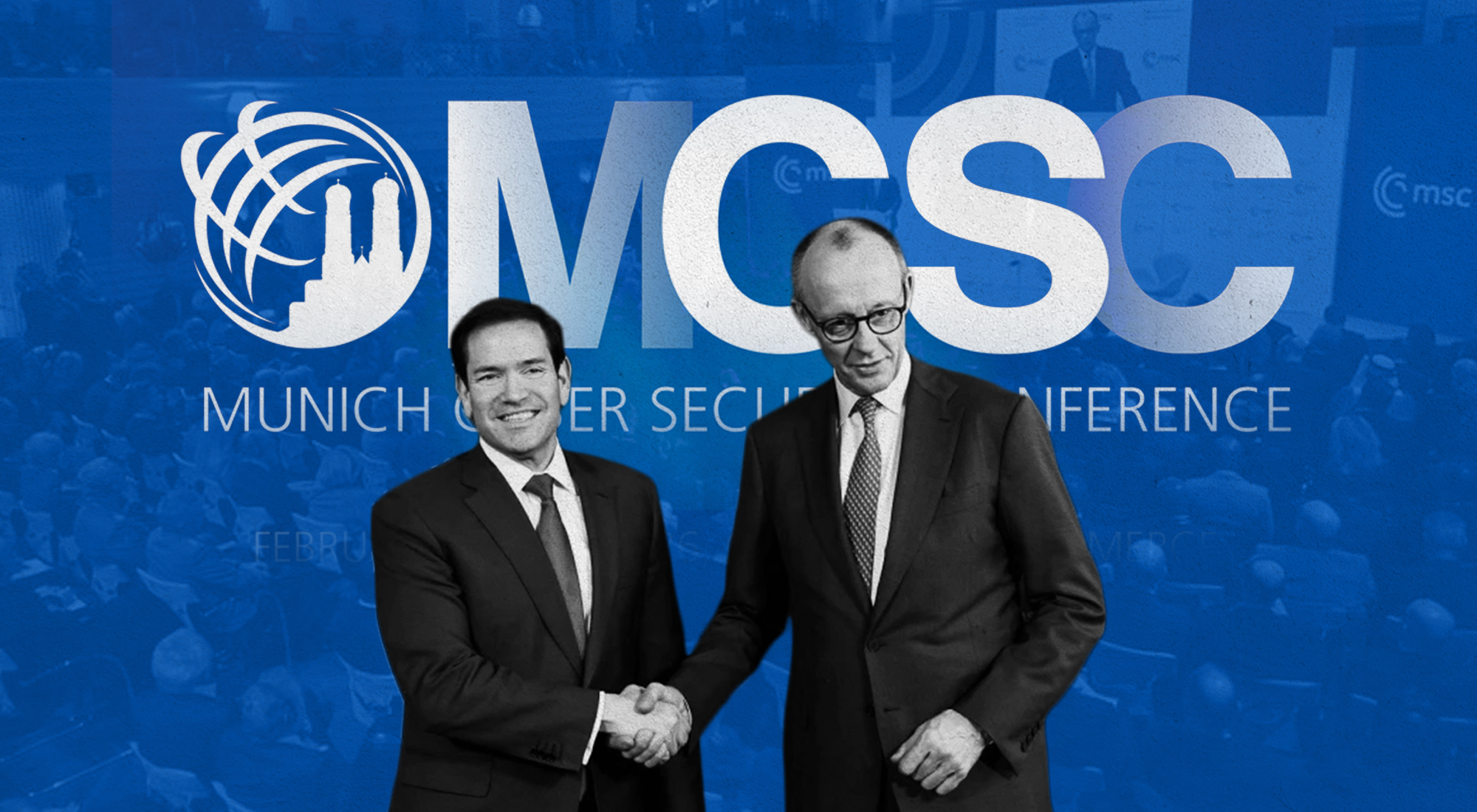

Transatlantic Relations at a Crossroads: Signals from Munich 2026
Strategic Studies Department
28 Feb 2026
Over the past two years, the Munich Security Conference has highlighted a noticeable shift in transatlantic relations. Although Vice President JD Vance in 2025 and Secretary of State Marco Rubio in 2026 differed in tone, both signaled that the Western alliance is entering a phase of reassessment rather than automatic unity.
In 2025, JD Vance delivered a confrontational speech arguing that Europe’s primary challenges come from within. He pointed to governance weaknesses, declining public trust, and inconsistencies in upholding democratic values. His remarks shifted the focus from external threats to internal resilience, marking a departure from the traditional narrative of Western cohesion against common adversaries.
In contrast, Marco Rubio adopted a more diplomatic tone in 2026 but maintained clear criticism. He raised concerns over migration policies and their potential impact on social stability. More importantly, he emphasized that Europe must assume greater responsibility for its own defense by increasing military spending and reducing dependence on the United States. While reaffirming U.S. commitment to the alliance, Rubio indicated that future American support would increasingly depend on reciprocal European efforts.
Strategically, these speeches reflect broader divergences in priorities, including climate policy, economic strategy, and burden-sharing. They have also deepened European uncertainty regarding the predictability of U.S. foreign policy, especially under the Trump administration. The debate is no longer about shared values alone, but about the distribution of responsibilities and the long-term sustainability of the alliance.
Three possible scenarios emerge:
- A Stronger European Pillar: The EU increases defense coordination and spending, creating a more balanced partnership with Washington.
- Managed Tension: Political disagreements continue publicly, but military and intelligence cooperation remains solid, preserving the alliance despite limited trust.
- Strategic Drift: Coordination weakens, leading to flexible “coalitions of the willing,” while Europe accelerates strategic autonomy and the U.S. shifts focus to other regions.
Overall, transatlantic relations are not collapsing but recalibrating. The future of U.S.–Europe ties will depend on whether both sides can share responsibilities effectively and manage disagreements within an increasingly complex global order.
