
This insight examines the impact of the Iranian conflict on energy security in the Gulf, coinciding with the rapid expansion of AI-driven infrastructure among regional states. The study uses a qualitative case study design that combines document analysis from policy reports, news articles, academic literature, and government data about the conflict, energy systems, and the use of AI. The results show that missile and naval threats to refineries, LNG terminals, and the Strait of Hormuz are linked to the growing need for energy and cooling caused by data centers and AI applications. This makes both threats more dangerous. AI-powered technologies for forecasting, automating networks, and responding to crises can make operations more resilient, but they can’t make up for high-level military and geopolitical concerns. The study shows that Gulf countries need to come up with plans that connect using AI with protecting people, getting different types of energy and fuel, and making energy security stronger at the policy level.
Introduction
Artificial intelligence (AI) is rapidly becoming a key driver of economic expansion, digital evolution, and infrastructure enhancement within the Gulf states. This is particularly evident as countries like the UAE and Saudi Arabia invest in their data centers, cloud computing infrastructures, and AI-focused sectors, all of which are reliant on stable and abundant energy supplies. The Gulf continues to be a crucial energy hub, and the Strait of Hormuz is a key passageway for the movement of crude oil and liquefied natural gas (LNG). This flow is essential for both the economies of the region and the wider world. The current tensions with Iran have heightened worries about the security of the Gulf’s energy infrastructure.[1]
Recent attacks on oil, gas, and shipping infrastructure have shown how quickly conflict can affect production, disrupt shipping routes, and raise energy prices. This, in turn, creates instability for both countries that export and import these resources.
This issue is especially significant considering that the Gulf’s energy network is not solely reliant on hydrocarbons; it is also increasingly integrated with digital infrastructure, given that AI systems require continuous power, cooling systems, and secure operational environments.[2]
Despite increasing interest in energy security in the Gulf, there is still insufficient understanding of how the Iranian conflict may impact the developing energy-AI ecosystem in the region. Recent research and policy evaluations indicate that forthcoming wars may focus on pipelines and refineries, as well as data centers, fiber optic networks, and other AI-dependent infrastructure that requires energy stability and marine connectivity.[3]
This creates a research gap in comprehending the degree to which geopolitical tension is transforming the relationship between AI development and energy security in the Gulf region. This study aims to analyze how the Iranian conflict affects energy security in the Gulf region, specifically looking at how these disruptions hinder the area’s plans for artificial intelligence. This study aims to examine the relationship between military escalation, the vulnerability of energy infrastructure, and the resilience of AI systems in the Gulf states. The present investigation endeavors to determine the broader strategic consequences for regional planning, technological self-sufficiency, and the diversification of energy sources.[4]
This research is significant for its contribution to the ongoing discussion concerning security, technological advancements, and energy governance within the Gulf region. It holds relevance for policymakers, energy strategists, technology investors, and researchers seeking to understand the potential for conflicts to reshape the foundations of digital and energy resilience. This paper establishes a link between the evolution of artificial intelligence and energy security in the context of regional instability, offering a contemporary perspective on how the Gulf might safeguard its economic prospects and geopolitical equilibrium.[5]
Research Problem
The Gulf states face a significant challenge: they must protect their energy infrastructure from conflict-related disruptions while also expanding AI systems. These systems require a reliable electricity supply, a strong data infrastructure, and stable supply chains.
Figure 1: The AI-Energy Security Dilemma for Gulf States
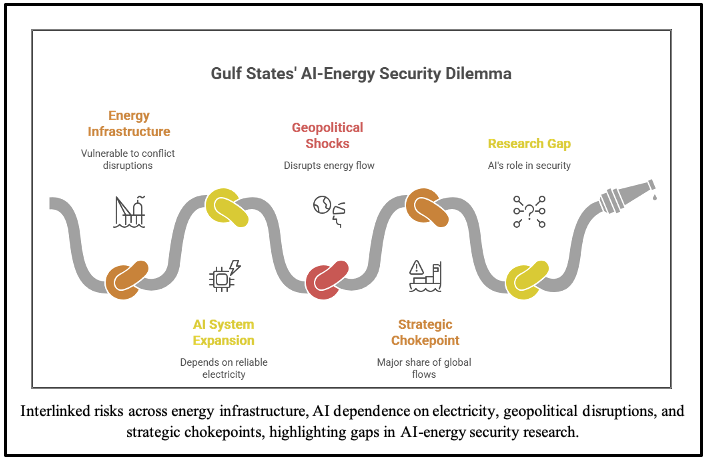
Iran’s aggressive actions and attacks on Gulf energy infrastructure have highlighted the vulnerability of advanced systems to geopolitical instability, particularly in a region where a considerable portion of global oil and LNG passes through a crucial strategic chokepoint. Consequently, this situation presents a research void concerning the potential of AI to either bolster energy security or, conversely, introduce a novel source of vulnerability amidst escalating conflict.[6]
Main Research Question
To what extent has the Iranian conflict affected energy security in the Gulf, and how can AI help Gulf countries mitigate these impacts?
Sub-Questions
- How has the Iranian conflict affected oil, gas, and maritime energy flows in the Gulf?
- What are the specific vulnerabilities in the Gulf’s energy infrastructure that have been exposed by recent Iranian attacks and threats?
- How is AI currently being used in the Gulf to improve energy forecasting, network resilience, and crisis response?
- To what extent can AI reduce the strategic impact of the conflict on energy security in the Gulf?
- What policies are required to integrate AI into a broader energy security strategy?
Research Objectives
- To examine the extent of the Iranian conflict’s impact on energy security in the Gulf.
- To identify the most vulnerable parts of energy infrastructure and supply routes.
- To evaluate the role of AI applications in enhancing energy resilience, monitoring capabilities, and response capacities.
- To analyze whether AI can reduce vulnerability to geopolitical shocks.
- To provide policy recommendations for strengthening energy security through digital and AI-supported systems.
Significance of the Study
This research is significant because it connects two important strategic areas: regional conflict and technological change. It adds to the discussion about energy security by showing how AI can improve efficiency and forecasting, and also strengthen resilience in politically unstable areas. The findings are especially useful for policymakers in the Gulf countries, as they can help with decisions about protecting critical infrastructure, improving networks, and strategically investing in AI-powered energy systems.
Research Methodology
This study can adopt a qualitative case study approach, focusing on Gulf countries such as the United Arab Emirates, Saudi Arabia, Qatar, and Kuwait. These countries are directly affected by regional energy shocks and are among the leading nations in adopting artificial intelligence. The research design relies on documentary analysis, including policy reports, media coverage, scientific literature, and official data related to the conflict, energy infrastructure, and artificial intelligence adoption. The qualitative approach is appropriate because the study seeks to interpret strategic relationships, political risks, and technological adaptation, rather than relying solely on quantitative measurement.[7]
Theoretical Framework
The “Securitization of Energy” approach is a suitable framework for this topic, as it assumes that states treat energy as a vital security issue when threats become existential or endanger political stability. This framework helps explain why Gulf governments treat oil ports, liquefied natural gas plants, pipelines, and maritime routes as national security assets rather than mere economic infrastructure in the context of the Iranian conflict. The realist geopolitical perspective serves as an important complement, given the close connection between energy in the Gulf and the competition for power, deterrence, and conflict behavior.[8]
Figure 2: AI-Powered Energy Security Resilience
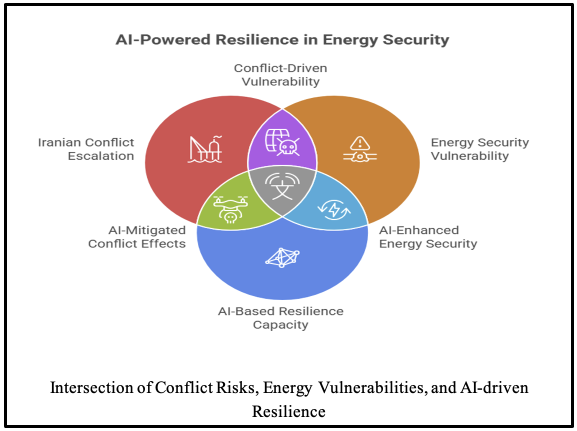
At the conceptual level, the study links three variables: escalation of the Iranian conflict, vulnerability of energy security, and AI-based resilience capacity. Iranian attacks or threats can reduce the reliability of supplies, increase transportation and insurance costs, and raise concerns about disruptions. Meanwhile, AI can improve predictive maintenance, demand forecasting, smart grid control, and crisis response. Thus, AI is viewed as a tool to enhance operational resilience, without being able to eliminate geopolitical risks.[9]
Literature Review
First Axis: The Iranian Conflict and Energy Flows in the Gulf
The recent escalation between Iran, Israel, and their partners has turned energy infrastructure into a central arena of conflict, making this conflict a worst-case scenario for energy security in the Gulf. Drone and missile strikes targeting gas processing facilities linked to the South Pars field, oil storage depots, and LNG centers in Qatar and the wider region have demonstrated how quickly the dispute can spill over into the energy domain. Given the spatial concentration of Gulf energy systems and their deep integration into global supply chains, even limited attacks lead to disproportionate disruptions in oil and gas flows and rapidly transmit instability to global markets.[10]
Maritime energy flows are equally at risk. The Strait of Hormuz remains one of the world’s most critical chokepoints, through which approximately one-fifth of global oil trade passes, and it has become a primary theater in the current crisis. Iran’s declaration that the Strait is open “to everyone except the United States and its partners,” along with the selective permission granted to ships from countries such as Pakistan, India, Turkey, China, France, and Italy, has created a state of strategic uncertainty regarding transit rights. This ambiguity undermines confidence among Gulf exporters, raises shipping and insurance costs, and increases the sense of vulnerability among energy-importing economies.[11]
The potential for attacks has demonstrably compromised energy security. Following assaults on Iranian energy assets, Tehran’s explicit threats of retaliation against critical oil and gas infrastructure within the Gulf have amplified apprehensions regarding potential strikes on refineries, gas fields, and export terminals in Saudi Arabia, the UAE, and Qatar. Such signaling exacerbates market volatility, given that energy security is contingent not only on the availability of resources but also on the anticipation of consistent production and uninterrupted maritime transport. Consequently, the Iranian conflict affects energy security in the Gulf through both direct infrastructure attacks and strategic maritime and rhetorical pressure.[12]
Second Axis: The Vulnerabilities Inherent in the Gulf’s Energy Infrastructure
The ongoing conflict has exposed fundamental weaknesses within the region’s energy systems. Centralized and expensive assets, such as large refineries, LNG plants, and export terminals, are difficult to disperse or completely secure, thereby rendering them appealing targets during periods of instability. Attacks and attempted assaults on these facilities have demonstrated that missiles, drones, and sabotage capabilities can bypass or penetrate current defense systems, thus revealing the vulnerability of essential nodes within regional supply chains.[13]
Consequently, this escalation has transformed the character of the threat, shifting it away from conventional deterrence strategies and toward direct physical threats aimed at energy infrastructure.
Analysts highlight that the Gulf’s energy infrastructure is effectively “in the crosshairs,” meaning that a successful attack could have far-reaching consequences. These consequences include production halts, damage to reputations, investor concerns, and a heightened perception of risk to the countries involved. This situation underscores the close link between the Gulf’s economic stability and the security of its few key facilities. Consequently, the infrastructure’s susceptibility engenders both physical and economic instability.[14]
These considerations carry significant policy ramifications, necessitating a heightened emphasis on protective measures, redundant systems, and early detection protocols. It is of utmost importance to mitigate the potential for regional or global energy crises resulting from the incapacitation or closure of a restricted number of facilities. Furthermore, the symbolic value and prominence of these installations make them likely targets in any future conflict.
Consequently, this underscores the necessity of considering infrastructure resilience as a fundamental component of national security strategy, rather than merely a technical concern.[15]
Third Axis: Artificial Intelligence in Gulf Energy Systems
Alongside these security concerns, Gulf and Middle Eastern nations are swiftly adopting AI within their energy and electricity sectors. AI is already proving its worth by aiding advanced energy management, demand forecasting, and boosting grid performance across the region. This technology assists operators in minimizing waste, integrating renewable energy sources, and improving operational control. Take the UAE, for instance; the Mohammed bin Rashid Al Maktoum Solar Park leverages AI to enable real-time monitoring, predictive maintenance, and automated load management. This contributes to grid stability, even when demand fluctuates. These advancements are positioning AI as a practical instrument for modernizing energy systems, increasing efficiency, and facilitating energy transition. Gulf states are increasingly recognizing artificial intelligence as a vital national asset, crucial for economic diversification and fortifying their geopolitical standing.[16]
Policy analyses show that investments in digital infrastructure, data capabilities, and AI-related human capital are now a core part of long-term national strategies, rather than just a way to promote commercial innovation. In this context, artificial intelligence is closely linked to smart city initiatives, sustainability agendas, and the development of more resilient and data-driven energy systems. This increasing presence of AI in Gulf policies reflects its transformation into a key component of the region’s overall power, alongside hydrocarbon resources and financial capital.[17]
Fourth Axis: Artificial Intelligence, Resilience, and Security
Beyond its role in efficiency, AI has significant implications for the resilience of systems in the face of conflict-related disruptions. In energy systems, AI-driven prediction and automated control can detect disruptions early, support rapid grid readjustment, and help maintain service continuity under stress. Smart grid recovery systems, which can automatically identify faults and reroute power flows and are already implemented in parts of the UAE, demonstrate how digital tools can reduce response times and mitigate the operational impacts of shocks. Similar strategies are being employed in renewable and hybrid energy systems to regulate variability and orchestrate distributed resources. Studies examining the renewable energy transition in the MENA region indicate that AI strengthens resilience by improving adaptability, efficiency, and the management of complex systems.[18]
Nevertheless, this existing scholarship frequently prioritizes technical and operational dimensions, often neglecting the consideration of sophisticated military threats, including missile strikes and blockades. Consequently, despite AI’s potential to improve prediction, monitoring, and system resilience, it cannot independently mitigate the geopolitical risks stemming from direct assaults, maritime pressures, or intentional sabotage. This highlights the necessity for integrated strategies that merge digital innovation with augmented physical protection, redundancy measures, and advanced security planning.[19]
Fifth Axis: Policy Implications of AI-Enhanced Energy Security
Emerging research literature agrees that AI should be addressed as part of a comprehensive energy security and national security strategy. It is recommended that Gulf states integrate AI into governance frameworks that link digital infrastructure, energy resilience, cybersecurity, and broader national security objectives. Government programs that integrate AI into energy planning, smart city development, and grid modernization demonstrate how public policies can accelerate technology adoption and deliver system-wide benefits. Simultaneously, analysts underscore the necessity of supplementing AI-driven energy management with strategies designed to mitigate the vulnerabilities arising from the Iranian conflict.[20]
These strategies encompass fortifying the physical security of essential infrastructure, diversifying export pathways, enhancing maritime security at strategic locations like the Strait of Hormuz, and formulating contingency plans to facilitate swift recovery following hostile actions. Therefore, the combined approach of using artificial intelligence, improving infrastructure, and implementing conflict mitigation strategies offers a more practical way for Gulf states to strengthen energy security, considering the ongoing geopolitical instability.[21]
Data Analysis and Results
The analysis reveals that the Iranian conflict exerts multidimensional pressures on energy security in the Gulf through interconnected mechanisms encompassing geopolitical, structural, and economic aspects. These pressures can be categorized into four main tracks:
First, the conflict poses a direct threat to the integrity of energy infrastructure, including refineries, LNG facilities, pipelines, and power generation systems. These assets have become increasingly vulnerable to missile attacks, drone attacks, cyber intrusions, and acts of sabotage.
Second, the conflict increases the risks to energy transport by sea, particularly through the strategically vital Strait of Hormuz. Any disruption to this waterway significantly impacts global oil and LNG flows, exacerbating uncertainty in international energy markets.
Furthermore, geopolitical instability exacerbates market expenses, encompassing elevated insurance rates, unpredictable shipping fees, and variable energy costs. These economic strains, in turn, jeopardize the stability of supply chains and the feasibility of long-term strategic planning.
Moreover, the ongoing conflict erodes investor confidence, especially within energy-dependent development sectors like AI and digital infrastructure, both of which necessitate a consistent and dependable electricity supply.
Threat Assessment
Table 1 below presents a classification of the most prominent threats associated with the Iranian conflict, along with their corresponding risk levels and their impact on energy systems.
Table 1: Most prominent threats linked to Iranian conflict
| Type of Threat | Description | Risk Level | Impact on Energy |
| Geopolitical Tensions | Iranian conflict with Gulf countries | High | Disruptions in supplies |
| Maritime Chokepoints | Disruption of navigation in the Strait of Hormuz | Very High | Rise in global prices |
| Cyber Attacks | Targeting energy infrastructure | Medium | Disruption of production |
As Table 1 illustrates, disruptions to maritime chokepoints represent the highest level of risk due to their global repercussions. In contrast, geopolitical tensions and military attacks pose direct and significant threats to supply continuity, while cyberattacks represent emerging but relatively less severe risks to production stability.
The Role of Artificial Intelligence in Enhancing Energy Security
AI is proving to be a key player in lessening the blow of geopolitical upheaval. Gulf nations, in particular, are weaving AI into their energy frameworks, aiming to boost both resilience and flexibility. These AI applications span a wide range, from predicting energy demand and managing smart grids to anticipating maintenance needs and forecasting renewable energy output. They also play a crucial role in swiftly restoring systems after disruptions. Though AI can’t erase geopolitical threats, it does significantly improve energy systems’ capacity to react quickly and keep operations running smoothly.
Table 2: Most prominent applications of AI in enhancing energy security
| Field | AI Application | Benefit |
| Forecasting | Analysis of geopolitical data | Prediction of crises |
| Cybersecurity | Detection of cyber attacks | Protection of infrastructure |
| Production | Improving operational efficiency | Cost reduction |
| Transportation | Monitoring of pipelines | Risk reduction |
As illustrated in Table 2, AI contributes to several operational areas, ranging from predictive analytics to infrastructure protection. These capabilities collectively enhance system resilience and reduce vulnerability to both physical and digital threats.
Interdependence Between AI and Energy Security
Despite the advantages of AI, it imposes new dependencies on the stability of energy supplies, digital infrastructure, and cooling systems. AI-dependent systems require continuous electricity supplies and secure data networks, making them vulnerable to disruptions caused by geopolitical conflicts. This creates a mutual relationship: while artificial intelligence contributes to enhancing the resilience of energy systems, it simultaneously depends on the reliability of these systems to ensure its operation and expansion.
Comparison of Traditional and Technological Threats
The changing nature of threats facing energy security is highlighted through Figure 3, which compares traditional military risks with emerging technological threats.
Figure 3: Traditional and Technological Threats in Comparison
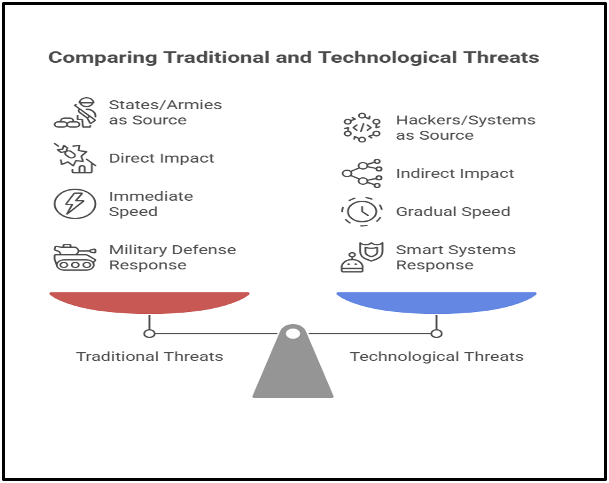
Figure 3 shows that traditional threats are characterized by their immediate and obvious effects, often requiring direct military responses. In contrast, technological threats develop gradually, operate indirectly, and require advanced countermeasures that rely on digital systems and artificial intelligence.
The research suggests that energy security in the Gulf region is increasingly shaped by a combination of traditional geopolitical risks and new technological vulnerabilities. Although AI has significant potential to improve resilience and operational efficiency, its effectiveness ultimately depends on the stability of the broader energy environment and the surrounding geopolitical context.
Discussion of Results
The findings suggest that the Iranian conflict has substantially undermined energy security within the Gulf region, thereby heightening the susceptibility of oil, gas, and maritime transport infrastructure to both direct and indirect disruptions. This conclusion is consistent with the existing literature examined in the initial section, which established that assaults on energy infrastructure and pressures on maritime routes can swiftly escalate a regional conflict into a wider energy security crisis, with international ramifications. Consequently, the evidence supports the assertion that energy security in the Gulf is contingent not only upon production capacity but also upon the political and military dynamics governing strategic waterways, including the Strait of Hormuz.[12]
The results also show that the vulnerability of Gulf energy systems is closely linked to the concentration of critical infrastructure in a limited number of high-value locations. This conclusion supports the argument developed in the second section, which posits that refineries, LNG terminals, pipelines, and export hubs are attractive targets due to their difficult distribution and because any disruption to them leads to cascading economic and strategic consequences. This research underscores the necessity of considering infrastructure resilience as a paramount security concern, transcending its classification as a purely technical matter.[13]
Moreover, a crucial finding is that AI can enhance the operational resilience of energy systems in the Gulf region, particularly in the areas of forecasting, smart grid administration, predictive maintenance, and system recovery procedures.
This observation is consistent with the conclusions drawn in the third and fourth segments of the literature review, which highlighted AI’s pivotal role in the modernization of the regional energy sector and its potential to fortify system resilience during periods of strain. Nevertheless, the present study also highlights that AI’s functionality is contingent upon the consistent availability of stable electricity, cooling infrastructure, and digital networks; consequently, while it can mitigate operational vulnerabilities, it does not directly address the fundamental geopolitical instability. Furthermore, the results suggest a reciprocal, rather than unidirectional, relationship between AI and energy security within the Gulf region.[14]
On the one hand, AI enhances crisis response, monitoring, and energy management; on the other hand, its expanded use leads to increased reliance on secure electricity supplies, digital infrastructure, and robust logistics systems. This is supported by the fourth point, which indicated that digital innovation enhances resilience but cannot, on its own, neutralize physical threats such as missile strikes, blockades, or sabotage. Consequently, AI ought to be conceptualized as a resilience-enhancing factor, rather than a replacement for strategic stability and physical safeguards.[15]
From a policy standpoint, this analysis underscores the necessity of a comprehensive strategy that connects AI implementation with bolstering physical infrastructure security, redundancy protocols, improved cybersecurity measures, and the safeguarding of maritime routes. This observation aligns with the fifth point discussed in the literature review, which emphasized the necessity of situating AI within a broader energy security paradigm, rather than treating it as an isolated technological solution. Consequently, the most efficacious strategy entails an integrated model that combines digital proficiencies, physical protective measures, and strategic foresight to mitigate the impacts of prospective conflicts on Gulf energy infrastructures.[20]
In summation, the discussion illustrates that the Iranian conflict has unveiled a new phase in Gulf energy politics, distinguished by the growing interdependence of conventional geopolitical threats and emerging technological systems. This study contributes to the literature by demonstrating that assessing energy security in the Gulf is no longer limited to production and export but must also include the resilience of AI-driven infrastructure and the associated strategic risks. In doing so, the findings broaden existing discussions on “energy security” by emphasizing that the future resilience of the Gulf depends on both technological adaptation and the management of geopolitical risks.[21]
Conclusion
This research posits that the Iranian conflict has significantly altered the energy security dynamics within the Gulf region, thereby revealing the physical, maritime, and economic susceptibilities inherent in a highly concentrated and interdependent energy infrastructure. Recent incidents and threats directed at refineries, LNG terminals, and vital shipping routes provide compelling evidence that regional tensions can swiftly precipitate global energy crises, thereby supporting the assertion that Gulf energy security should be regarded as a central concern for both national and international security, rather than solely an economic consideration.
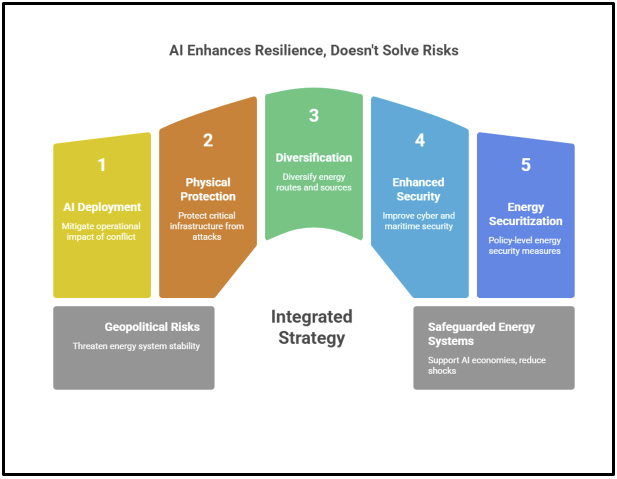
Figure 4: Integrated Strategy to Enhance Energy System Resilience Through AI, Protection, Diversification, Security, and Policy Measures
The research further demonstrates that artificial intelligence (AI) has become an essential tool for strengthening resilience, particularly through improved forecasting, network management, predictive maintenance, and accelerated recovery after disturbances. However, these functionalities are limited by their reliance on the continuous provision of electricity, cooling systems, and digital infrastructure.
The study generally indicates that AI strengthens resilience, rather than providing a complete solution to geopolitical risks. While AI can reduce the operational effects of conflict, it cannot eliminate threats like missile attacks, naval intimidation, or sabotage. Consequently, the Gulf states should pursue an integrated strategy. This strategy should combine the deployment of AI with improved physical security measures for critical infrastructure, diversification of energy sources and transportation routes, bolstering cybersecurity and maritime security, and incorporating energy security considerations into policy frameworks. Such an integrated approach would enable Gulf governments to protect their energy systems, facilitate the sustainable growth of AI-driven economies, and diminish the probability of future regional crises escalating into global energy disruptions.
Endnotes
- “Escalating Attacks on Gulf Energy Assets Plunge Iran War Into New Phase,” Wall Street Journal, March 18, 2026, https://www.wsj.com/world/middle-east/escalating-attacks-on-gulf-energy-assets-plunge-iran-war-into-new-phase-36cc0a6e.
- Karen E. Young, “How the War is Redefining Gulf Economic Power and Energy Strategy,” Middle East Council on Global Affairs, March 31, 2026, https://mecouncil.org/blog_posts/how-the-war-is-redefining-gulf-economic-power-and-energy-strategy/.
- “UAE Warns Targeting Energy Facilities Threatens Global Energy Security,” Gulf News, March 18, 2026, https://gulfnews.com/uae/uae-warns-targeting-energy-facilities-threatens-global-energy-security-1.500479089.
- DEWA, “UAE Leads Energy and AI Integration to Build Smart and Sustainable Cities,” December 18, 2025, https://www.dewa.gov.ae/en/about-us/media-publications/latest-news/2025/12/uae-leads-energy-and-ai-integration.
- Mohammed Soliman, “AI, the Gulf, and the US: A Primer,” Middle East Institute, February 25, 2026, https://mei.edu/report/ai-the-gulf-and-the-us-a-primer/.
- Khalid Qarooni, “How the Middle East’s Modern Power Systems Are Harnessing AI for Advanced Energy Management,” COPA-DATA Blog, November 20, 2025, https://blog.copadata.com/how-the-middle-easts-modern-power-systems-are-harnessing-ai-for-advanced-energy-management
- Talal Abdulla Al-Emadi, “Global Energy Security: Western Dependence on Gulf Oil and the Role of Regional Mediation,” Georgetown Journal of International Affairs, July 8, 2025, https://gjia.georgetown.edu/2025/07/08/global-energy-security-western-dependence-on-gulf-oil-and-the-role-of-regional-mediation-.
- Jacob H. Miller, “Strategic Culture as the Basis for Military Adaptive Capacity: Overcoming Battlefield Technological Surprises.” ScholarlyCommons (University of Pennsylvania), January 2014, https://repository.upenn.edu/curej/173.
- Lukasz Bednarski, Samuel Roscoe, Constantin Blome, and Martin C. Schleper, “Geopolitical Disruptions in Global Supply Chains: A State-of-the-art Literature Review,”Production Planning & Control 36, no. 4, 2025, https://doi.org/10.1080/09537287.2023.2286283.
- Chiara Signoria and Marco Barlettani, “Environmental, Health, Safety, and Social Management of Green Hydrogen in Latin America and the Caribbean,” 2023, https://doi.org/10.18235/0004888.
- Michael Haas, Henrik Boesen Lindbo Larsen, Linda Maduz, Niklas Masuhr, John Jack Thompson, and Benno Zogg, “Strategic Trends 2020: Key Developments in Global Affairs,” Repository for Publications and Research Data (ETH Zurich), April 2020, https://doi.org/10.3929/ethz-b-000413615.
- Manfred Hafner and Simone Tagliapietra, The Geopolitics of the Global Energy Transition, Lecture Notes in Energy, 2020, https://doi.org/10.1007/978-3-030-39066-2.
- “Escalating Attacks on Gulf Energy Assets Plunge Iran War Into New Phase,” Wall Street Journal, March 18, 2026, https://www.wsj.com/world/middle-east/escalating-attacks-on-gulf-energy-assets-plunge-iran-war-into-new-phase-36cc0a6e.
- Karen E. Young, “How the War is Redefining Gulf Economic Power and Energy Strategy.”
- “UAE Warns Targeting Energy Facilities Threatens Global Energy Security,” Gulf News, March 18, 2026, https://gulfnews.com/uae/uae-warns-targeting-energy-facilities-threatens-global-energy-security-1.500479089.
- DEWA, “UAE Leads Energy and AI Integration to Build Smart and Sustainable Cities,” December 18, 2025, https://www.dewa.gov.ae/en/about-us/media-publications/latest-news/2025/12/uae-leads-energy-and-ai-integration.
- Mohammed Soliman, “AI, the Gulf, and the US: A Primer.”
- Khalid Qarooni, “How the Middle East’s Modern Power Systems Are Harnessing AI for Advanced Energy Management.”
- Aisha Al-Sarihi, “Energy Transition in the Gulf: Best Practices and Limitations,” Carnegie Endowment, April 17, 2025, https://carnegieendowment.org/research/2025/04/energy-transition-in-the-gulf-best-practices-and-limitations.
- GIS Reports, “The Middle East’s Energy Security,” January 21, 2026. https://www.gisreportsonline.com/r/middle-east-power-future/
- Aleh Cherp and Jessica Jewell, “Energy Security Assessment Framework and Three Case Studies,” In International Handbook of Energy Security, 2013, https://lup.lub.lu.se/search/files/5850228/4239061.pdf.