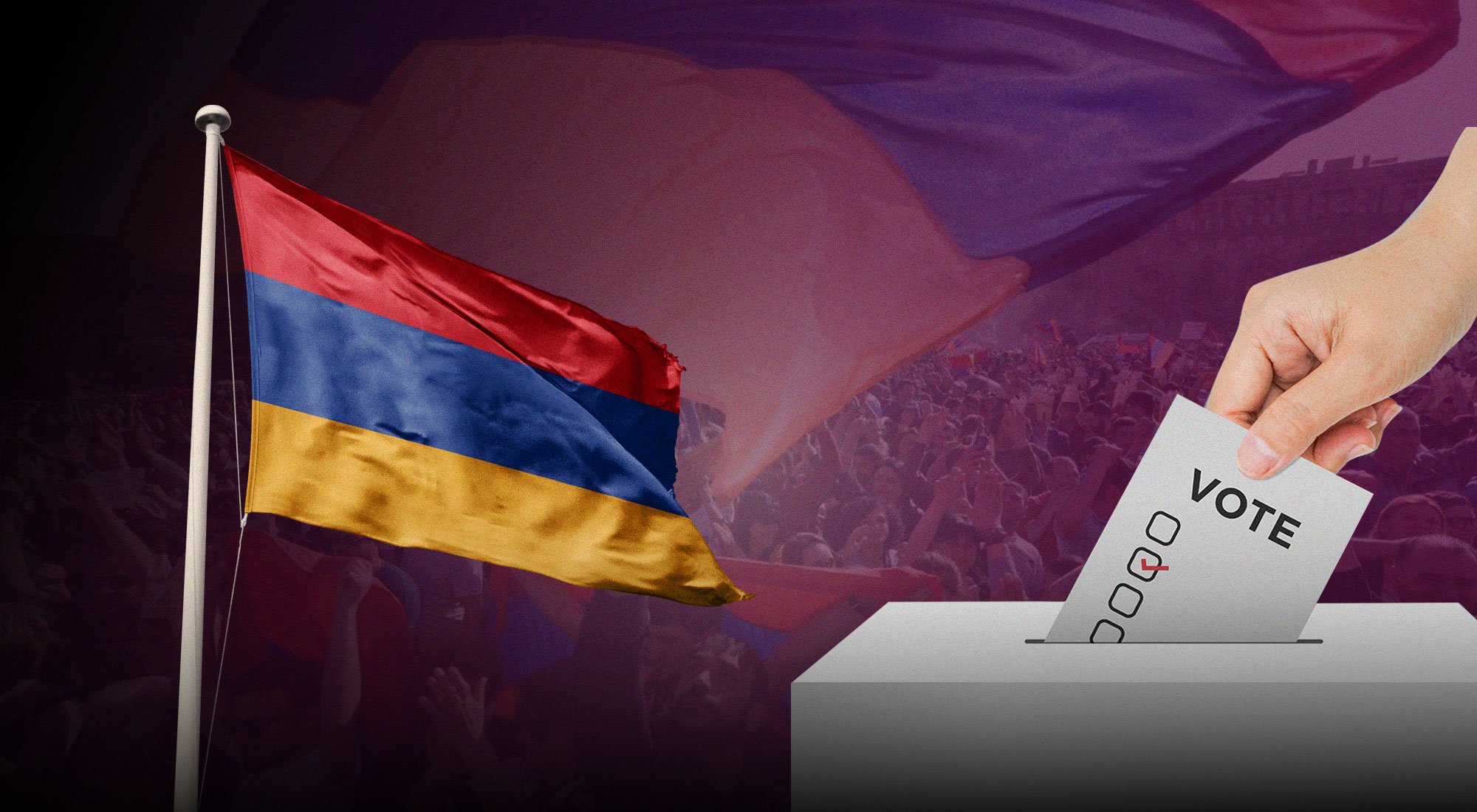



On 7 June, Armenia will hold parliamentary elections. The election results will determine not only Armenia’s next government, but also the country’s foreign policy direction. These will be the first regular elections since the 2018 “Velvet Revolution” that brought current Prime Minister Nikol Pashinyan and his Civil Contract party to power. In 2018, following mass street protests, then-Prime Minister Serzh Sargsyan resigned.[1] Armenia’s parliament appointed Nikol Pashinyan, the leader of the “Velvet Revolution”, as acting Prime Minister. In December 2018, his My Step Alliance won Armenia’s first-ever snap elections with around 70% of the vote.[2]
However, Armenia’s defeat in the Second Karabakh War in 2020 triggered a political crisis. After an alleged coup attempt in February 2021, the government called for early elections. Pashinyan’s Civil Contract party won those elections with 54% of the vote, securing 71 out of 107 seats in parliament.
The 2026 elections appear likely to be more challenging for Armenian Prime Minister Nikol Pashinyan and his party compared to the previous two elections. Public opinion polls conducted after the last election indicate that Pashinyan and his party have not maintained their former level of popularity.[3] In a poll by the International Republican Institute (IRI) released in March this year, 47% of respondents stated that they voted for Pashinyan’s Civil Contract Party in the 2021 elections. The share of those who say they would vote for him again in the next elections has dropped to 24%. Meanwhile, the same poll shows that a significant portion of voters in Armenia is considered apolitical or undecided. About 30% said they have not decided whom to vote for, and 8% said they will not vote at all.[4]
The Armenian Parliament has at least 101 seats, elected through a party-list proportional representation system. Parties must secure at least 4% of the vote to enter parliament, while alliances face higher thresholds: 8% for up to three parties and 10% for four or more.[5]
For Pashinyan and his party, the main goal in this year’s elections is to secure a constitutional majority by winning two-thirds of the seats in parliament. Although the ruling party secured a constitutional majority in previous elections, recent local elections have shown that a united opposition can effectively challenge it. In Gyumri—Armenia’s second-largest city, the ruling Civil Contract Party won the largest share of the vote with 36.8%. However, the opposition candidate Vartan Ghukasian, who got 20.7%, became mayor with support from other opposition forces.[6] Gyumri elections were widely seen as a political defeat for Nikol Pashinyan ahead of the upcoming parliamentary elections.
Opposition forces ahead of Armenian elections
Among Nikol Pashinyan’s main opponents are former president Robert Kocharyan and the Armenia Alliance formed with the Armenian Revolutionary Federation (ARF), the Strong Armenia party of Armenian-Russian billionaire Samvel Karapetyan, the Prosperous Armenia party of Armenian businessman Gagik Tsarukyan, the Wings of Unity party of former ombudsman Arman Tatoyan, and other political groups. According to polls, among these figures, Prime Minister Nikol Pashinyan’s strongest rival appears to be Samvel Karapetyan.
In Armenia, Karapetyan is known as a philanthropist and businessman. His company, Tashir Group, owns Electric Networks of Armenia CJSC (ENA), the country’s main electricity distribution company. In June 2025, amid tensions between the Armenian Apostolic Church and the government, Karapetyan publicly expressed support for Catholicos of All Armenians Karekin II. Shortly after, he was detained on allegations of calling for a takeover of power. Following his arrest, Prime Minister Pashinyan announced that the government intended to nationalize ENA, citing strategic and national security concerns.
In December, Karapetyan was released to house arrest after paying US$10.6 million in bail. Despite registering only in January 2026, Karapetyan’s Strong Armenia party is expected to become the country’s second-largest party in the parliament. The party has nominated Karapetyan as its candidate for prime minister. Karapetyan, who holds Armenian, Greek Cypriot (RoC), and Russian citizenship, is not eligible to become prime minister under the current constitution. The rules require a candidate to have only Armenian citizenship and to have lived in Armenia for the past four years.
His nephew, Narek Karapetyan, is leading the party’s campaign and has registered as a candidate in the elections. According to Narek Karapetyan, after the elections, they plan to propose a legal amendment allowing anyone with Armenian citizenship to become prime minister.[7] For such changes, the Strong Armenia party would also need a two-thirds majority in parliament.
The Armenia Alliance, led by former president Robert Kocharyan and ARF, is currently the main opposition force in parliament with 29 seats. The alliance has nominated Kocharyan as its candidate for prime minister in the June elections. In the 2021 elections, the bloc secured around 21% of the vote. However, recent polls indicate a sharp decline in its support, dropping to roughly 3%. This decrease is widely attributed to the rise of a new opposition force, the Strong Armenia party led by Samvel Karapetyan. The general view is that Karapetyan’s Strong Armenia party has taken votes away from the Armenia Alliance.
The Prosperous Armenia Party, led by Armenian businessman Gagik Tsarukyan and known for its pro-Russian stance, is among the parties expected to pass the electoral threshold and enter parliament. The party will participate in the elections as part of a coalition. In the 2018 elections, Tsarukyan’s party received 8.26% of the vote, becoming the second-largest party; however, in the 2021 elections, it failed to pass the threshold and remained outside parliament. According to recent polls, Tsarukyan ranks as the fourth most popular political figure.
Meanwhile, the Republican Party, led by former President Serzh Sargsyan, has announced that it will not participate in the June elections to avoid “dividing the opposition arena” even more.[8]
From peace to “Real Armenia”
Prime Minister Nikol Pashinyan and his party’s election agenda have changed significantly compared to the previous elections. After coming to power, Pashinyan’s maximalist rhetorics such as reference to the Treaty of Sèvres, created diplomatic tensions with Türkiye, and his declaration in Khankendi that “Karabakh is Armenian land” harmed the negotiation process with Azerbaijan. In 2021, one of Prime Minister Pashinyan’s campaign promises was to take back some of the territories that Azerbaijan liberated during the Second Karabakh War (2020).
By contrast, the priority in the 2026 elections has shifted toward peace with Azerbaijan and promoting the “Real Armenia” ideology. On 8 August 2025, two countries initialed a 12-point peace agreement in Washington. For the final agreement to be signed, Azerbaijan wants Armenia to remove territorial claims from its constitution. The Armenian government has already begun work on a new constitution. According to Pashinyan, if the new constitution is not accepted in a referendum, the government will hold another referendum to secure its adoption.[9]
There have also been concrete steps toward normalization between Armenia and Azerbaijan. Azerbaijan has allowed cargo transit to Armenia through its territory; grain shipments from Kazakhstan and Russia have reached Armenia via the Azerbaijan-Georgia route. In addition, initiatives to expand trade cooperation have begun, and at the end of 2025, fuel exports from Azerbaijan to Armenia took place.[10] All these developments are considered the most significant steps toward peace between the two countries in nearly 30 years.
According to the IRI survey, while 30% of respondents stated that they do not consider the Armenian government successful in any area, 17% identified the establishment of peace and security as the government’s greatest achievement. According to Pashinyan, maintaining peace requires his party to remain in power. During a press conference, the Armenian Prime Minister said that if the opposition wins the June elections, a new war threatening Armenia’s sovereignty could break out within a few months.[11] These statements triggered a backlash from the opposition, which accused the government of trying to influence society by instilling fear of war.
The opposition, meanwhile, opposes the ongoing peace process between Armenia and Azerbaijan, describing the initialed agreement as a one-sided concession. Despite this criticism, the opposition has not put forward a concrete alternative peace plan.[12] According to Samvel Karapetyan, leader of the Strong Armenia party, a key condition for an acceptable peace agreement for Armenia is the strengthening of the country’s military. More broadly, the opposition accuses the government of weakening and dismantling the army. In response to these criticisms ahead of the elections, Pashinyan announced that a military parade will be held on May 28—Republic Day, during which weapons purchased since 2022 will be showcased.[13] This will be the first military parade in the country since 2016.
The “Real Armenia” project is another important part of both Pashinyan’s peace agenda and election campaign. By introducing this concept, Pashinyan stressed that Armenian citizens should move beyond emotional attachments to the “Historical Armenia” idea, which claims territories in Azerbaijan and Türkiye and focus on the country’s future based on its actual borders.[14]
Pashinyan has promoted this concept through public campaigns, border visits, and symbolic actions such as maps highlighting Armenian territory. Mount Aragats, the highest mountain in Armenia, is the symbol of Pashinyan’s Real Armenia project, replacing the historical symbolism of Mount Aghri (Ararat) located in Turkiye. “Aragats is in Armenia; Ararat is not… All our problems lie between Ararat and Aragats, between dream and reality”, said Pashinyan.[15] As part of this ideology, the symbol of Mount Aghri was officially removed from Armenian border entry and exit passport stamps.[16]
All these steps have drawn criticism both within Armenia and from the Armenian diaspora. The opposition, along with certain church leaders and members of the diaspora, accused the Armenian government of creating this project to justify the loss of Karabakh. According to Pashinyan, whether the Real Armenia ideology is accepted by the public will be tested in the upcoming elections.
Armenia between Russia and the West
June elections are seen as a key moment not only for domestic politics but also for shaping Armenia’s foreign policy. These elections are widely viewed as a choice between closer ties with the European Union (EU) and the United States or continuing strong relations with Russia. The current government is generally seen as pro-Western, while the opposition prefers to maintain close ties with Russia.
Since gaining independence from the Soviet Union, Armenia has become highly dependent on Russia in areas such as energy, security, and the economy. The country is a member of the Collective Security Treaty Organization (CSTO) and the Eurasian Economic Union (EAEU), both led by Russia.
Due to the Karabakh conflict, Armenia’s borders with Azerbaijan and Türkiye have remained closed, limiting its ability to diversify economically after independence. This has limited its economic options and increased its dependence on Russia. Approximately 88% of Armenia’s natural gas consumption is imported from Russia. Natural gas serves as a key energy source for electricity generation, heating, and transportation.[17] Moreover, Russia supplies gas to Armenia at below-market prices, making it difficult for the country to shift to alternative suppliers.
Russia also remains one of Armenia’s key export markets. According to 2025 data, 35.3% of Armenia’s exports were directed to Russia, while only 7.9% went to the EU countries.[18] Remittances sent by Armenian workers in Russia also play a crucial role in the economy. In 2025, total transfers from Russia to Armenia amounted to US$3.9 billion, of which US$425 million consisted of non-commercial personal remittances. This highlights Russia’s continued importance as a source of income for Armenian citizens.
In recent years, to diversify its economy, Armenia has been steadily deepening its relations with the EU and the United States. Particularly after the Russia-Ukraine War, the weakening of Russia’s influence in the South Caucasus, along with steps toward peace between Armenia and Azerbaijan, has created more opportunities for Yerevan to expand cooperation with the West in various fields. Armenia and the United States signed a Strategic Partnership Charter in 2025. The agreement covers key areas such as economic and energy cooperation, defense and security, democracy and human rights, as well as cultural and educational exchanges.[19]
Another significant step was taken in August 2025 in Washington, where Azerbaijan, Armenia, and the United States agreed to open the “Trump Route for International Peace and Prosperity” (TRIPP) transit corridor. This route is planned to connect Azerbaijan with its exclave, Nakhchivan, through Armenian territory. In January, Armenia and the United States signed a framework agreement for the implementation of TRIPP. According to the agreement, a TRIPP Development Company will be established to develop and operate multi-modal transit infrastructure in Armenia.[20]
The Armenian government has also taken important steps to strengthen its ties with the EU. In March 2025, the Armenian parliament officially adopted a law initiating the country’s EU accession process. The parties adopted the EU-Armenia Strategic Partnership Agenda aimed at promoting reforms and multi-sectoral cooperation. One month before the elections, Armenia is expected to host the European Political Community Summit, attended by European leaders, as well as the first EU-Armenia summit.[21]
Armenia’s integration into regional projects and the normalization of its relations with Azerbaijan and Türkiye are also important for the EU. Opening the border with Türkiye and improving ties with Azerbaijan would increase Armenia’s economic connectivity and regional integration. In turn, this would create more favorable conditions for the EU to expand and deepen its economic and trade relations with Armenia.
While the Armenian government frames the deepening of ties with the West as a policy of “diversification”, Russia perceives the growing ties between Armenia and Western actors as a threat to its interests in the region.[22] For Nikol Pashinyan, confronting Russia ahead of the elections could be a risky move. Although trust in Russia has declined in recent years, an IRI poll indicates that 43% of respondents still see it as an important political partner. Given Armenia’s dependence on Russia in many areas, it is important for the government to reassure voters that its relations with Moscow are not at risk.
Against this backdrop, a meeting between Pashinyan and Russian President Vladimir Putin was held in early April at the initiative of the Armenian government. During the meeting, Putin stated that while Russia remains calm about Armenia’s efforts to strengthen ties with the EU, it is impossible for Armenia to be a member of both the EU and the EAEU at the same time. He also reminded that Russia provides important economic and energy benefits to Armenia. “Energy prices and gas prices in Europe exceed US$600 per 1,000 cubic meters, while Russia sells gas to Armenia at US$177.5 per 1,000 cubic meters”, Putin said.[23]
Putin also expressed hope that pro-Russian political forces would be allowed to compete freely in the June elections, noting that some of their representatives have been detained, in an apparent reference to Strong Armenia party leader Samvel Karapetyan. In response, Pashinyan stated that Karapetyan is not eligible to hold a seat in parliament due to his citizenship in other countries.
Following the meeting between Putin and Pashinyan, Russian Deputy Prime Minister Alexei Overchuk stated that serious problems have emerged regarding the future of economic relations between Russia and Armenia. According to Overchuk, these relations may need to be restructured in the near future.[24]Although the Armenian government described the meeting as productive, many in Armenia interpreted the Russian side’s remarks as a form of pressure. Some observers believe that Moscow’s message was mainly aimed at the Armenian public, warning of possible political and economic consequences after the elections.
Foreign interference in elections
In March, the Armenian Foreign Intelligence Service published a report stating that the intelligence agencies of a foreign country might attempt to influence the upcoming parliamentary elections. According to the report, these agencies could pressure Armenians abroad and Armenian citizens to vote in ways that serve their interests. It also warned that false or misleading information might be used to influence voters. While the report did not name the country, discussions in Armenia have widely focused on the possibility of Russian interference.[25]
Marta Kos, the EU Commissioner responsible for enlargement, stated that the EU would support Armenia against potential Russian hybrid interference and assist in countering disinformation. At the request of the Armenian government, the EU will deploy a “Hybrid Rapid Response Team” to address threats ahead of the elections. This team will provide advisory support to the offices of the Armenian Prime Minister, the Security Council, the Central Election Commission, and the Interior Ministry on crisis management plans and assist in shaping future crisis management protocols. A similar EU mission had also been deployed during the parliamentary elections in Moldova last September.[26]
Meanwhile, Russian officials and the Armenian opposition accuse the EU of interfering in the elections. Maria Zakharova, spokesperson for the Russian Foreign Ministry, said at a briefing that the EU is trying to reflect the Moldova scenario in Armenia. Zakharova added that if Yerevan invites them, Moscow is also ready to send a similar mission.[27]
Conclusion
The June elections are crucial for Armenia, as they will shape not only the country’s domestic politics but also its geopolitical direction. Geopolitical developments and conflicts have turned these elections into a competition between the West and Russia. Nikol Pashinyan’s Civil Contract party aims to integrate Armenia with the West, while the opposition wants to maintain traditional ties with Russia.
The political atmosphere is tense and polarized. Although Civil Contract leads in opinion polls, Pashinyan and his party have lost some of their earlier popularity. Their main goal is to secure a parliamentary majority. The Strong Armenia party, led by Russian-Armenian billionaire Samvel Karapetyan, is expected to become the second-largest party in parliament.
If the opposition secures a majority, it could lead to major changes in Armenia’s foreign policy and seriously threaten the normalization process with Azerbaijan and Türkiye. While the ruling party has received significant support from the West, maintaining balanced relations with Russia remains critical. Armenia depends on Russia in many ways, including energy and the economy, and Moscow’s actions could influence voters. Overall, the June elections will be an important test for the Armenian government’s peace agenda and the “Real Armenia” vision. The outcome will have implications not only for Armenia but for the entire region.
[1] “Shock as Armenia’s prime minister steps down after 11 days of protests,” The Guardian, April 23, 2018, https://www.theguardian.com/world/2018/apr/23/serzh-sargsyan-resigns-as-armenias-prime-minister-after-protests (Accessed: March 4, 2026).
[2] “Armenia election: PM Nikol Pashinyan wins by landslide,” BBC, December 10, 2018, https://www.bbc.com/news/world-europe-46502681 (Accessed: March 4, 2026).
[3] “New Poll Shows Dissatisfaction with Pashinyan, His Office and His Party, as Large Percentage Opts Not to Vote,” Asbarez, July 22, 2025, https://asbarez.com/new-poll-shows-dissatisfaction-with-pashinyan-his-office-and-his-party-as-large-percentage-opts-not-to-vote/ (Accessed: March 4, 2026).
[4] “Public Opinion Survey: Residents of Armenia | February 2026,” International Republican Institute, March 3, 2026, https://www.iri.org/resources/public-opinion-survey-residents-of-armenia-february-2026/ (Accessed: March 4, 2026)
[5] Hovhannes Nazaretyan, “Election Primer: Understanding Armenia’s Parliamentary Vote,” EVN Report, March 24, 2026, https://evnreport.com/elections/election-primer-understanding-armenias-parliamentary-vote (Accessed: March 24, 2026).
[6] “Armenian Ruling Party Falls Short In Key Local Election,” Azatutyun, March 31, 2025, https://www.azatutyun.am/a/33365114.html (Accessed: March 18, 2026).
[7] “Strong Armenia party nominates Samvel Karapetyan as PM candidate despite constitutional barrier,” Armenpress, February 12, 2026, https://armenpress.am/en/article/1241999 (Accessed: March 6, 2026).
[8] “Former President Serzh Sargsyan says Republican Party will skip June 7 elections to avoid dividing opposition,” Armenpress, April 4, 2026, https://armenpress.am/en/article/1246487 ( Accessed: April 4, 2026).
[9] “Pashinyan to hold referendums until full approval of new Constitution,” Vestnik Kavkaza, March 26, 2026, https://en.vestikavkaza.ru/news/Pashinyan-to-hold-referendums-until-full-approval-of-new-Constitution.html (Accessed: April 1, 2026).
[10] “Azerbaijan to send 2nd shipment of petroleum products to Armenia,” Anadolu Agency, January 8, 2026, https://www.aa.com.tr/en/asia-pacific/azerbaijan-to-send-2nd-shipment-of-petroleum-products-to-armenia/3793315 (Accessed: March 22, 2026).
[11] “Pashinyan warns of imminent war if foreign-controlled opposition forces win June elections,” Armenpress, March 19, 2026, https://armenpress.am/en/article/1245134 (Accessed: March 19, 2026).
[12] “’Armenia’s security guarantor led us to slaughter’ — Nikol Pashinyan,” Jam News, March 26, 2026, https://jam-news.net/armenias-security-guarantor-led-us-to-slaughter-nikol-pashinyan/ (Accessed: March 26, 2026).
[13] “Government to showcase new military equipment in Yerevan in ‘report to citizens,’ says Pashinyan,” Armenpress, March 26, 2026, https://armenpress.am/en/article/1245666 (Accessed: March 26, 2026 )
[14] Onnik James Krikorian, “Pashinyan’s ‘Real Armenia’ ideological address sparks debate,” Balcani Caucaso, February 27, 2025, https://www.balcanicaucaso.org/en/cp_article/pashinyans-real-armenia-ideological-address-sparks-debate/ (Accessed: March 23, 2026).
[15] “Family, Religion, National Identity,” Aravot, June 24, 2023, https://en.aravot.am/2023/06/24/328502/ (Accessed: April 14, 2026).
[16] “Armenia removes image of Türkiye’s Mount Agri from passport stamp,” TRT WORLD, September 15, 2025, https://www.trtworld.com/article/a3fd2b21e803 (Accessed: March 23, 2026).
[17] “Sustainable Transport Policy for Armenia: A Roadmap,” International Energy Agency, October 2025, https://www.iea.org/reports/sustainable-transport-policy-for-armenia-a-roadmap/sustainable-transport-in-armenia (Accessed: March 26, 2026).
[18] “Armenia’s Export Markets: Russia Up, EU Down,” Hetq.am, April 7, 2026, https://hetq.am/en/article/179748 (Accessed : April 8, 2026).
[19] “Charter on Strategic Partnership Between the United States of America and the Republic of Armenia,” U.S Embassy in Armenia, January 15, 2025, https://am.usembassy.gov/charter-on-strategic-partnership-between-the-united-states-of-america-and-the-republic-of-armenia/ ( Accessed: April 2, 2026)
[20] U.S Department of State, Joint Statement on the Publication of the U.S.-Armenia Implementation Framework for the Trump Route for International Peace and Prosperity (TRIPP), January 13, 2026, https://www.state.gov/releases/office-of-the-spokesperson/2026/01/joint-statement-on-the-publication-of-the-u-s-armenia-implementation-framework-for-the-trump-route-for-international-peace-and-prosperity-tripp (Accessed: March 28, 2026 )
[21] “First ever EU-Armenia summit to take place on 4 and 5 May 2026,” European Council-Council of the European Union, March 26, 2026, https://www.consilium.europa.eu/en/press/press-releases/2026/03/26/first-ever-eu-armenia-summit-to-take-place-on-4-and-5-may-2026/ (Accessed: April 2, 2026 )
[22] “Putin warns Armenia it can’t be both a member of EU and Russia-led economic bloc,” AP News, April 1, 2026, https://apnews.com/article/russia-armenia-putin-pashinyan-642f4d5863ab584e0dc1e9a894c8cd0b (Accessed: April 2, 2026).
[23] “Russia is selling gas to Armenia much cheaper than European prices — Putin,” TASS, April 1, 2026,
https://tass.com/economy/2110407 (Accessed: April 14, 2026).
[24] “Overchuk: Armenia is close to the point where Russia will have to restructure its economic relations with it,” Arka News Agency, April 2, 2026, https://arka.am/en/news/economy/overchuk-armenia-is-close-to-the-point-where-russia-will-have-to-restructure-its-economic-relations-/
[25] “Foreign Intelligence Service warns of risk of foreign interference in Armenia’s upcoming elections,” Armenpress, March 13, 2026, https://armenpress.am/en/article/1244668 (Accessed: April 2, 2026).
[26] “EU To Send Hybrid Rapid Response Team To Armenia Ahead Of Elections,” Azatutyun, March 17, 2026, https://www.azatutyun.am/a/33708654.html (Accessed: April 5, 2026).
[27] “Russia ready to support Armenia in countering hybrid threats — Zakharova,” Armenpress, April 1, 2026, https://armenpress.am/en/article/1246226 (Accessed: April 2, 2026).