

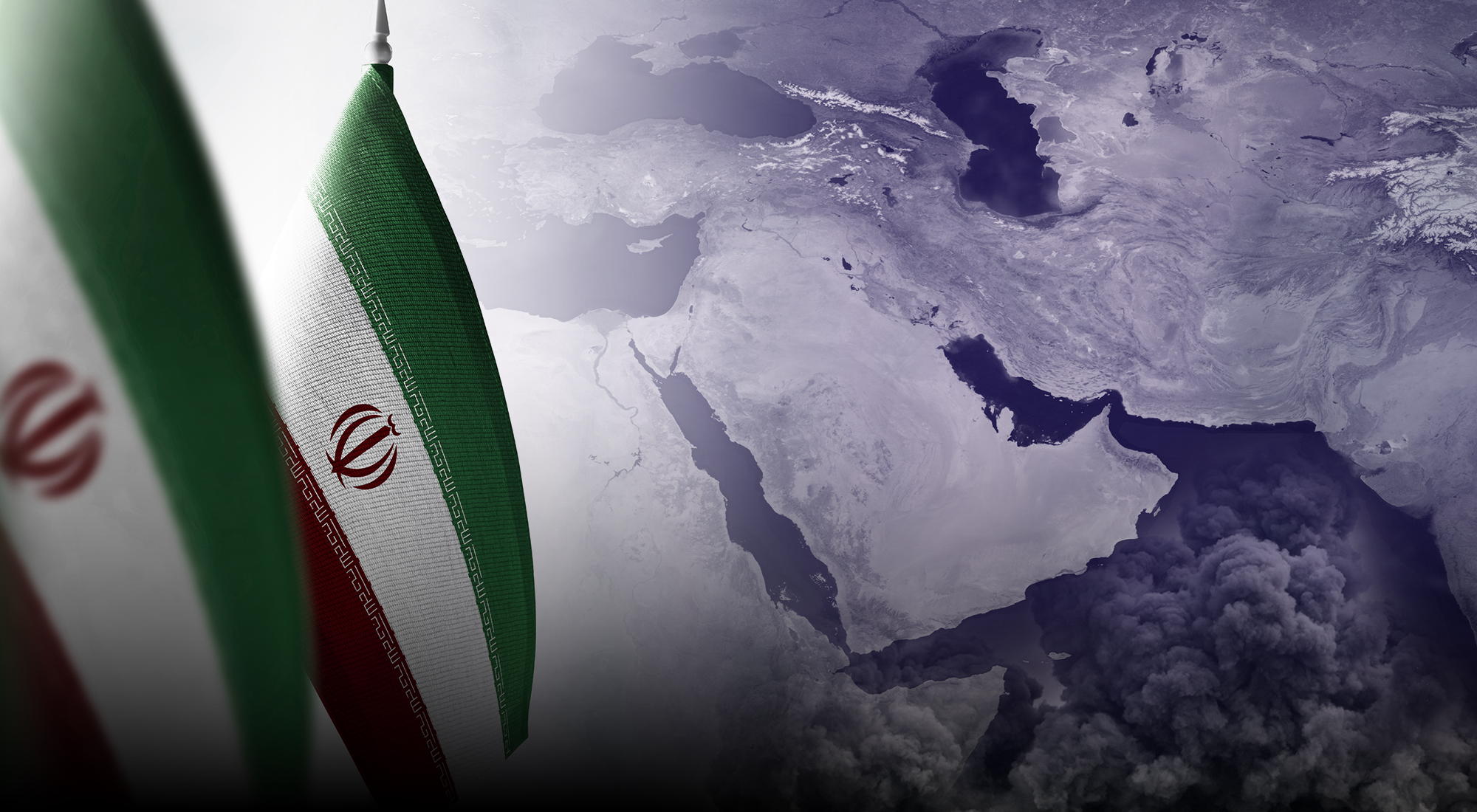





The Middle East may today be standing on the threshold of a pivotal historical moment. The ongoing war surrounding Iran does not appear to be merely a conventional military confrontation; rather, it may represent the culmination of a geopolitical trajectory that began with the Iranian Revolution, when the Islamic Republic that emerged from that upheaval redefined the nature of conflict in the region by combining revolutionary ideology with non-conventional instruments in the management of regional influence.[1]
For more than four decades, the Iranian clerical regime has constructed its regional strategy on a combination of ideological expansion, asymmetric warfare, and networks of armed proxies. From Lebanon to Iraq, and from Yemen to Syria, Tehran has sought to shape a regional system of influence based on local forces politically and militarily aligned with it. This approach has enabled Iran to extend its strategic reach beyond its geographical borders and to create what some of its leaders have openly described as influence stretching across several Arab capitals.[2]
However, the regional and international environment that enabled this expansion has begun to undergo a profound transformation. Direct military pressures on the regime’s strategic infrastructure have intensified, while internal economic crises have accumulated within Iran. At the same time, the network of regional influence on which Tehran has long relied has experienced gradual erosion as a result of political transformations and internal conflicts in several arenas that historically served as key platforms for the expansion of Iranian influence.[3]
Within such a fluid and volatile context, understanding the trajectory of the current war becomes more complex than a conventional military analysis would suggest. Some wars do not conclude through gradual and predictable pathways; rather, they end through sudden events of major impact that fundamentally redefine the rules of the game. It is here that the concept of the “Black Swan” emerges as a useful analytical tool for understanding major transformations within the international and regional system.[4]
The concept of the Black Swan refers to rare and unexpected events that carry profound strategic consequences. Their effects extend beyond altering the course of a particular conflict to reshaping the broader geopolitical environment within which that conflict unfolds.[5]
From this perspective, the present study seeks to employ the Black Swan approach as an analytical framework for understanding the potential trajectories of the war surrounding Iran. It is guided by a central question: Can Iran avoid losing this war? From this starting point, the analysis aims to deconstruct the pathways that could lead to the defeat of the Iranian clerical regime and to identify the critical—and potentially unexpected—moments or events that might accelerate such an outcome. At the same time, the study examines how this analytical approach may be received within certain ideological readings of the conflict, which at times tend to obscure the empirical realities of the war or to downplay their implications.
First: The Black Swan — A Three-Dimensional Approach to Understanding the Trajectories of the Black Turban Regime
Current military indicators suggest that Iran is facing unprecedented strategic challenges. Circulating reports indicate that a significant portion of its military capabilities has been damaged, including the complete loss of its naval fleet, its air superiority, and its air defense systems, as a result of successive strikes targeting its military infrastructure across these three sectors. Alongside this military setback, an equally serious economic factor emerges. Analysts point out that Iranian society is entering the war already economically exhausted due to prolonged sanctions, high inflation, and a weakened currency, which limits its ability to sustain a prolonged conflict. With the outbreak of hostilities, segments of economic activity have come to a halt and pressure on the rial has intensified, a situation that could lead to an economic shock with severe consequences for domestic living conditions and social stability.[6]
Within this intersection of military and economic pressures, a fundamental question arises: can Iran avoid losing this war? Major wars are not decided solely on the battlefield; they are also determined in the political and economic arenas. In both domains, according to many indicators, Iran appears as though it may have been defeated even before the direct military confrontation began.
Although multiple theoretical scenarios are often proposed when analyzing the outcomes of wars,[7] a realistic reading of the current indicators may lead to a different conclusion. The issue may not lie in the multiplicity of possible endings but rather in the gradual convergence toward a single likely scenario. It is precisely here that the concept of the Black Swan becomes relevant. The Black Swan in this context does not lie in the existence of multiple competing trajectories or unexpected alternatives; rather, it lies in the revelation that the outcome may be almost singular. In other words, the unexpected event is not the emergence of a new scenario, but the realization that all possible trajectories—despite their differing forms—may ultimately converge on a single result: the fall of the Iranian regime, whether this occurs through a single pathway or through the intersection of several pathways simultaneously (first dimension).
Within this context, the analysis seeks to identify the critical junctures at which a “Black Swan” may emerge in its classical sense, namely unexpected and decisive events capable of accelerating the trajectory toward this outcome (the second dimension). Such events may arise within any of the possible pathways, yet regardless of their nature, they ultimately contribute to pushing the broader dynamics toward the same end. Accordingly, the end of the regime may take shape through the following forms or through the interaction of several of them simultaneously.
1. A structural transformation of power in Iran, paving the way for a post-clerical orderA sudden internal shift within the structure of Iranian power could occur as a result of the accumulation of military and economic pressures. Such a transformation may lead to the reconfiguration of decision-making centers within the regime or to profound changes in its political structure, ultimately producing a transitional model that facilitates the passage from clerical rule to an entirely different political system, one reconciled with its regional environment and devoid of religious sanctification in the exercise of authority. In this context, historical precedents such as the Japanese and German experiences following defeat in the Second World War may be invoked, where the state was reconstructed according to new principles, including models in which the state no longer rested on military expansion and did not maintain a traditional army in the previous sense.
2. Geography and demography as destabilizing forces for the clerical regimeThe opening of a new regional front could fundamentally alter the balance of power and lead to a redistribution of roles and alliances in the region. In this regard, Azerbaijan and Türkiye appear as particularly plausible actors capable of playing a significant role, given their geographic proximity and demographic interconnections, especially the presence of ethnic minorities within Iran that could influence the evolution of regional balances. In this scenario, a decisive shift could emerge from the regional neighborhood through the minority question, whether partially or entirely. These states possess both the geographic position and the sociopolitical leverage to exert influence on certain minority groups, enabling them to affect the balance of power surrounding Iran. Any potential movement in this direction could open an additional front that multiplies the strategic and military pressures on the Iranian regime.
3. A rapid and unexpected economic collapse shifting the regime from crisis to failureA rapidly accelerating economic collapse may render the regime incapable of performing the basic functions of the state, particularly the provision of essential living conditions for citizens. Such a development could trigger a wave of large-scale protests demanding the removal of the ruling leadership and the redefinition of the nature of political authority in Iran.
4. A technological and military shock leading to the collapse of the remaining structures of the regimeConventional or unconventional military strikes, possibly involving advanced technologies used for the first time, or large-scale cyber operations conducted by the United States, could generate a strategic shock within the Iranian system by targeting vital centers of power, military capabilities, and sensitive infrastructure. Such actions could significantly weaken the regime’s capacity to control the core institutions of the state. If these developments coincide with ongoing economic pressures and internal tensions, this scenario could accelerate the fragmentation of the regime’s structures and open the path toward a transitional phase that reshapes the nature of political authority in Iran.
Within the same analytical framework, Black Swan theory and complexity approaches suggest that rare events with high impact often emerge from deep structural accumulations that remain invisible to conventional predictive models.[8] From this perspective, the war surrounding Iran can be understood as a paradigmatic case of a complex geopolitical system approaching a potential tipping point, where the intersection of military pressures, economic strains, and internal tensions creates the conditions for a strategic shock capable of reshaping the balance of power in the region.
The third dimension of the Black Swan lies in the recognition that the end of the war, through the disappearance of the clerical regime, would not merely signify the cessation of hostilities. Rather, it would represent the moment at which the entire regional landscape is redrawn, opening the door to the emergence of a fundamentally different regional order from the one that has prevailed since the 1979 revolution. Such an order may witness the gradual decline of political Islamism in both its Sunni and Shiite forms, alongside a renewed rise of the Arab national state as the principal framework for political stability and governance of the public sphere. In this context, that moment could be interpreted as a distinctly Arab moment, rather than what is sometimes portrayed as an “Israeli moment,”[9] marking a phase in which Arab states reposition themselves at the center of the regional balance of power and participate actively in shaping the future of the Middle East. In this sense, the current war may be viewed as the final—or near-final—stage of a historical cycle that has extended for nearly half a century.
Among the issues that may be revisited in the context of the end of the war is the question of the three Emirati islands occupied by Iran since 1971, as major wars often open the door to the reconfiguration of unresolved regional disputes. The issue concerns the islands of Abu Musa, Greater Tunb, and Lesser Tunb, which have remained a central point of contention between the United Arab Emirates and Iran.
“We will not relinquish a single grain of sand of our land to Iran; the land belongs to the people, not to a family.” These clear, firm, and resolute words were repeatedly affirmed by the founder of the United Arab Emirates, the late Sheikh Zayed bin Sultan Al Nahyan, on numerous occasions and in various public forums.[10]
It is also likely that the Middle East will witness a new phase of geopolitical reconfiguration. Major wars do not merely bring ongoing conflicts to an end; they often reshape the structure of the region itself, redefining its political, economic, and security balances. In this context, a series of profound transformations may emerge that could redefine the region’s position within the international system.
Among the most prominent features of this emerging phase are the following:
The decline of transnational ideological projects that dominated parts of the political landscape in previous decades.
The rise of new regional alliances primarily based on economic and security interests rather than ideological considerations.
The redrawing of balances of power in the Gulf and the Red Sea in ways that reflect shifting centers of regional influence.
The transformation of certain Arab states into more influential economic and geopolitical hubs within the international system, accompanied by an expanding role in global trade, energy markets, and strategic maritime corridors.
Within this analytical framework, the concept of the Black Swan thus possesses three interrelated dimensions. The first dimension lies in challenging the conventional assumption that multiple scenarios necessarily exist regarding the end of the war. Instead, the accumulated evidence suggests that the most likely outcome may not be a plurality of endings, but rather a single outcome: the defeat of Iran, as previously discussed.
The second dimension concerns the identification of the critical points or moments at which the Black Swan may appear in its traditional sense—namely, the unexpected event capable of accelerating this trajectory and pushing it toward its conclusion more rapidly than conventional calculations of conflict dynamics might suggest.
The third dimension relates to the nature of what may follow this outcome. The end of the war through the disappearance of the clerical regime would not merely represent the cessation of hostilities; rather, it would constitute a decisive moment in which the entire regional balance is redrawn. Yet such a transformation would not necessarily lead to a moment of Israeli dominance, as is sometimes suggested. On the contrary, it may open the possibility for the emergence of a new regional balance in which Arab roles are strengthened within the structure of the emerging regional order.
Second: The “Black Swan” Approach Between Realist Analysis and Ideological Readings of the Ongoing War
As is often the case with analyses employing the Black Swan approach, it is likely that this type of interpretation will not be warmly received by a significant segment of academics and researchers whose readings of international conflicts are frequently shaped by prior ideological or philosophical frameworks.[11] Such approaches tend to express skepticism toward analyses that anticipate decisive transformations or sudden collapses in the structures of political regimes. To illustrate this dynamic, one may recall a well-known example from the history of contemporary political thought, namely the position adopted by the French thinker Michel Foucault regarding the Iranian Revolution.
Foucault expressed sympathy for the revolution led by Ruhollah Khomeini, presenting it as an expression of what he described as “political spirituality”—that is, the convergence of popular mobilization with a moral and religious dimension capable of giving political action a meaning that transcended conventional Western frameworks. Yet this interpretation, shaped by Foucault’s profound critique of Western modernity and its institutions of power, ultimately led him to a form of analytical naivety whose limitations became evident after the establishment of the new Iranian regime and the repressive practices that accompanied it, including widespread violations of the rights of women and political opponents.[12]
In retrospect, Foucault appeared to have overestimated the revolutionary energy and the spiritual dimension of the movement without adequately recognizing the risks inherent in the establishment of an absolute religious authority. Consequently, his stance on the Iranian Revolution remains one of the most controversial aspects of his intellectual legacy, often cited as a revealing example of the tension between abstract philosophical analyses of power and resistance, on the one hand, and the complex realities of political transformations, on the other.[13]
This example reflects a broader pattern of misjudgment that can sometimes recur among certain Western academics in their interpretations of contemporary geopolitical conflicts, including their understanding of the ongoing war surrounding Iran. In many cases, rigid theoretical frameworks or pre-established ideological readings tend to obscure essential empirical realities on the ground or to downplay their significance.
In such situations, the surprise does not arise from reality itself but from the gap in understanding produced by these analytical approaches. It is precisely here that what may be described as a “Black Swan” emerges: an event that exposes the limits of such analyses and demonstrates their inability to anticipate the trajectory of events or foresee their outcomes. The strategic surprise thus becomes a direct consequence of epistemic frameworks incapable of interpreting reality as it is, but rather as they prefer to perceive it.
Another example may further illustrate this pattern of selective interpretation. Where were those who today denounce the war against Iran when its government openly boasted that it exercised influence over five Arab capitals? Where were their voices before the extensions of that influence began to recede following the weakening of its affiliated networks in Lebanon, Iraq, Yemen, Palestine, and Syria? And where were these positions when the forces associated with Iran in these countries acted as if they constituted instruments of influence or proxy domination, imposing their political and military will outside the framework of the national state and reshaping local balances of power in ways that served a broader regional project of expansion?
This prolonged silence, which accompanied years of expansion, intervention, and public declarations of regional dominance, raises fundamental questions regarding the selectivity of standards in interpreting regional conflicts and the reasons why certain voices have only now begun to awaken after the balance of power has shifted.[14]
This paradox becomes even clearer when recalling the discourse that accompanied what came to be known as the “Arab Spring.” At that time, some scholars and commentators justified external or regional interventions in Arab affairs in favor of political Islamist movements, particularly the Muslim Brotherhood, even when such interventions occurred at the expense of the national state. The recurrent justification was that an action might be illegal under international law, yet could become morally or strategically justified if the objective were to confront what was perceived as a greater threat.
However, these same arguments have largely disappeared today, after the balance of power has shifted and the political context has changed. The very discourse that once defended such reasoning now tends to reject it.
This contradiction reveals the extent to which concepts such as international legitimacy and political morality can sometimes be transformed into selective instruments, invoked or ignored depending on ideological alignments and political interests. In this context, a simple question arises: why do some observers consider Iran’s missile and drone attacks against its Gulf neighbors—despite the fact that these states did not participate directly in the war—as actions that can be viewed as “legitimate” or understandable, while attacks carried out by Israel or the United States are immediately classified as illegitimate?
Such interpretations reveal a clear double standard in analytical criteria, where international law and the principle of sovereignty cease to function as the governing benchmark. Instead, ideology becomes the framework that shapes the analysis and ultimately determines the judgments.
Conclusion
This study demonstrates that employing the concept of the Black Swan in analyzing the ongoing war surrounding Iran does not merely serve to explain a potential unexpected event; rather, it provides a broader analytical framework for understanding the possible end of a geopolitical cycle that has unfolded since the Iranian Revolution. The analysis has shown that this concept operates on three interrelated levels. The first consists of challenging the conventional assumption that multiple scenarios necessarily exist regarding the end of the war. Instead, the accumulated military, economic, and political indicators suggest that the most probable trajectory does not point toward a plurality of outcomes but toward a central result, namely the defeat of the regional project pursued by the Iranian clerical regime.
The second level concerns the identification of the critical moments at which the Black Swan may appear in its classical sense—that is, the unexpected event capable of accelerating this trajectory and pushing it toward its conclusion more rapidly than traditional calculations of conflict dynamics would suggest.
The third level relates to the nature of the transformation that may follow such an outcome. The disappearance of the clerical regime, should it occur, would not simply represent the conclusion of a regional war; it would mark a turning point at which the political and strategic balances of the Middle East are fundamentally reconfigured. In this context, the region does not necessarily appear to be moving toward a moment of Israeli dominance, as is sometimes suggested. Rather, it may enter a new phase in which the regional order is reorganized along different foundations—one characterized by the decline of transnational ideological projects and the strengthening of the Arab national state as the political framework most capable of generating stability and governing the public sphere. From this perspective, the current war may be viewed, through the lens of the Black Swan approach, not merely as a transient military confrontation but as a historical moment of transition that could bring to an end nearly half a century of transformations that followed the Iranian Revolution and open the way for the emergence of a new regional balance that will shape the Middle East in the decades to come.
At the same time, the significance of the Black Swan approach extends beyond anticipating the possible outcomes of the conflict; it also helps reveal the limitations of certain ideological readings that may hinder an accurate understanding of these transformations. The second part of the study has shown that many academic and political analyses sometimes fall into the trap of predetermined theoretical frameworks or ideological biases that obscure empirical realities on the ground or diminish their significance. In such cases, the Black Swan does not emerge from reality itself as much as from the gap in understanding between what is actually happening and what prevailing theoretical frameworks allow observers to perceive. Consequently, the strategic surprise often becomes the direct result of analytical approaches that fail to read ongoing transformations as they are, rather than as they would prefer them to be.
[1] Eric Lob, “The Islamic Republic of Iran’s foreign policy and Construction Jihad’s developmental activities in Sub-Saharan Africa,” International Journal of Middle East Studies 46, no. 4 (2017): pp. 675–691, Available at: https://www.jstor.org/stable/43998120.
[2] Michael Eisenstadt, “Iran’s Gray Zone Strategy, Cornerstone of its Asymmetric Way of War,” PRISM 9, NO. 2, https://www.washingtoninstitute.org/media/4505
[3] Aarti Nagraj, “Iran’s struggling economy ‘unlikely to cope’ with weight of war,” The National, March 5, 2026, https://www.thenationalnews.com/business/economy/2026/03/05/irans-struggling-economy-unlikely-to-cope-with-weight-of-war/.
[4] وائل صالح، حروب البجع الأسود (Black Swan Wars)، تريندز للبحوث والاستشارات، 11 سبتمبر 2022، https://trendsresearch.org/ar/insight/%D8%AD%D8%B1%D9%88%D8%A8-%D8%A7%D9%84%D8%A8%D8%AC%D8%B9-%D8%A7%D9%84%D8%A3%D8%B3%D9%88%D8%AF-black-swan-wars/?srsltid=AfmBOool4FXpU0w4Ww8gdWx489STwI8idZBBiQjEFISZE1by6sI3OBCi
[5] The term “Black Swan” was inspired by the long-held belief that all swans were white, until the discovery of black swans in Australia undermined this certainty, revealing the fragility of human epistemic structures and the limits of our ability to anticipate the future. The concept refers to rare and unexpected events that fall outside the realm of conventional expectations, yet when they occur, they produce profound effects that reshape reality. Illustrative examples often cited include the emergence of the Internet and the September 11 attacks, both of which are considered “Black Swan” events that significantly altered the trajectory of the international system. The concept thus helps explain complex political, economic, and social transformations that appear highly improbable before they occur, yet in retrospect often seem interpretable as though they had been foreseeable.
See: Nassim Nicholas Taleb, The Black Swan: The Impact of the Highly Improbable, 2008.
[6] Nagraj, “Iran’s struggling economy ‘unlikely to cope’ with weight of war.”
[7] See for example: “The Future of Iran After Khamenei,” TRENDS Research & Advisory, March 6, 2026, https://trendsresearch.org/insight/the-future-of-iran-after-khamenei/.
[8] Nassim Nicholas Taleb, The Black Swan: The Impact of the Highly Improbable (New York: Random House, 2007).
[9] Jérôme Chapuisat and Hussam Al-Mallak, “Hegemony or Normalization: Israel’s Future in the Middle East,” EISMENA, September 18, 2025, https://eismena.com/en/article/hegemony-or-normalization-israels-future-in-the-middle-east-2025-09-17.
[10] «استعادة الجزر الثلاث المحتلة».. قول البداية في خطابات زايد البرلمانية، الإمارات اليوم، 23 يونيو 2016،
https://www.emaratalyoum.com/local-section/other/2016-06-23-1.907953
[11] وائل صالح، حروب البجع الأسود (Black Swan Wars)، تريندز للبحوث والاستشارات، 11 سبتمبر 2022، https://trendsresearch.org/ar/insight/%D8%AD%D8%B1%D9%88%D8%A8-%D8%A7%D9%84%D8%A8%D8%AC%D8%B9-%D8%A7%D9%84%D8%A3%D8%B3%D9%88%D8%AF-black-swan-wars/?srsltid=AfmBOool4FXpU0w4Ww8gdWx489STwI8idZBBiQjEFISZE1by6sI3OBCi
[12] Michiel Leezenberg, “Foucault and Iran Reconsidered: Revolt, Religion, and Neoliberalism,” Iran Namag, Volume 3, Number 2 (Summer 2018), https://www.irannamag.com/wp-content/uploads/2018/08/2E-3.2-IranNamag-Leezenberg-Final.pdf.
[13] Sussan Siavoshi, Foucault in Iran: Islamic Revolution after the Enlightenment by Behrooz Ghamari-Tabrizi (Minneapolis and London: University of Minnesota Press, 2016, 257 pages.), American Journal of Islam and Society 34, no. 2 (2017): 90–93, https://doi.org/10.35632/ajis.v34i2.779.
[14] Leezenberg, “Foucault and Iran Reconsidered: Revolt, Religion, and Neoliberalism.”