


The comments were made by a distinguished group of Indonesian academics and experts in political, strategic, and international affairs during the 12th TRENDS Strategic Dialogue.
Indonesian experts and academics affirmed that the Republic of Indonesia’s position on the war related to Iran and its repercussions in the Middle East is based on a strategic approach that combines pragmatic realism with moral and humanitarian considerations, while safeguarding Indonesia’s national interests, foremost among them energy security, economic stability, the safety of supply chains, and international maritime routes.
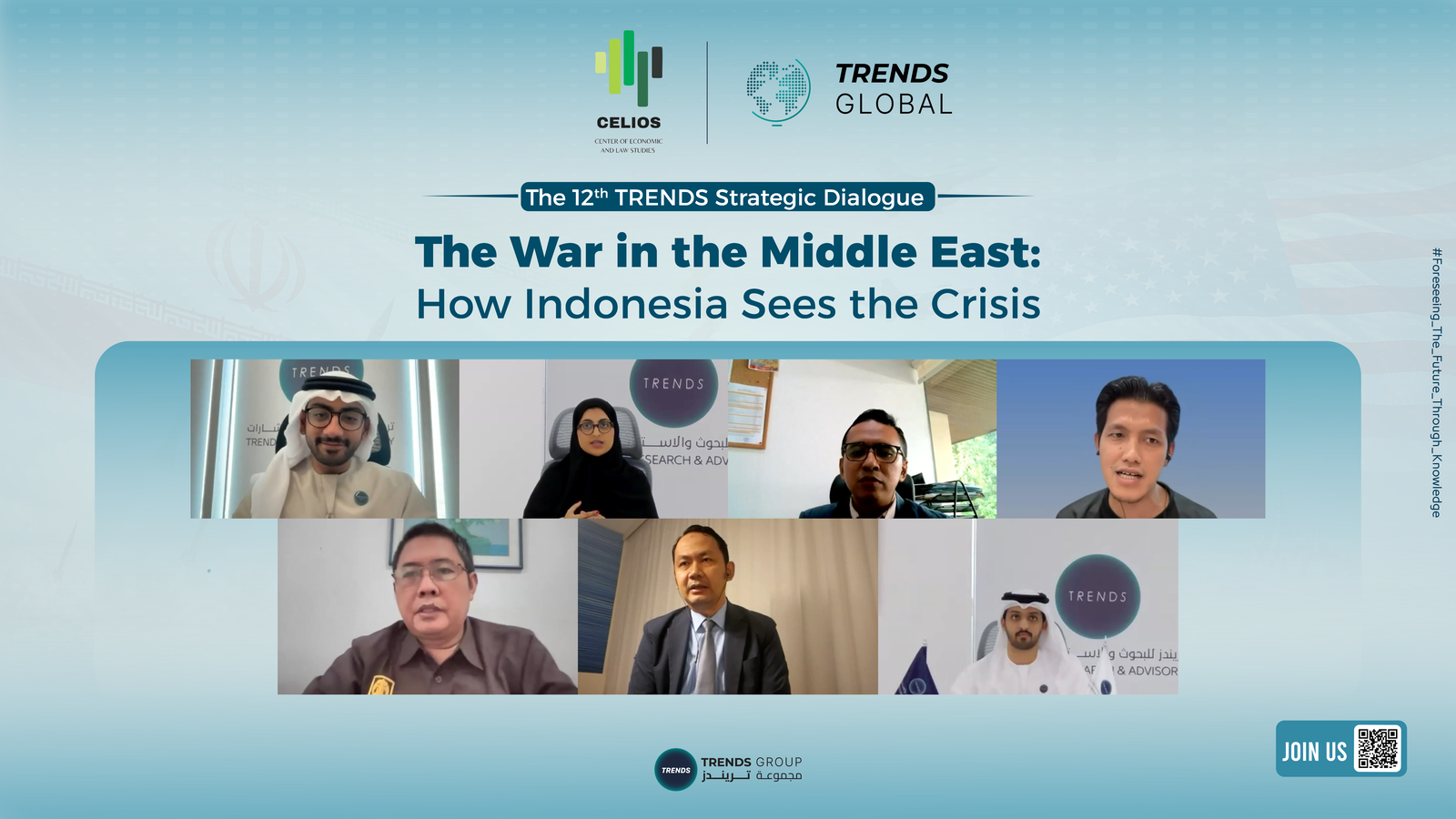
This came during the Twelfth TRENDS Strategic Dialogue, organized by TRENDS Global through the Jakarta Virtual Office, affiliated with TRENDS Group, under the title “The War in the Middle East: How Indonesia Sees the Crisis”, with the participation of a distinguished group of Indonesian academics and experts specializing in political, strategic, and international relations affairs.
The dialogue was opened by TRENDS researcher Issa Al Manaei, who stressed that the current crisis represents a real test of states’ ability to adapt to a turbulent international environment in which the effectiveness of multilateral frameworks is declining, while considerations of national sovereignty and strategic interests are becoming increasingly prominent. He explained that the war is no longer a limited regional matter but has evolved into a crisis with global repercussions affecting energy security, maritime stability, and the balance of the international economy, which explains the growing interest of emerging Asian powers, foremost among them Indonesia.
Al Manaei pointed out that Jakarta, as the world’s largest Muslim-majority country, an active member of the Association of Southeast Asian Nations (ASEAN), and a rising economic power with strong ties to Middle Eastern countries, finds itself directly and indirectly concerned with the repercussions of the war, particularly regarding security of navigation in the Strait of Hormuz, stability of energy markets, and the safety of global supply chains that constitute a vital artery for its national economy.
 Cautious Balancing
In his intervention, Dr. Muhammad Zulfikar Rakhmat, Director of the Indonesia and MENA Desk at the Center of Economic and Law Studies (CELIOS), explained that Indonesia’s policy toward the crisis is based on the concept of “active neutrality,” which has long been a cornerstone of Indonesian foreign policy. He noted that Jakarta seeks to preserve the independence of its political decision-making while avoiding involvement in sharp international and regional polarizations.
He pointed out that Indonesia faces a complex equation: it cannot adopt an openly hostile stance toward Iran due to domestic political pressures and the sympathy of broad segments of Muslim public opinion, while at the same time it cannot fully align itself with Tehran because of its deep economic ties with the Western economy and its strategic relations with the United States and its international partners.
Rakhmat stressed that the Indonesian government realizes that any large-scale military escalation in the Middle East would directly affect oil prices, transportation and shipping costs, and domestic economic stability. Therefore, Jakarta focuses on supporting de-escalation and political and diplomatic solutions, while continuously calling for restraint and respect for state sovereignty.
He added that Indonesia seeks to play a larger diplomatic role on the international stage but still needs to strengthen its tools of influence and regional relations in order to become a more effective mediator in Middle Eastern crises.
The Digital Narrative
Dr. Ridwan Habib, an expert in intelligence, terrorism, and politics, and a lecturer at the University of Indonesia, addressed the nature of popular and media interactions in Indonesia regarding the war. He noted that social media platforms reflect sympathy, but not necessarily direct political support.
He explained that Indonesia’s digital sphere is witnessing significant momentum in circulating narratives critical of Western policies in the Middle East, adding that the Indonesian government is trying to maintain a balanced discourse that aligns with domestic public sentiment without harming its international relations or economic and strategic interests.
‘Bombing Diplomacy’
Meanwhile, Professor Yoon Mahmudhi, Professor of Contemporary Middle Eastern and Southeast Asian History at the University of Indonesia, stressed the importance of prioritizing diplomacy and dialogue over military solutions, affirming that Indonesia believes rivalries and conflicts can be transformed into opportunities for cooperation and partnership.
He explained that Jakarta views the continuation of wars in the Middle East as a direct threat to global stability, particularly to energy security and vital maritime routes, including the Strait of Hormuz, a crucial artery for trade and energy flows to Asia.
He emphasized that Indonesia adopts an approach based on respect for state sovereignty and non-interference in internal affairs, while advocating for conflict resolution through dialogue and negotiation, away from the logic of force and military domination.
He added that Indonesia’s vision of the crisis is also linked to its desire to preserve its strategic independence and avoid being drawn into competing international blocs, within the framework of what he described as a policy of “strategic hedging” that balances relations with major powers without fully aligning with any side.
‘The Transfer of Solidarity’
Professor Agung Nuroyo, lecturer in the Department of International Relations at the University of Indonesia, addressed the popular and cultural dimensions of the crisis, presenting the concept of the “transfer of solidarity.”
He noted that Indonesia today invokes the legacy of the 1955 Bandung Conference and the spirit of non-alignment, considering itself part of the “Global South” that seeks to build a more just and balanced international order, free from the dominance of major powers.
He stressed that Jakarta sees stability in the Middle East not merely as a regional interest, but as a fundamental pillar of Asia’s and the world’s economic and strategic security, especially given Indonesia’s close connection to global trade and energy flows.
A Growing Role
In concluding the dialogue, TRENDS researcher Hessa Al Nuaimi emphasized that the discussions clearly demonstrated that Indonesia is emerging today as a rising balancing power seeking to reconcile the independence of its national decision-making with positive engagement in international affairs amid the rapid transformations taking place in the international system.
She explained that the participants stressed the importance of strengthening energy security through diversifying supply sources, reinforcing multilateral cooperation through ASEAN, and supporting preventive diplomacy to protect international maritime routes and ensure freedom of navigation.
She added that the dialogue concluded that the real challenge facing Indonesia lies in transforming global geopolitical shifts into strategic opportunities that enhance its international standing while preserving its economic stability and national interests.
At the conclusion of the dialogue, the participants affirmed that the “Indonesian message” to the world is clear: stability in the Middle East is no longer merely a regional issue but a strategic necessity for Asian national security and the global economy.
Cautious Balancing
In his intervention, Dr. Muhammad Zulfikar Rakhmat, Director of the Indonesia and MENA Desk at the Center of Economic and Law Studies (CELIOS), explained that Indonesia’s policy toward the crisis is based on the concept of “active neutrality,” which has long been a cornerstone of Indonesian foreign policy. He noted that Jakarta seeks to preserve the independence of its political decision-making while avoiding involvement in sharp international and regional polarizations.
He pointed out that Indonesia faces a complex equation: it cannot adopt an openly hostile stance toward Iran due to domestic political pressures and the sympathy of broad segments of Muslim public opinion, while at the same time it cannot fully align itself with Tehran because of its deep economic ties with the Western economy and its strategic relations with the United States and its international partners.
Rakhmat stressed that the Indonesian government realizes that any large-scale military escalation in the Middle East would directly affect oil prices, transportation and shipping costs, and domestic economic stability. Therefore, Jakarta focuses on supporting de-escalation and political and diplomatic solutions, while continuously calling for restraint and respect for state sovereignty.
He added that Indonesia seeks to play a larger diplomatic role on the international stage but still needs to strengthen its tools of influence and regional relations in order to become a more effective mediator in Middle Eastern crises.
The Digital Narrative
Dr. Ridwan Habib, an expert in intelligence, terrorism, and politics, and a lecturer at the University of Indonesia, addressed the nature of popular and media interactions in Indonesia regarding the war. He noted that social media platforms reflect sympathy, but not necessarily direct political support.
He explained that Indonesia’s digital sphere is witnessing significant momentum in circulating narratives critical of Western policies in the Middle East, adding that the Indonesian government is trying to maintain a balanced discourse that aligns with domestic public sentiment without harming its international relations or economic and strategic interests.
‘Bombing Diplomacy’
Meanwhile, Professor Yoon Mahmudhi, Professor of Contemporary Middle Eastern and Southeast Asian History at the University of Indonesia, stressed the importance of prioritizing diplomacy and dialogue over military solutions, affirming that Indonesia believes rivalries and conflicts can be transformed into opportunities for cooperation and partnership.
He explained that Jakarta views the continuation of wars in the Middle East as a direct threat to global stability, particularly to energy security and vital maritime routes, including the Strait of Hormuz, a crucial artery for trade and energy flows to Asia.
He emphasized that Indonesia adopts an approach based on respect for state sovereignty and non-interference in internal affairs, while advocating for conflict resolution through dialogue and negotiation, away from the logic of force and military domination.
He added that Indonesia’s vision of the crisis is also linked to its desire to preserve its strategic independence and avoid being drawn into competing international blocs, within the framework of what he described as a policy of “strategic hedging” that balances relations with major powers without fully aligning with any side.
‘The Transfer of Solidarity’
Professor Agung Nuroyo, lecturer in the Department of International Relations at the University of Indonesia, addressed the popular and cultural dimensions of the crisis, presenting the concept of the “transfer of solidarity.”
He noted that Indonesia today invokes the legacy of the 1955 Bandung Conference and the spirit of non-alignment, considering itself part of the “Global South” that seeks to build a more just and balanced international order, free from the dominance of major powers.
He stressed that Jakarta sees stability in the Middle East not merely as a regional interest, but as a fundamental pillar of Asia’s and the world’s economic and strategic security, especially given Indonesia’s close connection to global trade and energy flows.
A Growing Role
In concluding the dialogue, TRENDS researcher Hessa Al Nuaimi emphasized that the discussions clearly demonstrated that Indonesia is emerging today as a rising balancing power seeking to reconcile the independence of its national decision-making with positive engagement in international affairs amid the rapid transformations taking place in the international system.
She explained that the participants stressed the importance of strengthening energy security through diversifying supply sources, reinforcing multilateral cooperation through ASEAN, and supporting preventive diplomacy to protect international maritime routes and ensure freedom of navigation.
She added that the dialogue concluded that the real challenge facing Indonesia lies in transforming global geopolitical shifts into strategic opportunities that enhance its international standing while preserving its economic stability and national interests.
At the conclusion of the dialogue, the participants affirmed that the “Indonesian message” to the world is clear: stability in the Middle East is no longer merely a regional issue but a strategic necessity for Asian national security and the global economy.
Cautious Balancing
In his intervention, Dr. Muhammad Zulfikar Rakhmat, Director of the Indonesia and MENA Desk at the Center of Economic and Law Studies (CELIOS), explained that Indonesia’s policy toward the crisis is based on the concept of “active neutrality,” which has long been a cornerstone of Indonesian foreign policy. He noted that Jakarta seeks to preserve the independence of its political decision-making while avoiding involvement in sharp international and regional polarizations.
He pointed out that Indonesia faces a complex equation: it cannot adopt an openly hostile stance toward Iran due to domestic political pressures and the sympathy of broad segments of Muslim public opinion, while at the same time it cannot fully align itself with Tehran because of its deep economic ties with the Western economy and its strategic relations with the United States and its international partners.
Rakhmat stressed that the Indonesian government realizes that any large-scale military escalation in the Middle East would directly affect oil prices, transportation and shipping costs, and domestic economic stability. Therefore, Jakarta focuses on supporting de-escalation and political and diplomatic solutions, while continuously calling for restraint and respect for state sovereignty.
He added that Indonesia seeks to play a larger diplomatic role on the international stage but still needs to strengthen its tools of influence and regional relations in order to become a more effective mediator in Middle Eastern crises.
The Digital Narrative
Dr. Ridwan Habib, an expert in intelligence, terrorism, and politics, and a lecturer at the University of Indonesia, addressed the nature of popular and media interactions in Indonesia regarding the war. He noted that social media platforms reflect sympathy, but not necessarily direct political support.
He explained that Indonesia’s digital sphere is witnessing significant momentum in circulating narratives critical of Western policies in the Middle East, adding that the Indonesian government is trying to maintain a balanced discourse that aligns with domestic public sentiment without harming its international relations or economic and strategic interests.
‘Bombing Diplomacy’
Meanwhile, Professor Yoon Mahmudhi, Professor of Contemporary Middle Eastern and Southeast Asian History at the University of Indonesia, stressed the importance of prioritizing diplomacy and dialogue over military solutions, affirming that Indonesia believes rivalries and conflicts can be transformed into opportunities for cooperation and partnership.
He explained that Jakarta views the continuation of wars in the Middle East as a direct threat to global stability, particularly to energy security and vital maritime routes, including the Strait of Hormuz, a crucial artery for trade and energy flows to Asia.
He emphasized that Indonesia adopts an approach based on respect for state sovereignty and non-interference in internal affairs, while advocating for conflict resolution through dialogue and negotiation, away from the logic of force and military domination.
He added that Indonesia’s vision of the crisis is also linked to its desire to preserve its strategic independence and avoid being drawn into competing international blocs, within the framework of what he described as a policy of “strategic hedging” that balances relations with major powers without fully aligning with any side.
‘The Transfer of Solidarity’
Professor Agung Nuroyo, lecturer in the Department of International Relations at the University of Indonesia, addressed the popular and cultural dimensions of the crisis, presenting the concept of the “transfer of solidarity.”
He noted that Indonesia today invokes the legacy of the 1955 Bandung Conference and the spirit of non-alignment, considering itself part of the “Global South” that seeks to build a more just and balanced international order, free from the dominance of major powers.
He stressed that Jakarta sees stability in the Middle East not merely as a regional interest, but as a fundamental pillar of Asia’s and the world’s economic and strategic security, especially given Indonesia’s close connection to global trade and energy flows.
A Growing Role
In concluding the dialogue, TRENDS researcher Hessa Al Nuaimi emphasized that the discussions clearly demonstrated that Indonesia is emerging today as a rising balancing power seeking to reconcile the independence of its national decision-making with positive engagement in international affairs amid the rapid transformations taking place in the international system.
She explained that the participants stressed the importance of strengthening energy security through diversifying supply sources, reinforcing multilateral cooperation through ASEAN, and supporting preventive diplomacy to protect international maritime routes and ensure freedom of navigation.
She added that the dialogue concluded that the real challenge facing Indonesia lies in transforming global geopolitical shifts into strategic opportunities that enhance its international standing while preserving its economic stability and national interests.
At the conclusion of the dialogue, the participants affirmed that the “Indonesian message” to the world is clear: stability in the Middle East is no longer merely a regional issue but a strategic necessity for Asian national security and the global economy.
