


Indonesia advocates a contradictory stance on the global climate catastrophe. It is one of the nations most susceptible to the effects of climate change, yet it also has some of the most significant and vital natural carbon sinks in the world. This insight contends that Indonesia’s forests, peatlands, mangroves, and marine ecosystems represent global climate infrastructure, the governance of which will profoundly influence the efficacy of international climate mitigation initiatives, especially in relation to UN Sustainable Development Goal 13 (Climate Action). The paper analyzes Indonesia’s climate diplomacy, ecosystem-based mitigation solutions, and governance issues, emphasizing the strategic potential and structural limits confronting the nation. Indonesia’s rise as a global climate leader relies not only on natural wealth but also on coherent governance, inclusive institutions, and the translation of diplomatic aspirations into locally implemented actions.
Introduction: Indonesia’s role in global climate mitigation
Indonesia is a country that vividly illustrates the climate paradox. On the one hand, this tropical archipelago is among the first to feel the impacts of climate change due to rising sea levels, extreme weather, and frequent forest and peatland fires. On the other hand, Indonesia’s abundant natural resources, including rainforests, peatlands, mangroves, and coral reefs, make it one of the world’s natural climate regulators. Its ecosystems act as major global carbon sinks and provide natural refuges that protect local communities from the adverse impacts of climate change. Indonesia’s unique role in combating global warming stems from its status as both vulnerable to climate change and effective in mitigating it. The UN Sustainable Development Goal 13 (Climate Action) identifies climate change as the most significant challenge to sustainable development.
Global concern about Indonesia’s environmental situation is palpable. The health of its forests, the protection of its mangroves, and the health of its marine ecosystems are all important components of the global effort to mitigate climate change. Indonesia has set highly ambitious targets as a manifestation of its commitments under the Paris Agreement, driven by the pressures of global climate change. The Paris Agreement, signed by 196 countries in 2015, set a goal of limiting the increase in global average temperature to well below 2°C, ideally to 1.5°C. Despite consistent pledges by the international community to support it, progress at the global level remains far from satisfactory, with current trends indicating a 2.7°C increase in global temperature by 2100. In the worst-case scenario, where greenhouse gas emissions continue to rise without significant mitigation, temperatures could rise to 4°C, according to the IPCC AR6 report [1]. Indonesia has responded with increased ambition. Through its Nationally Determined Contribution (NDC), the country aims to reduce emissions by 43% by 2030, subject to international support [1], [2], [3]. At the national level, several regulations have been issued to guide carbon capture and storage activities, including Presidential Regulation No. 14 of 2024, which regulates the implementation of carbon capture and storage; Presidential Regulation No. 98 of 2021 concerning carbon pricing mechanisms; and Ministerial Regulation No. 21 of 2022, which outlines the implementation of carbon pricing and detailed procedures for carbon trading [1]. The aforementioned instruments support carbon markets and economic incentives for conservation, restoration, and sustainable land and coastal management. From this perspective, Indonesia is no longer a marginal party in the climate debate; it is a key factor in the global climate equation. Historically, at the national level, land use, land use change, and forestry (LULUCF), along with energy, have been major contributors to greenhouse gas emissions [4]. Currently, Indonesia is strengthening its national policy framework, but implementation at the local level remains uneven: local governments generally lack skills and funding, and economic incentives still favor resource conversion over conservation.
However, a fundamental problem is that national commitments often exceed local implementation capacity. Institutional fragmentation, overlapping mandates, limited technical capacity, and insufficient regional funding are major obstacles to effective implementation. Lack of investment, law enforcement, and effective coordination among all stakeholders (national, provincial, and regional) will hinder the successful transition of policies to practice, resulting in the degradation of natural capital [5]. Forest and land fires are a major contributor to greenhouse gas emissions, which are a major obstacle to achieving Indonesia’s climate goals [6], [7]. Indonesia has the largest remaining tropical rainforests and important peat swamp forests. These natural habitats store large amounts of carbon over long periods and are therefore crucial for the global carbon cycle. Peatlands, in particular, contain large carbon reserves; when drained or converted to agricultural or plantation land, large amounts of CO₂ are released, hampering global mitigation efforts [8]. Therefore, conserving peat swamp forests is not only a means of avoiding the release of large amounts of carbon but also essential for the sustainable provision of ecological services.
Mangrove forests and blue carbon: Indonesia’s secret weapon
Globally, Indonesia is gaining increasing attention as a key player in the blue carbon sector. As the world’s largest mangrove forest, the country occupies a crucial intersection among climate change mitigation, coastal resilience, and sustainable development. Mangroves store carbon very effectively and protect coastal areas from erosion, storm surges, and sea-level rise. This combination of natural services generates additional climate, environmental, and socio-economic benefits. Given their low cost and strong potential to enhance climate resilience, mangrove conservation and rehabilitation are among the most cost-effective nature-based solutions to address the global climate crisis. These three closely interconnected outcomes are the key benefits that countries can achieve through such interventions: significant reductions in GHG emissions, protection of coastal ecosystems, and improved living conditions for coastal populations [9], [10].
Indonesia’s mangrove ecosystems stand out as one of the world’s most visible examples of the climate relevance of coastal wetlands. Field data demonstrate their potential to mitigate climate change. A carbon sequestration assessment in Muara Tuntang, Central Java, estimated total carbon stocks at approximately 0.29 million Mg CO₂eq, with nearly 62 percent of this carbon stored in sediments, underscoring the crucial role of belowground carbon capture in mangrove environments [11]. Furthermore, a study comparing natural and reforested mangroves in Banten Province confirmed that even aggraded mangrove ecosystems retain a very high capacity to store and sequester carbon. These results are even more important given the significant dependence of local coastal communities on mangroves for fisheries, coastal protection, and livelihoods [12]. However, natural mangrove habitats have not been immune to threats and have been under constant pressure for decades, particularly due to land conversion for shrimp farming. It is clear from these examples of restoration activities that the rehabilitation of degraded mangrove forests is a highly promising approach to restoring ecosystem services, with particular emphasis on carbon sequestration, positioning Indonesia as a country with high potential to serve as a global example of large-scale blue carbon initiatives.
The rapid growth of aquaculture, agriculture, and other land uses has led to extensive deforestation of mangrove forests, which, if allowed to continue, could result in the loss of carbon reserves accumulated over many years. This will undermine not only mitigation efforts but also the entire coastal and marine environment. Indonesia’s coral reefs, seagrass meadows, and coastal wetlands are part of a natural system that helps regulate the climate and build resilience within the socio-ecological system. Coral reefs are home to many different kinds of plants and animals. They also protect coastlines from waves and provide food for fish. Seagrass meadows and coastal wetlands, on the other hand, act as blue carbon sinks and help reduce the risk of storms and sea-level rise [13]. However, these ecosystems, such as coral reefs, continue to suffer from overexploitation, pollution, global warming, acidification, and land-use changes, making them highly vulnerable. The governance of the Indonesian archipelago will significantly impact regional climate resilience and the success of biodiversity conservation efforts.
In addition to being a coastal country, Indonesia is home to peat swamp forests, which are globally recognized as among the terrestrial ecosystems with the highest carbon density. Therefore, draining or clearing these ecosystems releases carbon locked within them, posing a major threat—a practice most often carried out for agricultural purposes, such as the planting of oil palm trees. This process results in significant greenhouse gas emissions. To help the country address this challenge, the European Union, through GIZ, has provided technical assistance, among other measures, as part of an international cooperation initiative to strengthen environmental governance in Indonesia. Aerial drone mapping has been instrumental in identifying the most degraded peatland areas, such as in Aceh, Sumatra, enabling the development of low-emission land-use alternatives that are not only environmentally sustainable but also attract investment. What has been achieved so far clearly highlights the importance of peatlands in stabilizing climate change and is a strong demonstration of the integration of environmental conservation and sustainable economic development [14].
How local practices shape global trajectories
Indonesia’s climate strategy is a manifestation of a key paradox in international climate governance: on the one hand, countries develop highly ambitious plans; on the other, implementation at the local level is consistently inadequate. For example, the country has successfully integrated climate action into development plans through instruments such as the National Medium-Term Development Plan (RPJMN) and the Low Carbon Development Initiative (LCDI) [5]. However, the true power of these strategies depends on choices made outside national policy circles, namely at the local level. The overall success of global warming mitigation depends largely on local decisions—whether communities conserve mangrove forests or convert them into fish farming ponds, restore or drain peatlands, and sustainably manage forests or deforest. Local governments, communities, and small-scale economic actors whose livelihoods depend directly on nature largely make these decisions in Indonesia. This situation underscores an important point: climate mitigation is not just a matter of national commitment but also of local political economy.
The concept of climate-compatible development (CCD) reflects this reality by focusing on achieving “triple wins”: simultaneous improvements in mitigation, adaptation, and socio-economic development, as shown in Figure 1 [5]. This idea has been widely accepted among academics and policymakers; however, achieving three wins at once is not automatic. To achieve three objectives simultaneously, we need to implement governance changes in addition to technical improvements. Additionally, different levels of government must work together, and mechanisms must be in place to resolve conflicts of interest, with experts accountable for sharing benefits and responsibilities with less powerful parties. If this does not occur, CCD will be empty talk and have no impact.
Figure 1: Climate-Friendly Development Diagram
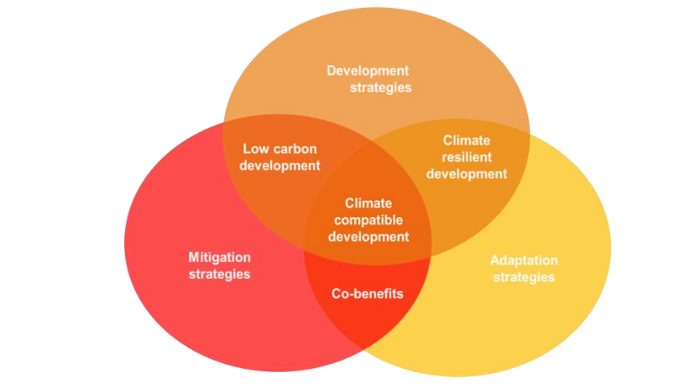
Source: Climate-compatible development diagram (Mitchel and Maxwell, 2010) [5]
Data from conservation and mitigation efforts support this idea. Climate programs, e.g., REDD+ (Reducing Emissions from Deforestation and Forest Degradation) and ecosystem restoration initiatives, have repeatedly shown that climate policies divorced from local circumstances are often ineffective or even disastrous [4]. In contrast, projects that incorporate equitable benefit sharing, recognize land and resource rights, and provide opportunities for genuine participation by indigenous peoples and local communities are more likely to be sustainable and successful. Therefore, rights-based and inclusive governance is more than a moral imperative; it is also a viable climate action solution. Where social legitimacy is lacking, mitigation initiatives tend not only to increase social inequalities but also to fuel opposition and undermine project sustainability. On the other hand, when we view local communities as partners, the outcomes of nature conservation tend to be more equitable and resilient.
Meanwhile, local governance also faces the challenge of increasing environmental degradation, which undermines the effectiveness of nature-based climate solutions. Mangrove forests, widely regarded as the most efficient carbon sinks, are increasingly vulnerable to factors such as sea-level rise, changing sediment patterns, coastal shrinkage, and ongoing conversion for aquaculture and infrastructure [15]. All of these impacts reduce their long-term carbon sequestration potential, turning them into net sources of emissions. The same can be said for peatlands; in fact, peat swamp forests are among the largest sources of carbon emissions. Furthermore, marine habitats, including coral reefs, seagrass beds, and coastal wetlands, are degraded by a combination of factors, including ocean warming, acidification, pollution, and overfishing. As a result, these ecosystems are gradually losing their capacity to control the climate and preserve biodiversity.
Taken together, these developments demonstrate an important policy lesson not only for Indonesia but for the entire world: the fight against climate change must always be linked to local governance, social legitimacy, and ecological integrity [16]. The Indonesian case demonstrates that local actions contribute to and shape the global climate trajectory. In other words, it is not simply a matter of effective governance if national-level ambition is aligned with inclusive and environmentally sound local-level actions; the latter is a crucial factor in the legitimacy and effectiveness of global climate mitigation [17].
SDG 13 and Indonesia’s leadership opportunity
The UN’s Sustainable Development Goal 13 “urges the world to take urgent action to combat climate change” and emphasizes that it requires “strengthened resilience” and sustained international cooperation, which will provide the “foundation” for an effective global response [18]. One country that illustrates the key tensions and the potential for implementing SDG 13 in the Global South is Indonesia. While few countries are hotspots of climate vulnerability, they possess ecosystems of global mitigation value and occupy geopolitical positions that enable meaningful climate diplomacy in regional and international contexts. Indonesia’s vulnerability to sea-level rise, extreme climate events, forest fires, and broader ecological degradation has made adaptation essential. However, the country’s mangroves, peatlands, forests, and marine ecosystems are among the world’s largest natural carbon sinks, making Indonesia a crucial contributor to global mitigation efforts. This situation highlights Indonesia and the carbon dilemma it faces, challenging the established model of climate leadership based on an emissions-only approach that primarily benefits industrialized nations. Indonesia’s climate story demonstrates that leadership can be demonstrated through ecosystem management that carries significant weight on the global stage and through the ability to combine mitigation with development and social justice, not merely through historical responsibility.
Indonesia holds significant potential for climate leadership, not limited to its ecological riches. As a powerful player in the Global South with growing diplomatic clout, the country has the potential to bridge the long-standing gap between climate ambition and development priorities. Indonesia can contribute to a shift in the global climate discourse by positioning nature-based solutions, equitable financing, and inclusive governance at the center of its climate diplomacy. This shift would be from a top-down approach that imposes obligations to one that recognizes different capabilities, responsibilities, and pathways. In this regard, climate leaders are not simply those with the lowest emissions but also those who can successfully integrate mitigation, adaptation, poverty reduction, and institutional legitimacy into a single development strategy [17]. Indonesia has also provided the world with an important lesson on the normative dimension of SDG 13 implementation: the authenticity of climate action is closely linked to the quality of governance and considerations of social justice [3]. The logic behind this theory is as follows: when protecting natural resources, if local communities are not part of the process, or worse, their livelihoods are threatened, such a situation will likely result in a loss of support and, in the long run, reduced effectiveness. On the other hand, inclusively and from a rights perspective, it enhances communities’ capacity to mitigate the impacts of climate change, ensures that policies are designed to be sustainable, and aligns climate change objectives with the broader goals of sustainable development. While not always the case, climate governance in the Global South is a powerful force; Indonesia’s recent achievements are evident in its efforts to address local realities and in its recognition that abstract global targets cannot be met.
When interpreted this way, other countries can also learn from Indonesia’s climate pathway. First, it demonstrates how nature can serve as a crucial source of climate stability, economic prosperity, and social well-being. Second, it affirms a core principle often overlooked in the climate debate: climate justice is essential to climate solutions, not merely an add-on. The point is that these two goals—protecting ecosystems and empowering communities—are not interchangeable; rather, they are mutually exclusive. Both are necessary conditions for credible and sustainable climate action. Consistently, Indonesia’s approach to SDG implementation can serve as the basis for a new definition of climate leadership in the Global South, one that emphasizes responsibility without sacrificing development, ambition without sacrificing equity, and global contributions grounded in local legitimacy. Given that we are witnessing an era marked by steadily increasing climate risks, this model should not be considered merely the most appropriate; rather, it is even more crucial to the credibility and sustainability of global climate governance.
Conclusion: defending nature as a global responsibility
Indonesia stands at a crucial juncture in its history. Its forests, peatlands, mangroves, and oceans are not only national assets but also among the most important climate assets globally. If managed wisely, these natural ecosystems can contribute to global climate stabilization, enhance community resilience, and promote equitable development. On the other hand, the situation will worsen significantly if natural ecosystems are poorly managed, as their degradation will accelerate irreversible climate impacts whose consequences extend far beyond a country’s immediate borders. The stakes are not just domestic but global. Indonesia’s role in mitigating global climate change depends not only on the vastness of its natural resources but also on how well it manages them as a shared global responsibility. This involves more than simply establishing conservation areas or tracking emissions. It requires consistent government policies that integrate national objectives with local implementation, employ a rights-based and inclusive approach, and treat ecosystems as essential climate infrastructure rather than expendable resources. Thus, climate policies that recognize nature’s environmental and social values will achieve sustainable greenhouse gas emission reductions, whereas policies that ignore these values will render even the most ambitious strategies ineffective.
Indonesia’s climate policy decisions significantly influence global climate politics. By leading climate talks based on nature-based solutions and equitable development, Indonesia can reimagine what constitutes competent leadership in addressing the global climate crisis, particularly in the Global South. This will enable the country to elevate its status from being primarily on the climate frontlines to a global climate mitigation force whose actions help shape a shared future. That is why nature conservation here is not a step taken by environmental activists but rather an act of global citizenship. Thus, by preserving its forests and other ecosystems intact, Indonesia secures its future and makes a significant contribution to planetary stability. Indonesia possesses a powerful weapon and a protective shield. How Indonesia uses it will determine not only its fate as a nation but also the future of the entire planet.
Recommendation: Advancing climate change mitigation and nature-based solutions in Indonesia to accelerate SDG 13
As the world approaches a decisive moment in the fight against climate change, our actions—or inaction—will determine the future of both people and the planet [19], [20], [21], [22]. Incremental changes and fragmented funding mechanisms are no longer sufficient. To achieve Sustainable Development Goal 13 (SDG 13)—”Take urgent action to combat climate change and its impacts”—a shift toward transformative, inclusive, and coordinated strategies is urgently needed [3], [18].
Indonesia holds a uniquely strategic position in this global response. Its extensive mangroves, peatlands, and coastal blue carbon ecosystems are among the most powerful carbon sinks on Earth, storing billions of tons of carbon and shielding communities from the worst impacts of climate change. Yet, this potential remains underutilized due to misaligned financing systems, limited global recognition of nature-based solutions, and insufficient integration of community-led governance.
Climate change mitigation—defined as efforts to reduce or prevent the emission of greenhouse gases—is not only urgent but foundational to safeguarding development gains and securing a livable future. According to the UNDP, these efforts must be ambitious, inclusive, and fast-tracked across sectors, including energy, land use, and finance [3], [17]. Indonesia is well-placed to lead by example.
To make meaningful progress, the following three-pronged strategy is recommended:
- Prioritize large-scale, long-term climate finance for ecosystem protection. Despite some increases, concessional finance remains a small share of overall climate funding and is often locked in short-term cycles [23], [24]. Redirecting subsidies away from fossil fuels and toward long-term, blended or results-based finance—especially for blue carbon, peatlands, and forest restoration—can have immediate and lasting mitigation benefits. These ecosystems not only capture carbon but also provide co-benefits such as coastal protection, food security, and biodiversity.
- Support community-led, rights-based approaches. Many local communities in Indonesia have preserved forests and ecosystems for generations through customary laws and self-governance. Scaling such approaches requires policy frameworks that respect land tenure rights, ensure benefit-sharing, and empower local decision-making. Climate mitigation that sidelines communities risks failure and undermines trust [17].
- Elevate Indonesia as a Global Partner. International climate governance must move beyond tokenism. Indonesia’s leadership in ecosystem-based mitigation should be acknowledged and supported through direct representation in global decision-making forums. Elevating the voices of ecosystem custodians in the Global South will ensure that climate action reflects local realities and global responsibilities.
In conclusion, Indonesia’s nature-based pathway offers not only a cost-effective and scalable solution to climate mitigation but also a powerful model of equity, resilience, and international cooperation. Supporting this path is not charity—it is strategic climate leadership and a vital step toward achieving SDG 13 for all.
References
[1] PwC Indonesia, “Indonesia Carbon Market White Paper,” Jakarta, 2024, https://www.pwc.com/id/en/publications/esg/indonesia-carbon-market-white-paper.pdf.
[2] Ministry of Environment and Forestry, Republic of Indonesia, “Folu Net Sink: Indonesia’s Climate Actions Towards 2030,” Jakarta, 2023.
[3] United Nations Development Programme, “Global Climate Promise,” 2025, accessed: December 12, 2025, https://climatepromise.undp.org/what-we-do/where-we-work/indonesia#:~:text=NDC Status,foster a more inclusive society.
[4] A. Gatto and E. R. Sadik-Zada, “REDD+ in Indonesia: An assessment of the international environmental program,” Environment Development and Sustainability 27, no. 10 (2024): pp. 24045–24060, doi: 10.1007/s10668-024-05368-w.
[5] R. R. E. Nainggolan, D. S. A. Suroso, T. A. Argo, and S. A. H. Sagala, “Multilevel Governance for Climate Compatible Development: A Case Study of Mangrove Governance in Indonesia,” Journal of Infrastructure Policy and Development 8, no. 6 (2024): pp. 1–24, doi: 10.24294/jipd.v8i6.3740.
[6] T. M. K. Dewi, H. Herdiansyah, T. E. B. Soesilo, and A. Venus, “Evaluating Fear Appeals in Community-Based Forest Fire Prevention to Support Indonesia’s Climate Goals,” Trees, Forest and People 22 (2025): p. 101062, doi: 10.1016/j.tfp.2025.101062.
[7] T. M. K. Dewi, H. Herdiansyah, T. E. B. Soesilo, and A. Venus, “Identifying and Addressing the Right to Burn for Indigenous-Led Fire Stewardship Practices,” International Journal of Environmental Impacts 7, no. 2 (2024): pp. 159–168, doi: 10.18280/ijei.070201.
[8] K. Hergoualc’h, R. Carmenta, S. Atmadja, C. Martius, D. Murdiyarso, and H. Purnomo, “Managing Peatlands in Indonesia: Challenges and Opportunities for Local and Global Communities,” Bogor, West Java, 2018. doi: 10.17528/cifor/006449.
[9] B. Suprayogi, J. Purbopuspito, M. S. Harefa, G. Y. Panjaitan, and Z. Nasution, “Ecosystem Carbon Stocks of Restored Mangroves and Its Sequestration in Northern Sumatra Coast, Indonesia,” Universal Journal of Agricultural Research 10, no. 1 (2022): pp. 1–19, doi: 10.13189/UJAR.2022.100101.
[10] D. Murdiyarso et al., “The Potential of Indonesian Mangrove Forests for Global Climate Change Mitigation,” Nature Climate Change 5, 2015, doi: 10.1109/iccsp.2017.8286346.
[11] A. Rahim, T. R. Soeprobowati, T. T. Putranto, M. H. Al Falah, and P. Gell, “Contribution of Mangrove Forest Carbon Stocks on Climate Change Mitigation: a Case Study at Tuntang Estuary, Central Java,” Journal of Coastal Conservation 28, no. 4 (2024), https://link.springer.com/article/10.1007/s11852-024-01059-w.
[12] M. A. Kusumaningtyas et al., “Carbon Sequestration Potential in the Rehabilitated Mangroves in Indonesia,” Ecological Research 37, no. 1 (2021): pp. 80–91, https://doi.org/10.1111/1440-1703.12279.
[13] B. Choudhary, V. Dhar, and A. S. Pawase, “Blue Carbon and the Role of Mangroves in Carbon Sequestration: Its Mechanisms, Estimation, Human Impacts and Conservation Strategies for Economic Incentives,” Journal of Sea Research 199 (2024), https://doi.org/10.1016/j.seares.2024.102504.
[14] GIZ, “Indonesia: Protecting Precious Swamps and Forest,” Jakarta, 2018, accessed: December 12, 2025, https://reporting.giz.de/2018/our-work-around-the-world/climate-and-energy/indonesia-protecting-precious-swamps-and-forests/index.html#:~:text=INDONESIA: PROTECTING PRECIOUS SWAMPS AND FORESTS%0A%0AIndonesia has,the stored greenhouse gases at a stroke.
[15] F. Nishma, A. CP, and M. PM, “Mangroves and Climate Change: Carbon Sequestration Implications. A Review,” Journal of Research in Environmental and Earth Sciences 11, no. 3 (2025): pp. 39–44, doi: 10.35629/2532-11033944.
[16] A. Wicaksono, I. Yunita, and G. Ginaya, “Living Side by Side with Nature: Evidence of Self-Governance in Three Local Communities in Indonesia,” Heliyon 8, no. 12 (2022): p. e12248, https://doi.org/10.1016/j.heliyon.2022.e12248.
[17] UNDP, “What is Climate Change Mitigation and Why Is It Urgent?,” Global Climate Promise, accessed: January 2, 2026, https://climatepromise.undp.org/news-and-stories/what-climate-change-mitigation-and-why-it-urgent
[18] UNSD, “The Sustainable Development Goals Report 2025 – UNSD,” New York, USA, 2025, https://unstats.un.org/sdgs/report/2025/The-Sustainable-Development-Goals-Report-2025.pdf.
[19] National Academies, “Recommendations for Meeting the Challenge of Climate Change Research,” in Advancing the Science of Climate Change, Washington DC: The National Academies Press, 2010, ch. Chapter 5, https://www.nationalacademies.org/read/12782/chapter/8
[20] United Nations Department of Global Communications, “Actions for a Healthy Planet,” Act Now, accessed: January 5, 2026, https://www.un.org/en/actnow/ten-actions.
[21] European Environment Agency, “Climate Change Mitigation: Reducing Emissions,” European Union, accessed: January 8, 2026, https://www.eea.europa.eu/en/topics/in-depth/climate-change-mitigation-reducing-emissions.
[22] NWF, “Climate Policy Recommendations,” National Wildlife Federation, accessed: January 8, 2026, https://www.nwf.org/Our-Work/Climate/Climate-Change/Policy.
[23] D. S. A. Suroso, B. Setiawan, P. Pradono, Z. S. Iskandar, and M. A. Hastari, “Revisiting the Role of International Climate Finance (ICF) towards Achieving the Nationally Determined Contribution (NDC) Target: A Case Study of the Indonesian Energy Sector,” Environmental Science & Policy 131 (2022): pp. 188–195, https://doi.org/10.1016/j.envsci.2022.01.022.
[24] CPI, “Understanding Global Concessional Climate Finance,” San Francisco, 2024, https://www.climatepolicyinitiative.org/publication/understanding-global-concessional-climate-finance-2024/.