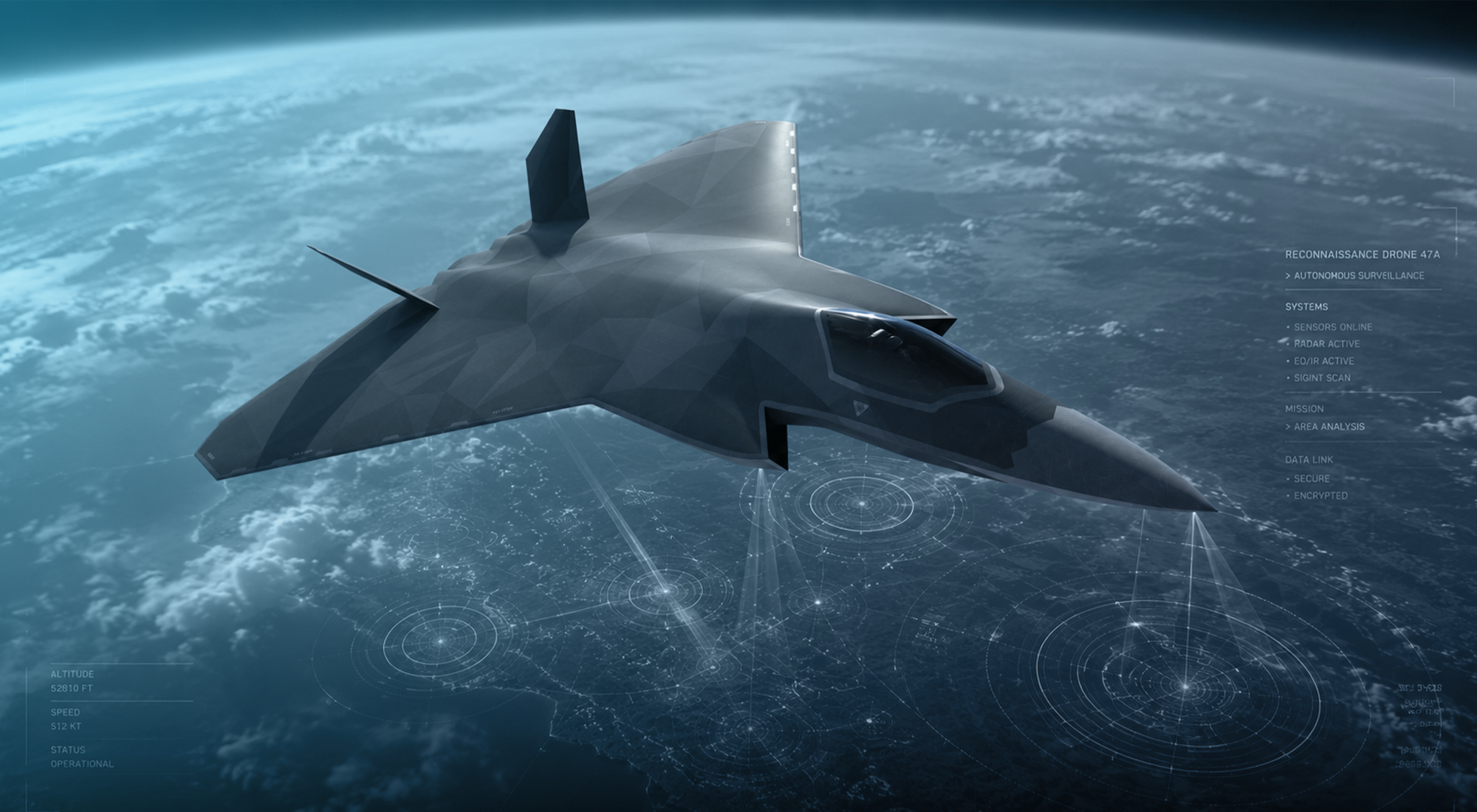




The rapid evolution of unmanned aerial vehicles (UAVs) is fundamentally transforming modern airpower. The way defense planners think about unmanned systems, how they are employed, and ultimately the very nature of the combat system itself, is undergoing significant changes. What was once associated mainly with intelligence, surveillance, and reconnaissance (ISR) missions or limited strike roles is now moving toward collaborative, contested, and increasingly autonomous operations. At the center of this shift are Collaborative Combat Aircraft (CCA), often described as “loyal wingmen”: uncrewed systems designed to operate alongside manned aircraft as part of a broader combat architecture.
This transition reflects a wider doctrinal change. In an environment marked by tight air defenses, electronic warfare, pilot shortages, and the rising cost of high-end fighters, the traditional model of airpower centered on a relatively small number of sophisticated crewed platforms is becoming harder to sustain. CCAs respond with an operational logic based on distributed mass, modularity, and manned-unmanned teaming (MUM-T), expanding the reach, survivability, and lethality of existing fleets while distributing risk across a broader set of systems. The effectiveness of this shift results from integration, data-sharing, and coordinated execution of missions instead of the stand-alone performance of solo aircraft.
CCAs redefine collaborative engagement through advanced artificial intelligence (AI), data-sensor fusion, and combat management systems. Rather than extending the reach of existing air forces, these systems represent a paradigmatic shift in how air warfare is conducted, supporting a wide spectrum of missions in contested environments. CCAs are a critical component of the emerging sixth-generation air warfare that serve as complementary assets rather than replacements for high-end manned fighter platforms.
At the same time, the rise of CCAs is a symptom of underlying structural challenges confronting airpower. Among the most pressing issues are escalating costs associated with fifth- and sixth-generation fighter programs; a shortage of pilots for training; increasing concern regarding survivability of manned platforms in hostile spaces (as evidenced during the Iran War); and the growing need for attrition-tolerant capabilities. Together, these factors have contributed to driving demand for uncrewed alternatives. CCAs are advantageous in terms of development timelines, modular payload capabilities, and a more favorable cost per effect, thereby enabling nations to maintain operational resilience without the financial and political burden associated with traditional investments in airpower.
This transformation is inextricably linked to structural changes in the defense-industrial base and evolving dynamics of the global arms market. As data-sensor fusion and AI assume higher priority over purely kinetic performance, the competitive landscape surrounding the CCAs is expanding beyond the established players in the aerospace industry to include new entrants focused on autonomous capabilities. CCAs do not merely act as force multipliers but also disruptors in the global defense market, influencing procurement strategies, industrial relationships, and export competitiveness.
Recent developments around the globe confirm that this is no longer a conceptual debate. CCA-related programs are moving from experimentation to procurement, force design, and export positioning, with implications that extend beyond platform innovation to procurement choices, industrial partnerships, and global defense competition. For major military powers, they offer a way to restore combat mass in high-intensity conflict; for middle powers, they provide a pathway to enhanced airpower at lower financial and political cost.
This insight examines how CCAs are redefining airpower through technological change, evolving operational concepts, and shifting industrial logics in the United States, Australia, and Türkiye. Each case demonstrates unique aspects, yet converging development pathways related to collaborative airpower. The U.S. efforts emphasize scalable, modular platforms such as General Atomics’ Gambit,[1] which support large force structures and future naval aviation concepts. Conversely, Australia’s MQ-28 Ghost Bat reflects a loyal wingman approach based upon alliance-oriented missions and high-end interoperability.[2] Lastly, Turkish Baykar Kızılelma focuses on rapid iteration, combat credibility, and exportability, reflecting an overarching doctrine to integrate unmanned systems into multiple domains.[3]
By analyzing these developments within broader technological, operational, and industrial trends, the insight illustrates how CCAs are revolutionizing air warfare and transforming the structure of global defense markets. In volatile, tumultuous theaters such as the Middle East and the Western Pacific, where nations seek affordable yet effective airpower solutions, CCAs are rapidly becoming a central focus of global airpower transformation, further reinforcing their potential role as instruments of both military capability and strategic influence.
Conceptual and technological foundations of CCAs
CCAs are best understood not simply as another category of drones, but as a distinct stage in the evolution of combat aviation. Earlier unmanned aerial systems were generally conceived either as remotely piloted ISR assets or as strike platforms operating in relatively permissive environments. CCAs, by contrast, are designed for integration into highly contested operational settings and for cooperation with crewed aircraft within a broader system-of-systems architecture.[4] Their value lies less in isolated platform performance than in their ability to function as force multipliers within a networked air combat ecosystem. While the concept is widely referred to as “loyal wingman” systems in several national contexts, the term “Collaborative Combat Aircraft” (CCA) is primarily used by the United States Air Force (USAF) to denote this emerging class of platforms.
The core concept underpinning CCA development is manned-unmanned teaming (MUM-T).[5] In practice, this implies a shift in the role of human pilots—from platform operators to mission commanders coordinating formations that include semi-autonomous uncrewed aircraft. Within such a framework, CCAs can perform a wide range of tasks that would otherwise absorb scarce and costly manned assets, including extending sensor coverage, carrying additional weapons, conducting electronic warfare, acting as decoys, supporting suppression of enemy air defenses (SEAD), and, in some cases, contributing to air-to-air engagements. This model does not remove the human from the battlespace; rather, it elevates human decision-making while delegating selected tactical functions to machines operating at greater scale and speed.[6] This evolution builds on earlier interoperability frameworks, such as NATO’s STANAG 4586, which defined in 2002 graduated Levels of Interoperability (LOI) for MUM-T—from basic remote control to increasing levels of autonomy, including coordinated and network-enabled operations.[7]
CCAs should also be situated within a broader and increasingly diversified unmanned ecosystem. At one end of this spectrum are low-cost, attritable systems—such as First-Person View (FPV) drones and interceptors—optimized for mass, rapid deployment, and tactical expendability.[8] At the other end are CCAs: more advanced, AI-enabled platforms designed for integration into networked airpower architectures and MUM-T frameworks. The contrast is instructive. While lower-end systems have demonstrated the operational value of scale and cost-efficiency in recent conflicts,[9] CCAs reflect a different logic—one centered on survivability, mission flexibility, sensor fusion, and coordination with high-end crewed platforms in contested environments. More broadly, this spectrum highlights a central challenge for future airpower: how to balance scalable mass with high-end capability in ways that remain operationally and economically sustainable.[10]
What differentiates CCAs from more traditional UAVs is therefore not autonomy in the abstract, but the combination of autonomy, adaptability, and affordability. Most current concepts emphasize semi-autonomous operation rather than full independence. Human oversight remains essential, particularly in relation to the use of force, escalation management, and dynamic mission adaptation.[11] At the same time, the level of onboard decision-support envisioned for CCAs is significantly more advanced than that of legacy remotely piloted systems. Advances in AI and machine learning increasingly enable these platforms to process sensor inputs, adapt to evolving mission conditions, and maintain continuity even in degraded communications environments—conditions that are likely to characterize high-end warfare.[12]
A second defining feature of CCAs is their integration into resilient datalink and combat-cloud architectures. Future air combat will depend not only on stealth or kinematic performance, but also on the ability to generate, share, and exploit data across dispersed formations. In this context, CCAs function as nodes within distributed networks. Their effectiveness depends on secure communications, sensor fusion, and interoperability with both legacy and next-generation platforms.[13] The objective is not simply to attach uncrewed aircraft to manned ones, but to enable a more flexible and survivable force structure in which sensing, targeting, and command functions are distributed across multiple systems.
A third key element is modularity. Many CCA concepts are built around open architectures and reconfigurable payloads, allowing a single airframe to perform different tasks depending on mission requirements. This approach reduces development timelines, facilitates software upgrades, and enables more flexible adaptation to evolving operational needs. In policy terms, modularity links technological flexibility to industrial scalability, making these systems particularly attractive for air forces seeking to generate mass without committing to rigid and lengthy procurement cycles.[14]
These characteristics help explain why CCAs are becoming central not only to operational planning but also to procurement strategy. Compared to fifth- and especially sixth-generation crewed fighters, CCAs promise a more favorable cost-per-effect ratio. They are often framed in terms of “affordable mass”: not expendable in a simplistic sense, but sufficiently affordable to be deployed in high-risk missions where the loss of a crewed platform would carry far greater strategic, political, and financial costs.[15] In this context, the growing interest in CCAs reflects more than budgetary pressure. It signals a broader recognition that future air superiority may depend less on preserving individual platforms than on sustaining operational tempo, complicating adversary targeting, and generating sufficient combat mass to absorb attrition.
However, the economic logic underpinning CCAs is not without tensions. While frequently presented as a cost-effective complement to high-end crewed platforms, CCAs must still balance performance requirements such as range, payload, and survivability—factors that inevitably drive costs upward. In certain mission profiles, particularly long-range strike, they may compete with advanced precision munitions capable of delivering comparable effects at lower unit cost. Conversely, if designed for higher survivability in contested environments, their cost may begin to approach that of traditional combat aircraft.[16] The trade-off between affordability and capability, therefore, remains central to ongoing force design debates.
These tensions reinforce a critical point: CCAs are unlikely to replace crewed combat aircraft in the foreseeable future. Rather, their primary value lies in their role as enablers—platforms that enhance the effectiveness of existing systems by extending sensor coverage, increasing weapons capacity, and supporting specialized missions such as electronic warfare or SEAD. Their contribution is best understood not in isolation, but in terms of how they expand the operational envelope of manned airpower.
At the same time, several key aspects of CCA employment remain unresolved. Questions persist regarding optimal force composition, including the ratio between crewed and uncrewed systems, the appropriate degree of autonomy, and the tactics and procedures required for effective integration. Sustainment, maintenance, and training architectures for mixed fleets are also still evolving. As a result, while the technological trajectory is increasingly clear, the operational concepts underpinning large-scale deployment remain under development.
The industrial implications are equally significant. CCA development’s premium on software, autonomy, data integration, and mission systems is shifting part of the center of gravity in airpower innovation away from traditional airframe-centric competition toward digitization. Firms and states capable of combining aerospace manufacturing with advanced software integration are likely to gain a comparative advantage. In this sense, the CCA field is emerging not only as a military race but also as a competition over industrial ecosystems, exportability, and standards-setting.[17]
For many states, this creates an attractive strategic proposition. CCAs can strengthen existing fleets without requiring large-scale acquisition of additional crewed fighters, while also mitigating constraints related to cost, delivery timelines, and export restrictions. In this sense, they occupy an increasingly important space between technological ambition and strategic practicality, which explains why they are no longer viewed as a niche adjunct to airpower, but as one of its emerging organizing principles.
First case: The United States – scale, modularity, and service-level diffusion
The United States is currently setting the pace in the development of CCA, not only in technological terms but also at the doctrinal and institutional levels. More than any other actor, Washington has moved the CCA concept beyond experimentation into force design, procurement planning, and inter-service integration. In the U.S. context, CCAs are not treated as marginal adjuncts to existing combat aviation but as a central pillar of future air superiority. This is most evident in the U.S. Air Force’s effort to embed CCAs within its broader Next Generation Air Dominance (NGAD) family of systems,[18] as well as in the U.S. Marine Corps’ parallel efforts—known as Uncrewed Expeditionary Tactical Aircraft (MUX TACAIR)—to adapt similar concepts for expeditionary operations.[19]
For the U.S. Air Force, the CCA program is fundamentally tied to the challenge of restoring combat mass in a high-end operational environment. Over time, the service’s fighter fleet has contracted as aircraft have become more capable but significantly more expensive to procure and sustain. In a potential conflict with a peer competitor such as China, this trend presents acute operational risks. Range limitations in the Indo-Pacific, advanced integrated air defense systems, electronic warfare threats, and the vulnerability of enabling assets all constrain the employment of a relatively limited fleet of high-end crewed platforms. Against this backdrop, the Air Force’s response has been to pair advanced manned aircraft with larger numbers of lower-cost, semi-autonomous systems capable of extending sensing, carrying additional payloads, and absorbing operational risk.
This logic lies at the core of the NGAD family-of-systems approach. Rather than centering air superiority on a single next-generation fighter, the U.S. model increasingly emphasizes a networked architecture integrating crewed platforms, sensors, weapons, autonomy packages, and battle management systems. Within this framework, CCAs are expected to operate alongside both fifth-generation aircraft, such as the Lockheed Martin F-35 Lightning II and future sixth-generation platforms, such as the Boeing F-47.[20] Early planning envisaged a fleet of at least 1,000 CCAs, often framed around a notional ratio of two uncrewed systems per crewed fighter. Whether or not this ratio endures, the underlying signal is clear: CCAs are central to scaling force structure at a cost point below that of additional manned platforms.[21]
The U.S. approach is also characterized by the relative maturity of its acquisition pipeline. Following initial contract awards in 2024 to multiple industry players, the Air Force down-selected Increment 1 to two finalists: General Atomics and Anduril.[22] Their respective platforms—designated YFQ-42A Dark Merlin and YFQ-44A Fury in 2025—mark a significant institutional milestone as the first uncrewed aircraft to receive a formal fighter designation. Beyond symbolism, the two designs reflect a deliberate effort to pursue multiple variants of the CCA concept within a common strategic framework.
General Atomics’ YFQ-42A,[23] derived from the XQ-67A and linked to the broader Gambit family, prioritizes endurance, modularity, and mission adaptability. Its “common chassis” approach is particularly noteworthy, as it points toward a scalable production model in which multiple mission configurations can be derived from a shared architecture. This aligns with a broader U.S. preference for open systems, iterative upgrades, and flexible procurement pathways. By contrast, Anduril’s YFQ-44A Fury[24] reflects the increasing prominence of software-centric defense firms within the airpower domain. Integrated with Anduril’s Lattice ecosystem, the platform underscores the growing centrality of autonomy, human-machine teaming, and rapid software iteration in shaping next-generation combat aviation.
In this sense, the U.S. model is not simply about fielding additional platforms, but about integrating airframe development, autonomy, operational experimentation, and procurement into a continuous adaptation cycle. Earlier initiatives—such as Skyborg, DARPA’s Air Combat Evolution program, and autonomy testing on platforms like the X-62A VISTA—have laid much of the conceptual and technical groundwork.[25]
More recent developments, including flight testing of the YFQ-42A and YFQ-44A, operational assessments at Nellis Air Force Base, and the designation of Beale Air Force Base as a readiness hub, indicate a transition from experimentation to operationalization. This shift has been marked by key flight milestones within the Increment 1 framework. General Atomics’ YFQ-42A conducted its first flight in August 2025, representing the initial airborne validation of the Air Force’s next-generation CCA architecture and of the scalable “common chassis” approach underpinning the Gambit family.[26] This was followed in late October 2025 by the maiden flight of Anduril’s Fury, which further demonstrated the maturation of a production-oriented, software-centric CCA design.[27] Together, these milestones signal a transition from experimental demonstrators to operationally relevant platforms within the NGAD ecosystem. Budget trends reinforce this trajectory, with procurement funding now requested for the first production lot and follow-on work underway for subsequent increments.
This transition has been further reinforced by recent operational experimentation. In mid-April 2026, the U.S. Air Force deployed the YFQ-44A Fury with an Experimental Operations Unit at Edwards Air Force Base, integrating operators directly into testing cycles. This marks a departure from traditional acquisition sequences, introducing operational personnel at an earlier stage to accelerate feedback loops between design, testing, and employment.[28] In doing so, it reflects a broader shift toward adaptive, networked airpower tailored to contested environments.
At the operational level, CCA development is closely linked to evolving concepts such as dispersed basing and Agile Combat Employment (ACE).[29] In this context, CCAs are intended not only to increase combat mass but also to enable more distributed and resilient force postures. Their modularity, autonomy-enabled mission execution, and potential to operate from austere or less-developed locations align with broader efforts to complicate adversary targeting, particularly in the Indo-Pacific theater.
Manned-unmanned teaming trials further illustrate this doctrinal evolution. Recent experiments involving a Lockheed Martin/Boeing F-22 Raptor and General Atomics’ MQ-20 Avenger have begun to translate abstract concepts into operational practice.[30] While still developmental, such activities are critical in defining how pilots, autonomous systems, and uncrewed platforms interact under realistic conditions. They highlight that the U.S. approach to CCAs is not limited to procurement planning, but extends to the development of tactics, techniques, and procedures for their effective employment.
At the same time, the diffusion of CCA-related efforts beyond the Air Force underscores their growing relevance across the wider U.S. military. The U.S. Marine Corps is pursuing its own approach, the MUX TACAIR program, closely tied to expeditionary operations and the Marine Air-Ground Task Force.[31] Here, the emphasis shifts from the NGAD model to the use of relatively low-cost autonomous platforms capable of supporting Expeditionary Advanced Base Operations in contested environments. Programs involving Northrop Grumman and Kratos—particularly around the XQ-58A Valkyrie[32]—as well as General Atomics’ contributions to AI-enabled flight architectures, reflect this parallel track.
This Marine Corps approach highlights a distinct but complementary operational logic. Whereas the Air Force prioritizes air superiority, force mass, and integration with next-generation fighters, the Marines focus on modular systems that support sensing, electronic warfare, and strike functions in distributed expeditionary settings. The underlying strategic rationale remains consistent—distributed operations, reduced risk to personnel, and enhanced mission flexibility—but the operational application differs. As such, the U.S. experience suggests that CCAs are not converging toward a single standardized solution but rather evolving into a family of mission-specific concepts shaped by service-level requirements.
Taken together, these developments explain why the United States currently represents the most advanced and consequential model of CCA development. Its significance lies not only in the number of platforms under development, but in the broader ecosystem that underpins them: a coherent doctrinal framework, sustained public investment, a competitive industrial base, and increasing diffusion across services. In this respect, the U.S. model offers the clearest illustration of how CCAs are evolving from a technological innovation into a structural component of future airpower.
This model is also beginning to extend beyond the U.S. domestic market. In June 2025, Anduril and Rheinmetall announced a strategic partnership to co-develop and manufacture European variants of systems, including the Fury, integrating them into Rheinmetall’s “Battlesuite” digital sovereignty framework.[33]
A similar dynamic is emerging in the Gulf, albeit with a stronger emphasis on scale and industrial integration. Recent negotiations between U.S. defense firms and Saudi Arabia highlight the ambition of this shift. During Crown Prince Mohammed bin Salman’s visit to the United States in November 2025, discussions included a package reportedly including up to 200 Gambits. While still under negotiation, these agreements are likely to include provisions for local assembly, maintenance, and technology transfer, reflecting a broader transition from procurement to co-production.[34]
A similar trajectory is visible in the United Arab Emirates (UAE), albeit framed through earlier-stage industrial agreements. The January 2026 memorandum of understanding (MoU) between General Atomics and the UAE-based Calidus Aerospace reflects a comparable ambition to integrate advanced uncrewed systems into a broader defense-industrial strategy. The agreement envisages the potential co-production of MQ-9B drones and Gambit Collaborative Combat Aircraft within the UAE, covering manufacturing, assembly, testing, and operational integration.[35]
Second Case: Australia – from experimental concept to operational prototype
While the United States has prioritized the development of a broad CCA ecosystem, Australia offers a more focused yet equally instructive case: the rapid maturation of a single platform from concept to advanced operational testing. The Boeing MQ-28 Ghost Bat, developed in partnership with the Royal Australian Air Force (RAAF), stands among the most advanced loyal wingman systems currently in development and provides an early indication of how such concepts may translate into deployable capabilities.
Originally launched as the Airpower Teaming System (ATS), the MQ-28 is significant not only for its technical characteristics but also for its strategic and industrial implications. It represents the first combat aircraft designed and developed in Australia in over half a century, reflecting a deliberate effort to cultivate sovereign capabilities in advanced aerospace systems.[36] At the same time, it has been conceived from the outset as a collaborative platform, designed for integration within allied architectures and coalition operations, particularly alongside the United States.
From a technical standpoint, the MQ-28 incorporates many of the defining features associated with CCA concepts. It is a jet-powered, stealth-configured uncrewed aircraft with a range exceeding 2,000 nautical miles, designed to operate in close coordination with crewed platforms. Its most distinctive characteristic is its modular architecture, notably the swappable nose section, which enables rapid reconfiguration across mission profiles, including ISR, electronic warfare, and potential strike roles. This reflects a broader shift toward flexible, mission-adaptable systems rather than platform-specific designs.[37]
Equally central is its autonomy model. Unlike traditional remotely piloted systems, the MQ-28 is designed to execute complex tasks with a high degree of onboard autonomy while remaining under human supervision. A typical mission profile involves ground-based oversight during launch and recovery, followed by tasking from a crewed aircraft or airborne command platform. This approach aligns closely with evolving MUM-T concepts, in which human operators retain command authority while delegating tactical execution to autonomous systems.
What distinguishes the Australian case is the program’s level of maturity. Since its first flight in 2021,[38] the MQ-28 has progressed through sustained testing cycles, including multiple Block 1 prototypes and the development of Block 2 and future Block 3 variants.[39] Testing has encompassed increasingly complex scenarios, including dispersed operations, integration with airborne command-and-control platforms, and multi-platform coordination, demonstrating both technical viability and an expanding operational framework.
A key milestone was achieved in December 2025, when the MQ-28 conducted a live air-to-air engagement using an AIM-120 AMRAAM missile. Operating within a networked formation alongside an E-7 Wedgetail and an F/A-18F Super Hornet, the platform received shared targeting data and executed the engagement with limited human input. The test demonstrated a distributed operational model in which sensing, targeting, and weapons employment are decoupled and shared across multiple platforms, rather than concentrated within a single aircraft.[40] Such testing places the MQ-28 at the forefront of current CCA developments. Unlike many programs that remain at the conceptual or early prototype stage, the Australian effort has already demonstrated key elements of future air combat, including autonomous coordination and distributed lethality. In this sense, it provides a tangible bridge between conceptual frameworks and operational implementation.
At the same time, the program underscores the growing importance of industrial strategy in shaping CCA development. The MQ-28 has been designed and manufactured domestically, supported by sustained government investment and dedicated production infrastructure. This emphasis on sovereign capability is increasingly complemented by external engagement. The platform has attracted interest from multiple international partners, suggesting its potential as a basis for adapted, export-oriented variants.
On the industrial side, construction of a dedicated production facility in Toowoomba, Queensland, is expected to be completed in 2026, with operations starting in 2027. Australia has also set an ambitious cost target, aiming for the MQ-28 to reach roughly 10% of the cost of a crewed combat aircraft—an objective that, if achieved, would significantly strengthen its export competitiveness.[41]
This trajectory was further reinforced in March 2026, when Boeing Australia and Rheinmetall signed an MoU to position the MQ-28 as a candidate for Germany’s future CCA requirements. Under the agreement, Rheinmetall would act as system integrator, adapting the platform to national specifications while embedding it within local industrial and digital ecosystems. Beyond its commercial dimension, the partnership reflects a broader trend toward the internationalization of CCA development.[42] Recent developments reinforce this trajectory. Canberra is exploring the integration of European weapon systems into the MQ-28, a move aimed at facilitating access to European export markets and enhancing interoperability beyond the U.S.-led ecosystem. In parallel, in April 2026, Australia and Japan signed an implementation arrangement enabling Japan Air Self-Defense Force participation in MQ-28 testing and observation, signaling a growing role for the platform within allied experimentation frameworks.[43]
This dual logic—combining sovereign capability with interoperability and exportability—positions Australia as a key node within the emerging global CCA landscape. Rather than competing with the scale of the U.S. program, the Australian approach prioritizes the delivery of a mature, adaptable platform capable of integration within allied force structures. In this respect, the MQ-28 functions both as a national capability and as a building block for coalition-based airpower architectures.
Third Case: Türkiye – rapid iteration, combat readiness, and export potential
Türkiye’s CCA trajectory has emerged less from a formally defined “loyal wingman” program than from a broader national effort to turn unmanned systems into a central pillar of airpower. The Turkish UAV ecosystem has evolved into a near-self-sufficient model that now commands 65% of the global drone market. Baykar’s Bayraktar Kızılelma sits at the heart of this approach. It is not simply another addition to Türkiye’s already crowded UAV ecosystem, which includes the TB-2, TB-3, Akıncı, Aksungur, and Anka, but rather it represents the apex of a more demanding upper category of uncrewed airpower: jet-powered, stealth, networked, and increasingly oriented toward missions that were once considered the preserve of manned fighter jets.
The strategic logic behind Kızılelma is rooted in Türkiye’s airpower dilemma. The Turkish Air Force remains heavily dependent on F-16s, with more than 230 aircraft in service, making it one of NATO’s largest F-16 operators.[44] Yet the fleet is ageing, and Ankara’s access to high-end Western aircraft has become politically constrained. Its removal from the F-35 program after the S-400 dispute in 2019 created a serious capability gap, while negotiations over new F-16 Block-70 Vipers, modernization kits, and Eurofighter Typhoons have shown how vulnerable Türkiye’s procurement choices remain to external political bargaining.[45] In this context, Kızılelma is not a vanity project or a precursor for Türkiye’s indigenous fifth-gen fighter aircraft KAAN, but should be understood as a bridging platform and a force multiplier: a decisive leap into a modern CCA that is designed to extend the reach, survivability, and operational density of Türkiye’s manned aircraft fleet while reducing dependence on foreign suppliers.
This strategic proposition does not mean that Türkiye is abandoning the logic of air superiority in favor of a purely defensive “air denial” posture. On the contrary, the Turkish case shows why the distinction matters. The tactical success of drones may create a misleading impression that airpower can be secured through unmanned systems alone.[46] These are nonetheless insufficient for high-intensity conflict, prompting calls for an integrated strategy with fifth-generation fighters, air-defense systems, early-warning networks, and allied deterrence architectures rather than treating UAVs as substitutes for them.
For a middle power like Türkiye operating in dense regional air-defense environments from the Aegean Sea and the Eastern Mediterranean to Syria and the Black Sea, the realistic goal is not permanent, theater-wide air supremacy. It is the ability to generate local and temporary air superiority at decisive moments, enabling joint effects while limiting the exposure of scarce manned assets. Recent debates in U.S. airpower circles have made a similar point: air denial with a large number of drones can frustrate an adversary, but it does not automatically produce the freedom of action needed for maneuver, strike, and decisive outcome.[47] Kızılelma, therefore, fits into a more calibrated Turkish approach of not replacing manned fighters but helping them operate more effectively in contested and politically sensitive environments.
The platform’s development pace has been central to its significance. Kızılelma first flew in December 2022 and has since moved through flight-envelope validation, payload integration, sensor testing, formation operations, and air-to-air trials with unusual speed in just under four years. Its public test campaign has also been structured around visible milestones, reinforcing both domestic confidence and export credibility. In November 2025, Kızılelma electronically “shot down” an F-16 in a simulated beyond-visual-range (BVR) engagement, using defense-electronics giant Aselsan’s Murad AESA radar to detect, track, and guide the indigenous Gökdoğan missile,[48] developed by Tübitak Sage.[49] Shortly afterward, Baykar announced that Kızılelma had fired a Gökdoğan missile against a jet-powered target aircraft off the Black Sea coast, marking the first successful air-to-air missile BVR, radar-guided engagement by an uncrewed aircraft against such a target.[50] These tests should not be overstated, however, as proof of combat performance against a peer air force. They were controlled trials, not wartime engagements. Still, they matter for having validated an indigenous radar-missile-datalink kill chain on an unmanned jet, which is precisely the kind of integration required for MUM-T concepts. Baykar announced that Kızılelma entered the serial production phase with the objective to deliver 10 aircraft in 2026.[51]
Kızılelma’s technical profile also reflects Türkiye’s preference for an integrated combat ecosystem rather than isolated platforms. The aircraft is designed as a stealth, turbofan-powered CCA capable of carrier operations, with reportedly an 8.5-ton maximum takeoff weight, 1.5-ton payload, roughly 500 nautical miles of combat radius, and a top speed approaching Mach 0.9.[52] The main limitation is its propulsion: the Ukrainian Ivchenko-Progress AI-322F engine that gives the aircraft useful performance but not the thrust-to-weight ratio of a full-sized fighter. Turkish efforts to develop domestic turbofan engines, including the TEI-TF6000 family, are therefore important not only for sovereignty but also for the platform’s future air-combat envelope. Nonetheless, Kızılelma’s value and relevance lie less in speed and range but more in the combination of sensors, datalinks, munitions, autonomy, and operational concepts that can allow it to act as a forward sensor, weapons carrier, decoy, stand-in strike asset, or air-defense node.
Its autonomous formation tests point in the same direction. In December 2025, Kızılelma’s PT-3 and PT-5 prototypes conducted a close formation flight using smart fleet autonomy algorithms and the Azra national datalink. The two aircraft flew at a proximity of 15–20 meters, while Turkish officials described the test as simulating an air patrol mission.[53] This is particularly relevant for CCA development because teaming is not just a question of whether a drone can fly near a fighter. It equally requires reliable coordination among AI-assisted uncrewed aircraft themselves, resilient communications, predictable behavior under mission constraints, and the ability to distribute sensing and weapons employment across a formation. In this sense, Kızılelma’s development path is moving from platform demonstration toward tactical experimentation.
The maritime dimension further distinguishes Türkiye from the U.S. and Australian cases. Kızılelma has been designed with carrier-capable operations in mind, complementing Baykar’s foldable wing TB-3 and Türkiye’s wider attempt to reshape sea-based airpower around unmanned systems. The TCG Anadolu LHD was originally expected to operate F-35B STOVL fighter jets (the carrier variant of F-35A), but Türkiye’s expulsion from the F-35 program in 2021 turned it into a testbed for a different model: a drone-centric amphibious assault ship. The next step is more ambitious. The MUGEM national aircraft carrier, which is planned to weigh 60,000 tons at roughly three times the size of TCG Anadolu, has entered the production phase to become the future sea-based hub for an integrated air wing of Kızılelma, TB-3, Turkish Aerospace Hürjet and Anka-3.[54] Expected to enter service in 2030,[55] MUGEM would give Türkiye a naval-air architecture, a formidable blue-water capability, and global power projection that does not replicate the American supercarrier model, but offers a more affordable and politically viable form of distributed maritime airpower.
Export potential is the final and perhaps most disruptive element of the Turkish case. Baykar’s success with TB-2 and Akıncı models has already demonstrated that Türkiye can sell not only drones but also training, doctrine, and political access. Kızılelma raises that proposition to a higher level. For countries that cannot afford or access fifth-generation fighters, a jet-powered CCA with credible strike and emerging air-to-air functions offers an attractive cost-per-effect proposition. For NATO countries such as Italy and Spain, and even perhaps the UK, which operate short-deck carriers or amphibious landing/helicopter dock ships (LHDs), Kızılelma could provide a way to expand naval aviation without relying exclusively on expensive manned aircraft.
The Leonardo-Baykar joint venture as well as Baykar’s acquisition of Piaggio Aerospace are therefore significant in this perspective. These are not simple foreign purchases or partnerships but steps into industrial integration: Leonardo brings certification pathways, mission-system integration, radar expertise, and access to European markets, while Baykar brings rapidly developed, combat-tested platforms.[56] Similarly, Piaggio Aerospace brings deep expertise in aircraft design, propulsion systems, and aviation technologies, by which Baykar is positioning itself to broaden its technological base.[57] Planned M-346–Kızılelma teaming demonstrations also suggest that Italy’s CCA experimentation and entry into MUM-T may begin with existing aircraft rather than waiting for sixth-generation platforms.[58]
This export logic extends into Middle Eastern air forces, Central Asian countries, and East Asian littorals such as Malaysia, Indonesia, and Japan, which are natural markets for Turkish UAVs. Many of these countries face contested maritime spaces, budget pressures, and political hesitation about dependence on a single Western or Chinese supplier. Türkiye’s offer is appealing because it combines affordability, operational experience, fewer political strings, and an increasingly complete national package of airframes, sensors, munitions, datalinks, and training.
Kızılelma is still an unproven CCA in real combat, and its future will depend on propulsion, production scale, maturity of autonomous operation, and further integration with manned aircraft, naval platforms, and air-defense networks. Yet its significance is already clear. It shows how a middle power in a tightly contested geography can use rapid iteration and defense-industrial integration to enter a field once dominated by major aerospace manufacturers. In doing so, Türkiye is not merely adding another drone to the global market; it is helping redefine what affordable, exportable, and collaborative airpower can look like.
Conclusion
The emergence of Collaborative Combat Aircraft (CCA) marks a structural shift in airpower rather than the introduction of a single new platform category. The cases examined in this insight show that CCAs are developing along different national pathways, but they are converging around the same strategic problem: how to preserve airpower relevance in environments where manned platforms are increasingly expensive, politically sensitive, and vulnerable to layered air defenses, electronic warfare, and attrition.
The United States, Australia, and Türkiye each offer a distinct answer to this challenge. The U.S. model is built around scale, institutional experimentation, and system-of-systems integration. It seeks to embed CCAs into a broader architecture of sixth-generation airpower, where autonomy, open systems, and distributed operations can compensate for shrinking fighter fleets and expanding operational demands. Australia’s MQ-28 Ghost Bat reflects a more focused approach: a sovereign but alliance-compatible platform designed to strengthen interoperability, accelerate operational testing, and position Canberra as a niche industrial actor within the allied CCA ecosystem. Türkiye’s Kızılelma, by contrast, shows how a middle power can use rapid iteration, domestic industrial capacity, and export ambition to enter a field once dominated by major aerospace powers. Its carrier-capable design enables distributed maritime airpower projection in a more affordable and politically viable form.
This comparison highlights the inherently dual—operational and industrial—nature of CCAs. Operationally, they are force multipliers designed to extend sensor reach, increase weapons capacity, absorb risk, and create temporary windows of local air superiority. Industrially, they are becoming instruments of market disruption, technology transfer, and defense diplomacy. What distinguishes this transformation is not only its scope but also its pace, as CCA programs move from experimentation to operational relevance within compressed timelines. The growing interest of Gulf, European, and Asian states suggests that CCAs are emerging as a new layer of airpower competition, particularly for countries seeking advanced capabilities without the full cost or political constraints of fifth-generation fighters.
Yet this transformation remains incomplete. Questions over autonomy governance, command-and-control resilience, cost escalation, and integration with existing force structures remain unresolved. Crucially, the effectiveness of CCAs is structurally dependent on the parallel development of artificial intelligence (AI), which remains uneven, contested, and highly sensitive from both a technological and ethical standpoint. As a result, the maturation of CCAs is inseparable from the broader trajectory of military AI, creating a dependency that may both accelerate and constrain their operational deployment.
For this reason, CCAs should not be understood as replacements for manned combat aircraft. Their significance lies in how they reshape the ecosystem around them. They allow air forces to distribute risk, complicate adversary targeting, and expand operational mass, while also redefining procurement and industrial partnerships. In doing so, CCAs are likely to become a defining feature of next-generation airpower and a central arena of global defense-industrial competition.
[1] Naval News Staff, “General Atomics Reveals New Carrier-Capable Drone,” Naval News, August 7, 2024, https://www.navalnews.com/naval-news/2024/08/general-atomics-reveals-new-carrier-capable-drone/.
[2] “MQ-28 Ghost Bat,” Boeing, Boeing, 2026, https://www.boeing.com.au/products-services/defence-space-security/ghost-bat.
[3] “Turkish KIZILELMA Becomes First UAV to Fire Air-to-Air Missile at Jet-Powered Target,” TRT World, TRT World, November 30, 2025, https://www.trtworld.com/article/335f173af415.
[4] Gregory C. Allen and Isaac Goldston, “The Department of Defense’s Collaborative Combat Aircraft Program: Good News, Bad News, and Unanswered Questions,” CSIS, Report, August 6, 2024, https://www.csis.org/analysis/department-defenses-collaborative-combat-aircraft-program-good-news-bad-news-and#:~:text=In%20the%20spring%20of%202024,step%2Dby%2Dstep%20instructions.
[5] “Manned-Unmanned Teaming,” European Security and Defence Magazine, November 7, 2019, https://euro-sd.com/2019/11/articles/15156/manned-unmanned-teaming/.
[6] “What is Manned-Unmanned Teaming?,” BAE Systems, https://www.baesystems.com/en-us/definition/what-is-manned-unmanned-teaming.
[7] Mário Monteiro Marques, “STANAG 4586 –Standard Interfaces of UAV Control System (UCS) for NATO UAV Interoperability,” Publications, NATO, https://publications.sto.nato.int/publications/STO%20Educational%20Notes/STO-EN-SCI-271/EN-SCI-271-03.pdf#:~:text=Level%201:%20Indirect%20receipt%20and/or%20transmission%20of,UAV%20payload%20unless%20specified%20as%20monitor%20only.
[8] Jakub Jajcay, “I Fought in Ukraine and Here’s Why FPV Drones Kind of Suck,” War on the Rocks, June 26, 2025, https://warontherocks.com/i-fought-in-ukraine-and-heres-why-fpv-drones-kind-of-suck/#:~:text=Proponents%20of%20first%2Dperson%20view%20drones%20often%20repeat,casualties%20in%20the%20Russo%2DUkrainian%20War%20are%20now.
[9] Krzysztof Nieczypor Sławomir Matuszak, “Game of drones: the production and use of Ukrainian battlefield unmanned aerial vehicles,” Centre For Eastern Studies (OSW), Commentary, October 14, 2025, https://www.osw.waw.pl/en/publikacje/osw-commentary/2025-10-14/game-drones-production-and-use-ukrainian-battlefield-unmanned#:~:text=It%20is%20estimated%20that%20a,types%20were%20produced%20in%20Ukraine.
[10] Stephen Losey, “US Air Force wants drone wingmen to bring ‘mass’ airpower on a budget,” Air Force Times, May 11, 2023, https://www.airforcetimes.com/unmanned/2023/05/11/us-air-force-wants-drone-wingmen-to-bring-mass-airpower-on-a-budget/.
[11] Livio Rossetti, “Manned-Unmanned Teaming,” Joint Air Power Competence Centre, Journal Edition 29, January 2020, https://www.japcc.org/articles/manned-unmanned-teaming/.
[12] “Shield AI acquires Heron Systems,” Shield IA, Shield IA, July 26, 2021, https://shield.ai/shield-ai-acquires-heron-systems/.
[13] “Air Force validates open architecture, expands Collaborative Combat Aircraft ecosystem,” Secretary of the Air Force Public Affairs, Tinker Air Force Base, February 12, 2026, https://www.tinker.af.mil/News/Article-Display/Article/4406460/air-force-validates-open-architecture-expands-collaborative-combat-aircraft-eco/#:~:text=YFQ%2D42%20aircraft%20sit%20on,field%20a%20decisive%20operational%20capability.
[14] Joseph Trevithick, “Collaborative Combat Aircraft Program ‘Ingesting’ Modular Chassis Concept Pioneered By XQ-67 Drone,” The War Zone, September 19, 2025, https://www.twz.com/air/collaborative-combat-aircraft-program-ingesting-modular-chassis-concept-pioneered-by-xq-67-drone#:~:text=The%20USAF%20is%20very%20interested%20in%20the,systems%20that%20can%20equip%20different%20CCA%20airframes.
[15] Allen and Goldston, CSIS, Report, August 6, 2024, https://www.csis.org/analysis/department-defenses-collaborative-combat-aircraft-program-good-news-bad-news-and#:~:text=In%20the%20spring%20of%202024,step%2Dby%2Dstep%20instructions.
[16] Mark A. Gunzinger, Lawrence A. Stutzriem, and Bill Sweetman, “The Need for Collaborative Combat Aircraft forDisruptive Air Warfare,” Mitchell Institute for Aerospace Studies, February 2024, chrome-extension://efaidnbmnnnibpcajpcglclefindmkaj/https://www.mitchellaerospacepower.org/app/uploads/2024/02/The-Need-For-CCAs-for-Disruptive-Air-Warfare-FULL-FINAL.pdf.
[17] Greg Hadley, “Industry Races to Develop Small Engines for Drones, CCAs,” Air&Space Forces Magazine, October 2, 2025, https://www.airandspaceforces.com/industry-small-engines-drones-ccas/.
[18] Jennifer DiMascio, “U.S. Air Force Collaborative Combat Aircraft (CCA),” Library of the Congress, United States Congress, November 28, 2025, https://www.congress.gov/crs-product/IF12740.
[19] Jon Harper, “Marine Corps requests more funding for collaborative combat aircraft development,” DefenseScoop, July 9, 2025, https://defensescoop.com/2025/07/09/marine-corps-cca-mux-tacair-fy26-budget-request/#:~:text=MUX%20TACAIR%2C%20or%20Marine%20Air%2DGround%20Task%20Force,into%20the%20INDOPACOM%20Area%20of%20Responsibility%20(AoR)**.
[20] Steve Trimble, “Boeing Wins U.S. Air Force’s NGAD F-47 Fighter Contract,” Aviation Week & Space Technology, March 21, 2025, https://aviationweek.com/defense/aircraft-propulsion/boeing-wins-us-air-forces-ngad-f-47-fighter-contract
[21] “Kendall Reveals New Details on Air Force Plans: 1,000 CCAs, 200 NGAD Fighters,” Air&Space Forces Magazine, March 7, 2023, https://www.airandspaceforces.com/kendall-new-details-air-force-plans-200-ngad-1000-ccas/.
[22] “Air Force designates two Mission Design Series for collaborative combat aircraft,” Secretary of the Air Force Public Affairs, March 3, 2025, https://www.af.mil/News/Article-Display/Article/4092641/air-force-designates-two-mission-design-series-for-collaborative-combat-aircraft/#:~:text=WASHINGTON%20(AFNS)%20%2D%2D,be%20dropped%20upon%20entering%20production).
[23] “Gambit Systems,” General Atomics Aeronautical, https://www.ga-asi.com/remotely-piloted-aircraft/gambit-series
[24] “Fury,” Andurill, https://www.anduril.com/fury.
[25] Brian Moscioni, “Drones Will Not Replace Fighter Pilots, They Will Be Their Wingmen,” Harvard Kennedy School, Belfer Center, June 2025, https://www.belfercenter.org/sites/default/files/2025-06/AutonomousDrones%2C%20Moscioni%2C%20DETS.pdf.
[26] “Collaborative Combat Aircraft, YFQ-42A takes to the air for flight testing,” Secretary of the Air Force Public Affairs, August 27, 2025, https://www.af.mil/News/Article-Display/Article/4287627/collaborative-combat-aircraft-yfq-42a-takes-to-the-air-for-flight-testing/.
[27] Jason Levin, “Anduril’s YFQ-44A Begins Flight Testing for the Collaborative Combat Aircraft Program,” Anduril, October 31, 2025, https://www.anduril.com/news/anduril-yfq-44a-begins-flight-testing-for-the-collaborative-combat-aircraft-program.
[28] Mark Shushnar, “YFQ-44A Integrates with the Experimental Operations Unit,” Anduril, Press release, April 16, 2026, https://www.anduril.com/news/yfq-44a-integrates-with-the-experimental-operations-unit.
[29] Luke A. Nicastro, “Defense Primer: Agile Combat Employment (ACE) Concept,” Library of Congress, United States Government, June 24, 2024, https://www.congress.gov/crs-product/IF12694#:~:text=The%20DAF%20FY2025%20Presidential%20Budget,request%20include%20ACE%2Drelated%20funding.
[30] “GA-ASI Lockheed Martin and L3Harris Collaborate on Crewed-Uncrewed Teaming Flight Test,” General Atomics Aeronautical, Press release, November 17, 2025, https://www.ga-asi.com/ga-asi-lockheed-martin-and-l3harris-collaborate-on-crewed-uncrewed-teaming-flight-test.
[31] Harper, “Marine Corps requests more funding for collaborative combat aircraft development.”
[32] Kratos Defense, “XQ-58 Valkyrie,” https://www.kratosdefense.com/unmanned-systems/air/uncrewed-tactical-aircraft/xq-58a.
[33] “Anduril Industries and Rheinmetall Partner to Design and Manufacture Barracuda, Fury & Solid Rocket Motors for European Defence,” Anduril Industries, Press release, June 18, 2025, https://www.anduril.com/news/anduril-industries-and-rheinmetall-partner-to-design-and-manufacture-barracuda-fury-and-solid#:~:text=The%20partnership%20will:%20*%20Jointly%20develop%20and,Army’s%20Optionally%20Manned%20Fighting%20Vehicle%20(OMFV)%20program.
[34] Agnes Helou, “Saudis could buy up to 200 CCA drones, in addition to MQ-9s, GA’s Alexander says,” Breaking Defense, November 18, 2025, https://breakingdefense.com/2025/11/gas-alexander-saudis-could-buy-up-to-200-cca-drones-in-addition-to-mq-9s/.
[35] “GA-ASI and Calidus Sign MOU To Collaborate on Co-Production of MQ-9B and Gambit Collaborative Combat Aircraft,” General Atomics, Press release, January 20, 2026, https://www.ga.com/ga-asi-and-calidus-sign-mou-to-collaborate-on-co-production-of-mq-9b-and-gambit-collaborative-combat-aircraft.
[36] Nigel Pittaway, “Ghost Bat program a priority,” The Australian, May 25, 2023, https://www.theaustralian.com.au/special-reports/ghost-bat-program-a-priority/news-story/84c1dbc7290e4abc7dc7245c9cfc62ab.
[37] “MQ-28,” Boeing, https://www.boeing.com/defense/autonomous-and-unmanned-systems/mq-28-ghost-bat.
[38] “Boeing Loyal Wingman Uncrewed Aircraft Completes First Flight,” Boeing, Press release, March 1, 2021, https://web.archive.org/web/20210302113816/https://www.flightglobal.com/defence/australian-loyal-wingman-to-form-basis-of-boeing-skyborg-effort/142689.article.
[39] Greg Waldron, “Boeing’s big bet on Australia’s MQ-28,” Flight Global, January 19, 2025, https://www.flightglobal.com/military-uavs/boeings-big-bet-on-australias-mq-28/161397.article.
[40] “Boeing, RAAF Achieve CCA Missile Fire from MQ-28 Ghost Bat,” Boeing, Press Release, December 9, 2025, https://boeing.mediaroom.com/2025-12-09-Boeing,-RAAF-Achieve-CCA-Missile-Fire-from-MQ-28-Ghost-Bat.
[41] “MQ-28 Ghost Bat announcement; successful aerial target test; the AUKUS review,” Australian Government, Defense Ministers, Press Conference, December 9, 2025, https://www.minister.defence.gov.au/transcripts/2025-12-09/press-conference-sydney.
[42] “Rheinmetall and Boeing partner on German MQ-28 Ghost Bat,” Rheinmetall, Press release, March 31, 2026, https://www.rheinmetall.com/en/media/news-watch/news/2026/03/2026-03-31-rheinmetall-and-boeing-partner-on-german-mq-28-ghost-bat.
[43] Jérôme Brahy, “Australia approves Japanese participation in MQ-28A Ghost Bat drone testing under new agreement,” Global Defense News, April 23, 2026, https://www.armyrecognition.com/news/aerospace-news/2026/australia-approves-japanese-participation-in-mq-28a-ghost-bat-drone-testing-under-new-agreement.
[44] TRENDS Türkiye Office, “Turkish Air Force: Prospects and Challenges Ahead,” TRENDS Research & Advisory, March 19, 2025, https://trendsresearch.org/insight/turkish-air-force-prospects-and-challenges-ahead/.
[45] Ibid.
[46] “Can Turkey Become a Smart Power Through Air Supremacy? – Ahmet Erdi Öztürk – Global Panorama,” Opinion, Global Panorama, July 10, 2025, https://www.globalpanorama.org/en/2025/07/can-turkey-become-a-smart-power-through-air-supremacy/.
[47] Lt Col Grant “SWAT” Georgulis, “Air Denial Is Not Air Control, and the Air Force Should Not Pretend It Is,” Breaking Defense, March 11, 2026, https://breakingdefense.com/2026/03/air-denial-is-not-air-control-and-the-air-force-should-not-pretend-it-is/.
[48] Teoman Nicanci, “F-16 Fighter Jet Outmatched By Türkiye’s Kizilelma Drone In Successful Unmanned Air Combat Test,” Army Recognition, November 21, 2025, https://www.armyrecognition.com/news/aerospace-news/2025/f-16-fighter-jet-outmatched-by-tuerkiyes-kizilelma-drone-in-successful-unmanned-air-combat-test.
[49] “Gökdoğan – Beyond Visual Range Air-to-Air Missile,” TÜBİTAK SAGE, TÜBİTAK, March 27, 2024, 66, https://www.sage.tubitak.gov.tr/en/air-air-missiles/gokdogan/.
[50] “TRT World – Turkish Kızılelma Becomes First UAV to Fire Air-to-Air Missile at Jet-Powered Target,” TRT World, TRT World, November 30, 2025, https://www.trtworld.com/article/335f173af415; “Baykar Technology | A New Chapter in Aviation History,” Baykar, Baykar, November 29, 2025, https://baykartech.com/en/press/a-new-chapter-in-aviation-history/?utm_source=chatgpt.com.
[51] Stratejik Düşünce Enstitüsü, “Selçuk Bayraktar: 2026’da 10’dan fazla Kızılelma Üretmeyi Planlıyoruz,” Stratejik Düşünce Enstitüsü, Ankara, Turkey, October 3, 2024, https://www.sde.org.tr/haber/selcuk-bayraktar-2026da-10dan-fazla-kizilelma-uretmeyi-planliyoruz-haberi-55719.
[52] Nicanci, “F-16 Fighter Jet Outmatched By Türkiye’s Kizilelma Drone In Successful Unmanned Air Combat Test.”
[53] “Two Kızılelma Prototypes Fly Side-by-Side Autonomously,” TurDef, Ankara, Turkey, December 29, 2025, https://turdef.com/article/two-kizilelma-prototypes-fly-side-by-side-autonomously.
[54] “Türkiye’nin en büyük askeri gemisi MUGEM için inşa süreci başladı,” Deniz Haber, Istanbul, Turkey, February 1, 2026, https://www.denizhaber.net/turkiyenin-en-buyuk-askeri-gemisi-mugem-icin-insa-sureci-basladi-haber-123279.htm.
[55] “Türkiye bir Akdeniz ülkesindeki en büyük savaş gemisini inşa edecek, Charles De Gaulle gemisinin önüne geçecek (Fransa),” T.C. İletişim Başkanlığı, Ankara, Turkey, September 4, 2025, https://www.iletisim.gov.tr/turkce/dis_basinda_turkiye/detay/turkiye-bir-akdeniz-ulkesindeki-en-buyuk-savas-gemisini-insa-edecek-charles-de-gaulle-gemisinin-onune-gececek-fransa/.
[56] Riccardo Gasco and Francesco Salesio Schiavi, “Italy’s Turkish Turn — and Europe’s Unspoken Defence Shift,” Substack newsletter, Riccardo Gasco, April 9, 2026, https://gasco66.substack.com/p/italys-turkish-turn-and-europes-unspoken.
[57] Alfredo Nocera, “Baykar’s Acquisition of Piaggio Aerospace: A Pivotal Move in Aviation Industry,” Anadolu, AA, January 6, 2025, https://www.aa.com.tr/en/opinion/opinion-baykar-s-acquisition-of-piaggio-aerospace-a-pivotal-move-in-aviation-industry/3442715.
[58] Gasco and Schiavi, “Italy’s Turkish Turn — and Europe’s Unspoken Defence Shift.”