


The United States of America, since the end of the Second World War, has stood out as the world’s dominant power. Through its military strength, economic capacity, and cultural reach, it has exerted unparalleled influence and established what many referred to as the American Century. It shaped politics, dominated global markets, defined military power, and set the tone for international relations. Its influence extended far beyond its borders, solidifying its position as a dominant force in the 20th century. However, at the dawn of the 21st century, this dominance was called into question as alternative power centers like China, India, Japan, and Russia, as well as institutional blocs like BRICS, began to swiftly emerge.
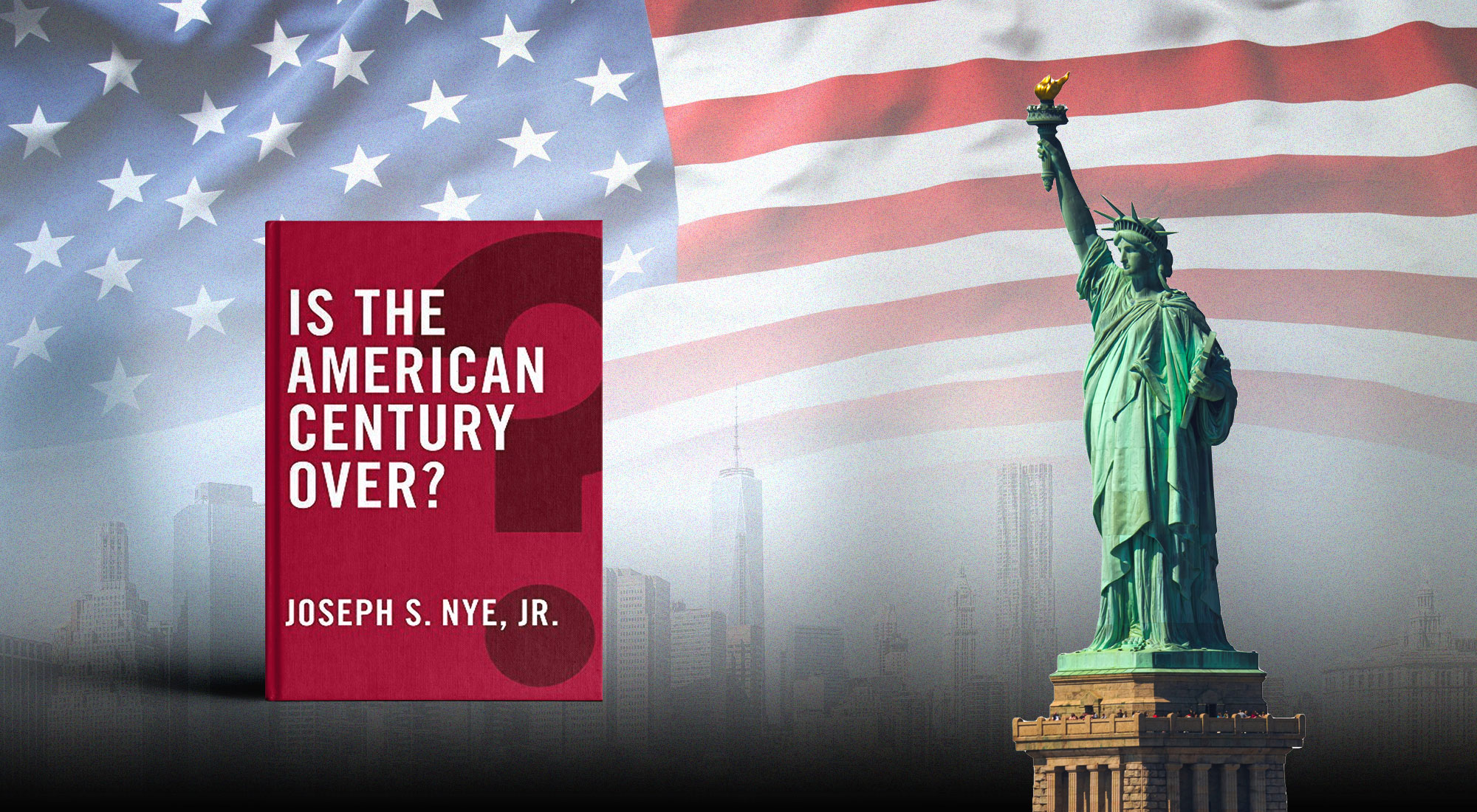
It was against this backdrop that Joseph Nye, the American political scientist, published a book in 2015 titled “Is the American Century Over?” In his book, he examined whether the era of the United States’ global leadership is coming to an end or whether its supposed decline is perhaps exaggerated by many. By relying on previous research and personal experiences, he compares the U.S.’ military capabilities, economic resources, and cultural influence to those of Europe, Japan, Russia, India, and specifically China, to which he devoted a full chapter titled “The Rise of China” to affirm whether Beijing could, at some point in the near future, replace the United States as a dominant global power.
A decade later, the debate on the decline of American hegemony has returned as the power shifts Nye examined have only intensified, and doubts about U.S. leadership’s success have returned with new urgency. As a result, this piece seeks to revisit and critically review his book. It thoroughly analyzes, evaluates, and reflects on Nye’s main arguments in light of today’s global context and contemporary international developments that are taking place, and whether his book remains relevant ten years after its publication.
Serving also as a mirror and a critique, this review captures a glimpse of the book’s strengths and its underlying weaknesses, as it explores the extent to which recent global developments have challenged his predictions. Overall, this comprehensive review argues that although Nye underestimated the intensity and long-term impacts of the domestic divisions and global complexity that could challenge the United States’ power, his general analysis that ‘the American century is not over but rather it is changing shape’ remains largely accurate in 2025. The United States continues to occupy a central position in global affairs, but it no longer constitutes the sole center of power within the international system.
Overview and Analysis of Nye’s Work
Known for his contributions to conceptualizing power as multidimensional within the realm of global politics, Joseph S. Nye stood out as one of the most influential thinkers in modern international relations, leaving behind, at the age of 88, a legacy that continues to shape the way we understand and analyze the dynamics of power on the global stage. In a career spanning six decades as both a professor at Harvard University and a former U.S. policymaker, Nye has had a profound impact on scholars and leaders around the world. It was during his academic tenure that he introduced the groundbreaking concept of soft power, emphasizing that influence, attraction, and persuasion are powerful tools alongside military and economic means when pursuing national interests—a concept he said U.S. President Donald Trump had failed to comprehend (McCormick, 2025). Beyond his academic contributions, Nye gained credibility by serving in key U.S. policy roles such as Assistant Secretary of Defense and Chair of the National Intelligence Council under various U.S. presidents, including Jimmy Carter and Bill Clinton. This combination of academic knowledge and practical policy work provided him with a unique perspective on power and leadership. His ability to translate complex ideas into actionable strategies made him one of the most reliable voices in discussing U.S. foreign policy and its international influence.
Drawing on his extensive experience, in his book “Is the American Century Over?” Nye set out to address the central question of whether the American Century has come to an end. He came to a conclusion that “the American Century is not over, but because of transnational and non-state forces, it is definitely changing in important ways” (p. 14). Nye arrived at this conclusion by writing a comprehensive seven-chapter analysis. He began by identifying the main concept of his argument, stating that “First we need to be clear about what we mean by the American Century… When did it start?” (p. 2), situating it within the broader context of the post-World War II international order and the idea of American exceptionalism. He then explored ongoing debates about whether the American era is drawing to a close, considering various indicators of decline. In the chapters that followed, Nye assessed both absolute and relative decline, comparing the United States’ power and influence to potential emerging challengers such as Europe, Japan, Russia, India, Brazil, and particularly China, for which he devoted a full chapter, as mentioned earlier. Nye also examined the absolute decline of the United States, questioning whether the U.S. is fated to follow Rome’s historic trajectory. He also investigated contemporary global power shifts and the increasing complexity of international relations, emphasizing how the rise of multiple global centers of influence is transforming the international landscape.
Every chapter Nye wrote builds upon the previous one, creating an easy flow and layered understanding of geopolitical dynamics. The language he uses and the way he structured the book provide a useful comparative framework, allowing readers to grasp complex shifts in global power through accessible and understandable analysis. In terms of its overall structure, the book has been called “one of the best short reads about global geostrategic power shifts” (Tufekci, 2015). Many critics have lauded Nye’s work for its logical structure, clarity, and balanced perspective, as it provides readers with a comprehensive understanding of the complexities surrounding U.S. power in the 21st century.
However, among the weaknesses one may come to see after thoroughly reading Joseph Nye’s seven-chapter book, despite its structured outline, is the fact that it lacks practical solutions that could be useful to readers and policymakers who would rather have guidance than broad conceptual frameworks to overcome the challenges outlined. Nye did not provide detailed, actionable solutions on how the United States should and can adapt its ruling power to fit a multipolar world. He only tends to focus on what the challenges, problems, and emerging dynamics are that threaten the U.S.’ global position. This was even brought up by Monir H. Moni. In his book review, Moni expressed his disappointment that in the book “Is the American Century Over?” Nye focused on theory and literature review rather than providing relevant actionable insights that could have been useful for decision-makers (2018).
In addition, while skimming through the book’s references and reading the various perspectives added within it, one may find it somewhat biased, as it was written only from a Western-centric perspective, excluding scholarly works from non-Western writers, particularly emerging powers like China, who might have a say in the topic. This not only restricted the richness, depth, and balance of the book’s analysis but also created the limitation of fully engaging with alternative viewpoints that might either challenge or add a new perspective to the topic and shape its conclusion. This narrow approach actually supports what other scholars, like Iqbal, pointed out. In his book review, Iqbal argued that Nye appears to be caught between what he wishes to happen and what is actually happening in terms of the global power shift. As seen, he tends to adopt a somewhat idealistic attitude to comfort and reassure others about America’s position and responsibilities on the world stage (Iqbal, 2015). Some of the other drawbacks that arise in the book and are worth pointing out are that Nye underestimated the complexities and challenges the United States faces by referring to them as manageable. He also underestimated the rapid rise of China, as we will come to see in the following section when discussing Nye’s main arguments in light of today’s global context and contemporary international developments.
Ten Years Later, How Relevant Is Joseph Nye’s Book?
Although Joseph Nye published the book in 2015, some of the insights presented within it continue to be highly relevant in 2025. Its main argument that the United States’ century is not over but is rather transforming remains accurate and relevant. The United States of America, which Nye claimed holds unmatched military, economic, and cultural resources, still maintains its status as a world powerhouse, but it is no longer the only one of its kind in the international system. The system has undeniably shifted to a more complex multipolar world, with new regional and economic powers increasingly influencing global dynamics. Countries like China, India, and Russia, Nye noted, were on the rise but argued that none were very likely to surpass the United States as they had yet to develop the full spectrum of capabilities necessary to do so (p. 115).
Yet, while his assessment in 2015 that China’s rise was undeniable but still far from challenging the United States’ position (p. 70) may have been accurate at the time, it no longer holds true in 2025. China today stands as the world’s second-largest power in terms of economy (and first in terms of Purchasing Power Parity—PPP), with a world-class military following the United States (Council on Foreign Relations, 2025). China has made significant strides in the last ten years. It has emerged as a major strategic rival to the U.S. in infrastructure investment, technology, and diplomacy. In addition, its Belt and Road Initiative spans over 150 countries, expanding its economic and geopolitical influence across regions like Asia, Africa, the Middle East, and Europe. China has also positioned itself as a vital diplomatic actor, mediating the 2023 Saudi-Iran reconciliation, which signaled its growing capability to act as a neutral mediator in the Middle East, a region that was traditionally influenced by the United States. Within BRICS, China has also been able to promote BRICS as an alternative to Western-led institutions such as the IMF and World Bank. All in all, this indicates that over the past ten years, China has grown significantly, intensifying the competition Nye mentioned in his book even further, demonstrating that while the American century persists, it now exists within a shared and contested landscape of power.
Similarly, Nye’s caution that the United States faces its biggest danger from within is remarkably true and has become even more relevant today (p. 71). Yet perhaps he underestimated the long-term impacts of the internal divisions the U.S. faces and downplayed the growing complexities of the global system. He argues that the issues the U.S. faces will not end indefinitely, given the country’s strong capacity for managing and correcting itself (pp. 92-93). According to John Ikenberry, the U.S. no longer leads as it once did, not because others destroyed its systems but rather because it has lost its will and consistency. During the past few years, the United States withdrew from both the Paris Climate Accord and the Iran nuclear deal, which created a vacuum that others quickly began to fill (Ikenberry, 2018). Other domestic challenges, such as social and economic inequality and political polarization, have also undermined its global credibility. However, it is worth noting that these developments do not necessarily mean that U.S. power is ending; rather, they indicate a significant shift in its foreign policy from outright dominance toward a strategy of selective engagement and partnership. Instead of trying to control every situation individually, the United States now focuses on working collaboratively with other nations. A notable example was its active involvement with Qatar and Egypt in facilitating a ceasefire in Gaza and coordinating responses to the crisis in Ukraine, helping to promote peace and security. These efforts also reflect Joseph Nye’s idea about soft power and the importance of diplomatic influence in maintaining global leadership, which he has highly stressed.
In essence, Joseph Nye’s book is unquestionably valuable. A decade after its publication, it remains a timely and thought-provoking reflection on the nature of United States power and leadership, as it also captures the core transformation of power in the 21st century, from traditional dominance to a leadership model rooted in cooperation, credibility, and innovation. While the primary readers consist of experts, scholars, policymakers, and students in the field of international relations, it is also likely to be of significant appeal to those interested in global leadership, strategic foresight, and the shifting balance of world power.
References
Council on Foreign Relations, China’s Approach to Global Governance (Council on Foreign Relations, 2025), https://www.cfr.org/china-global-governance/.
G. John Ikenberry, “The End of Liberal International Order?” International Affairs 94, no. 1 (2018): 7–23, https://doi.org/10.1093/ia/iix241.Khalid Iqbal, “Book Review: ‘Is the American Century Over?,’ by Joseph S. Nye Jr.,” Academia (2015), https://www.academia.edu/16937763/Book_Review_Is_the_American_Century_Over_by_Joseph_S_Nye_Jr_Reviewed_by_Air_commodore_R_Khalid_Iqbal.
Meredith McCormick, “Joseph Nye, Who Coined the Term ‘Soft Power,’ Dies Aged 88,” Financial Times, May 7, 2025, https://www.ft.com/content/f78aab9d-9cb0-4194-a9a3-b6d545dfc725.
Md. Hasan Moni, “Book Review: Is the American Century Over?,” The Journal of International Relations, Peace Studies, and Development 4, no. 1 (2018): 1–10, https://scholarworks.arcadia.edu/agsjournal/vol4/iss1/7/.
Joseph S. Nye Jr., Is the American Century Over? (Cambridge: Polity, 2015), 1–127.
Olgu Tufekci, “Book Review: Is the American Century Over?,” Caucasus International 5, no. 2 (2015): 187–90, https://www.researchgate.net/publication/345360282_Book_Review_Is_the_American_Century_Over#full-text.