


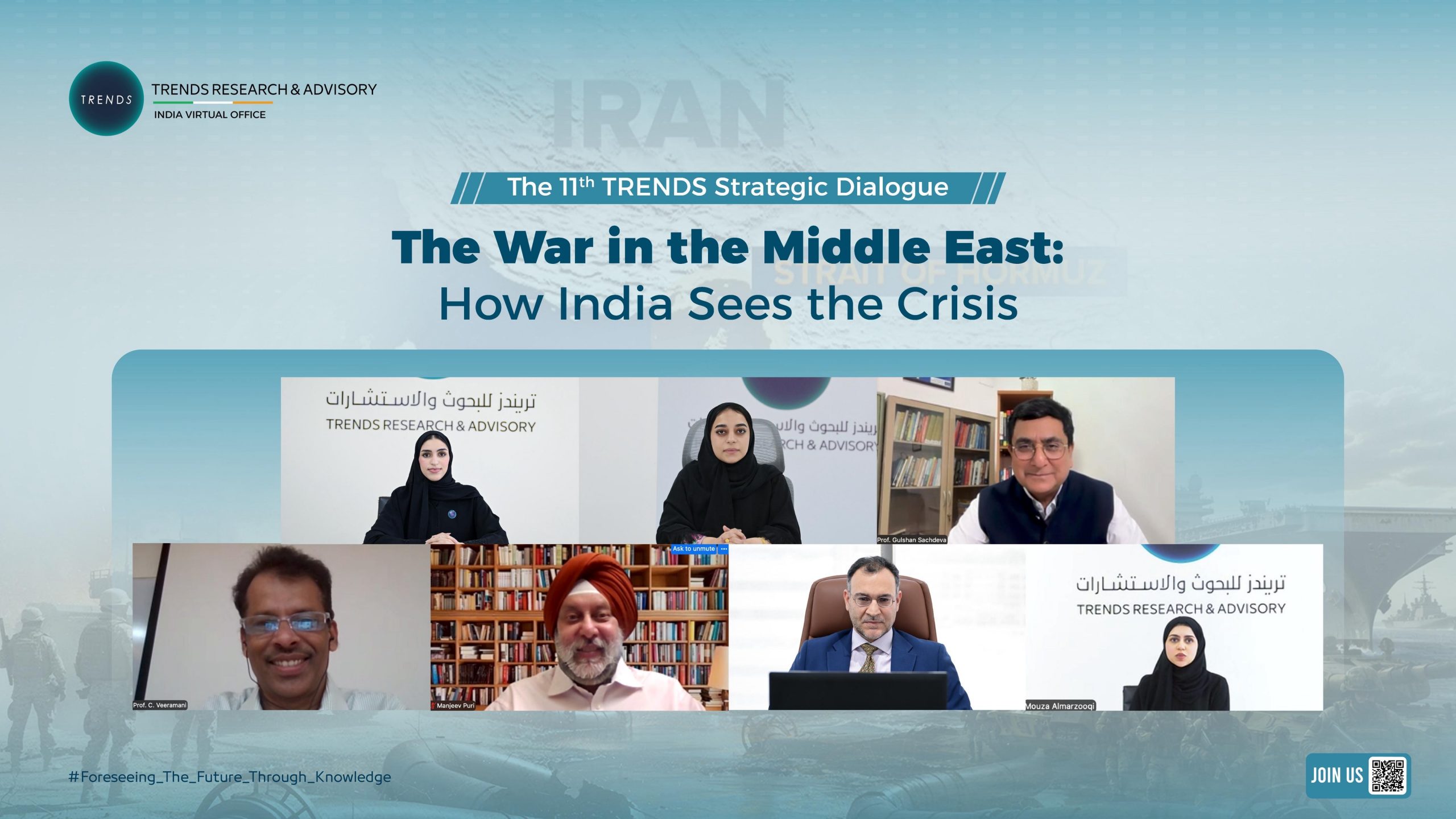
Amid the profound geopolitical transformations taking place in the Middle East, and the direct repercussions of escalating military tensions on the global economy, energy security, and maritime routes, TRENDS Global, affiliated with TRENDS Group, organized the 11th Strategic Dialogue under the title The War in the Middle East: How Does India View the Crisis?
The dialogue was organized under the supervision of the TRENDS office in New Delhi, even as the region undergoes an unprecedented strategic reshaping in which security calculations intersect with economic interests and major international transformations. This has prompted emerging powers, foremost among them India, to reassess their position and role within the Middle East’s evolving geopolitical equation.
The dialogue brought together a distinguished group of Indian researchers, diplomats, and strategic experts who offered an in-depth reading of India’s position toward the crisis. They stressed that New Delhi no longer views the Middle East merely as a source of energy, but rather as a vital sphere directly connected to its national security, economic stability, and ambitions as a rising global power.
Discussions demonstrated that the ongoing war is no longer a limited regional crisis, but has become a real test of the international system’s ability to manage complex crises, as well as the capacity of middle and rising powers to play more influential roles in preserving global stability.
Participants emphasized that the Middle East occupies a central place in India’s contemporary strategy, not only because of oil and gas, but also because of the interconnection of commercial, humanitarian, and geopolitical interests.
They noted that India, one of the world’s fastest-growing economies, relies heavily on the stability of the Gulf region to ensure the uninterrupted flow of energy and the security of its supply chains and maritime trade, especially through the Strait of Hormuz, a vital artery for global commerce.
Speakers noted that the ongoing war has presented India with a complex strategic challenge: maintaining balanced relations with various regional and international actors amid mounting political and economic pressures stemming from growing international polarization.
They explained that the importance of the crisis for India is reflected in three main dimensions:
The first is energy security and economic stability. India depends heavily on oil and gas imports from the Gulf region to meet a large share of its domestic needs, making any disruption in supplies or increase in energy prices a direct threat to economic growth and financial stability. Rising oil prices also affect inflation rates, transportation and industrial costs, and the government’s ability to maintain economic and social balance.
The second dimension is trade security and maritime routes. Maritime corridors in the Gulf and the Red Sea constitute strategic arteries for India’s international trade. Therefore, any threat to maritime navigation or closure of sea passages directly impacts the Indian economy and global supply chains. In this context, New Delhi is increasingly concerned about the growing security risks associated with maritime navigation, especially amid the widening scope of military tensions in the region.
The third dimension concerns humanitarian considerations and the Indian diaspora. Millions of Indians live in Gulf countries, forming one of the largest foreign communities in the region, while their remittances represent an important component of the Indian economy. Participants noted that any large-scale security escalation would impose additional challenges on the Indian government in protecting its citizens and ensuring the continued socioeconomic stability of Indian communities abroad.
Opening Session
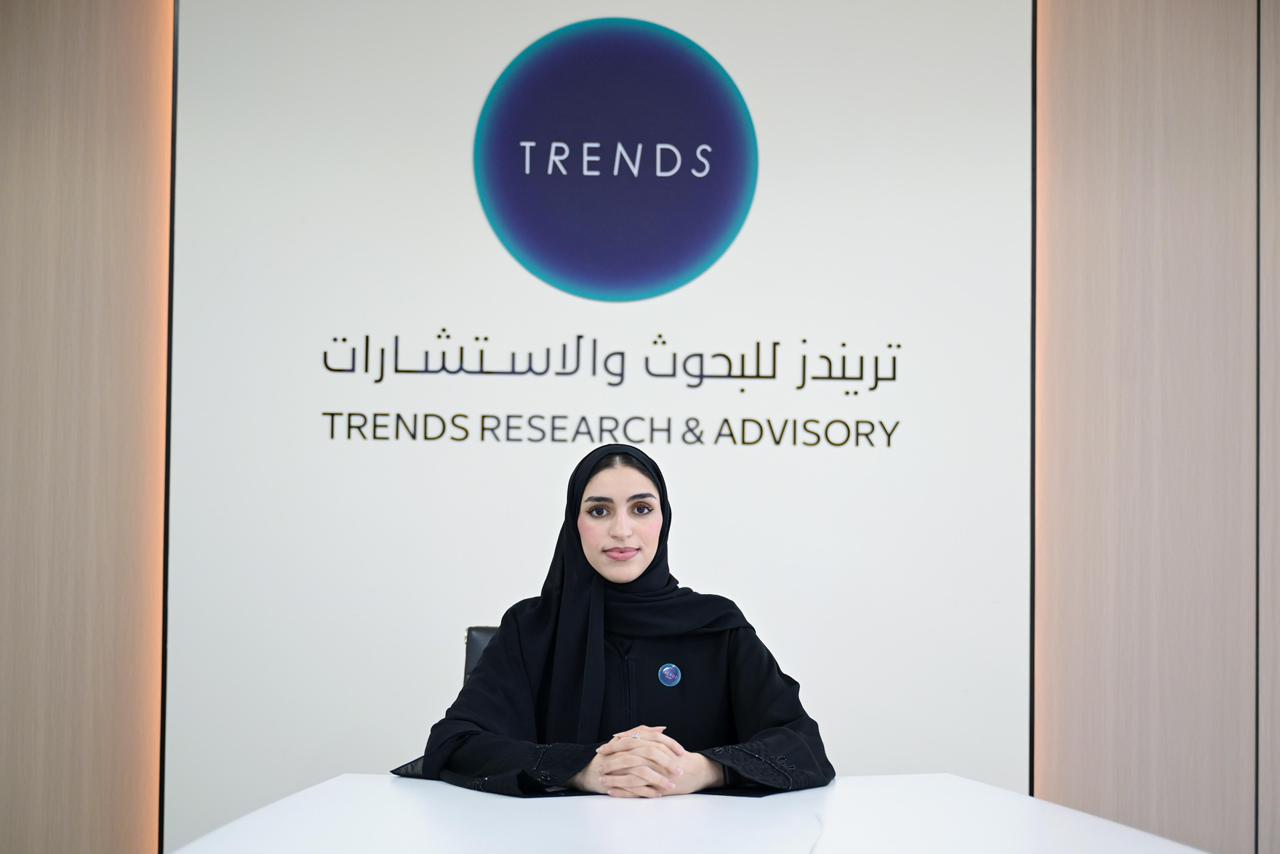
Researcher Noor Al Matrooshi launched the new episode of the TRENDS Strategic Dialogue series, stressing that Middle East crises linked to Iran have become an international issue where the interests of major powers intersect with energy security and global supply chains. She noted that the coming phase may witness fundamental shifts in regional alliances and investments.
She explained that India faces a complex strategic equation tied to energy security, the protection of its economic interests and communities in the Gulf, and the safeguarding of maritime routes, particularly the Strait of Hormuz.
She also indicated that the crisis represents a test for New Delhi’s policy of “strategic autonomy,” amid growing pressure to adopt clearer positions to protect its partnerships with Gulf countries.
She concluded by emphasizing that India is pursuing a “pragmatic strategic realism” aimed at supporting regional stability, recognizing the impact that any further escalation could have on its economic growth.
The Futility of War
TRENDS researcher Ebrar Al Ali moderated the session. Prof. Wulshan Sachdevas, Chair of the Jean Monnet Chair at the Center for European Studies at Jawaharlal Nehru University, opened the discussion with a critical reading of the war, arguing that the crisis reflects an international failure to contain tensions through political and diplomatic means.
He explained that the region had genuine opportunities to avoid confrontation, particularly through negotiations linked to nuclear and security issues. However, the logic of force prevailed over the logic of dialogue. He pointed out that the war has destroyed strategic infrastructure and vital facilities, with long-term repercussions for regional and global economies.
Prof. Sachdevas also warned that continued tensions in the Strait of Hormuz threaten to undermine global economic stability, particularly as oil prices exceed critical levels that directly affect Asian and European economies. He stressed that India is now required to play a more active role in supporting regional stability, whether through multilateral diplomacy, protecting trade routes, or supporting reconstruction and development efforts.
The Resilience of Gulf–India Partnership
Stephen Scalett, Scientific Advisor at TRENDS Global Sector, affirmed that Gulf–India relations have, for years, moved beyond traditional economic partnership to become a comprehensive strategic partnership grounded in mutual interests and long-term stability.
He explained that the ongoing crisis has revealed a high level of coordination and flexibility between India and the Gulf states, particularly in energy, transportation, and logistics, where the relevant parties have mitigated the initial economic shock of the conflict.
He also underscored the geopolitical importance of the India-Middle East–Europe Corridor (IMEC), considering it one of the most important future strategic projects aimed at reshaping global trade routes and linking Asia with Europe through the Middle East.
He added that the success of this project fundamentally depends on regional stability, making the preservation of regional security a shared interest for India, Gulf states, and their international partners.
Economic Repercussions and Managing Balances
Prof. C. Veeramani, Director and RBI Chair Professor at the Center for Development Studies, addressed the direct economic repercussions of the war on the Indian economy, explaining that the crisis has placed New Delhi before a highly complex equation that requires it to maintain balanced relations with various regional actors.
He pointed out that India maintains defense and strategic relations with Israel, while simultaneously relying heavily on Gulf states for energy and maintaining important relations with Iran related to transportation, trade, and energy. He stressed that these balances require India to pursue a policy of “multi-alignment,” aimed at protecting national interests without aligning with any sharp geopolitical blocs.
Prof. Veeramani also reviewed the economic repercussions of the war, including the decline in the value of the Indian rupee, rising import costs, and impacts on agriculture, industry, and the energy sector.
Despite these challenges, he believed, the crisis could push India to accelerate its transition toward renewable energy and strengthen its energy independence, thereby reducing its vulnerability to future geopolitical crises.
Ethical Diplomacy and Regional Stability
Former Indian Ambassador to the European Union and Nepal, Manjeev Singh Puri, emphasized that India’s position on the crisis combines political pragmatism with a moral dimension, noting that Indian society is following with deep concern the humanitarian destruction and security deterioration unfolding in the region.
He explained that the Indian leadership advocates political solutions and de-escalation, based on the conviction that wars are no longer an effective means of resolving conflicts in an economically and strategically interconnected world.
Ambassador Puri also noted that any disruption in gas and energy supplies directly affects the daily lives of Indian citizens, especially in rural areas, giving the crisis domestic social and political dimensions that go beyond traditional geopolitical calculations.
He stressed that India will continue supporting regional stability and strengthening its partnerships with Gulf countries, foremost among them the United Arab Emirates, which it considers a key strategic partner in the fields of economy, energy, investment, and development.
Recommendations
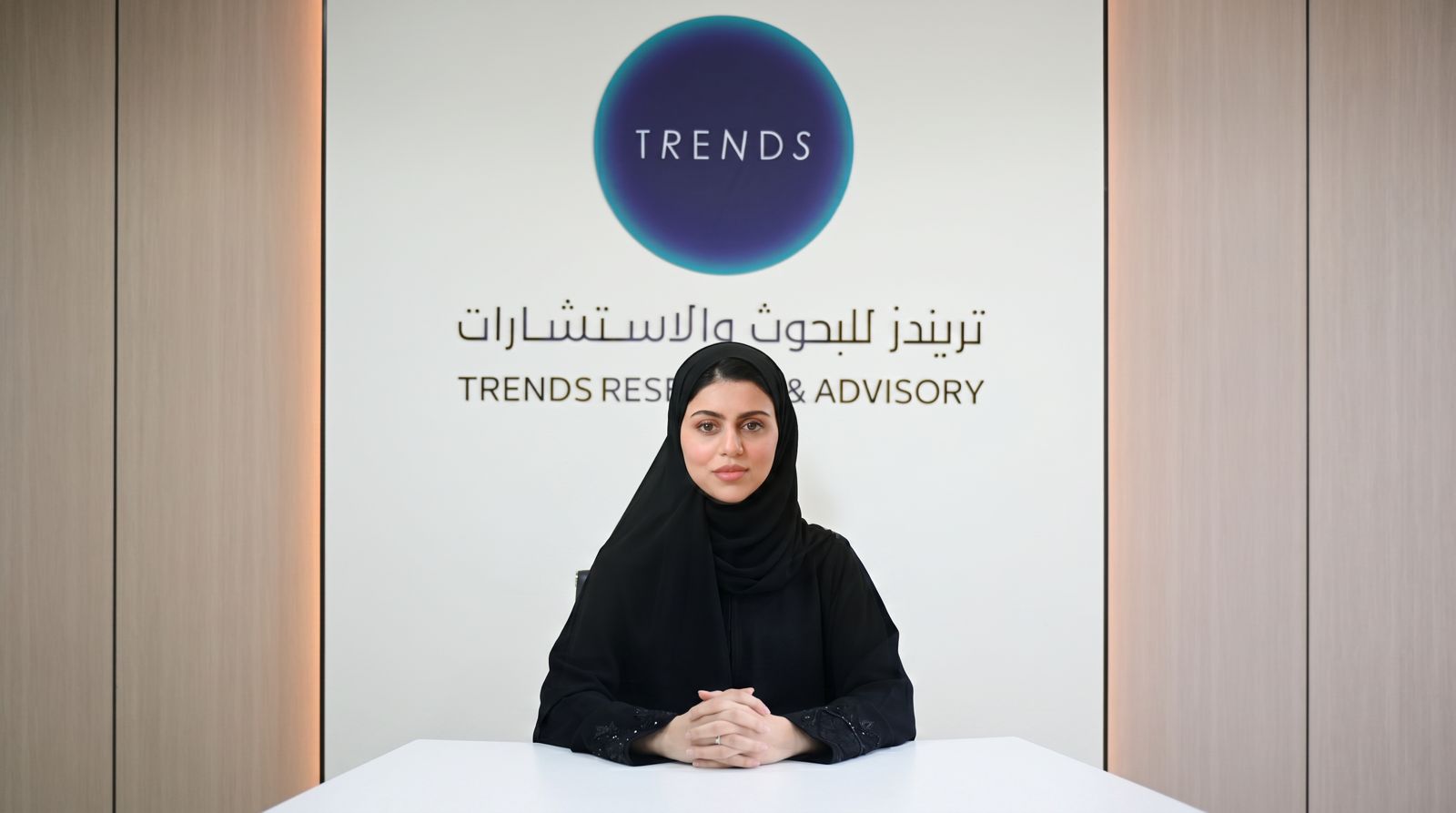
The dialogue concluded with remarks by Mouza Al Marzouqi, Senior Researcher at TRENDS, who stressed that the coming phase will witness significant transformations, including India’s role in the Middle East.
The dialogue recommended enhancing India’s diplomatic presence in mediation and de-escalation efforts, developing long-term strategic partnerships with Gulf countries in clean energy and green hydrogen, supporting maritime security initiatives to protect vital trade routes, accelerating the transition toward renewable energy to reduce dependence on conventional oil, strengthening the resilience of the Indian economy through diversifying import sources and localizing vital industries, and supporting regional and international connectivity projects, foremost among them the India-Middle East-Europe Corridor (IMEC).
Al Marzouqi emphasized that the 11th Strategic Dialogue demonstrated that India has become a key player in Middle East equations, and that the region’s stability is no longer a foreign issue for New Delhi, instead a strategic interest directly linked to its national security, economic future, and international role.
The discussions also revealed that New Delhi seeks to formulate a new foreign policy model that balances economic interests with international responsibility, thereby enhancing its ability to act as a trusted partner and a force supporting regional stability.
Given ongoing global geopolitical transformations, India appears to face a historic opportunity to strengthen its political and economic presence in the Middle East, provided it manages its complex balancing act and turns current challenges into tools to enhance its influence and global role.
