


* The dialogue emphasized the importance of the Gulf-Turkish partnership and rejected escalation and aggression against regional states.
* Calls were made to strengthen diplomacy and enhance economic resilience to ensure regional stability.
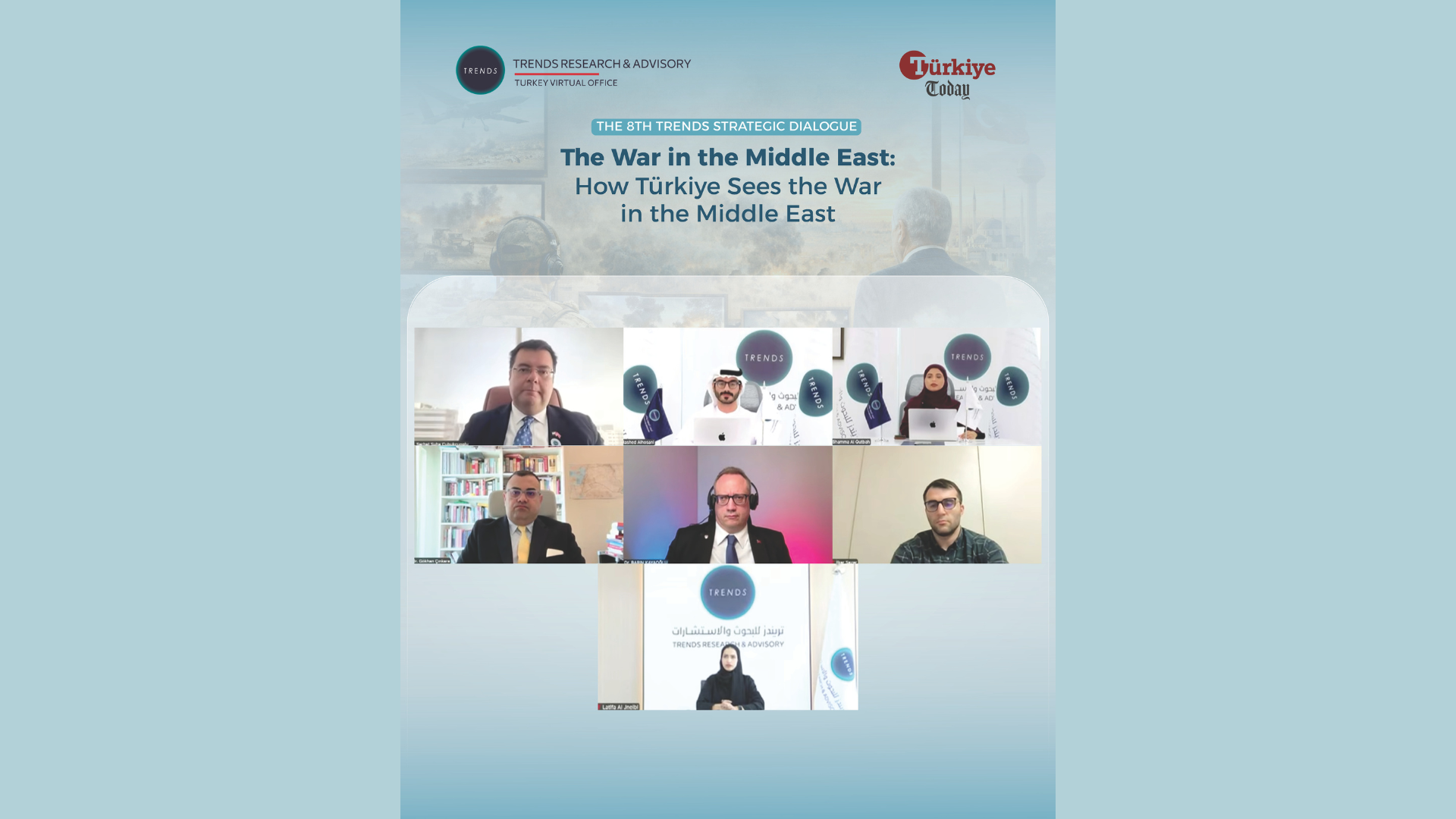
TRENDS Research & Advisory, through its Türkiye office and in collaboration with Türkiye Today, organized its 8th Strategic Dialogue titled The War in the Middle East: How Does Turkey See the Crisis? Participants of the dialogue discussed the dimensions of Türkiye’s vision of the crisis and its repercussions on regional and international balances.
Participants emphasized that the region is at a pivotal moment, redrawing the maps of influence and forcing a redefinition of relations among regional powers. They noted that Turkey seeks to consolidate its position as a “balancing actor” capable of engaging with various parties without being drawn into sharp polarizations.
The dialogue clarified that the war is not limited to military and political dimensions but extends to cross-border economic and security impacts, affecting market stability, energy security, and global supply chains—factors directly linked to Turkish interests.
Repercussions Beyond the Region
Rashid Al Hosani, a researcher at TRENDS, opened the event by highlighting the importance of addressing the Turkish stance on the Middle East war, given its rapid repercussions that now affect the global international order and economic security. He noted that the war has revealed profound shifts that will reflect on the nature of relations, alliances, and investments in the coming period.
Stability First
During the panel discussion moderated by researcher Shamma Al Qutba, Ilker Sezer, Editor-in-Chief of Türkiye Today, emphasized that Ankara does not seek short-term gains from instability in the Gulf. Instead, it relies on a diplomacy based on “collective stability,” maintaining balanced relations with various parties, including Iran and NATO.
A Complex Relationship with Iran
Dr. Barın Kayaoğlu, Professor of American Studies at Ankara University of Social Sciences, described the Turkey-Iran relationship as “complex,” combining competition and cooperation. It is governed by clear pragmatism and mutual respect for strategic red lines despite ideological differences.
Flexible Autonomy
Dr. Gökhan Çınkara, Assistant Professor at Necmettin Erbakan University, focused on the concept of “interdependent autonomy” in Turkish policy as a structural response to shifts in the international system. He noted that while Turkey is expanding its defense capabilities, the greatest challenge remains economic constraints and reliance on Western capital.
Active Neutrality
Dr. Serhat S. Çubukçuoğlu, Senior Fellow and Director of TRENDS Turkey Office, explained that Turkey positions itself as an independent middle power adopting “active neutrality.” It seeks a delicate balance that prevents the weakening of its adversaries from leading to their collapse, and prevents any single regional party from achieving hegemony.
Complexity and Opportunities
The session concluded with remarks from Latifa Ibrahim Al-Junaibi, a TRENDS researcher, who stressed that the regional scene is heading toward further complexity. Participants concluded that Ankara’s ability to maintain its “active neutrality” and its role as a regional mediator will depend on its success in balancing domestic economic pressures with international shifts.
Key Takeaways:
* Gulf-Turkish Partnership: Identified as a fundamental pillar for regional stability.
* Geopolitics as Opportunity: The challenge lies in converting current geopolitical complexities into real opportunities for peace.
* Economic Resilience: Strengthening the ability to face shocks in energy and logistics.
