


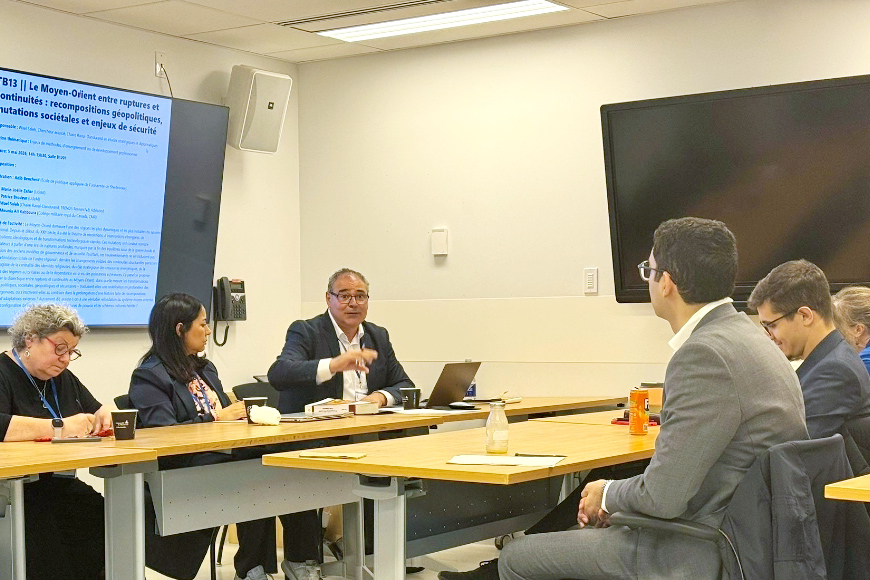
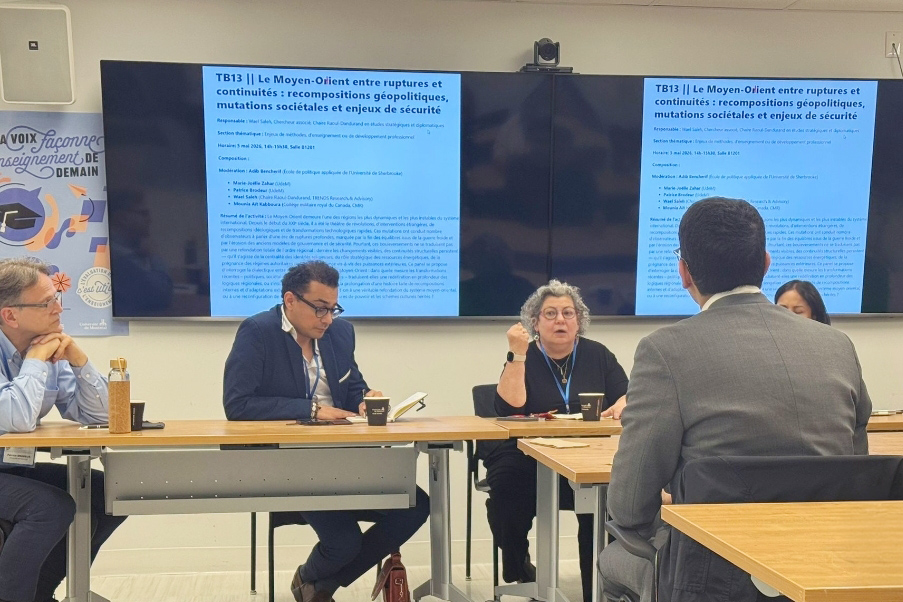
TRENDS Research & Advisory, through its Virtual Office in Canada, organized a specialized scientific panel discussion titled The Middle East Between Rupture and Continuity: Reshaping Geopolitics, Societal Transformations, and Security Challenges as part of its participation in the 63rd Conference of the Quebec Political Science Society, held at the University of Montreal.
The panel was part of the conference’s academic program and, in the context of the TRENDS’s contribution to ongoing discussions, addressed the transformations and challenges facing the world marked by rapid geopolitical and technological change and increasingly complex international interactions.
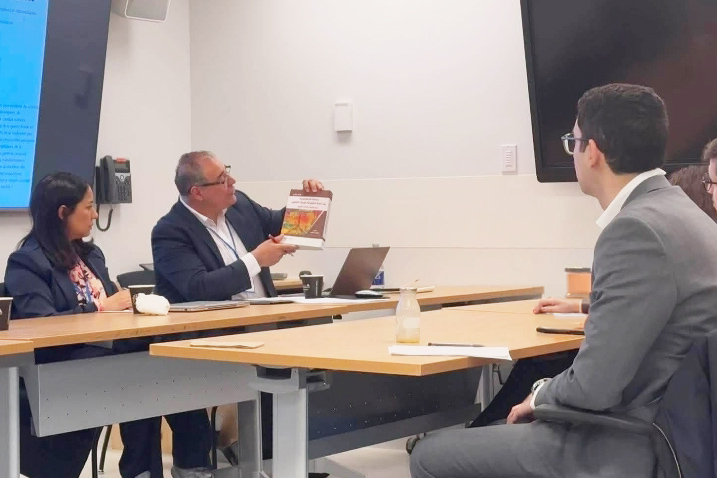
The panel, moderated by Dr. Adib Bencherif, Professor and Researcher at the School of Applied Politics at the University of Sherbrooke, featured a distinguished group of academics and specialized researchers, including Dr. Marie-Joëlle Zahar, Professor of Political Science at the University of Montreal; Dr. Patrice Brodeur, Professor of Interfaith Dialogue and Extremism Studies at the University of Montreal; Dr. Mounia Ait Kabboura, Professor and Researcher at the Royal Military College of Canada; and Dr. Wael Saleh, Advisor on Political Islam Affairs and Director of the TRENDS Virtual Offices in France and Canada.
Middle East Transformations
Participants emphasized that the panel aimed to provide an in-depth analytical reading of the transformations taking place in the Middle East through a critical approach that explores the interaction between the dynamics of change and the factors of continuity. It also sought to understand the implications of these transformations for the structure of the regional order, the balance of power, and the forms of political and security influence in the region. Speakers stressed that this approach is not limited to describing phenomena but also seeks to deconstruct them within their historical and structural contexts, enabling a more accurate and complex understanding of the current regional landscape.
The panel also aimed to reconsider the traditional analytical frameworks used to study the Middle East by discussing whether the current transformations represent fundamental changes in the region’s structure or reflect the reproduction of patterns of power, conflict, and sovereignty in new forms compatible with contemporary regional and international transformations.
The Rise of the Nation-State
In his remarks, Dr. Wael Saleh, Advisor on Political Islam Affairs and Director of the TRENDS Virtual Offices in France and Canada, emphasized that the Arab world is experiencing a “moment of historical rupture,” reflected in four interconnected transformations. The first is the decline of Islamism and the renewed rise of the nation-state as the central framework for stability. The second relates to global geopolitical restructuring, with the Arab world becoming a pivotal strategic space, particularly in the Chinese vision, in a way that parallels Europe’s role in the rise of the United States.
Technology as a Tool of Influence
Dr. Saleh explained that the third rupture is reflected in the efforts of some Arab countries to position themselves as middle powers in the digital sphere, using technology as a tool of sovereignty and influence. Meanwhile, the fourth rupture is represented in the epistemological dimension, through the emergence of an Arab intellectual movement seeking to produce its own analytical frameworks and assert its presence in scientific discussions related to its reality.
He considered these four transformations to form a single path reflecting the transition from a system dominated by transnational ideologies to one centered on the nation-state, geopolitical power, and the independent production of knowledge.
– End –
About TRENDS Group
Established in Abu Dhabi, UAE, in 2014, TRENDS is a private, independent research institution that explores the future through its various specialized research programs. It has been able to build a network of strong partnerships with global research centers and think tanks as well as with governmental and non-governmental organizations and institutions. The Center aims to benefit from international cooperation and research initiatives to further enhance its reach and impact at both regional and global levels. It regularly organizes lectures, conferences, and symposiums to ensure the exchange of research experiences and expertise. TRENDS’ broad array of publications cover subjects of global interest and consequence, which fall within its area of interest.
