


The event brought together an elite group of experts and decision-makers to analyze the repercussions of the war in the Middle East and its profound implications for the international system.
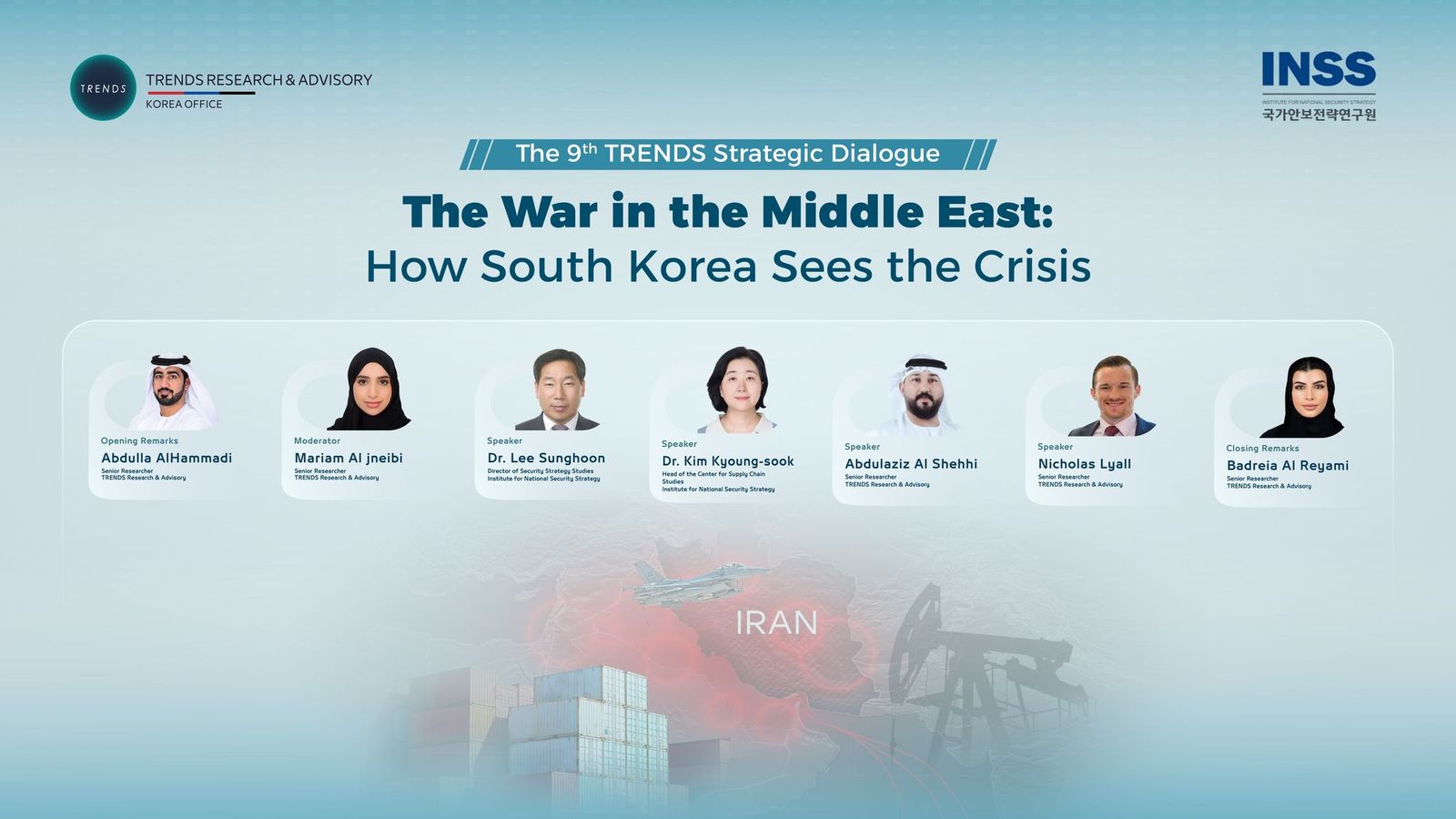
Amid a highly complex international context, TRENDS Research & Advisory, in cooperation with the Institute for National Security Strategy (INSS), organized a high-level strategic seminar as part of the 9th TRENDS Strategic Dialogue. The event brought together an elite group of experts and decision-makers to analyze the repercussions of the war in the Middle East and its profound implications for the international system, with a specific focus on South Korea’s repositioning in a changing global environment.
Participants emphasized that the world is at a pivotal turning point, as the current crisis is no longer merely a regional conflict but is reshaping international balances. This shift is driving major economic powers—led by South Korea—to reformulate their security and economic doctrines comprehensively.
 Opening Reading
The session commenced with Abdullah Al-Hammadi, Main Researcher at TRENDS, who stressed that the Middle East is witnessing rapid, complex developments in which political, security, and economic dimensions intersect in unprecedented ways, necessitating a comprehensive re-reading of the global geopolitical landscape.
Al-Hammadi explained that the crisis’s repercussions have transcended regional borders, impacting global energy markets, international supply chains, and the broader system of global security and stability. He noted that understanding South Korea’s vision regarding these developments represents an important entry point for analyzing the ongoing international transformations in light of the increasing interconnectedness between economy and security.
An Integrated Analytical Approach
The session was moderated by Maryam Mohammed Al-Junaibi, Director of the Monitoring and Digital Analysis Department at “TRENDS – Dubai,” who precisely directed the discussion toward its strategic themes. She worked on linking the interventions within a coherent analytical framework that reflects the depth of the ongoing shifts and their various impacts at both regional and international levels.
Strategic Independence
Lee Seong-hoon, Director of Strategic Security Studies at INSS, presented a critical reading of the future of international alliances, noting that the current crisis has revealed a clear shake in the credibility of American leadership on the international stage.
He explained that South Korea is moving seriously toward enhancing its strategic independence, diversifying its international partnerships, and reducing its absolute reliance on the American security umbrella. Lee Seong-hoon pointed out that redeploying American defense systems from the Korean Peninsula to other regions has created a security gap at a time when regional threats are escalating, confirming that the current stage represents an “era of multi-chaos.”
Rules of the Game
In turn, Nicholas Lyall, Main Researcher at TRENDS, addressed the concept of “weaponizing the global commons,” noting that vital corridors such as the Strait of Hormuz are no longer merely arteries of international trade but have effectively become tools of geopolitical pressure. He explained that targeting navigation and vital facilities poses a direct threat to the global economy, indicating that this pattern may extend to other strategic corridors, such as the Strait of Malacca, which threatens to redefine the rules of international security and open a new stage of economic pressures with a geopolitical dimension.
Economic Pressures
In the economic context, Kim Kyung-sook, Head of the Center for Supply Chain Studies at INSS, provided an in-depth analysis of the crisis’s repercussions on the global economy. She noted that approximately 20% of global oil and 25% of liquefied natural gas pass through the Strait of Hormuz, and that South Korea relies on the Middle East for about 70% of its total oil imports. Kim Kyung-sook warned that escalating tensions could push oil prices to record levels of up to 200 dollars per barrel, causing sharp disruptions to global supply chains and leaving direct, painful impacts on technology industries, particularly the semiconductor sector.
Defense Cooperation
In one of the seminar’s most prominent themes, TRENDS Main Researchers Abdulaziz Al-Shehhi and Nicholas Lyall presented an in-depth discussion of radical transformations in the war and defense industries, asserting that what is happening in the Middle East is a real laboratory for future wars. Al-Shehhi explained that modern conflicts have revealed a clear transition from conventional warfare to asymmetric warfare, with the widespread use of low-cost drones and the intensive employment of artificial intelligence and advanced technologies. He noted that this shift requires countries to develop multi-layered smart defense systems capable of simultaneously addressing threats that are rapid, complex, and low-cost.
In this context, Al-Shehhi confirmed that the Korean air defense system (M-SAM 2) in the UAE represents an advanced model for this transformation, as it has demonstrated high operational efficiency in complex environments and a superior ability to intercept multiple, simultaneous targets, with success rates approaching 97%. He noted that this performance is no longer just a technical success but also reflects a strategic shift in the global defense industry market toward more flexible and efficient models.
Nicholas Lyall explained that the crisis revealed an increasing gap in defense capabilities among traditional suppliers, driven by rising global demand for air defense systems, the limited effectiveness of some traditional systems against modern threats, and severe pressures on defense supply chains. He emphasized that these facts have opened a wide path for South Korea to transform into a reliable strategic defense partner, especially in the Arabian Gulf region.
From Supply to Strategic Partnership
Al-Shehhi and Lyall stressed that cooperation between the UAE and South Korea is undergoing a qualitative shift from the “buyer and supplier” model to an “integrated strategic partnership.” This includes the transfer of advanced technology, joint military manufacturing, and the development of customized and innovative defense solutions that suit the regional environment and its challenges.
A Race Toward AI and Lasers
In a forward-looking reading, Lyall indicated that future threats will increasingly rely on drone swarms, cyber warfare, and fully autonomous systems. He emphasized that confronting these challenges requires developing defense systems based on laser technologies, leveraging artificial intelligence for analysis and immediate response, and integrating them with advanced digital infrastructure to ensure security superiority.
A Multi-dimensional Partnership
The extensive discussions confirmed that relations between the UAE and South Korea are steadily moving toward a new phase that transcends the traditional energy sector to encompass defense manufacturing, artificial intelligence, cybersecurity, and supply chain security. In her concluding remarks, Maryam Mohammed Al-Junaibi stressed the importance of developing effective cooperation models among middle powers to address rising global challenges and enhance stability.
A Pivotal Role for Think Tanks
The session concluded with Badriya Al-Riyami, Main Researcher at TRENDS, who emphasized that the current crisis is a global challenge that requires a deep, multidimensional understanding and flexible, innovative responses. She highlighted the pivotal role that think tanks play in supporting decision-makers and promoting fruitful international dialogue.
Al-Riyami stated that the 9th Strategic Dialogue recommended the necessity of enhancing strategic independence through the diversification of alliances, the development of advanced defense systems based on artificial intelligence, the expansion of economic and technological partnerships, the enhancement of security for vital maritime corridors, and the support of all means of cooperation among middle powers in the international system.
Opening Reading
The session commenced with Abdullah Al-Hammadi, Main Researcher at TRENDS, who stressed that the Middle East is witnessing rapid, complex developments in which political, security, and economic dimensions intersect in unprecedented ways, necessitating a comprehensive re-reading of the global geopolitical landscape.
Al-Hammadi explained that the crisis’s repercussions have transcended regional borders, impacting global energy markets, international supply chains, and the broader system of global security and stability. He noted that understanding South Korea’s vision regarding these developments represents an important entry point for analyzing the ongoing international transformations in light of the increasing interconnectedness between economy and security.
An Integrated Analytical Approach
The session was moderated by Maryam Mohammed Al-Junaibi, Director of the Monitoring and Digital Analysis Department at “TRENDS – Dubai,” who precisely directed the discussion toward its strategic themes. She worked on linking the interventions within a coherent analytical framework that reflects the depth of the ongoing shifts and their various impacts at both regional and international levels.
Strategic Independence
Lee Seong-hoon, Director of Strategic Security Studies at INSS, presented a critical reading of the future of international alliances, noting that the current crisis has revealed a clear shake in the credibility of American leadership on the international stage.
He explained that South Korea is moving seriously toward enhancing its strategic independence, diversifying its international partnerships, and reducing its absolute reliance on the American security umbrella. Lee Seong-hoon pointed out that redeploying American defense systems from the Korean Peninsula to other regions has created a security gap at a time when regional threats are escalating, confirming that the current stage represents an “era of multi-chaos.”
Rules of the Game
In turn, Nicholas Lyall, Main Researcher at TRENDS, addressed the concept of “weaponizing the global commons,” noting that vital corridors such as the Strait of Hormuz are no longer merely arteries of international trade but have effectively become tools of geopolitical pressure. He explained that targeting navigation and vital facilities poses a direct threat to the global economy, indicating that this pattern may extend to other strategic corridors, such as the Strait of Malacca, which threatens to redefine the rules of international security and open a new stage of economic pressures with a geopolitical dimension.
Economic Pressures
In the economic context, Kim Kyung-sook, Head of the Center for Supply Chain Studies at INSS, provided an in-depth analysis of the crisis’s repercussions on the global economy. She noted that approximately 20% of global oil and 25% of liquefied natural gas pass through the Strait of Hormuz, and that South Korea relies on the Middle East for about 70% of its total oil imports. Kim Kyung-sook warned that escalating tensions could push oil prices to record levels of up to 200 dollars per barrel, causing sharp disruptions to global supply chains and leaving direct, painful impacts on technology industries, particularly the semiconductor sector.
Defense Cooperation
In one of the seminar’s most prominent themes, TRENDS Main Researchers Abdulaziz Al-Shehhi and Nicholas Lyall presented an in-depth discussion of radical transformations in the war and defense industries, asserting that what is happening in the Middle East is a real laboratory for future wars. Al-Shehhi explained that modern conflicts have revealed a clear transition from conventional warfare to asymmetric warfare, with the widespread use of low-cost drones and the intensive employment of artificial intelligence and advanced technologies. He noted that this shift requires countries to develop multi-layered smart defense systems capable of simultaneously addressing threats that are rapid, complex, and low-cost.
In this context, Al-Shehhi confirmed that the Korean air defense system (M-SAM 2) in the UAE represents an advanced model for this transformation, as it has demonstrated high operational efficiency in complex environments and a superior ability to intercept multiple, simultaneous targets, with success rates approaching 97%. He noted that this performance is no longer just a technical success but also reflects a strategic shift in the global defense industry market toward more flexible and efficient models.
Nicholas Lyall explained that the crisis revealed an increasing gap in defense capabilities among traditional suppliers, driven by rising global demand for air defense systems, the limited effectiveness of some traditional systems against modern threats, and severe pressures on defense supply chains. He emphasized that these facts have opened a wide path for South Korea to transform into a reliable strategic defense partner, especially in the Arabian Gulf region.
From Supply to Strategic Partnership
Al-Shehhi and Lyall stressed that cooperation between the UAE and South Korea is undergoing a qualitative shift from the “buyer and supplier” model to an “integrated strategic partnership.” This includes the transfer of advanced technology, joint military manufacturing, and the development of customized and innovative defense solutions that suit the regional environment and its challenges.
A Race Toward AI and Lasers
In a forward-looking reading, Lyall indicated that future threats will increasingly rely on drone swarms, cyber warfare, and fully autonomous systems. He emphasized that confronting these challenges requires developing defense systems based on laser technologies, leveraging artificial intelligence for analysis and immediate response, and integrating them with advanced digital infrastructure to ensure security superiority.
A Multi-dimensional Partnership
The extensive discussions confirmed that relations between the UAE and South Korea are steadily moving toward a new phase that transcends the traditional energy sector to encompass defense manufacturing, artificial intelligence, cybersecurity, and supply chain security. In her concluding remarks, Maryam Mohammed Al-Junaibi stressed the importance of developing effective cooperation models among middle powers to address rising global challenges and enhance stability.
A Pivotal Role for Think Tanks
The session concluded with Badriya Al-Riyami, Main Researcher at TRENDS, who emphasized that the current crisis is a global challenge that requires a deep, multidimensional understanding and flexible, innovative responses. She highlighted the pivotal role that think tanks play in supporting decision-makers and promoting fruitful international dialogue.
Al-Riyami stated that the 9th Strategic Dialogue recommended the necessity of enhancing strategic independence through the diversification of alliances, the development of advanced defense systems based on artificial intelligence, the expansion of economic and technological partnerships, the enhancement of security for vital maritime corridors, and the support of all means of cooperation among middle powers in the international system.
Opening Reading
The session commenced with Abdullah Al-Hammadi, Main Researcher at TRENDS, who stressed that the Middle East is witnessing rapid, complex developments in which political, security, and economic dimensions intersect in unprecedented ways, necessitating a comprehensive re-reading of the global geopolitical landscape.
Al-Hammadi explained that the crisis’s repercussions have transcended regional borders, impacting global energy markets, international supply chains, and the broader system of global security and stability. He noted that understanding South Korea’s vision regarding these developments represents an important entry point for analyzing the ongoing international transformations in light of the increasing interconnectedness between economy and security.
An Integrated Analytical Approach
The session was moderated by Maryam Mohammed Al-Junaibi, Director of the Monitoring and Digital Analysis Department at “TRENDS – Dubai,” who precisely directed the discussion toward its strategic themes. She worked on linking the interventions within a coherent analytical framework that reflects the depth of the ongoing shifts and their various impacts at both regional and international levels.
Strategic Independence
Lee Seong-hoon, Director of Strategic Security Studies at INSS, presented a critical reading of the future of international alliances, noting that the current crisis has revealed a clear shake in the credibility of American leadership on the international stage.
He explained that South Korea is moving seriously toward enhancing its strategic independence, diversifying its international partnerships, and reducing its absolute reliance on the American security umbrella. Lee Seong-hoon pointed out that redeploying American defense systems from the Korean Peninsula to other regions has created a security gap at a time when regional threats are escalating, confirming that the current stage represents an “era of multi-chaos.”
Rules of the Game
In turn, Nicholas Lyall, Main Researcher at TRENDS, addressed the concept of “weaponizing the global commons,” noting that vital corridors such as the Strait of Hormuz are no longer merely arteries of international trade but have effectively become tools of geopolitical pressure. He explained that targeting navigation and vital facilities poses a direct threat to the global economy, indicating that this pattern may extend to other strategic corridors, such as the Strait of Malacca, which threatens to redefine the rules of international security and open a new stage of economic pressures with a geopolitical dimension.
Economic Pressures
In the economic context, Kim Kyung-sook, Head of the Center for Supply Chain Studies at INSS, provided an in-depth analysis of the crisis’s repercussions on the global economy. She noted that approximately 20% of global oil and 25% of liquefied natural gas pass through the Strait of Hormuz, and that South Korea relies on the Middle East for about 70% of its total oil imports. Kim Kyung-sook warned that escalating tensions could push oil prices to record levels of up to 200 dollars per barrel, causing sharp disruptions to global supply chains and leaving direct, painful impacts on technology industries, particularly the semiconductor sector.
Defense Cooperation
In one of the seminar’s most prominent themes, TRENDS Main Researchers Abdulaziz Al-Shehhi and Nicholas Lyall presented an in-depth discussion of radical transformations in the war and defense industries, asserting that what is happening in the Middle East is a real laboratory for future wars. Al-Shehhi explained that modern conflicts have revealed a clear transition from conventional warfare to asymmetric warfare, with the widespread use of low-cost drones and the intensive employment of artificial intelligence and advanced technologies. He noted that this shift requires countries to develop multi-layered smart defense systems capable of simultaneously addressing threats that are rapid, complex, and low-cost.
In this context, Al-Shehhi confirmed that the Korean air defense system (M-SAM 2) in the UAE represents an advanced model for this transformation, as it has demonstrated high operational efficiency in complex environments and a superior ability to intercept multiple, simultaneous targets, with success rates approaching 97%. He noted that this performance is no longer just a technical success but also reflects a strategic shift in the global defense industry market toward more flexible and efficient models.
Nicholas Lyall explained that the crisis revealed an increasing gap in defense capabilities among traditional suppliers, driven by rising global demand for air defense systems, the limited effectiveness of some traditional systems against modern threats, and severe pressures on defense supply chains. He emphasized that these facts have opened a wide path for South Korea to transform into a reliable strategic defense partner, especially in the Arabian Gulf region.
From Supply to Strategic Partnership
Al-Shehhi and Lyall stressed that cooperation between the UAE and South Korea is undergoing a qualitative shift from the “buyer and supplier” model to an “integrated strategic partnership.” This includes the transfer of advanced technology, joint military manufacturing, and the development of customized and innovative defense solutions that suit the regional environment and its challenges.
A Race Toward AI and Lasers
In a forward-looking reading, Lyall indicated that future threats will increasingly rely on drone swarms, cyber warfare, and fully autonomous systems. He emphasized that confronting these challenges requires developing defense systems based on laser technologies, leveraging artificial intelligence for analysis and immediate response, and integrating them with advanced digital infrastructure to ensure security superiority.
A Multi-dimensional Partnership
The extensive discussions confirmed that relations between the UAE and South Korea are steadily moving toward a new phase that transcends the traditional energy sector to encompass defense manufacturing, artificial intelligence, cybersecurity, and supply chain security. In her concluding remarks, Maryam Mohammed Al-Junaibi stressed the importance of developing effective cooperation models among middle powers to address rising global challenges and enhance stability.
A Pivotal Role for Think Tanks
The session concluded with Badriya Al-Riyami, Main Researcher at TRENDS, who emphasized that the current crisis is a global challenge that requires a deep, multidimensional understanding and flexible, innovative responses. She highlighted the pivotal role that think tanks play in supporting decision-makers and promoting fruitful international dialogue.
Al-Riyami stated that the 9th Strategic Dialogue recommended the necessity of enhancing strategic independence through the diversification of alliances, the development of advanced defense systems based on artificial intelligence, the expansion of economic and technological partnerships, the enhancement of security for vital maritime corridors, and the support of all means of cooperation among middle powers in the international system.
