Insight Image

TRENDS Panel Explores OPEC’s Future and the Global Energy System Amid Major Transformations

19 May 2026

TRENDS Panel Explores OPEC’s Future and the Global Energy System Amid Major Transformations

19 May 2026

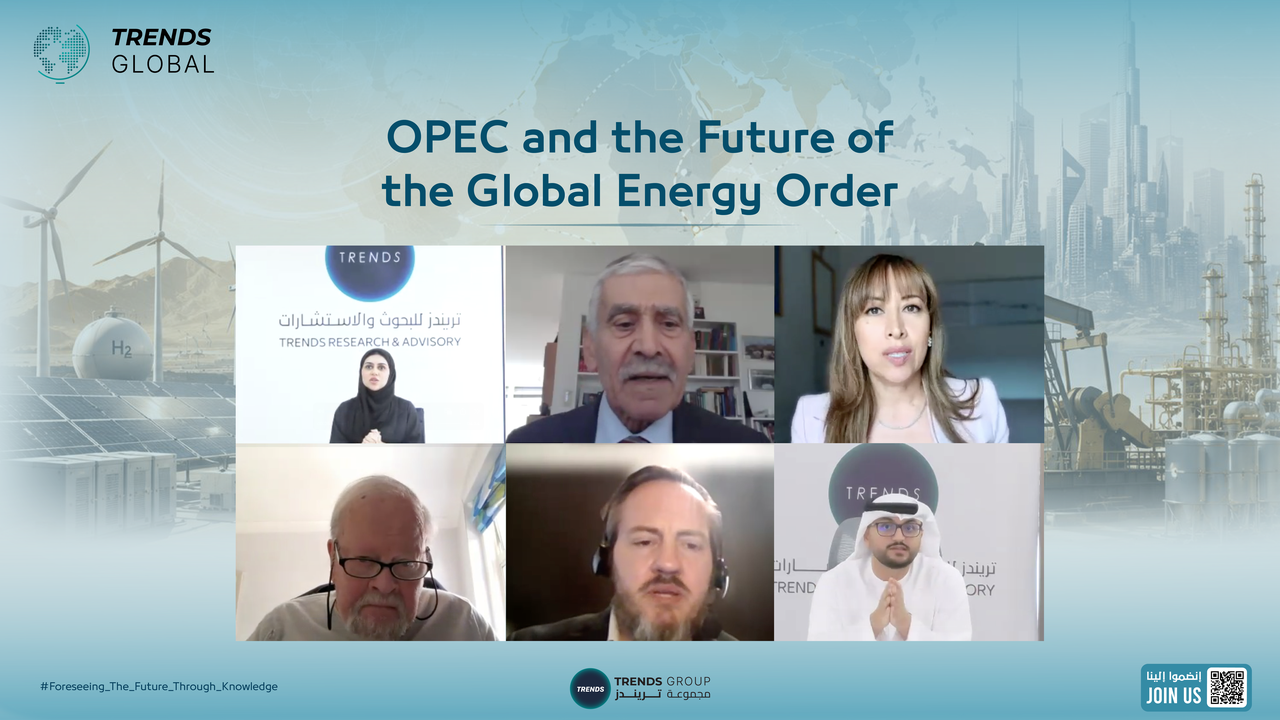
Researchers and experts: Oil markets entering a comprehensive restructuring phase the UAE is shaping a new low-carbon energy model Amid accelerating geopolitical shifts and profound changes reshaping the global energy sector, TRENDS Global, affiliated with the TRENDS Group, organized an international panel discussion titled OPEC and the Future of the Global Energy System, bringing together researchers and specialists in energy and international economics. The discussion examined the future of the Organization of the Petroleum Exporting Countries (OPEC) and the structural challenges facing global oil and gas markets amid mounting pressures stemming from the transition to clean energy, growing security and geopolitical considerations, and the redrawing of global production and consumption patterns. Participants stressed that the world is at a pivotal moment, with oil no longer merely an economic commodity but a strategic instrument shaping global balances of power, amid the declining effectiveness of multilateral systems and intensifying competition among major powers. Reshaping the Global Energy Market Speakers explained that oil and gas markets are currently facing unprecedented tests due to the intersection of national security concerns, economic development requirements, and climate transition pressures. They emphasized that traditional models are no longer capable of explaining the rapid transformations occurring in the global energy sector. They noted that OPEC and OPEC+ are confronting complex strategic challenges, most notably:
  • Volatile global demand and difficulties in forecasting future demand trajectories.
  • Growing competition from U.S. shale oil.
  • Increasing international pressure to phase out fossil fuels.
  • The emergence of new energy systems in Asia, Africa, and Latin America.
  • Escalating geopolitical tensions and their impact on supply security and global trade routes.
Participants also stressed that a world consuming nearly 100 million barrels of oil per day must reconsider its production and consumption models and restructure pricing policies and energy-related logistics systems. The panel discussion, moderated by Mouza Al Marzouqi, Senior Researcher at TRENDS, featured:
  • Adnan Shihab-Eldin, former Acting Secretary General and former Director of Research at OPEC.
  • Carole Nakhle, Founder and CEO of Crystol Energy.
  • Robin Mills, CEO of Qamar Energy.
  • Professor Paul Stevens, Emeritus Professor at the University of Dundee and Fellow at Chatham House.
  • Sultan Al Hosani, Researcher at TRENDS.
  The UAE and OPEC Dr. Adnan Shihab-Eldin, former Acting Secretary General and former Director of Research at OPEC, stated that the UAE’s withdrawal from the organization, effective May 1, 2026, does not signal the collapse of OPEC, but it will make market management more complex, given the UAE’s weight as a major energy producer. He explained that shared interests between both sides — particularly market stability and safeguarding producers’ and consumers’ interests — will remain intact despite the institutional separation. He further noted that the UAE seeks greater freedom to implement its own strategy away from the production quota constraints imposed by the organization. He added that even if OPEC’s role declines, the world will still need a collective coordination mechanism to regulate the market, warning that the absence of coordination could lead to price chaos and fierce competition among producers. A Collective Mechanism Professor Paul Stevens, Emeritus Professor at the University of Dundee and Fellow at Chatham House, reviewed the historical role of OPEC in regulating the global oil market, emphasizing that an entity capable of managing production and prices has always been necessary to prevent price collapses driven by fierce competition among low-cost producers. He explained that since the 1920s, the international oil market has faced a fundamental dilemma: the abundance of low-cost oil in the Middle East, which has necessitated a collective mechanism to manage production and prices and prevent market collapse. He remarked: “If OPEC did not exist, the world would have had to invent it.” Stevens argued that the accelerating transition toward clean energy will place increasing pressure on OPEC, particularly as energy security has returned to the top of consuming countries’ priorities following recent geopolitical crises. He added that this transition will push more countries to reduce dependence on fossil fuels and accelerate investments in alternative energy sources. He also warned that declining global oil demand in the future will increase the “pain” of adhering to OPEC production quotas, potentially prompting more countries to leave the organization and bringing the world back to an era of fierce competition and extremely low prices. A New Phase For her part, Dr. Carole Nakhle, Founder and CEO of Crystol Energy, said that the UAE’s withdrawal from OPEC was not a sudden decision, but rather the result of long-term strategic calculations carefully timed amid regional tensions, which helped minimize disruption in oil markets. She emphasized that the UAE, as a major — not marginal — OPEC producer, is opening a new chapter in its economic and energy model. She noted that many countries will closely monitor the UAE experience to benefit from its outcomes or avoid its potential drawbacks. Nakhle stressed that returning to the “normal” conditions that existed before major geopolitical crises is unrealistic, because major crises always create permanent structural changes in supply, demand, and consumption patterns. She explained that markets are currently experiencing what she described as the “structural destruction of demand,” as consumption behaviors have changed due to high prices and the accelerating energy transition. She affirmed that the world has already entered a “new normal” in energy markets. She further stated that the future of OPEC will depend on the commitment and discipline of its members. Still, she argued that the greatest future influence will belong to low-cost and low-carbon producers, especially amid the global shift toward a low-emissions economy. Regarding the energy transition, Nakhle emphasized that the world is not moving toward completely abandoning oil and gas, but rather toward reshaping the global energy mix in a more balanced manner, with increasing investments in all energy sources, including renewables, oil and gas, nuclear energy, and energy infrastructure. Low-Carbon Advantage Robin Mills, CEO of Qamar Energy, explained that the UAE’s reconsideration of its OPEC membership is not new and dates back many years. Still, current geopolitical conditions helped facilitate the final decision. He noted that over recent years, the UAE felt that OPEC+ commitments were limiting its ability to fully utilize its production capacity, particularly after major expansions in its oil and gas sector, prompting the country to seek greater flexibility in implementing its economic and energy strategy. Mills emphasized that the UAE has a significant competitive advantage due to its lower carbon footprint from oil compared to several other producers, thanks to investments in nuclear energy, solar power, carbon capture technologies, the electrification of oil facilities, and emissions-reduction efforts. He argued that the world is gradually moving toward favoring lower-carbon oil under mounting climate restrictions, giving the UAE, Saudi Arabia, and other low-emission producers a competitive edge in the coming phase. He also warned that many countries with large reserves are racing against time to extract their oil resources before global demand declines, cautioning that unilateral action by producers could trigger a new wave of fierce competition and price wars. A New Model for Energy and the Economy Participants agreed that over the past two decades, the UAE has successfully developed an advanced model that combines maintaining its role as a major supplier of conventional energy with heavy investment in renewable energy and the low-carbon economy. Experts noted that the UAE has adopted flexible policies focused on economic diversification, enhancing energy security, investing in clean technologies, and expanding international partnerships, thereby strengthening its ability to adapt to upcoming global transformations. They affirmed that the UAE’s experience reflects a deep strategic understanding of ongoing changes in energy markets, particularly as “flexibility” and “diversification” become decisive factors in the future of energy-producing nations. Balancing Transition In his closing remarks, Sultan Al Hosani, Researcher at TRENDS, stated that the discussion concluded that the world is entering a new phase in which the global energy system will be comprehensively reshaped. While oil will remain necessary for decades to come, preference will increasingly be given to lower-emission oil and to countries capable of balancing energy security with the requirements of transitioning toward a more sustainable economy. Participants concluded that developing coherent analytical visions for the future of energy is no longer an intellectual luxury but a strategic necessity for the success of national and regional policies in a world whose economic and geopolitical maps are being redrawn at an accelerating pace.