


Researchers and Specialists: The region is entering a phase of strategic restructuring as the new international order redraws the balance of power.
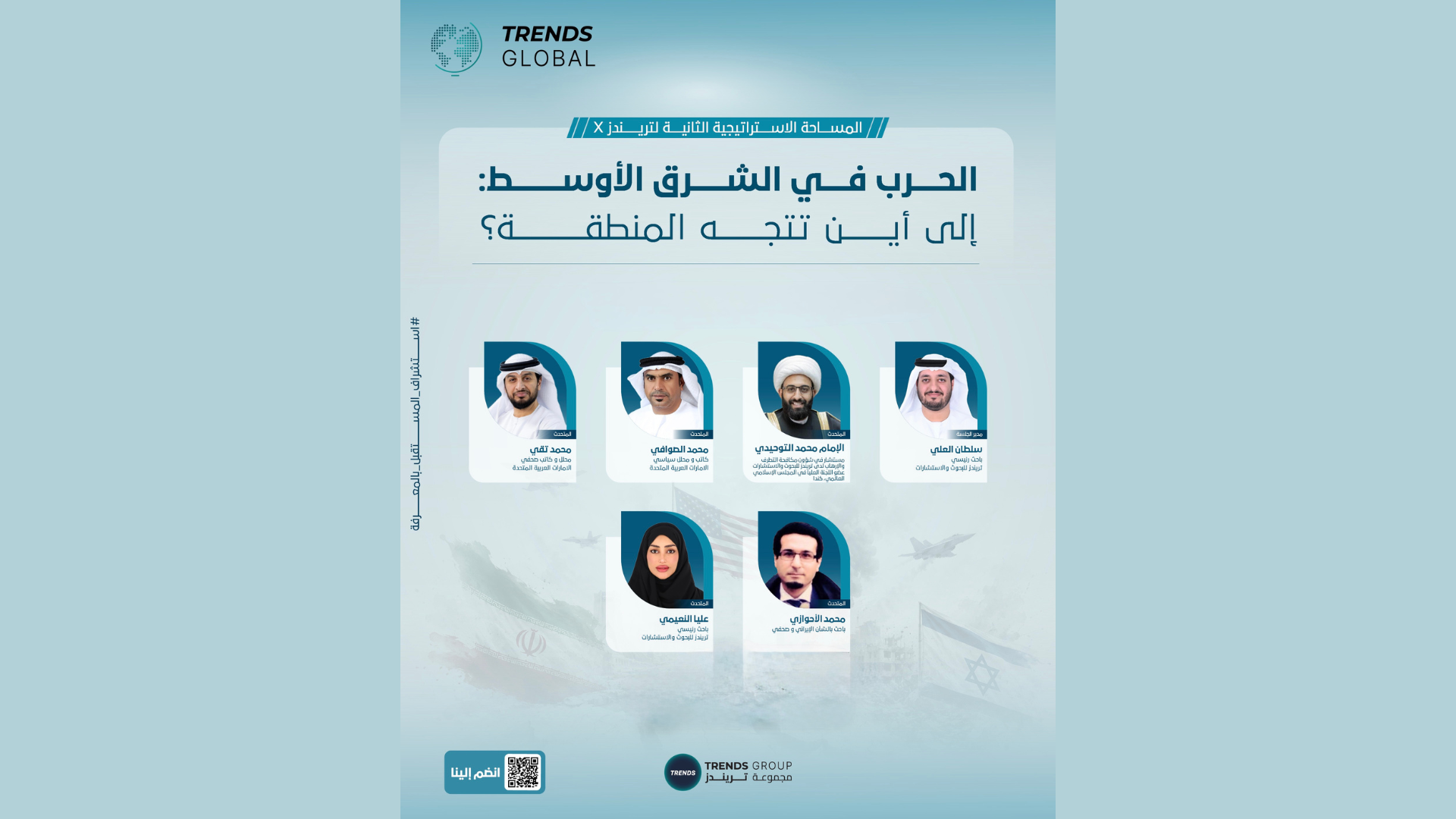
The second strategic session of TRENDS X, held through the TRENDS account on the X Spaces platform, witnessed an in-depth discussion on the future of war in the Middle East and the accelerating political, security, and economic repercussions of the Iranian-Israeli escalation, amid warnings that the region may be entering a new phase capable of reshaping regional and international balances of power.
Through its Dubai branch, TRENDS organized a panel discussion titled War in the Middle East… Where Is the Region Heading? The event brought together researchers and specialists who examined scenarios of escalation, the future of the Strait of Hormuz, anticipated transformations in the emerging international order, and the position of the Gulf states, including the UAE, within these major changes.
Developments on the Ground
The seminar began by reviewing the most significant developments taking place in the region, most notably the meeting between the American and Chinese presidents in Beijing, the attacks targeting military sites in Bandar Abbas and Qeshm, as well as Iranian threats concerning the cutting of submarine cables, which participants considered indicators that the confrontation is moving toward more complex and sensitive levels.
Speakers emphasized that these developments are no longer merely isolated military incidents, but have become part of an international struggle for influence that extends beyond the Middle East to encompass global energy security, supply chains, and international geopolitical balances.
Participants
The seminar featured Imam Tawhidi, Advisor on Counterterrorism and Counter-Extremism Affairs at TRENDS Group; Mohammed Khalfan Al Sawafi, writer and political analyst; Mohammed Taqi, journalist and political analyst; Alia Al Nuaimi, Senior Researcher at TRENDS Group; and Iranian affairs researcher Mohammed Al Ahwazi. Sultan Al Ali, Principal Researcher at TRENDS, moderated the session.
Rationality and Strategic Preparedness
Journalist and analyst Mohammed Taqi affirmed that the UAE and the Gulf states are handling current developments with a high degree of rationality and advanced strategic preparedness, combining diplomacy, defensive readiness, and coordination with international allies.
He explained that Gulf security is no longer merely a regional matter, but has become part of global security, given the close connection between the stability of the region and the stability of the international economy, energy security, and maritime navigation.
He also pointed out that the next phase may witness new alliances based on pragmatic interests and the safeguarding of stability, rather than traditional alliances, stressing that the UAE has demonstrated a strong ability to manage crises efficiently through proactive policies grounded in development, stability, and strategic balance.
Divisions Within Iran
Iranian affairs researcher Mohammed Al Ahwazi stated that understanding the current situation requires a deep comprehension of the divisions within the Iranian establishment, explaining that disagreements are not limited to the negotiation file, but also extend to positions regarding the war itself, amid the presence of hardline factions within the Revolutionary Guard that view continued escalation as a guarantee for the survival of the Iranian regime.
He noted that the conservative faction and the Revolutionary Guard have tightened their grip on political and military decision-making, and that Tehran views time as a strategic card, believing that pressure on the global economy and energy markets will force Washington and Western countries to make concessions.
He added that Iran views the Strait of Hormuz as “the ultimate deterrence card” and seeks to maintain it as a tool of pressure and bargaining in any future negotiations, particularly after Iranian confidence in international guarantees declined following Washington’s withdrawal from the previous nuclear agreement.
A Global Center of Gravity
Writer and political analyst Mohammed Khalfan Al Sawafi stressed that the world is gradually moving toward a new international order with multiple centers of influence, and that the Middle East has become a pivotal player in this transformation.
He explained that recent crises, especially those related to the Strait of Hormuz and energy security, have reaffirmed that the region has become a fundamental pivot in the global economy, and that any instability there directly impacts international markets.
He added that the UAE has succeeded over recent years in building a model of global influence based on the economy, investment, technology, port management, and international partnerships, making it a strong candidate to become one of the key pillars in the emerging international order.
The Nature of the Iranian Regime
Imam Tawhidi, Advisor on Counterterrorism and Counter-Extremism Affairs at TRENDS Group, addressed the ideological dimension of the Iranian regime, considering that the West still deals with Iran as a conventional state, while it is — according to his description — an ideological project based on the concept of Wilayat al-Faqih and the export of the revolution.
He stressed that understanding the nature of this regime is key to understanding its political and military behavior, warning against the exploitation of sectarian rhetoric and religious and media platforms to enhance Iranian influence within the region.
The ‘Madman Strategy’
Alia Al Nuaimi, Senior Researcher at TRENDS, stated that the Iranian regime relies on what she described as the “Madman Strategy,” through continuous threats to close the Strait of Hormuz and raise the cost of escalation for all parties, in an attempt to impose new equations in the region.
She explained that the Revolutionary Guard seeks to redefine the Strait as an Iranian security operations zone, granting Tehran greater ability to control international navigation and politically and economically pressure the international community.
She added that the danger of the current crisis is not limited to energy alone, but also extends to global food security, supply chains, fertilizer and urea markets, stressing that continued escalation may push the international community toward firmer actions to protect strategic maritime routes.
Future Scenarios
The seminar attracted broad participation from researchers and participants, who discussed possible scenarios for the crisis amid expectations of continued military escalation and an economic blockade. At the same time, the possibility of an open regional war remains on the table if political and diplomatic efforts fail to contain the crisis.
Participants emphasized that the region is at a pivotal moment that could redraw the map of alliances and influence in the Middle East, amid rapid transformations in the international system and the emergence of new equations in global politics, security, and economics.
